









But for how long will it hang on to the title.
BMW'S two—door Mini will soon snatch away from rival Smart the bragging rights of having Australia's greenest new car — but it looks like its reign is going to be short lived.
The diesel version of the Mini arrives in June, promising an average a budget friendly fuel consumption of 3.9 litres per 100km — or a remarkable 3.5 litres on the highway — giving it a range of just over 1000km on a tank from an engine which produces just 104g of CO2 per kilometre.

That will make the Mini D cleaner than the much vaunted Toyota Prius hybrid and the current green car king, the Fourtwo from Mercedes—Benz subsidiary Smart which has a mild hybrid system.
But Smart isn't lying down and will fight back with an even cleaner two—seat FourTwo, which may go on sale as early as August. It will lower the green bar even further to 3.3l/100km and promising an astonishing clean exhaust for a conventional combustion engine of just 88g/km of CO2.
And waiting in the wings will be an equally smart 1.2—litre Fiat 500 cabriolet, due to be launched at the Geneva Motor Show next month which will use the same fuel saving stop—start engine technology as the Mini. It's due in Australia next year to take its share of the frugal limelight.
Meanwhile, all eyes are on the new diesel version of the cute—as Mini, and the big advantage it has over the Smart is that it at least has a back seat, of sorts.
The stylish Mini's maxi appeal is you can have fun and at the same time feel good about being environmentally responsible. It promises class leading fuel economy from its direct injection turbo engine, jointly developed with Peugeot and Citroen, without the need for expensive and hefty batteries which are the millstone of existing electric/petrol hybrid systems.
Pricing is yet to be fixed but the Mini D is expected to come into the market for about $34,000 for the base Cooper version and just under $38,000 for the better equipped sporty Chilli.
But the diesel Mini nearly didn't make it to our market. A year ago it would not have been possible for BMW to sell it here.
The Mini D's remarkable fuel economy is largely achieved by automatically shutting down its engine when at idle, such as stopped at traffic lights. Depressing the clutch instantly fires up the engine again. It also switches off ancillaries, such as the alternator and water pump until needed to reduce engine load to save fuel while energy traditionally lost when braking is recaptured and fed back to the battery.
As well, there's even a gauge to tell the driver when to change gears for maximum efficiency.
But most of this technology, developed by Bosch, works best with a lean burn diesel engine and until last month Australia's diesel was too high in sulphur to make it work. The sulphur level was reduced in December, opening a flood gate to companies like BMW to bring in high tech engine technology.
The green friendly message will be a big marketing draw card for Mini as buyers look to downsize and look at fuel efficient alternatives.
BMW Australia last year successfully convinced Germany there was a sound business case for adding the diesel to the Australian Mini range. It was, in hindsight, a brave move considering the majority of Mini owners scoffed at such an idea of having a diesel under the bonnet. But times have changed and being seen to being green is now OK.
So how does the diesel Mini drive? The quick answer is a lot better than many critics thought.
Driving
Good grief, a Mini with a diesel. What next? But hang on, there's some sound reasoning for going down the diesel path, not the least is the feel good factor.
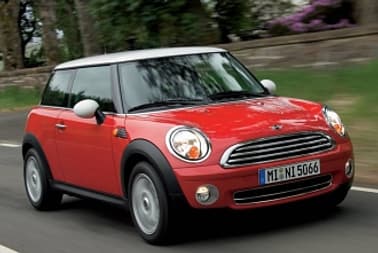
And by the way, you can spot the diesel by the slight power bulge — or is that a pot belly — on the bonnet and the D badge on the boot, otherwise it looks like a regular Mini.
For those who frown at the thought of a diesel Mini: be prepared for a culture shock. This one comes high on the fun factor scale.
There are a couple of minor downsides — at highway speeds there's some wind noise around the A frames, the engine sounds harsh over 3000rpm and there's some old fashioned diesel clatter on start up and engine shudder when it automatically shuts down and goes into idle mode.
And the engine shutting down when the car is stopped feels strange but you get used to it and you can switch it off if not needed.
But the positives here far outweigh the negatives. This is no sprint car but underway this oil burner is remarkably quiet and refined.
Punting it along dead smooth German autobahns and average quality rural roads proved the Mini, despite the extra weight of the diesel motor, sits well on the road with a compliant suspension setup , good dampening and precise gear shifting.
It certainly has the potential to shine on Australian roads and the claimed 3.9l/100kmh looks achievable. The ride from the runflat tyres is firm without being uncomfortable. And it retains the Mini magic of crisp point to point steering.
It may only have 80kW under its belt, and zero to 100km/h takes a leisurely 9.9 seconds but you don't buy the this Mini for off the line pace. This is a fairly relaxed engine: at 100km/h it is only pulling 1800 revs.
Torque is what the Cooper D is all about — 240Nm of it spread between 1750 and 2000rpm which can be briefly boosted to 260Nm under full throttle. To put that another way, the diesel produces the same amount of torque as the existing turbocharged Cooper S, but uses substantially less fuel and will be markedly cheaper to buy. The Cooper D will sell for about $34,000, the petrol Cooper S sells for $42,100.
And that's the conundrum facing Mini buyers. Can they live with the D for diesel badge on the boot?
If not, hide the badge and still boast to your friends you are doing your bit to save the planet.
Let them guess what's under the bonnet.
On sale: June
Price: $34,000 to $38,000
Engine: 1.6—litre turbo diesel, 80kW at 4000rpm, 240Nm torque from 1750rpm; peak torque 260Nm under full boost.
Transmission: Six—speed manual or six—speed automatic optional
Economy: 3.9l/100km combined, 104g/km CO2
Related cars for sale on CarsGuide
See more Mini Coopers for sale View cars for saleMini Cooper 2009: D
| Engine Type | Diesel Turbo 4, 1.6L |
|---|---|
| Fuel Type | Diesel |
| Fuel Efficiency | 5.0L/100km (combined) |
| Seating | 4 |
| Price From | $3,850 - $5,610 |


Pricing Guides
.jpg)


.jpg)
.jpg)
.jpg)
.png)
.jpg)
.png)
.jpg)
.jpg)


.png)

