What's the difference?
BMW has recently launched its fourth-generation (G45) X3 range, which comprises three petrol variants including the entry-level 20 xDrive, mid-grade 30e xDrive PHEV and top-shelf M50 xDrive.
The new trio brings revised powertrains, new exterior and interior styling, increased standard equipment, enhanced technology and an emphasis on the use of sustainable materials.
We recently trialled the five-seater flagship to see if it has the right mix of performance and practicality to maintain the X3’s enduring appeal for Aussie families.
Jeep's Renegade might be late to the mini-SUV party but it comes with a pretty impressive back catalogue to suggest that this is a SUV that can cash the cheques its name can write.
The top of the range Trailhawk can write even bigger cheques than the lower models, bringing with it a range of off-road tech toys to let you really get down and dirty.
This is a highly competent all-rounder, given that it has the comfort and practicality for urban family duties yet with its revered M breeding can produce a level of performance which, in competent hands, could hold its own at a track day where its capabilities could be safely explored.
Rugged, dependable and good off-road are the most obvious qualities of the Trailhawk. It stands out from the rest of the mini-SUVs by being able to do the S and the U with plenty of vigour.
It's just a shame that its on-road manners can't match that of its big brother, the Cherokee. Unless you're planning on proper off-roading, the Trailhawk might not be quite what you're looking for.
The fourth-gen X3, which has a lighter but stiffer body, shares the same wheelbase as its third-gen predecessor but at 4755mm end-to-end it's 34mm longer and it's 29mm wider.
It’s also 25mm lower, which combined with front and rear track-width increases and adaptive suspension damping to sharpen the handling underlines its sportiness and driver appeal, despite a substantial 2055kg kerb weight.
The new exterior design is characterised by short overhangs, flush door handles, a larger ‘split kidney’ grille, new LED taillights and L-shaped light elements for the LED headlights.
The new interior design is a classy mix of soft-touch materials and high-gloss hard surfaces in tastefully contrasting tones. The seats are upholstered in a new synthetic leather called 'Veganza' ('Espresso Brown' in our example) which according to BMW requires 85 per cent fewer CO2 emissions to produce than genuine leather (which is still available as an extra-cost option).
Combined with subtle use of ‘Magnolia’ fine-wood trim inserts, satin chrome, piano black, blue/red M highlights and slender ambient light-strips, it’s a cabin that exudes opulence.
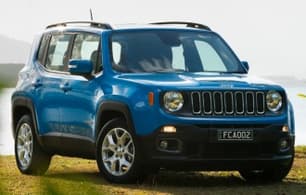
In what is absolutely not a coincidence, the Renegade immediately conjures up the Wrangler. Upright grille from the Willys Jeep (references abound here), round headlights, squared off wheel arches to mimic the Wrangler's guards, short overhangs and big rear view mirrors.
The 17-inch wheels look completely lost in the wheelarches which are even more cavernous owing to the Trailhawk's 50mm of extra ride height. The wheels are also a bit cheap looking but will probably survive the belting the car is intended to take.
Less rugged is the interior, despite a fairly self-conscious effort to make it look and feel chunky. The front seats are flat and unsupportive with the rears just as lacklustre making sure everyone is sliding around together. Luckily, front passengers get a dash-mounted grab handle.
It seems quite well put together, however, but with carpets and easily-marked plastics, you'll hope your passengers don't bring the mud in with them too often. And the "Since 1941" stamped into the steering wheel can go.
The dashboard is reasonably clear and has plenty of information to share via the screen between the dials but whoever thought marking the redline with a water splash graphic in bright orange should probably rethink their design decisions.
Storage is limited to two cupholders up front, door pockets in each door and nets on the front seat backs.
Our X3 M50 xDrive test vehicle, finished in new 'Dune Grey Metallic', comes standard with a 3.0-litre turbocharged inline six-cylinder petrol engine incorporating 48-volt mild-hybrid technology, plus an eight-speed automatic and permanent all-wheel drive for a list price of $128,900.
You’d expect a high performance prestige vehicle costing six figures would be packed with desirable standard features and the M50 xDrive delivers, starting with big 21-inch 'M' lightweight alloy wheels shod with wide 285/35R21 tyres.
However, there’s no room for a spare (not even a space-saver) so you get a tyre repair kit instead.
The standard equipment list also includes adaptive LED headlights (with matrix high-beam and blue design detailing), a power tailgate, an ‘Iconic Glow’ illuminated kidney grille with M-specific elements, quad exhaust outlets, a panorama full-length (fixed) glass roof, a choice of six premium metallic paint colours and more. The 'M Sport Pro' visual enhancement package is also included.
Step inside and the driver is treated to a head-up display and an elegantly curved digital dash display, which spans about two-thirds of the cabin's width. It seamlessly incorporates a 12.3-inch driver’s instrument display (made from recycled polyester) and 14.9-inch multimedia display controlled by BMW’s latest 'iDrive System 9' software.
Premium audio is provided by a 15-speaker 750-watt Harman Kardon surround sound system, which includes digital radio and wireless Apple/Android connectivity. There’s also wireless phone charging.
The driver gets a thick leather-rimmed and heated 'M Sport' flat-bottom steering wheel and the driver and front passenger are also treated to sumptuous bucket seats with multiple power adjustments and heating/cooling.
Up to three passengers can share the rear bench seat and indulge in the luxury of three-zone automatic climate control, heating for the outer seating positions, privacy glass, roll-up sunshades, two USB-C ports and lots more.
The Renegade range starts at $28,000 for the 1.6-litre Renegade Sport manual front-wheel drive, climbing between $2000 and $3000 through the Sport Auto, Longitude Auto, Limited Auto with a final jump of $4000 to the 2.4-litre auto-only Trailhawk.
Standard is a nine-speaker stereo with Bluetooth and USB, 17-inch alloys, dual-zone climate control, reversing camera, rear parking sensors, keyless entry and start, cruise control, electric front seats with heating, satellite navigation, automatic bi-xenon headlights, auto wipers, leather trim, roof rails, front and middle bash plates, full size spare, heated leather steering wheel, privacy glass, trailer sway control and tyre pressure monitoring.
The lairy Omaha orange is $500, part of an eleven colour palette with only two no-cost paint options (black and white).
You can add lane departure warning, auto-parking and a black painted roof for $500 each, a removable and retractable roof called My Sky Roof for $2200 or a more conventional electric sunroof for $1900.
The Beats-branded nine-speaker stereo is run via Fiat-Chryser's UConnect system, accessible through the 6.5-inch touchscreen. While it improves with every attempt, it's still quite clunky and when the sat-nav is added, becomes a bit of a mess.
Thankfully, not every function has been crammed into the touchscreen interface, so you'll spend more time with your hands on the wheel rather than working out which bit of the screen has the climate control.
According to BMW, the M50 xDrive features the most powerful inline six-cylinder petrol engine fitted to an M Performance model.
This 3.0-litre unit clearly benefits from BMW’s twin-scroll turbocharging technology, which combined with variable valve timing and an extra 13kW/200Nm from the 48V mild-hybrid technology produces a stomping 293kW of power at 5500rpm and 580Nm of torque at 1900rpm.
It also has a ‘boost’ function, which provides an extra burst of power for short periods when maximum acceleration is required when overtaking etc.
It’s activated by the left paddle-shifter on the steering wheel and automatically optimises transmission/chassis settings to suit. There’s also a drive mode selector, with ‘Sport’ offering the most responsive and engaging experience.
The eight-speed torque converter automatic is a refined and efficient transmission well suited to this full-time all-wheel drive application. Rapid-fire manual shifting is also available using the steering wheel paddles.
The Trailhawk is powered by Fiat's 2.4-litre four naturally-aspirated four-cylinder producing 129 kW and 230 Nm. Jeep reckons you'll get 7.5L/100km on the combined cycle. Our mostly city driving with a longish motorway run produced an 11.0L/100km average over a week.
The transmission is a nine-speed ZF automatic driving all four wheels.
The Trailhawk also has Jeep's five mode Selec-Terrain system which should cover pretty much every eventuality – Auto, Sport, Mud, Sand and, just for the Trailhawk, Rock. The Trailhawk is rated to tow 400kg unbraked and 907kg braked.
First, the fun stuff. It certainly feels like ‘the ultimate driving machine’ when you slide behind the chunky leather-rimmed flat-bottom steering wheel and hold it in your hands.
The driver’s seat offers not only powered adjustment of backrest and base-cushion rake, but also four-way lumbar support and side-bolsters that can tighten their embrace of your upper torso to contend with high cornering loads.
There’s also manual extension of the base-cushion length for greater thigh support and a big left footrest to brace against, so you could not ask for a more accommodating and purposeful driving position.
The steering is perfectly weighted and the quartet of enormous disc brakes provide ample bite with superb pedal feel. Combined with its adaptive suspension and wide grippy tyres, the X3 is a family car that’s also invigorating to drive, particularly when you select the ‘Sport’ mode.
The enhanced engine response and sharper steering that result (even the instrument panel display changes) make any twisting mountain road an engaging experience, enhanced by an intoxicating exhaust note that only a BMW M six can deliver.
The turbocharged engine offers an unyielding surge of acceleration from well below peak torque at 1900rpm to maximum power at 5500rpm, making BMW’s claim of 0-100km/h in a scant 4.6 seconds sound credible.
You can also manually change gears using the steering wheel paddles, but we found the gearing and shift calibrations so good that we preferred to leave it in auto mode.
However, the X3 M50 has two distinct personalities, as in more relaxed drive modes it’s just as happy serving as practical family transport during the week for grocery shopping, daily school runs and other common tasks.
It’s also a comfortable tourer for family getaways, with long gearing that requires only 1500rpm to cruise at 100km/h where low engine, tyre and wind noise allow highway conversations at lounge room levels.
The Trailhawk name suggest that things are going to get muddy – compared to the rest of the range, the range-topper rides 50mm higher and has exposed, easy-to-reach tow hooks in the fairly unlikely event you get stuck. It also has a 20:1 low-range crawl ratio and Active Drive 4x4 which means it can switch between front and all-wheel drive. It'll also wade through almost half a metre of water. It's a genuine mud-plugging proposition and will take on some much bigger machinery out in the bush.
On the road, where we spent all our time in the Renegade, it's not what you'd call particularly inspiring. There's a number of sources of noise that contribute to a less than quiet cabin and having to constantly correct your course at freeway speeds adds to the tiring nature of the Renegade.
It's much better at lower speeds, pottering around but then again, its nine-speed transmission needs a lot more work on the shift mapping because it seems to forget which gear it needs to be in when you sink the right foot. If you don't need the Trailhawk's extra off-road goodies, consider the 1.4 litre Limited or Longitude.
No ANCAP rating as yet but this X3 comes with a long menu of standard safety features including multiple airbags, AEB with pedestrian/cyclist/junction detection, front collision warning with brake intervention, lane-keeping, active cruise control, head-up display with speed sign recognition, front and rear cross-traffic alert, tyre pressure monitoring and lots more.
There are also ISOFIX and top tethers for the two outer rear seating positions.
Seven airbags (including driver's knee bag), traction and stability controls, roll mitigation, blind spot monitoring, ABS and brake assist.
The Renegade does not yet have an ANCAP star rating although it scored five EuroNCAP stars in 2014.