What's the difference?
Eco-friendly vehicles are the leather pants of the new-car world; it takes a lot of money to make them look good (but people who own them think they look fantastic regardless). If you don't have a gazillion dollars to drop on a Tesla, then it's a one-way ticket to Prius town. And really, who wants that?
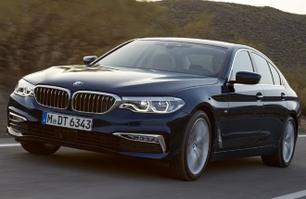
But what if it didn't have to be that way? Behold the BMW 530e iPerformance.
Seemingly tired of waiting for the Australian Government to introduce any sort of meaningful subsidy for green cars, BMW has made the choice simple: you can have a petrol-powered 530i for $108,900, or opt for the plug-in hybrid 530e for... $108,900. This is truly revelatory thinking.
There's no specification penalty, either, and the hybrid will power to 100km/h in an identical 6.2 seconds, so you're not even any slower. But you are sipping less fuel, emitting less C02 and basking in the general smugness, and sweet silence, that comes with feeling like you're saving the world.
So what's the catch?
We live in a strange time, where cars are going the way of the dinosaur and SUVs will take their place as the primary offerings of the worlds oldest and biggest car companies.
Look at Ford, the brand that literally wrote the book on automotive mass-production will soon no longer sell cars in its home market of America (apart from the Mustang, of course…) There’s a story your grandpa won’t believe.
It makes SUVs, especially small ones like the EcoSport all the more important. Customers who once would have considered the Fiesta small hatch (on which the EcoSport is based) would now rather hop into one of these. At least, that’s what the data says.
So, is the EcoSport a worthy successor to the hatchback mantle? Is it even economical or sporty? And what happened to the spare wheel on the rear door? Read on to find out.
Not all superheroes wear capes, and we're proud to report the 530e does its bit for green motoring without feeling the need to shout about it. And with no price or specification penalty, it's easier being green than ever before, and the pricing of this BMW really puts the cat amongst the canaries.
So, should you buy a base-model Ford EcoSport Ambiente?
For the money it’s a great little daily commuter with an odd mix of dated trim and a great multimedia, but it’s definitely worth making room in your budget to investigate the Trend or Titanium grades.
Plus, it’s worth keeping in mind that many competitors now offer more comprehensive safety or more powerful drivetrains for not much more money.
Crucially, there's nothing weird about the way the 530e looks. While some green cars look like they've been designed by one of the kids from 3rd Rock from the Sun, the 530e looks much the same as the rest of the range, save a few tiny but telltale giveaways - like the e-drive badging outside, and what looks like a bonus fuel flap tucked in behind a front wheel that houses the whole plug-in bit.
And we really, really like it. It's elegant and statesman-like from every angle, and looked especially important in the deep-blue colour of our test vehicle. It's not over-designed, with body creases used sparingly, and the occasional glint of polished silver that rings the windows and the grille adds a final sense of shininess to an understated design.
Inside, there's more going on than you might normally find in a BMW. The hugely complicated digital display screen now includes everything from battery charge, power usage to the usual assortment of speedometers and petrol readouts.
It doesn't feel overdone or crazily festooned, but there's more at play here than in your usual BMW.
The dash is busy, too, with a wide screen emerging from a centre stack that also houses a CD player and a digital aircon setup, which in turn sits above a complex centre console from which you can alter driving settings, control the multimedia or cycle through electric modes. It doesn't feel overdone or crazily festooned, but there's more at play here than in your usual BMW.
Elsewhere inside, the seats are beautifully designed, with a quilted leather highlight through the middle, while the gloss-black strip that lines the dash hides a dual strip of ambient interior lights that also runs across all four doors.
The EcoSport has had a second refresh this year, simply removing the spare wheel from the back. According to Ford, this was due to consumers not liking the extra 12kg it added to the rear hatch. Fair enough.
Personally though, I think it detracts from the EcoSport’s look, the rear spare was a cheeky stab at small soft-roaders of the ‘90s.
The lack of a spare also makes the side-swinging door a bit pointless now (it also swings the wrong way, toward the kerb instead of away from it, due to its European design origins) and just gives the rear three-quarter another anonymous SUV look.
Aside from that the EcoSport has come a long way styling-wise.
It has ditched the weird hatchback grille it used to have, instead employing a tough-looking single plastic grille insert, bringing it stylistically in line with larger Ford SUVs like the Everest and Escape. Plus, the plastic guards on the underside give it a fun off-roader look.
Importantly, it strays far enough from its Fiesta underpinnings to look like something new entirely, unlike the Holden Trax, which simply looks like a Holden Cruze on stilts…
Inside, it maintains a little too much of that last-generation Fiesta look. The dash juts too far into the cabin, feeling as though it reduces space, and there is an abundance of terrible plastics and hardly aesthetic textures across the entire cockpit.
The seat trim is some el-cheapo nylon material, but at least it will be easy to clean.
A saving grace is the slick-looking multimedia interface, but it looks so much newer than its surroundings its obvious Ford has simply tacked this on as part of a facelift. Thankfully, unlike some other current Fords, the volume, fan-speed and temperature controls are all dials instead of buttons.
The touchscreen itself, as with most new Ford products, is a pleasure to use and not difficult to navigate. The Apple CarPlay connectivity didn’t throw me any lag or problems.
In terms of interior trim, the Honda HR-V is still the target to beat in this segment, but the EcoSport shapes up pretty well compared to the Trax and ASX with their tiny media screens and equally average interior materials.
As the world's motoring tastes shrink faster than a lap-banded Clive Palmer, it's easy to forget the joys of the full-size sedan, but the space for passengers and luggage in the 5 Series will have you questioning your downsizing ways.
Upfront, there's plenty of room between front-seat riders, who will also share two smallish cup holders, along with room in each front door for bottles. There's also a dedicated wireless charge pad (which, because of its tight design, is crazy difficult to actually remove your phone from), but you'll also get two USB points and a power outlet that's hidden in the sizeable centre storage bin as standard fit.
Backseat riders get heaps of space, both in width and in leg room behind the front seats. And there's twin air-con temp controls and twin power outlets, too. But middle-seat passengers will be forced to sit with their legs on either side of the raised tunnel, which will definitely impact on comfort.
The boot's still sizeable, despite shrinking slightly to house the battery/fuel tank setup
Best to ditch the fifth passenger, then, and deploy the pull-down seat divider, which also houses two cup holders. Finally, there are three ISOFIX attachment points, one for each seat in the back.
The boot's still sizeable, despite shrinking slightly to house the battery/fuel tank setup (the tank has been moved further back to accomodate the batteries), and can be adjusted to be a flat load area if you'd like, offering up to 410 litres with the rear seats in place.
Despite being based on a car as compact as the Fiesta (complete with aforementioned dash design that feels like it detracts from space), the EcoSport has a good amount of head and legroom in both seating rows.
In terms of storage, there’s a little trench under the air conditioning controls, two decently-sized cupholders in the centre console and what has to be one of the smallest storage boxes I’ve ever used under the armrest.
Rear passengers get… um… not much. There are no storage areas in the doors, no drop-down centre armrest and no air vents in the back of the centre console. They do get two ISOFIX points on the outer seats, though. At least in terms of dimensions, space is decent back there.
The EcoSport’s boot is large. As Ford provides measurements in SAE rather than VDA, it’s hard to compare number for number, but the boot is deep and tall with the seats up, and with them down there’s a nifty variable boot floor so you can level it out or take advantage of the extra depth.
CarsGuide colleague Matt Campbell points out in his latest range review, that one of the EcoSport's main selling points in other markets is that it can fit a whole washing machine in the boot.
The HR-V still aces this segment in terms of flexibility, but the EcoSport possesses one of the most useful boots in its class.
Oh, and the missing full-size spare wheel on the back? That's now gone entirely, replaced with an inflation kit under the boot floor. Don't blame Ford, blame the consumers.
The 530e commands a 530i-equalling $108,900 price tag, which is genuinely impressive when you consider all the extra bits and pieces that go into make a plug-in hybrid. That money buys you a well-equipped car, and only those allergic to money need reach for the options list.
As standard, you'll find leather-wrapped - and heated in the front - sports seats, 19-inch alloy wheels and a 10.25-inch touchscreen that pairs with a really very good 16-speaker Haman Kardon stereo. Wireless Apple CarPlay is available, but it'll cost you an extra $500. To be honest, though, we didn't miss it.
You'll also find adaptive LED headlights, a huge head-up display (so big, in fact, that it impedes vision when climbing steep hills), dynamic dampers, an auto opening/closing boot and a self-parking system, along with BMW's suite of self-driving tech - but we'll come back to that under the Safety sub-heading.
We’ll start with one of the most appealing points of the EcoSport, and that’s price. Our Ambiente is the base-model and comes in at a total of $22,790 before on-roads.
That’s cheap. Especially when lined up against competitors, like the base automatic Holden Trax LS ($26,490), the automatic Mitsubishi ASX ES ($25,490), and the Honda HR-V VTi ($24,990).
It comes closest to the base-model Suzuki Vitara RT-S, which can be had in automatic form from $23,990.
Obviously cheapest doesn’t always mean best, and you’ll notice right off the bat items like the dorky 16-inch steel wheels with plastic hubcaps, cheap black plastic finishes on the door handles and wing-mirrors and bargain halogen headlamp fittings.
Better features for the price are the wing-mirror mounted indicators, new 6.5-inch multimedia touchscreen with DAB+, two USB ports, Apple CarPlay and Android Auto as well as a very welcome reversing camera and rear parking sensors.
Frustratingly, auto headlights are missing… a let down in any 2019 car.
The new touchscreen with Ford’s 'Sync 3' software is the most important value add for the base EcoSport, It’s way better than similar offerings in more expensive base-model competitors, although, unlike the Suzuki Vitara, does not offer sat-nav at this price.
One thing I’m not entirely sure of is why you wouldn’t simply stretch the extra $1700 to upgrade the EcoSport to the mid-spec Trend grade, as it scores a better turbocharged engine, alloy wheels, bigger 8.0-inch multimedia screen with sat-nav, ditches the dorky black plastic finish and adds a leather-trimmed steering wheel. Worth the money for sure.
Drift around in pure EV mode and you'll be relying on the 530e's 83kW and 250Nm electric motor, which will provide what BMW refers to as "between 28 and 32 real-world kilometres".
Run out of range, or simply use too much throttle, and the 2.0-litre petrol engine comes into play, adding 135kW and 320Nm to the mix. All up, that's 185kW and 420Nm - respectable numbers by any measure, and enough to match the petrol-powered 530i's zero to 100km/h sprint of 6.2 seconds.
That power is fed through an eight-speed automatic transmission before being sent exclusively to the rear wheels, where it belongs.
The EcoSport Ambiente is the only EcoSport in the range powered by a 1.5-litre non-turbo three-cylinder engine.
The Trend and Titanium levels get a more advanced 1.0-litre three-cylinder turbo engine bearing Ford’s 'EcoBoost' branding.
On paper the 1.5-litre in our car is underpowered. It produces just 90kW/150Nm, comparing poorly to four-cylinder competitors like the Holden Trax with its 1.4-litre turbo (103kW/200Nm), the Mitsubishi ASX with its 2.0-litre non-turbo (110kW/197Nm) and Honda HR-V with its 1.8-litre non-turbo (105kW/172Nm).
In practice though, it’s not too bad. Quite a bit of the available torque arrives early, letting the EcoSport zip around city surroundings with ease. It’s only really out on open roads where you’ll feel the power fade away at higher revs.
All EcoSports have a six-speed torque converter automatic transmission and are front-wheel drive only in Australia.
Like a Facebook relationship status, it's complicated. The 530e will sip a claimed combined 2.3 litres per hundred kilometres on the claimed/combined cycle, which is amazing for a car this size. Better still, it seems genuinely achievable - at the vehicle's launch, our own Richard Berry recorded a stunning 2.0 litres per hundred kilometres on a short test route.
But that's with a full load of battery charge on board. For our week with the 530e we were unable to actually plug it in (living in Sydney, I can't afford a garage), so once the initial battery charge had been used we were back to mostly petrol power. Unlike some other plug-in hybrids we've driven, we found it very difficult to recharge the battery to any meaningful level using regenerative braking, so once we were flat we stayed flat. If we had plugged it in, it would have been a two-hour recharge using a specialised wall unit, or about four hours using a normal plug.
As a result, though, our fuel use was closer to 7.0 litres per hundred kilometres after some considerable real-world testing.
The bad news for the 1.5-litre three-cylinder is clearly in this department.
Ford claims a not-great combined figure of 6.9L/100km, and after my mixed drive (freeways on the weekend, traffic during the week) I managed to add another 2.1 litres to that total, bringing my final number to 9.0L/100km.
An average score, considering you can extract better fuel figures from much bigger and more engaging engines. For comparison, I recently scored 8.0L/100km in the 1.4-litre four-cylinder turbo Suzuki Vitara.
All EcoSports have a 52-litre fuel tank, and happily drink base-grade 91 RON petrol.
There's so much to like about the way the 530e sets about saving the world, and that's mostly because it doesn't shout about it, either to the driver or the outside world.
It's very much an underpants inside its pants superhero, which makes us like it even more. Set off in EV mode, and the 530e will drift silently away from the curb, burning battery power over fuel for as many as 30(ish) kilometres. But equally important, the shift from green to gas is largely imperceptible, with the petrol engine joining in willingly when you ask it to - usual via a prod of your right foot.
It is so effortlessly smooth that you need to really pay attention to notice the eight-speed 'box changing gears at city speeds, and it's commendably quiet, whichever drive mode you're in.
Downsides? Well, it doesn't feel quite as sharp as it's conventional-engined siblings. The batteries add around 230kg in weight, which never helps, and it all feels a little softer and a little less dynamic, even with Sport mode engaged. BMW assures us the adaptive suspension setup and tune is identical, but the 530e feels noticeably softer when you tackle a twisting back road. And that encourages you to use your right foot a little more, which in turn negates the whole electric thing in the first place.
One of the great joys of BMWs has always been their ability to transform from cosseting comfort to rear-drive rocket when you want them to, and you can't help but notice the 530e isn't quite up to that challenge. But if your intentions are mostly city- and freeway-based, then this plug-in BMW is almost indiscernible from its petrol-powered sibling.
The EcoSport is a great city companion. With long suspension travel that’s comfortable and compliant, neglected infrastructure didn’t bother the ride much at all, and it was surprisingly quiet during our week.
Prodding the accelerator too far will only lead to disappointment, the engine starts to make a bit more noise, but doesn’t propel the car with an equal amount of gusto. It’s hardly the most entertaining car to drive, even in the small SUV segment.
The steering is great, if a little light and the transmission makes itself largely unknown. Ford’s choice to stick with a torque converter rather than a CVT has probably saved this little engine from being a major let down.
All those features combine with a high seating position and great visibility for a little SUV that’s simply easy to pilot in urban surroundings.
More can be had from competitors like the HR-V with its excellent ride, and the Suzuki Vitara with its fun-packed engine, but Ford has nailed the experience for daily commuters.
You'll want for little here, with front, front-side and full curtain airbags joining parking sensors, a surround-view camera and a self-parking system.
You can also expect active cruise control, lane control assist with lane keep assist (so it will stay between the lane markings for you), AEB and cross-traffic warning. And all of that means that, technically, the 530e can drive for you. That is, of course, if you don't mind driving like a dick - in full-autonomous mode it will swerve from lane marking to lane marking like it's playing bumper bowling.
The EcoSport carries a maximum five-star ANCAP safety rating as of December 2017, although it has not been rated to the more stringent standards introduced in 2018 that place a higher importance on autonomous systems.
No EcoSport grade has auto emergency braking (AEB), Lane Keep Assist (LKAS) or active cruise, but Blind Spot Monitoring (BSM) does become available on the top Titanium grade.
It’s a letdown given most competitors are now at least offering low-speed AEB.
Our understanding is that Ford doesn’t even plan to add those more recent active safety features to the EcoSport for the foreseeable future, unlike the Suzuki Vitara which is set to get features like AEB soon.
The Ambiente still has seven airbags, the standard suite of stability systems and hill decent control, as well as the aforementioned reversing camera and rear parking sensors.
Like the rest of the 5 Series range, the 530e falls under BMW's three-year, unlimited-kilometre warranty. There are no set service intervals, either, with BMW using what it calls 'condition-based' servicing. In other words, the car will tell you when it requires a trip to the service centre.
The batteries are covered by a separate warranty covering six years or 100,000km.
Just like Mazda, Honda and Holden, Ford has updated its warranty recently to five-years/unlimited km coverage. Kia doesn’t operate in the small SUV segment (unless you count the quirky Soul) so five years is the bar to beat.
The 1.5-litre non-turbo three-cylinder engine option was not available in Ford’s service calculator tool at the time of writing but expect it to cost between $230-270 per regular service, jumping to somewhere just under $500 every four years (assuming it keeps a similar pricing structure to the previous engine options).
Ford offers a free loan car while your car is down for servicing, which needs to happen once a year or every 15,000km.