What's the difference?
Eco-friendly vehicles are the leather pants of the new-car world; it takes a lot of money to make them look good (but people who own them think they look fantastic regardless). If you don't have a gazillion dollars to drop on a Tesla, then it's a one-way ticket to Prius town. And really, who wants that?
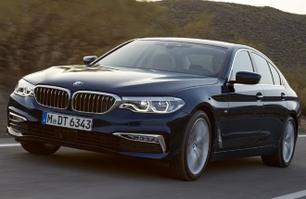
But what if it didn't have to be that way? Behold the BMW 530e iPerformance.
Seemingly tired of waiting for the Australian Government to introduce any sort of meaningful subsidy for green cars, BMW has made the choice simple: you can have a petrol-powered 530i for $108,900, or opt for the plug-in hybrid 530e for... $108,900. This is truly revelatory thinking.
There's no specification penalty, either, and the hybrid will power to 100km/h in an identical 6.2 seconds, so you're not even any slower. But you are sipping less fuel, emitting less C02 and basking in the general smugness, and sweet silence, that comes with feeling like you're saving the world.
So what's the catch?
It’s easy to forget BMW was paddling into the growing electric vehicle wave when it was only a gentle swell. It took off early with the i3 city car, which believe it or not has been in the Aussie new car market for six years.
While the German maker has long been developing the concept of electrified powertrains in existing models, the i3 was the result of a dramatically different approach, showcasing the use of exotic materials and innovative packaging.
Like its i8 supercar sibling, the i3 won’t be replaced with a new-generation version, but BMW says it will continue to develop this high-tech hatch before it departs, and we spent a week in the sporty i3s to see how it stands up in 2020.
Not all superheroes wear capes, and we're proud to report the 530e does its bit for green motoring without feeling the need to shout about it. And with no price or specification penalty, it's easier being green than ever before, and the pricing of this BMW really puts the cat amongst the canaries.
Yes, it’s pricey for a small hatch, but this little BMW is a city car like no other. The i3s is tailor made for the urban environment, and six years on retains the quirkiness and charisma that stood it apart at launch, and it can still hold its head high among the current EV crop.
Crucially, there's nothing weird about the way the 530e looks. While some green cars look like they've been designed by one of the kids from 3rd Rock from the Sun, the 530e looks much the same as the rest of the range, save a few tiny but telltale giveaways - like the e-drive badging outside, and what looks like a bonus fuel flap tucked in behind a front wheel that houses the whole plug-in bit.
And we really, really like it. It's elegant and statesman-like from every angle, and looked especially important in the deep-blue colour of our test vehicle. It's not over-designed, with body creases used sparingly, and the occasional glint of polished silver that rings the windows and the grille adds a final sense of shininess to an understated design.
Inside, there's more going on than you might normally find in a BMW. The hugely complicated digital display screen now includes everything from battery charge, power usage to the usual assortment of speedometers and petrol readouts.
It doesn't feel overdone or crazily festooned, but there's more at play here than in your usual BMW.
The dash is busy, too, with a wide screen emerging from a centre stack that also houses a CD player and a digital aircon setup, which in turn sits above a complex centre console from which you can alter driving settings, control the multimedia or cycle through electric modes. It doesn't feel overdone or crazily festooned, but there's more at play here than in your usual BMW.
Elsewhere inside, the seats are beautifully designed, with a quilted leather highlight through the middle, while the gloss-black strip that lines the dash hides a dual strip of ambient interior lights that also runs across all four doors.
Built around a carbon-fibre reinforced plastic (CFRP) tub, the i3s is ultra-light (for a battery-electric vehicle), super strong, and unlike anything else on the road.
At just over 4.0m long, close to 1.8m wide, and a fraction under 1.6m tall, the i3s is compact, upright, and boxy. A classically polarising design, with some crossing the street to avoid it, and others (like me) loving its unique proportions and stand-out styling.
The nose is tall, short and upright, with the distance from the base of the front windscreen to the front axle (car designers call it the ‘dash-to-axle ratio’) unusually short.
That’s because the electric motor sits in the back of the car driving the rear wheels, with only a small front boot compartment required to house charging cables and other bits and pieces.
Despite the lack of anything of substance behind it, BMW’s signature ‘kidney grille’ is present and accounted for, with swoopy LED headlights (and DRLs) either side. Our test car’s ‘Fluid Black’ finish with ‘i Blue’ highlights dialed up the little car’s charismatic personality.
One of the i3’s most impressive party tricks is its counter-opening ‘clamshell’ doors, and the engineering trickery used to create a B-pillar free side opening (including the strength of the carbon body structure) means the high window line follows a jagged path from front to back, the rearmost hatch windows shrinking the rear glass area appreciably.
The i3s’s standard 20-inch (dual) five-spoke alloy rims, although slightly wider in this performance model, are alarmingly skinny. But taking the car’s relatively light weight (1245kg) and urban-centric purpose into consideration, the narrow, low-rolling resistance rubber makes sense.
With the roofline and sides of the car tapering distinctly towards the back, the rear view is suitably idiosyncratic, highlighted by flush-fit, vaguely U-shaped LED tail-lights.
The hatch window is small, and the bumper sits high to marry with the load space floor sitting on top of the motor and transmission.
And when it comes to moving inside, BMW offers a choice of three ‘interior worlds - ‘Loft’, ‘Lodge’, and ‘Suite’ - featuring renewable natural fibres, recycled plastics, naturally tanned leather, and open-pore wood (sourced from 100 per cent Forest Stewardship Council-certified forestry).
But irrespective of where everything comes from, the end result is inviting, comfortable and sub-zero cool. Our car’s ‘Suite’ interior was combined with ‘Oak dark matt’ wood, and ‘Vernasca’ brown leather to stunning effect.
A tunnel-free floor, gently curved dash and digital screens for instruments and media let you know you’re in something different and special. It might be six years old, but the i3 still feels contemporary and distinctive.
As the world's motoring tastes shrink faster than a lap-banded Clive Palmer, it's easy to forget the joys of the full-size sedan, but the space for passengers and luggage in the 5 Series will have you questioning your downsizing ways.
Upfront, there's plenty of room between front-seat riders, who will also share two smallish cup holders, along with room in each front door for bottles. There's also a dedicated wireless charge pad (which, because of its tight design, is crazy difficult to actually remove your phone from), but you'll also get two USB points and a power outlet that's hidden in the sizeable centre storage bin as standard fit.
Backseat riders get heaps of space, both in width and in leg room behind the front seats. And there's twin air-con temp controls and twin power outlets, too. But middle-seat passengers will be forced to sit with their legs on either side of the raised tunnel, which will definitely impact on comfort.
The boot's still sizeable, despite shrinking slightly to house the battery/fuel tank setup
Best to ditch the fifth passenger, then, and deploy the pull-down seat divider, which also houses two cup holders. Finally, there are three ISOFIX attachment points, one for each seat in the back.
The boot's still sizeable, despite shrinking slightly to house the battery/fuel tank setup (the tank has been moved further back to accomodate the batteries), and can be adjusted to be a flat load area if you'd like, offering up to 410 litres with the rear seats in place.
Wide-opening clamshell doors make getting in and out of the i3s a breeze. But bear in mind you have to open the front door to get to the latch for the back one, which can be a pain.
The driver and front passenger enjoy heaps of room, in an open environment, but there’s only a single cupholder in the centre console, so let the coffee cup wars begin.
Aside from that there are seriously big bins in the front doors, a modest glove box, and a handy elasticised pocket near the floor at the base of the bulkhead.
Outlets for 12-volt and USB are provided, and there’s a small oddments tray at the rear of the centre console.
Slip around to the rear and you’re in anything but limousine territory. Sitting behind the driver’s seat set for my 183cm height, head and legroom are modest but do-able. And remember it’s two seats only back there.
In terms of storage, there are two cupholders between the seats but no storage pockets or bottle holders in the doors. You won’t find adjustable ventilation outlets either, but that’s not a huge factor in car of this stature.
The boot’s volume is quoted at 260 litres with the 50/50 split-fold rear seatback upright, which is enough to easily swallow the largest 124-litre suitcase in the CarsGuide three-piece set. The smaller 95- and 36-litre cases will sit side-by-side without a problem.
Fold the rear seat down and you have 1100 litres of space at your disposal, with tie-down anchors, an elasticised pocket and 12-volt power provided.
Don’t bother looking for a spare of any description, a repair/inflator kit is your only option. And not surprisingly, the i3 is a no-tow zone.
The 530e commands a 530i-equalling $108,900 price tag, which is genuinely impressive when you consider all the extra bits and pieces that go into make a plug-in hybrid. That money buys you a well-equipped car, and only those allergic to money need reach for the options list.
As standard, you'll find leather-wrapped - and heated in the front - sports seats, 19-inch alloy wheels and a 10.25-inch touchscreen that pairs with a really very good 16-speaker Haman Kardon stereo. Wireless Apple CarPlay is available, but it'll cost you an extra $500. To be honest, though, we didn't miss it.
You'll also find adaptive LED headlights, a huge head-up display (so big, in fact, that it impedes vision when climbing steep hills), dynamic dampers, an auto opening/closing boot and a self-parking system, along with BMW's suite of self-driving tech - but we'll come back to that under the Safety sub-heading.
For a compact, four-seat hatch the BMW i3s is all the money at $70,900, before on-road costs. Close to $20K more than even the top-spec ‘Premium’ version of Hyundai’s Ioniq electric hatch ($52,490), and even further away from Renault’s cute little Zoe ($49,490).
But a carbon monocoque body and high-tech powertrain don’t come cheap, and that’s where BMW’s ‘i’ model program has seemingly run out of juice.
Getting into the EV market early, BMW took a punt on niche vehicles using exotic materials, appealing to a relatively small group of premium buyers. And in glorious hindsight, that path has proved something of a dead end.
But putting all that to one side, it’s fair to expect a generous standard equipment list in a $70K-plus BMW, and the i3s comes to the party with a solid, if not spectacular batch of features.
Aside from the safety tech detailed later, Included is a 10.25-inch media touchscreen, managing audio, built-in nav (with real time traffic alerts), phone connectivity and more.
Other features include, wireless phone charging (for compatible devices), a rear-view camera, automated parking assist, active cruise control (with stop-go function), climate control air, driver’s digital display, ambient interior lighting, 20-inch alloy wheels, auto LED headlights, LED DRLs, indicators and tail-lights, keyless start, rain-sensing wipers, plus heated and folding power mirrors.
But there are a few surprises. It might be an electric car, but forget power adjustment of either front seat. And despite inclusion of Apple CarPlay (BMW says Android Auto will be available later in 2020) and digital radio, the audio system only has four speakers, all in the front doors (because of the clamshell arrangement detailed later).
Our test car featured the ‘Suite’ interior package ($2308) which brings ‘Vernasca Dark Truffle’ leather on the seats, instrument panel, doors and side trim, as well as ‘Oak dark matt’ wood trim, the steering wheel in black with a ‘Satin Silver’ contrast ring, floor mats (and general interior fabrics) in ‘Anthracite’, the roofliner in ‘Carum Spice Grey’, plus orange/white LED lighting for the door pull handles and front map pocket. A dual porthole-style glass sunroof adds another $2246, for an as-tested price of $74,454.
Drift around in pure EV mode and you'll be relying on the 530e's 83kW and 250Nm electric motor, which will provide what BMW refers to as "between 28 and 32 real-world kilometres".
Run out of range, or simply use too much throttle, and the 2.0-litre petrol engine comes into play, adding 135kW and 320Nm to the mix. All up, that's 185kW and 420Nm - respectable numbers by any measure, and enough to match the petrol-powered 530i's zero to 100km/h sprint of 6.2 seconds.
That power is fed through an eight-speed automatic transmission before being sent exclusively to the rear wheels, where it belongs.
The i3s is powered by BMW’s ‘eDrive’ hybrid synchronous electric motor, producing 135kW at 7000rpm, and 270Nm from 0-4500rpm. Yep, that’s right, maximum torque is delivered the instant you depress the right-hand pedal, and we’ll get to what that brings to the driving experience a little later.
The unit incorporates a charging and generator function for braking energy recuperation, the latter delivering up to 50kW.
Drive goes to the rear wheels via a single-speed (fixed-ratio) automatic transmission.
The battery powering the whole show is a 352-volt/120 amp-hour (Ah) Lithium-ion unit with a (gross) energy rating of 42.2kWh.
Like a Facebook relationship status, it's complicated. The 530e will sip a claimed combined 2.3 litres per hundred kilometres on the claimed/combined cycle, which is amazing for a car this size. Better still, it seems genuinely achievable - at the vehicle's launch, our own Richard Berry recorded a stunning 2.0 litres per hundred kilometres on a short test route.
But that's with a full load of battery charge on board. For our week with the 530e we were unable to actually plug it in (living in Sydney, I can't afford a garage), so once the initial battery charge had been used we were back to mostly petrol power. Unlike some other plug-in hybrids we've driven, we found it very difficult to recharge the battery to any meaningful level using regenerative braking, so once we were flat we stayed flat. If we had plugged it in, it would have been a two-hour recharge using a specialised wall unit, or about four hours using a normal plug.
As a result, though, our fuel use was closer to 7.0 litres per hundred kilometres after some considerable real-world testing.
When it comes to an electric car’s energy use and projected range, there are two main things to consider - the motor’s power consumption and the battery’s capacity.
And according to BMW, the i3s’s power consumption for the combined (urban/extra-urban) cycle is 14.6–14.0kWh/100km.
Over a week, and roughly 250km of urban driving (with some brief freeway runs thrown in) we saw 19.3kWh/100km staring back at us from the on-board computer.
When BMW launched the i3 in Australia in 2014, the pure EV version came with a 60Ah battery pack delivering a claimed 130 kilometre range (a range extender model featuring the addition of a two-cylinder petrol motorcycle engine was also offered).
In 2016 a 94Ah version arrived to boost range up to 183km, and the i3s launched in 2018, with its 120Ah battery pushing range out to BMW’s current, real-world estimate of 260km.
Then, there’s charging time, which is like asking how long is an electric piece of string.
According to BMW, for a 0–80 per cent charge from a (50 kW DC) fast-charging station, you’re looking at 45min.
From a (11kW/16A/380V) high-output home/office wall unit, that pushes out to 3.10h, and using a (3.7kW/16A/240V) low-output home/office unit stretches the wait time to 9.40h.
BMW offers the ‘WallBox plus’ charging suite as a dealer accessory priced from $1990 (not including GST or install costs).
Plug into a domestic (2.4kW/10A/240V) socket, and you’re staring down the barrel of 15.00h. But at least you can use low-cost, off-peak energy overnight, right? Nah, I don’t buy that line either.
There's so much to like about the way the 530e sets about saving the world, and that's mostly because it doesn't shout about it, either to the driver or the outside world.
It's very much an underpants inside its pants superhero, which makes us like it even more. Set off in EV mode, and the 530e will drift silently away from the curb, burning battery power over fuel for as many as 30(ish) kilometres. But equally important, the shift from green to gas is largely imperceptible, with the petrol engine joining in willingly when you ask it to - usual via a prod of your right foot.
It is so effortlessly smooth that you need to really pay attention to notice the eight-speed 'box changing gears at city speeds, and it's commendably quiet, whichever drive mode you're in.
Downsides? Well, it doesn't feel quite as sharp as it's conventional-engined siblings. The batteries add around 230kg in weight, which never helps, and it all feels a little softer and a little less dynamic, even with Sport mode engaged. BMW assures us the adaptive suspension setup and tune is identical, but the 530e feels noticeably softer when you tackle a twisting back road. And that encourages you to use your right foot a little more, which in turn negates the whole electric thing in the first place.
One of the great joys of BMWs has always been their ability to transform from cosseting comfort to rear-drive rocket when you want them to, and you can't help but notice the 530e isn't quite up to that challenge. But if your intentions are mostly city- and freeway-based, then this plug-in BMW is almost indiscernible from its petrol-powered sibling.
It might not look like a conventional sports car, but the BMW i3s certainly accelerates like one, with a claimed 0-100km/h time of 6.9sec. The i3s is a smile-inducing hoot to drive.
Every one of this little hatch’s 270 newton metres of torque is available from the minute you hit the accelerator pedal, and remain in service until 4500rpm, at which point torque delivery drops off a cliff.
But peak power steps in at exactly 7000rpm, so if you’re determined to make that overtaking move you won’t be left in the lurch. In fact, BMW says it only takes the i3s 4.3 seconds to surge from 80km/h to 120km/h.
However, the i3’s forte is 100 per cent the city, rather than the open road. Its ‘point and squirt’ ability making it the perfect partner for the cut and thrust of the urban jungle.
The i3s features an upgraded ‘Sports Suspension’ incorporating firmer dampers, re-tuned springs and revised anti-roll bars. It’s also lowered 10mm, the track is widened (+21mm front / +2.0mm rear) and the wheels go plus one inch to 20-inch alloys.
The standard i3 (no longer offered in Australia) rolls on 19-inch rims shod with 155/70 rubber all around. And while the i3s’s 175/55 front and 190/50 rear tyres are still exceptionally narrow, from the side the low-profile Bridgestone Ecopias look like fan belts wrapped around pulleys rather than tyres around wheels..
No surprise then that ride comfort isn’t exactly cushy, and in signing on for the i3s experience you’ll need to be ready for more than occasional bumps and thumps.
But the pay-off is super-sharp dynamics, Suspension is by alloy struts at the front, and a five-link alloy set-up at the rear..The steering responds to inputs quickly yet smoothly, and with 48/52 front to rear weight distribution, the car always feels balanced, eager, and taut.
And if you really want to dial things up the ‘driving experience control’ allows a switch to Sport mode for a further tweak of the suspension, steering, and traction control set-ups.
A tight 10.3m turning circle makes for easy parking and stress-free U-turns. But if things get too tight, rapid three-point turns are assisted by the gear shift controller bring mounted on a chunky stalk on the right-hand side of the steering column. Too easy.
Braking is by vented discs front and rear, but they’re tiny. That’s because the ‘Brake Energy Regeneration’ system does most of the work.
Effectively turning the motor into a generator, the system not only slows the car dramatically but feeds energy to the battery in the process. It takes a while to get used to the sensation, but soon becomes a fun, and surprisingly easy game to use the brake pedal as little as possible… often not at all, for long periods.
You'll want for little here, with front, front-side and full curtain airbags joining parking sensors, a surround-view camera and a self-parking system.
You can also expect active cruise control, lane control assist with lane keep assist (so it will stay between the lane markings for you), AEB and cross-traffic warning. And all of that means that, technically, the 530e can drive for you. That is, of course, if you don't mind driving like a dick - in full-autonomous mode it will swerve from lane marking to lane marking like it's playing bumper bowling.
The i3 scored a maximum five ANCAP stars when it was assessed at the time of its local launch in 2014, and the standard safety spec has been boosted since then.
Active tech includes ‘the usual suspects’ such as ABS, EBD, and ESC, as well as city-speed AEB (with 'Forward Collision Warning', and 'Traffic Sign Recognition'). reversing collision avoidance, a reversing camera, and tyre pressure monitoring.
If all that doesn’t prevent an impact, passive safety tech includes, dual front, side chest and side curtain airbags.
There are also top-thether points and ISOFIX anchors to secure child seats/baby capsules in both rear seating positions, as well as a first aid kit and warning triangle..
Like the rest of the 5 Series range, the 530e falls under BMW's three-year, unlimited-kilometre warranty. There are no set service intervals, either, with BMW using what it calls 'condition-based' servicing. In other words, the car will tell you when it requires a trip to the service centre.
The batteries are covered by a separate warranty covering six years or 100,000km.
BMW offers a three year/unlimited km warranty, which is off the pace given the majority of mainstream brands have stepped up to five-year cover, with some at seven. And the pressure is on with Mercedes-Benz recently announcing its shift to five years/unlimited km.
That said, the BMW's body is warranted against rust (perforation) for 12 years/unlimited km, and roadside assistance is provided free-of-charge for three years/unlimited km.
Maintenance is 'condition based' with sensors and on-board algorithms (mileage, time since last service, driving style) determining whether an annual vehicle inspection is required.
The 'BMW Service Inclusive' package, offering a single, one-off advance payment to cover selected service and maintenance costs, is available in two levels - 'Basic' ($850) or 'Plus' (dealer quote)