What's the difference?
More than half a century of 5 Series pedigree has led BMW to this, the first electric version of its venerable sedan, the i5.
It's true that electric cars come with benefits that suit the realm of luxury (or at least executive) motoring like their effortless acceleration and near-silent operation, so this new G60 5 Series has the potential to be the best yet in its ‘i5’ form.
But there are rivals, well-liked ones at that, which BMW must contend with to snatch the spot at the top of the large premium sedan ladder technically held currently by the Porsche Taycan in terms of sales - though Mercedes’ E-Class would lead if its electric cousin EQE’s sales were combined.
So, with names like that to go up against, BMW better have brought its A-game.
The LDV G10 arrived on the scene in the van segment a few years ago, with the aim of upsetting the equilibrium.
It was a budget-priced, Chinese-made mid-size van with its target set squarely on appealing to customers who might have wanted a HiAce, but couldn’t afford one.
After almost four-and-a-half years on the market in Australia, the LDV G10 is better than ever. It has seen new additions in the cabin, more comfortable seats, and still offers big value for money.
But with the van market moving forward at pace, does the LDV G10 offer appeal beyond the sticker price? We tested the diesel auto model to find out.
There’s no getting around the i5 being a rather expensive offering. More than $150,000 to get into an electric sedan that’s not much faster than a hot hatch is a big ask, but there’s plenty to enjoy about the 5 Series.
Things like its heated leather seats shouldn’t be the reason you’re willing to spend so much on a sedan when a $50,000 hybrid SUV will score you the same, instead it’s the fact the 5 Series is a delight to drive and hasn’t lost the feeling of prestige the badge has earned over the last half a century.
In terms of value - if speed isn’t your focus and you’re less of a gadget-type-operator when looking at cars like this - the 520i has the style and comfort you’d need and at $100K less than the M60.
And in terms of large electric sedans, the i5 eDrive40 is cheaper than a Porsche Taycan (by a little) or an Audi e-Tron (by a lot). The Genesis G80 Electrified is the closest cheaper rival, by about $10K, or the less powerful Mercedes EQE is similarly priced at $154,900.
Essentially, if you’re looking at a 5 Series, it might be worth considering if you really need it to be electric, but if so, there aren’t many alternatives in its category for the price.
Note: CarsGuide attended this event as a guest of the manufacturer, with meals provided.
The LDV G10 is a solid option for those buyers who just want a van that gets the job done. It was decent with weight on board, but is probably better suited to parcel carriers rather than pallet shifters.
Safety levels are the biggest concern, as it is falling behind in the class when it comes to active safety tech, and its weak crash test score could be enough to rule it out for some customers.
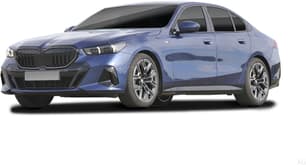
If you’ve watched other members of the BMW family go into a new generation within the last few years - the 3, 4 and 7 Series particularly, you won’t be too surprised by what you see here. Especially with the latter, having seen the petrol variants look roughly the same as the electric ones.
BMW specifically made the petrol 520i and the i5 variants look similar for egalitarian purposes - to not disenfranchise 520i buyers who are still spending a fair chunk of cash but might not be ready to go EV.
That means all three variants score a mix of new and old. The kidney grille remains and isn’t as large as on the M3 or 4 Series, while the bonnet line following it and the ‘character line’ down the car’s side also remain. And yes, the Hoffmeister kink where the C-pillar meets the passenger window’s lower corner is still there.
On that C-pillar though is a ‘5’ stamped into the bodywork, new to this generation, while the front grille as mentioned has a glowing light surround - the brand’s ‘Iconic Glow’ already seen on the 7 Series.
Overall, thanks to being slightly larger in every dimension, the new 5 is starting to look bigger than a 7 Series from a little while ago. And that’s because it is - its body is overall longer than an E65 7 Series from the mid-2000s.
It’s 5060mm long 1900mm wide, 1515mm tall (97mm longer, 32mm wider, and 36mm taller). Its wheelbase is 20mm longer too at 2995mm.
The more you see LDV G10 vans, the more regular they look. Familiarity breeds ignorance, I guess, but I still think the G10 looks smart.
It isn’t quite as boxy as some, with its sleeker front-end styling and almost sedan-like tail-lights helping it stand out from the ‘box-on-wheels’ stigma. It gets 16-inch alloy wheels as standard, and has halogen headlights and misses out on daytime running lights.
But it still is a box on wheels, measuring 5168mm long (on a 3198mm wheelbase), 1980mm wide and 1928mm tall. That makes it a darn sight smaller than the new HiAce, which stepped up significantly in size, and about on par with a Renault Trafic SWB or Ford Transit Custom 300S SWB.
The perceived build quality is mostly okay, though our test car had a few loose plastics on the outside and a seemingly mis-fit windshield rubber.
A longer wheelbase means more space inside, where the 5 Series also still looks fairly familiar to those who have spent any significant time in a recent model BMW.
BMW has historically been pretty bang-on with ergonomics, and the new-gen 5 does a good job of sticking to that. Comfortable sports seats and quality feel for the materials on touch points mean the 5 Series feels nice to be in, and relatively restrained interior design for a somewhat luxurious car means it looks nice too.
It’s let down only by a couple of things - its multimedia screen and Operating System 8.5 is a little less simple to use now, and requires more touching the screen than previous iDrive systems, rendering the scroll wheel less useful.
The BMW Interaction Bar too is a little tricky to see controls on, as well as lacking physical feedback for using controls. Vent flow controls are digital sliders on the Bar, while vent direction is controlled by an unusual ‘joystick’ style control nearby.
The rear seat is plenty spacious, as you’d expect from a large sedan, with climate controls and ports for charging devices in the rear.
Those dimensions translate to a cargo space of 5.2 cubic metres, with a load space spanning 2500mm long, 1590mm wide (1270mm between the arches) and 1270mm tall. That mightn’t be big enough for you, and that’s too bad - there is no high roof version, nor a long-wheelbase model; but you could get an LDV V80 if you really need to step up in size… but we wouldn’t suggest you do that.
The payload for this model is 1010kg, which is decent but not benchmark-setting. It has a gross vehicle mass of 3000kg, meaning a kerb weight of 1990kg. The gross combination mass depends on the model: the GCM for diesel models is 5000kg for a braked trailer, while petrol models have a GCM of 4750kg for a braked trailer (auto) and 4500kg (manual). All models have a GCM of 3750kg for unbraked trailers.
The petrol versions have 1093kg of payload, if you prefer that fuel type. Interestingly, the manual versions have leaf spring rear suspension, while the auto models have coil springs as part of a five-link suspension architecture.
The load area has a six floor-mounted and four wall-mounted tie-down hooks, and the floor is lined with a vinyl covering while up to half-height the inner walls are lined, too. There are four lights mounted on the walls, which is handy for after-hours work.
And every LDV G10 comes with dual sliding side doors (some brands charge thousands more for this convenience), while the back door is a tailgate as standard, with the option of barn doors for diesel models.
For those who need to fork loads in, the barn doors are a no brainer, because the side door apertures (at 820mm wide) aren’t broad enough to load in using a lift. The tailgate also makes it very difficult to load weight in, as we found on test, as our mates at Crown Lifts had to use long tines to fork in our 750kg ballast.
When it comes to creature comforts up front, there is a pair of low-mounted pop-out cupholders, and an open storage area between the seats. There isn’t much covered storage, so if you often carry valuables, you may need to keep that in mind.
The seats are comfortable and offer good adjustment, and they’ve been changed since the diesel auto model launched. They’re no longer a cheap-feeling fabric, but rather a faux-leather accented, mesh-lined set of seats, and both have armrests. Nice.
The presentation is okay, but the ergonomics could be better. The touchscreen is mounted down lower than most, and means you may need to take your eyes away from the road because the controls are down even lower. And the USB? Near the floor.
That screen is still a 7.0-inch display, but now has the same software system as the newer models in the LDV range. That means a nice crisp colourful display with the added advantage of Apple CarPlay… if you can get it to work. We had a few issues when reconnecting a phone without re-starting the car.
There are three members of the new 5 Series family from launch, with a base 520i starting things off from $114,900 before on-road costs.
It’s the only petrol-powered (with mild-hybrid, we’ll come back to this) variant in the trio, but it does have a fairly extensive list of features as standard. In terms of tech and comfort, most of what comes with the 520i is available further up the range too, with the major differences being drivetrain related.
In the 520i, the interior upholstery is synthetic ‘Veganza’ leather with Alcantara, though optional Merino leather is a $4000 BMW Individual option. The front seats are heated as standard, however, and electrically adjustable with memory settings and lumbar support.
A 12.3-inch instrument display paired with a 14.9-inch multimedia display are standard across the range, running BMW’s Operating System 8.5, while a head-up display, ambient lighting, wireless phone charging tray and BMW’s ‘new’ Interaction Bar are included too - a crystalline-style strip across the dash with touch-sensitive ‘buttons’ like the climate controls.
A panoramic glass roof - unable to be opened - is standard too, while the 520i’s sound system is a Harman Kardon set-up with 12 speakers.
Exterior features are quite similar to the more expensive i5 variants, with Adaptive LED headlights, automatic boot opening, an M design kit with front and rear aprons, side sills, and BMW’s Iconic Glow kidney grille surround.
Optional in the 520i is an ‘Enhancement Package’ which adds a choice of aerodynamic 21- or 20-inch wheels, metallic paint, and a 655-watt 17-speaker Bowers & Wilkins surround sound system for $5400. One test car on the launch we attended was painted in a BMW Individual colour - Tanzanite Blue - which upped the price to $7800.
Moving up the range to the mid-tier i5 eDrive40, which starts from $155,900, adds Merino leather interior, metallic paint, Bowers & Wilkins surround sound and aerodynamic 20-inch wheels standard, but it also includes adaptive suspension and some other EV-related features.
BMW’s ‘Adaptive Suspension Professional’ comes with Integral Active Steering (rear-wheel steering) and is a step up over the M Sport suspension from the 520i, while its aero wheels function as a way to keep the electric car’s range being affected by resistance.
The eDrive40 also comes with an acoustic protection system to make ‘electric car noises’ to warn pedestrians, as well as BMW’s ‘Iconic Sounds’ for the occupants - basically a system that uses orchestral sounds composed by Hans Zimmer that are affected by acceleration intensity, speed, and drive mode.
It also comes with the standard kit for an electric car, a Mode 2 and Mode 3 charger, cable, and a five-year Chargefox subscription.
The top-spec i5 M60 xDrive ups the cost to $215,900 and the features list again slightly (as well as being far more powerful).
Its suspension is even more advanced, adding the brand’s Adaptive M Suspension Professional with active anti-roll, plus 21-inch aero wheels as a no-cost option. The M60 also gains an M rear boot lip spoiler.
Inside, BMW’s ‘Crafted Clarity Glass’ controls in the centre console are standard, as is ventilation for the front seats and a four-zone automatic air conditioning system.
If you’re buying an LDV G10, it’s because of the price. The cost of the diesel automatic model we’ve got is usually $32,490 drive-away for ABN holders, but there are promotions running listing it at $29,990 drive-away for ABN holders at the time of writing. If you’re not an ABN holder, just get one, because you’ll save heaps (the G10 diesel auto is $34,147 drive-away for non-ABN holders).
You can get other vans for around this money - the Renault Trafic Trader Life manual, with its gutless 66kW turbo-diesel engine, is $30,990 d/a. But you won’t find a diesel Hyundai iLoad, Peugeot Partner or Toyota HiAce within $10,000 of the LDV.
As for standard spec, you get 16-inch alloy wheels, tyre pressure monitoring, climate control air-conditioning, a 7.0-inch touchscreen with USB connectivity, Apple CarPlay, Bluetooth phone and audio streaming, CD player and AM/FM radio, a digital speedometer, two part fake-leather seats with arm-rests (driver’s side with height adjust), carpet flooring up front, and vinyl floor protective liner in the rear, and a reversing camera.
Standard body fit out is dual sliding side doors and a lift tailgate, though you can get barn doors fitted on diesel models. Unlike some competitors, there is no option for glazing in the rear doors or side panels.
There are also no auto headlights, no auto wipers, push-button start, keyless entry, leather-lined steering wheel, reach adjustment for the steering, and there’s quite a bit missing in the safety section of this review - see below.
Despite BMW calling it ‘electrified’, the base 520i is only a mild hybrid so most wouldn’t realise unless they were told.
Its turbocharged 2.0-litre four cylinder puts out a modest 153kW and 330Nm, with power and torque sent to the rear wheels via an eight-speed automatic transmission.
BMW claims it’ll knock over the 0-100km/h sprint in 7.5 seconds, a few seconds too slow to blow anyone’s socks off.
The mid-spec eDrive40 has a little more kick to it, its rear-mounted electric motor capable of 250kW/430Nm and able to cut that time to 6.0 seconds.
It’s fitted with an 84kWh battery to draw its power from, the same as the 442kW/820Nm M60 with its all-wheel drive dual-motor setup.
The M-tuned i5 can hit 100km/h in a claimed 3.8 seconds. Bye bye socks, perhaps.
Under the bonnet of the diesel G10 is a 1.9-litre four-cylinder turbo-diesel with 106kW of power and 350Nm of torque. There’s the choice of a six-speed manual or six-speed automatic, and the G10 is rear-wheel drive. It has a diesel particulate filter, but not stop-start or AdBlue.
Prefer petrol? There’s a 2.4-litre five-speed manual model (105kW/200Nm) or a 2.0-litre turbocharged six-speed auto (165kW/330Nm). Those models are cheaper - $25,990 for the manual for ABN holders, while the turbo-petrol auto is $30,990 d/a.
BMW claims the petrol 520i sips 6.7 litres per 100km from its 60-litre fuel tank, though we were unable to independently test any of the claimed figures on the launch day.
The base car has a theoretical range of 896km if it was possible to achieve the claimed fuel consumption figure for the duration of the whole tank - but it isn’t and realistically you could knock about 20-30 per cent off that, depending on how enthusiastically you drive.
In the i5 variants, the same 84kWh battery provides slightly different ranges due to the eDrive40 using 16.56kWh per 100km, and the M60 using 18kWh.
The eDrive40 has a claimed 550km maximum range, while the M60 has a 506km figure thanks to its extra motor and weight.
The combined cycle fuel use claim for the LDV G10 diesel auto is 8.6 litres per 100 kilometres. The manual version uses 8.3L/100km according to the brand.
On test we saw a fuel use return of 9.7L/100km at the pump, across a mix of urban, highway and freeway driving, with and without a load.
Petrol models use a claimed 11.5L (manual) and 11.7L (auto) per hundred.
For some cars, the list of features is what really separates the variants, but that’s not the case for the 5 Series. As is a bit of a BMW tradition, the drivetrains dictate the different trim levels and prices, and there are three fairly distinct flavours of 5 Series.
Starting at ground level, the 520i might at first seem like a bit of boring vanilla. Except it’s actually quite smooth and light vanilla.
There’s not a lot to write about when it comes to its drivetrain, but the lightness of its engine and petrol tank combo when compared to EV batteries and motors is refreshing, and makes for a quite dynamic rear-drive sedan.
Its 153kW and 330Nm is delivered smoothly enough with the mild hybrid assistance doing a little in helping responsiveness, but without intervening in the gearshifts it doesn’t feel particularly keen.
It lacks the ride comfort of the i5’s adaptive suspension, but it’s able to be driven in a spirited manner that belies its size and even, to some extent its 1725kg kerb weight. Chocolate sprinkles on the vanilla, if you like.
It’s not fast, but it feels nimble compared to its electric siblings and can carry a fair bit more speed through corners, after which there’s room to notice its rear-drive characteristics.
It’s especially noticeable after getting out of the 2130kg eDrive40, though the extra power from its 250kW/430Nm motor makes for some more spirited acceleration and a little more excitement when exiting a corner, especially if you’re aiming to double-check if it really is rear-wheel drive. There’s a little more than choc-topped vanilla going on here.
The steering is, like in the 520i, direct and responsive, though in most cases is probably best set to ‘comfort’ rather than ‘sport’ in its settings.
The eDrive40 is rather comfortable and capable when barrelling through twisty backroads, and doesn’t feel out of hand for a five-metre-long sedan. It holds its weight well, and telegraphs when you might be approaching the limit quite sensibly.
When considering that, then, it’s impressive how brutally capable the 2305kg M60 is.
Here, we’re looking at a double-choc fudge with extra choc, and maybe some cookie dough in there for good measure. There’s a lot to like, but boy is it heavy.
It’s 580kg (or exactly half a Peugeot 208 GTi) heavier than the 520i, but it feels quick on its feet and its anti-roll seems to do a lot in terms of dynamics, the limiting factor really seems to be its tyres (which can and will squeal quite quickly to let you know when approaching said limit).
While you’ll need to take caution with how much speed you approach a corner with, you’re not going to lack acceleration on the other side, its all-wheel drive being less ‘fun’ but more efficient at getting you away from the bend than in the rear-drive eDrive40.
That adaptive suspension does also translate to a comfortable ride on relatively rough roads - only particularly bad bumps will reveal how much weight and pressure is being placed on each corner of the big sedan.
You probably wouldn’t choose an LDV G10 as a daily driver if you didn’t intend to use the cargo zone at least 80 per cent of the time.
But if - for whatever reason - you really want to use a van like this on a day-to-day basis, you won’t hate it.
The G10 drives pretty nicely for this type of vehicle. It isn’t as bouncy when unladen as some of the other vans out there, with the suspension proving very quick to settle and mostly very compliant across mixed surfaces.
The steering wheel can jostle a bit over sharp edges, but it steers well, with decent (not too heavy) weighting and predictable response at all speeds.
Without weight on board the engine feels reasonably urgent in its response, which is a bit of a surprise because it’s not a powerhouse based on its outputs. It revs smoothly and pulls with good strength, with little turbo lag to contend with. While it is a bit of a grumbly engine at times, the response is better than adequate.
Plus the transmission is well sorted, with smooth shifts that are predictable.
The braking response is definitely better without weight on board, with a decent progression to the pedal and decent bite when you press hard on the anchors.
ANCAP hasn’t crash tested the new 5 Series. The last generation was a five-star car and it would be unusual to see that change with additional safety features - even with stricter testing.
The 5 Series comes with BMW Driving Assistant Professional as standard, with active cruise, lane assist and departure warning, front and rear cross traffic alert, collision prevention and intervention systems - in fact BMW says it has about 40 safety systems including an augmented reality dash display.
Its list of airbags includes front and side airbags for driver and passenger including one between the two occupants, as well as curtain airbags front and rear.
If safety matters to you, this could be your reason not to buy an LDV G10.
The van scored a mediocre three-star ANCAP crash test safety score - which would be more acceptable if that was under the current, strictest criteria, but it was actually tested in 2015. Which means it would be even lower if tested today.
One of the reasons is the safety equipment - there’s not a lot of it. You get dual front airbags, but no side airbags or curtains. There is no advanced tech like auto emergency braking (AEB), no lane keeping assistance or lane departure warning, no blind spot monitoring or rear cross-traffic alert… But you do get a reversing camera and rear parking sensors.
BMW has a fairly industry-standard five-year/unlimited kilometre warranty on its new cars, while its electric car batteries are covered by an eight year/160,000km warranty.
For servicing, BMW offers numerous discounted packs and deals based on your preferences and desire to pay upfront.
For the 5 Series, a five-year/80,000km basic service package is $2400, though the i5 will have different needs and lower servicing costs not yet listed by the brand.
LDV isn’t close to the leaders in the segment for ownership, with a behind-the-times three-year/100,000km warranty (admittedly with the same cover for roadside assist), and no capped price servicing plan.
Service intervals are every 12 months/10,000km, which is short, and you need to get an initial service done at 5000km, too.
If you’re worried about long-term longevity, you can check out our LDV G10 problems page.