What's the difference?
You know when you're walking along the footpath and you come to a soft spongey bit that the council have put in around a tree and your mind goes: "Whoah, the ground is bouncy but it looks just like bitumen?!"
Well that's the kind of response you'll get from people when they think they're looking at a regular BMW 7 Series, only to have their world go a bit bouncy when they see the Alpina B7 badge on the back of this car as you're overtaking them at Warp Factor 9000.
And you will be overtaking them like a blur because, thanks to the elves at German tuning house Alpina, the B7 is hugely fast for a five-seat, 5.3m-long, 2.2 tonne limo. But then the B7 is fast for any type of car of any dimensions, because with its 330km/h top speed this beast will outrun a McLaren 570GT. Yes, seriously.
Based on the BMW 750Li long wheelbase, the B7 begins life rolling down the same production line as a regular 7 Series. Alpina then goes on to make so many changes to the engine and chassis that the German government requires the BMW VIN to be replaced with a new one.
Ready to find out more? Well there's so much to see here that things may go a bit weird and bouncy again. Be prepared.
Eco-friendly vehicles are the leather pants of the new-car world; it takes a lot of money to make them look good (but people who own them think they look fantastic regardless). If you don't have a gazillion dollars to drop on a Tesla, then it's a one-way ticket to Prius town. And really, who wants that?
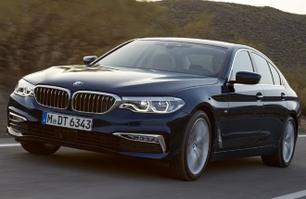
But what if it didn't have to be that way? Behold the BMW 530e iPerformance.
Seemingly tired of waiting for the Australian Government to introduce any sort of meaningful subsidy for green cars, BMW has made the choice simple: you can have a petrol-powered 530i for $108,900, or opt for the plug-in hybrid 530e for... $108,900. This is truly revelatory thinking.
There's no specification penalty, either, and the hybrid will power to 100km/h in an identical 6.2 seconds, so you're not even any slower. But you are sipping less fuel, emitting less C02 and basking in the general smugness, and sweet silence, that comes with feeling like you're saving the world.
So what's the catch?
The BMW Alpina B7 is a special car destined (like all Alpinas) to be a collector's item, due to its rarity and exclusivity. I asked Alpina just how many current model B7s there are in Australia and the answer was "less than five", which is just as mysterious as most people find the car in general.
The B7 is fast – too fast to enjoy legally on Australian roads – but it is also supremely comfortable and well appointed. For Alpina fans lucky enough to be driven in on,e this would make for a truly rare and niche way to be chauffeured.
Not all superheroes wear capes, and we're proud to report the 530e does its bit for green motoring without feeling the need to shout about it. And with no price or specification penalty, it's easier being green than ever before, and the pricing of this BMW really puts the cat amongst the canaries.
This is a good place to start because the B7 looks just like the 750Li it's based on, until you see the first tell-tale signs that it's not one.
There's the front wing with Alpina lettering and the boot-top spoiler, the graphics, which run the length of the car, and the 20-spoke wheels with Alpina badging.
This is late '70s, early '80s styling at its best (and possibly worst), but these special cars can pull off the irony-free look because this is how Alpina BMWs have rolled since 1975, when the E21 320-based Alpina A1/3 was launched.
BMW badges have been left on the bonnet and boot, but there's Alpina B7 BiTurbo lettering in place of the 7 Series identifier.
Most people walked by it in the street thinking it was just a big BMW, others scratched their heads wondering what I'd done to my big German limo and a handful almost dropped to their knees in praise and wonderment at spotting a rare beast like this in the wild.
These people all had their own Alpina stories – one was the third generation of an Alpina-owning family. You become a member a small and passionate club when you buy into this rarefied brand.
The standard B7's cabin is close to identical to the luxurious interior of the 750Li, save for Alpina-embossed stitching in the headrests of the soft, leather seats, the virtual instrument cluster and the Alpina plaque on the centre console denoting the build number.
The B7 is long, low and wide at just under 5.3m end to end, 1.5m tall and 1.9m across. A 3.2m wheelbase means cabin room is more than just spacious.
The B7 rolls off the Dingolfing production line in Germany and is then handed over to Alpina's facility in Buckle, where significant changes take place. Read on to find out how the B7 is different from a regular 750Li.
Crucially, there's nothing weird about the way the 530e looks. While some green cars look like they've been designed by one of the kids from 3rd Rock from the Sun, the 530e looks much the same as the rest of the range, save a few tiny but telltale giveaways - like the e-drive badging outside, and what looks like a bonus fuel flap tucked in behind a front wheel that houses the whole plug-in bit.
And we really, really like it. It's elegant and statesman-like from every angle, and looked especially important in the deep-blue colour of our test vehicle. It's not over-designed, with body creases used sparingly, and the occasional glint of polished silver that rings the windows and the grille adds a final sense of shininess to an understated design.
Inside, there's more going on than you might normally find in a BMW. The hugely complicated digital display screen now includes everything from battery charge, power usage to the usual assortment of speedometers and petrol readouts.
It doesn't feel overdone or crazily festooned, but there's more at play here than in your usual BMW.
The dash is busy, too, with a wide screen emerging from a centre stack that also houses a CD player and a digital aircon setup, which in turn sits above a complex centre console from which you can alter driving settings, control the multimedia or cycle through electric modes. It doesn't feel overdone or crazily festooned, but there's more at play here than in your usual BMW.
Elsewhere inside, the seats are beautifully designed, with a quilted leather highlight through the middle, while the gloss-black strip that lines the dash hides a dual strip of ambient interior lights that also runs across all four doors.
The B7 is a five-seater limousine although with the fold-down rear centre armrest which houses the media control panel the back is really set up to carry two.
That 3.2m wheelbase means cabin space is enormous. At 191cm tall I can sit behind my driving position with about 30cm between my knees and the seatback. Those rear doors open wide and the entrance is huge, making entry and exit almost as easy as just walking through a doorway. The air suspension also rises and lowers the B7's ride height for better access.
Storage is excellent, with two cupholders and door pockets for rear passengers, along with the area inside the centre armrest.
Up front, the driver and co-pilot have a deep centre console storage bin with split-opening lid, two cupholders and door pockets.
Luggage space is good, with a 515-litre boot.
As the world's motoring tastes shrink faster than a lap-banded Clive Palmer, it's easy to forget the joys of the full-size sedan, but the space for passengers and luggage in the 5 Series will have you questioning your downsizing ways.
Upfront, there's plenty of room between front-seat riders, who will also share two smallish cup holders, along with room in each front door for bottles. There's also a dedicated wireless charge pad (which, because of its tight design, is crazy difficult to actually remove your phone from), but you'll also get two USB points and a power outlet that's hidden in the sizeable centre storage bin as standard fit.
Backseat riders get heaps of space, both in width and in leg room behind the front seats. And there's twin air-con temp controls and twin power outlets, too. But middle-seat passengers will be forced to sit with their legs on either side of the raised tunnel, which will definitely impact on comfort.
The boot's still sizeable, despite shrinking slightly to house the battery/fuel tank setup
Best to ditch the fifth passenger, then, and deploy the pull-down seat divider, which also houses two cup holders. Finally, there are three ISOFIX attachment points, one for each seat in the back.
The boot's still sizeable, despite shrinking slightly to house the battery/fuel tank setup (the tank has been moved further back to accomodate the batteries), and can be adjusted to be a flat load area if you'd like, offering up to 410 litres with the rear seats in place.
The B7 lists for $389,955, while a 750li is about $319,000. At this level, $70K seems like a downright reasonable premium to pay for a faster, more powerful, better handling and comfier version of the 750Li.
In this case you're paying more but getting more, although standard features are close to identical. There's adaptive LED headlights, head-up display, night vision with pedestrian detection, a 10.25-inch touch screen up front and two screens in the second row for TV and other media functions.
There's a reversing camera, sat nav, harman/kardon surround stereo and Apple CarPlay. There's leather upholstery, seat massagers in the front and rear, four-zone climate control, heated and ventilated front and rear seats, front and rear parking sensors, auto tailgate, sunblinds for the rear and rear-side windows and proximity key.
The safety features are listed in the section below, and that list is also impressive.
Rivals to the B7 include the Mercedes-AMG S63, which lists for $375,000, the $331,700 Audi S8 and even the Bentley Flying Spur, which almost matches its price at $389,500.
The 530e commands a 530i-equalling $108,900 price tag, which is genuinely impressive when you consider all the extra bits and pieces that go into make a plug-in hybrid. That money buys you a well-equipped car, and only those allergic to money need reach for the options list.
As standard, you'll find leather-wrapped - and heated in the front - sports seats, 19-inch alloy wheels and a 10.25-inch touchscreen that pairs with a really very good 16-speaker Haman Kardon stereo. Wireless Apple CarPlay is available, but it'll cost you an extra $500. To be honest, though, we didn't miss it.
You'll also find adaptive LED headlights, a huge head-up display (so big, in fact, that it impedes vision when climbing steep hills), dynamic dampers, an auto opening/closing boot and a self-parking system, along with BMW's suite of self-driving tech - but we'll come back to that under the Safety sub-heading.
Alpina takes the 4.4-litre twin turbo V8 from the BMW 750Li and rebuilds the engine by hand. Alpina fits its own turbochargers, air-intake set -up, high-capacity cooling system and Akrapovic quad exhaust. Output is 447kW and 800Nm – an increase of a whopping 117kW and 150Nm over the 750Li's grunt.
It's interesting to note that the V12-powered 760Li has a smidge more power, at 448kW, and the same torque output as the B7.
How fast is the B7? Supercar fast – the B7 has a top speed of 330km/h, which will see it outrun a McLaren 570 and almost keep up with a Ferrari F12. That's quite incredible for a 2.3-tonne limousine with three TVs on board. A 0-100km/h time of 4.2 seconds is also hugely impressive.
In comparison, a 750Li has a 0-100km/h time of a not-too-shabby 4.7 seconds, but the car is electronically limited to 250km/h.
An eight-speed automatic transmission shifts gears smoothly, although a little slowly in Normal mode, while Sport and Sport+ add urgency and harder shifts.
Finally, the B7 is all-wheel drive, and those rear wheels are designed to steer slightly for better cornering performance.
Drift around in pure EV mode and you'll be relying on the 530e's 83kW and 250Nm electric motor, which will provide what BMW refers to as "between 28 and 32 real-world kilometres".
Run out of range, or simply use too much throttle, and the 2.0-litre petrol engine comes into play, adding 135kW and 320Nm to the mix. All up, that's 185kW and 420Nm - respectable numbers by any measure, and enough to match the petrol-powered 530i's zero to 100km/h sprint of 6.2 seconds.
That power is fed through an eight-speed automatic transmission before being sent exclusively to the rear wheels, where it belongs.
The B7 is probably not the car to own if you're concerned about either fuel prices or emissions, but then the twin-turbo V8 may not be as thirsty as you'd think, with Alpina stating that, after a combination of urban and open-road driving, you should only use 9.6L/100km.
My time in the B7 saw me double that usage but this could have had something to do with me turning off the stop-start system and driving in Sport mode constantly.
Like a Facebook relationship status, it's complicated. The 530e will sip a claimed combined 2.3 litres per hundred kilometres on the claimed/combined cycle, which is amazing for a car this size. Better still, it seems genuinely achievable - at the vehicle's launch, our own Richard Berry recorded a stunning 2.0 litres per hundred kilometres on a short test route.
But that's with a full load of battery charge on board. For our week with the 530e we were unable to actually plug it in (living in Sydney, I can't afford a garage), so once the initial battery charge had been used we were back to mostly petrol power. Unlike some other plug-in hybrids we've driven, we found it very difficult to recharge the battery to any meaningful level using regenerative braking, so once we were flat we stayed flat. If we had plugged it in, it would have been a two-hour recharge using a specialised wall unit, or about four hours using a normal plug.
As a result, though, our fuel use was closer to 7.0 litres per hundred kilometres after some considerable real-world testing.
Who on Earth thinks a BMW 750Li isn't fast enough or comfortable enough, even with all its horsepower, luxurious cabin and technology? Alpina, that's who.
Redevelopment of the 4.4-litre V8 with new turbochargers, a high-capacity cooling system, different air suspension set-up and an exhaust system made by Akrapovic have made this already exceptional car better. Better to drive and better to be driven in.
The ride, even on those 21-inch wheels and low-profile Michelin Pilot Super Sport tyres (255/35 ZR21 on the front and 295/30 ZR 21 on the rear) is incredibly comfortable. I drove it and also had a chance to recline in the back and be chauffeured (by our photographer) and the ride was so composed and refined it was hard to believe I was travelling along some truly awful urban roads with their cracked and pot-holed surfaces.
And it's quiet, too. Which will suit those in the back being transported swiftly from the airport to their next meeting, but if you're after a loud and angry exhaust note then you won't find it in the B7. Sure, from the outside at full throttle the B7 has a menacing growl, but this isn't a BMW M car that will bark and snarl.
See, while BMW's M division makes brutal, loud, high-performance versions of their regular cars, Alpina makes comfortable, stealthy, high-performance ones.
All-wheel drive provides fantastic traction and ensures that grunt doesn't just tear the tyres off those rims when you sneeze on the throttle.
And while the air-suspension is soft and comfortable, adaptive dampers adjust for when the road goes twisty, providing impressive handling for a heavy and long car.
Really, though, the B7 is built for long, endless stretches of roads, and the acceleration beyond 100km/h is almost as startling as that from 0-100km/h, as it wants to push straight past 200km/h towards that 330km/h top speed.
Which, unless you know a good lawyer or happen to be one, will send you straight to jail. Yes, the B7 is probably too much car for Australian roads. Only on a German autobahn would a B7 be fully at home.
I felt like I was given a Melbourne Cup-winning racehorse for a week but could only ride it in my suburban backyard.
There's so much to like about the way the 530e sets about saving the world, and that's mostly because it doesn't shout about it, either to the driver or the outside world.
It's very much an underpants inside its pants superhero, which makes us like it even more. Set off in EV mode, and the 530e will drift silently away from the curb, burning battery power over fuel for as many as 30(ish) kilometres. But equally important, the shift from green to gas is largely imperceptible, with the petrol engine joining in willingly when you ask it to - usual via a prod of your right foot.
It is so effortlessly smooth that you need to really pay attention to notice the eight-speed 'box changing gears at city speeds, and it's commendably quiet, whichever drive mode you're in.
Downsides? Well, it doesn't feel quite as sharp as it's conventional-engined siblings. The batteries add around 230kg in weight, which never helps, and it all feels a little softer and a little less dynamic, even with Sport mode engaged. BMW assures us the adaptive suspension setup and tune is identical, but the 530e feels noticeably softer when you tackle a twisting back road. And that encourages you to use your right foot a little more, which in turn negates the whole electric thing in the first place.
One of the great joys of BMWs has always been their ability to transform from cosseting comfort to rear-drive rocket when you want them to, and you can't help but notice the 530e isn't quite up to that challenge. But if your intentions are mostly city- and freeway-based, then this plug-in BMW is almost indiscernible from its petrol-powered sibling.
The Alpina B7 comes with all of the BMW 750Li's safety equipment – this includes AEB, lane-keeping assistance and lane-departure warning, blind-spot warning, active cruise control, night vision with object recognition, auto parking and surround view camera.
Along with the suite of airbags, there's traction and stability control and ABS, as you'd expect.
The 750Li and B7 have not been given an ANCAP score.
You'll want for little here, with front, front-side and full curtain airbags joining parking sensors, a surround-view camera and a self-parking system.
You can also expect active cruise control, lane control assist with lane keep assist (so it will stay between the lane markings for you), AEB and cross-traffic warning. And all of that means that, technically, the 530e can drive for you. That is, of course, if you don't mind driving like a dick - in full-autonomous mode it will swerve from lane marking to lane marking like it's playing bumper bowling.
The B7 is covered by BMW's three-year, unlimited-kilometre warranty. Servicing is recommended every 12 months or 15,000km. The B7 is covered by BMW special vehicles servicing plan, which means services are cost-free for the first three years of the car's life.
Like the rest of the 5 Series range, the 530e falls under BMW's three-year, unlimited-kilometre warranty. There are no set service intervals, either, with BMW using what it calls 'condition-based' servicing. In other words, the car will tell you when it requires a trip to the service centre.
The batteries are covered by a separate warranty covering six years or 100,000km.