What's the difference?
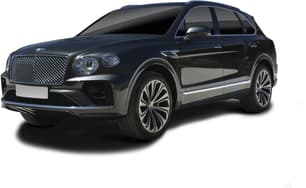
Yes, you can drive your Bentley and keep your family. It's called compromise, or the Bentayga, Bentley's SUV.
The Bentayga my family has been living with is the Azure grade which promises to be even more comfortable and pleasant than the rest of the range.
Comfort is important and we'll cover the Bentayga's lavish details in time, but our mission first and foremost is to find out if the Bentayga makes a good family SUV.
This Jeep isn’t a 4WD, it’s electric, front-wheel drive and built on the same platform as cars from France.
It’s not sounding very ‘Jeep’ so far, but the Avenger isn’t trying to be a traditional Jeep in that sense.
What it is trying to do is draw in a new kind of Jeep owner, and lead the brand into the electric era without being all ‘EV-ish’ - just a car that happens to be electric.
So can Jeep do it? We’re jumping in the light SUV as it hits our shores to find out.
The Bentley Bentayga Azure may look a bit awkward and it surely isn't great value for money, but it is a true Bentley and a very good family SUV that not only provides terrific practicality but superb performance and comfort.
The Jeep Avenger is a strong move for the brand as a city-focused offering, and particularly as its first EV.
The styling and easy driving experience should be a draw, but its price in an increasingly competitive small SUV (and electric car) market could be a turn-off for some - even if it is only few thousand dollars more expensive than the slightly larger Compass.
Despite a couple of small flaws and a lacklustre safety rating overseas, the Avenger is ultimately one of the best-driving cars the brand has put out in years, and deserves a look if you’re keen on a practical but stylish EV.
You'd think of all automotive brands Bentley, with its beautiful swooping and powerful saloons, would be able to floor us with something just exquisite in SUV form. But right from the 2012 concept the Bentayga has struggled to stun the world with its design.
So, while there are Bentley family traits all over the Bentayga, from the intricate headlights and mesh grille, to the oval tail-lights and body which squats over the rear wheels, the overall design looks awkward to my eyes.
To me it appears the boxy design with the tall, flat roofline and elevated ride height favours practicality over the sleekness possessed by a lower, more coupe-like SUV.
I favour dark coloured clothes because it hides my shapes, creases and bulges, but these are the things you want to see in a car and our Bentley's 'Onyx Black' paint, despite being a beautiful colour with a blue hue added, make it a featureless blob in the sunlight.
A lighter shade or something outlandish like a turquoise or yellow would look amazing, and even better, upset your neighbours.
Let's look at the interior design which is lavish with all the quilted leather and Mulliner customisation, but lacks the modern look of many contemporary cabins with its smallish media screen and busy mosaic of buttons.
I like the little chrome plungers for the air vents, the winged styling to the dashboard and the stitched leather upholstery, but it's easy to spot parts that are shared by other members of the Volkswagen Group (which owns Bentley).
For example, there are the indicator and wiper stalks, as well as the steering wheel buttons, all from Audi. Surely Bentley should have its own crafted parts?
The interior colour scheme on our Bentayga is 'Beluga' (black) and 'Camel' (tan) and the Mulliner option split the colours with a cream tone.
From a family perspective the tan and black will hide dirt, although the cream will struggle. It's possibly the best leather on the planet, however, coming from cattle living high enough that their hides are unblemished by insect stings.
One of the Avenger's biggest draws for me is its style.
Those who like the Jeep brand for its rugged off-road vibes, but don’t actually want or need to go off-road might enjoy that it still looks very Jeep.
We’re told that the decisions made in this car’s design are all for a purpose, and some of them are very clear.
For a start there’s a deliberate plastic barrier wrapped around the full 360 degrees of Avenger to protect the paintwork and body panels in low-speed collisions that can be just as likely off-road as in a carpark.
There’s also the sunken headlights, which sit far enough back that they’re less likely to be damaged in an impact, being one of the most expensive and breakable parts at the front of a car.
But there’s also a series of little hidden ‘easter eggs’ that the Avenger’s head designer Daniele Calonaci left up to us to find for ourselves.
For a start, the tail-lights feature an ‘X’ shape that’s inspired by the jerry cans used to carry spare fuel and liquids in World War 2.
The ‘X’ theme continues in other places on the Avenger, though there are some more cutesy design features like a series of seven-slot grille motifs around the car in places like the wheels, tail-light, and even a small one under the front grille.
There’s a 3D ladybug in the roof rail up top, too. But perhaps the most ‘aww’-inspiring is the silhouette of a child looking through a telescope in the lower passenger side of the windshield, up at some stars in the upper driver’s side. The child? That’s Calonaci’s son.
Being shaped like a bus does nothing for the Bentayga's beauty but makes it spacious for cargo and roomy for people.
With its large doors and elevated ride height (the car can be lowered for easier access) it's great for families.
Our Bentayga is a five-seater, which is fine for my little family of four, but there are four- and seven-seat configurations available, too.
Second row legroom is exceptional, even for me at 189cm tall, and sitting behind my own driving position there's still plenty of room.
Headroom is also outstanding throughout. We could be a family that loves top hats, on our way to the top hat championships, and not have to remove our top hats. That's how good headroom and hat room is.
Sun blinds in the second row are vital in Australia, and the electric ones in the Bentayga raise and lower quickly, not just offering protection but also more privacy.
Storage is good throughout with big door pockets and five cupholders.
It seems the cabin space eats into the cargo area because the boot isn't overly large at 484 litres with all seats in place.
Buttons in the cargo area allow the rear of the car to be raised and lowered to make it easier to hoist items in the boot.
For devices there's a wireless phone charger up front along with USB ports in both rows.
The outside of the Avenger is plenty of fun, but the inside is a fairly sensible place.
That’s not to say it’s boring, but the use of space for a car of this size is impressive, and there are plenty of places to store things.
There’s a well thought out phone charging pad in a relatively deep storage compartment in the centre of the Avenger, as well as the cupholders in front of the centre armrest and another storage bin underneath, plus a ‘shelf’ along the dash.
The amount of storage is impressive given the Avenger’s interior is a nice, tidy design that still manages to incorporate some useful elements some cars forgo - buttons for the climate controls, for example, are something that are increasingly (and frustratingly) rare.
Anyone who has used a Uconnect system in a Jeep or Fiat in the past might like to know that this one (accessible via a 10.25-inch touchscreen) is a step-up from predecessors.
It’s not perfect, some elements of the menu and feature placement seem a little random at first, but it doesn’t lag, is easy to connect to wirelessly, and has a fairly helpful voice control system.
Functionality is most of the way there generally, but a few missing things like dual-zone climate control or electric adjustment for the passenger seat feel like let-downs, plus the heating on the front seats seemed to be quite weak for a long time before eventually warming.
Behind those seats, the second row is lacking just about any amenities besides a USB port, but it’s not too cramped for a light SUV. Adults might find it suitable for relatively short trips, but kids should be fine for a while.
The sunroof (when featured) doesn’t extend very far back, so the second row also feels a little dark.
Behind that, an impressive 355 litres of boot space expands to 1250 litres when the seats are folded down, plus a plastic lining on the boot lip means you don’t scratch the car when loading or unloading.
Reviewing every type of car on the market provides a pretty good perspective, but when it comes to Bentleys we enter a realm where value-for-money often isn't as crucial as it is for more mainstream options.
The same goes for the price. Bentleys are among the most expensive cars in the world. So if, like me, you flinch at the thought of paying more than half a million dollars for an SUV, it may not be the car for us right now.
With that I can tell you the Bentley Bentayga Azure's list price is $475,000 and our car with all of its options comes to $515,000.
That's more money than any SUV from Mercedes-Benz and BMW costs. Even Range Rover can't quite reach that mark.
Only the likes of Aston Martin's DBX 707 and Lamborghini's Urus can match the price.
There are always bigger fish, though, and Rolls Royce's Cullinan swims in at $700,000, making the Bentayga's price seem quite reasonable.
Let's look at the standard features.
Coming standard on the Bentayga Azure are the prettiest LED headlights in the world. There are LED tail-lights, too, as well as a proximity key, roof rails and a panoramic glass roof, plus a hands-free tailgate.
Inside there's the 10.9-inch media screen, sat nav, wireless Apple CarPlay and wireless Android Auto.
The diamond quilting to the door trims is also standard and so are the Bentley sports pedals.
Many of these features are standard on lower grades in the Bentayga range, but the point in choosing the Azure is that many of the optional bundles on offer are fitted as standard here.
So, while leather upholstery is of course standard the 'Colour Specification' package gives you a choice of all interior colour combinations and an extended choice of hide colours.
The 'City Specification' brings extra safety tech like rear cross-traffic alert and a top view camera.
The 'Front Seat Comfort' specification adds 20-way power front seats, ventilation and massage as well as comfort headrests.
The 'Touring Specification' brings adaptive cruise control, a head up display, lane keeping assistance and 'Night Vision'.
And then the 'Sunshine Package' adds electric sun blinds, which are great for kids in the back.
Despite the multitude of standard packages there's plenty left to option on the Azure.
Our car was fitted with about a dozen options including piano black veneer ($5884), 22-inch alloy wheels ($4733), rear privacy glass ($2617), LED welcome lights ($2238), self-levelling wheel centre caps ($1208), a heated acoustic windscreen ($1094), luggage management for the boot ($937) and a heated steering wheel ($543).
Then there's Mulliner, Bentley's in-house customisation division which will personalise your Bentley.
The Mulliner custom features on our Bentayga Azure include the addition of an extra colour in the leather upholstery ($13,492), 'Honeycomb' stitching on the steering wheel ($5391) and contrasting stitching on the quilted areas of leather trim ($2688).
Best family features would have to be the privacy glass, temperature control in the second row and the rear sun blinds.
The second row also comes with a removable tablet which can be used to adjust the climate control, sunroof and media settings among other functions.
In the hands of children this is every parent's nightmare and there's a 100 percent chance of the tablet being lost forever, possibly on the motorway between Sydney and Canberra.
Before the Avenger had even landed, Jeep announced a $3000 reduction to the original pricing. While it might seem like this move stems from an increasingly competitive small-SUV market, Jeep says production costs dropped after the pricing was initially set, and the decision was made to pass it along to customers.
In any case, the Avenger now starts from $49,990 before on-road costs for the entry-level Longitude, with a mid-spec Limited costing $54,990 and the appropriately named Summit set at $60,990.
This puts the Avenger among the most expensive offerings in the 'Light SUV' category along with the electric Mini Aceman (from $55,990) and hybrid Lexus LBX (from $47,550), but around the same price as the slightly larger Hyundai Kona Electric (from $54,000) and Renault Megane E-Tech (from $54,990).
It also looks like brilliant value compared to the much smaller and lower-ranged Fiat 500e (from $52,500). Style comes at a cost.
For the Avenger, there’s a bunch of kit that’s standard across the range, plus only one cost-option - premium paint at $990.
Each Avenger gets dual 10.25-inch screens inside, one for the driver instrument display and the other a touchscreen for the multimedia controls, centred on the dash so it can be reached by both front occupants.
Satellite navigation, keyless start, adaptive cruise control and Jeep’s Selec-terrain drive mode system are all also standard features.
The Limited adds partial synthetic leather trim to the seats, keyless entry, more safety features like blind-spot assist and parking sensors, plus a height-adjustable boot floor and more powerful AC charger, with an 11kW version replacing the 7kW of the Longitude. The Limited also has optional two-tone roof paint in black for $495.
Climbing to the Summit means you get the two-tone roof as standard, plus LED projector headlights and LED tail-lights, 18-inch alloys, leather accented heated seats with power adjustment and lumbar massage for the driver, plus it also gets a sunroof over the front occupants.
When Bentley stopped putting its W12 into the Bentayga this year I was unsurprised yet sad. The world is moving toward tighter fuel emissions but the twin-turbo petrol V8 in this Azure is still a beast.
The 4.0-litre turbo-petrol V8 is from the Audi family and I love it as much for its plentiful torque and superb acceleration as the deep rumble of its exhaust.
Making 404kW and 770Nm the V8 can lift and throw the 2.5-tonne Bentayga to 100km/h from a standstill in 4.5 seconds and onto a top speed of 290km/h. I reckon you could get it to 300km/h with the wind behind you.
Drive goes to all four wheels via an eight-speed transmission and a Torsen-type centre differential.
Default drive balance is 40/60 front to rear, with up to 70 per cent of power able to be sent to the front wheels and up to 85 per cent to the rear axle.
I don't think you'll be astounded to hear this powertrain uses a lot of fuel? Let's go there...
The Avenger has one drivetrain for now, a front-wheel drive electric motor, though it sounds like we shouldn’t rule out the possibility of other petrol hybrid drivetrains in the future.
The EV Avenger we’ve got is built on a 400-volt electric architecture, with a single motor delivering 115kW of power and 260Nm of torque.
It’s got a a mode that increases the regenerative braking, though isn’t quite a one-pedal driving experience.
Jeep says it’ll hit 100km/h in 9.0-seconds, but apparently tops out at 150km/h.
Bentley says the Bentayga Azure with the V8 petrol engine will use an average of 11.4L/100km over a combination of open and urban roads.
But what happens if you live in the suburbs not far from the city and drive the Azure every day to do the school drop offs and trips to the shops and then take in some fun country roads? You use an average of 22.8L/100km according to the car's trip computer.
This is still not as high as I was expecting. I've driven V6-powered SUVs which use more than this under the same conditions.
That said, even when using as much fuel as Bentley says you should, an 85-litre fuel tank is only going to deliver an approximate 745km driving range.
The Avenger has a reasonably sized 54kWh lithium-ion battery for a light SUV, which it says allows for a driving range of up to 396km, or 390km in the top-of-the-range Summit, due to the specification.
Under WLTP testing, Jeep says the Avenger is rated at 15.4kWh/100km (15.8kWh/100km for the Summit) for efficiency, and it comes with a Type 2 CCS combo charging socket for either DC fast charging up to 100kW, or AC charging up to 7kW in base Longitude and 11kW in higher variants.
On DC charging at its max 100kW rate, the Avenger should take about 24 minutes to charge from 20 to 80 per cent, while slower AC charging at 11kW takes five hours and 34 minutes.
On the launch drive route, we were seeing between 14.8 and 16.4kWh/100km on the trip computer, so Jeep’s claims seem accurate.
The Bentley Bentayga doesn't have a safety rating as like many extremely high-end cars it hasn't been assessed by ANCAP or Euro NCAP.
That said, the Azure grade comes standard with an armoury of safety tech including AEB (with turn assistance), lane keeping assistance, blind-spot warning, rear cross-traffic alert, evasive steering assistance, and adaptive cruise control.
Front and rear parking sensors are standard (and the most relied-upon feature I use daily), while exit warning saved my child and myself more than a few times from leaping out into the traffic on the school run.
The Jeep Avenger hasn’t been tested by ANCAP, but comes with a disappointing three-star score from Euro NCAP.
Jeep Australia says it’s currently working with ANCAP regarding a potential local score, but wouldn’t detail what that could mean. A small SUV’s score dropping below four stars might concern some young family-type buyers, though most of its poor scoring comes in the categories of Vulnerable Road Users (pedestrians and cyclists) and Safety Assist (active tech).
In terms of what the Avenger offers as standard, there’s auto emergency braking (AEB), lane-keep assist, traffic sign recognition, driver monitoring, a reversing camera and six airbags (no front-centre bag, though).
It’s notably missing rear-cross traffic alert, and the base Longitude makes do with regular adaptive cruise control and parking sensors at the rear only, while higher variants get blind-spot assist, surround parking sensors, and intelligent cruise control.
The Bentayga is covered by Bentley's three-year/unlimited-kilometre warranty. Servicing is recommended every 12 months or 16,000km.
The good news is all new Bentley's have five years regular servicing included in the cost of the vehicle.
Jeep offers a five-year/100,000km warranty, which is starting to be overtaken by other brands increasingly offering seven-year/unlimited kilometre warranties or longer.
The high-voltage battery system of the Avenger is, however, covered for eight years or 160,000km, whichever comes first.
Jeep also offers capped-price servicing for the five-year warranty, with scheduled visits costing just $250 and spaced out at 12,500km or 12-month intervals.
There’s also the brand’s lifetime roadside assist, but only when you service your car with Jeep.