What's the difference?
Do you remember when you first saw an Audi TT? I can go first. It was 1998 and I’d been backpacking through Europe for months and had arrived in Paris just as all my money had run out.
Anyway, as I was beating myself up for spending way too much on a fridge magnet in a souvenir shop (it had a built-in thermometer) when one drove past me.
I saw the Audi badge but before I could work out what it was it turned the corner and was gone.
The mysterious Audi was silver and it looked like it was from the future, but actually it was the original TT, the first one, and being about October ‘98 it would have only just come out.
I would never have believed you if you’d told me at the time that 25 years later I’d be a motoring journalist and that I’d be reviewing the final Audi TT ever.
And here we are with the Audi TT Final Edition. That’s right, Audi has decided to discontinue this sports car after 25 years of production and it’s made this commemorative TT Final Edition that adds unique fettling and some nice features.
So, is the TT Final Edition worth buying? What’s so good about it? And how much more does it cost over a regular TT?
I found out after spending a weekend on some great roads to say goodbye to this icon. Oh, and I still have the fridge magnet.
The original Ford Fiesta ST from 2013 was a modern classic. The combination of appealing pricing, point-and-shoot driving dynamics and a sweet turbocharged engine ensured it won a legion of fans.
Its follow-up from 2020 continued that formula and brought with it a refinement missing from the original. But it was just as fun to drive.
Ford has launched a mid-life update for the sprightly hot hatch, which despite arriving in Australia halfway through 2022, is still officially an MY22 model. This latest version introduces upgrades to interior tech and exterior styling, as well as a 30Nm bump in torque.
But given it’s facing a ballsy competitor from Hyundai, has Ford done enough to keep its B-segment hot hatch crown?
Audi is finally saying hooroo to this model which has made the world stop and stare like I did on that Parisian street all those years ago.
The Final Edition is a fitting tribute to this iconic sports car and I’m glad Audi didn’t go ‘OTT’ and deck it out with gimmicky features.
At the same time the Final Edition’s big rear wing, blacked out badges, wheels and interior colour coding hint that this is not just any ordinary TT and those that know will know.
Farewell Audi TT, we hope something just like you but probably electric appears to stop us in our tracks again.
The Fiesta ST is an addictive car to drive. It's a modern classic and hard to beat when it comes to engaging performance and smile-inducing dynamics. Add in excellent value for money and you have a certified performance car bargain.
The Audi TT’s shape has morphed over the past 25 years from the cute, rounded bubble car that first appeared in the late 1990s to the more aggressively and sleek looking sports car with the sharp creases we see today.
Still, there are the familiar pumped-out wheel arches and, while not as prominent as it used to be, that arching roof and the way it flows down to those tail-lights and stumpy tail remains so true to the original TT.
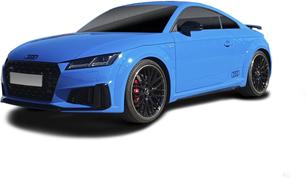
The TT Final Edition has a more menacing and athletic look than the regular 45 TFSI its based on thanks to the S Line Competition Plus exterior package.
So you’re getting the big fixed wing, an aggressive front bumper, and the 19-inch alloy wheels in gloss black.
There’s a black package, too, which add the decals down the side, the blacked-out badges, the black exhaust tips and black wing mirrors.
My test car’s paint colour was Turbo Blue and you can see in the images of the cabin how Audi matches interior elements in the same colour. The contrast stitching on the seats also lifts the sporty feel into high-end territory.
It’s a simple cabin, though, free from busy buttons and giant screens and the incorporation of climate controls into the air vents is genius.
If you’re wondering what the TT Final Edition’s dimensions are its 4191mm long, 1832mm wide and 1376mm tall.
The styling changes ushered in by the 2022 update are subtle. The Fiesta ST gains a revised front fascia with LED Matrix headlights, a larger grille with a repositioned Ford badge, and restyled bonnet and bumper.
It gets a fresh 18-inch alloy wheel design and black tail-light surrounds at the rear. It also comes in two new exterior paint colours - 'Mean Green' and the 'Boundless Blue' of our test car.
The current-generation Fiesta ST has an appealing design that represents a clear evolution of its predecessor, and, arguably, it didn’t need much work this time around.
The ST’s sporty bodykit adds a touch of aggression but not in a boy racer sort of way. It’s a classic hatchback design with a bit of an edge.
The Audi TT isn’t going to cut it as a family car, but it’s more practical than a lot of people might think.
First this is a '2+2' sports car meaning those two rear seats are there for the odd occasion when you might need them, because the space back there is limited.
But for most of the time having a place to throw a jacket or extra luggage and not have to ask your co-plot to rest it on their lap will feel like absolute luxury.
Up front head and legroom is good, even for me at 189cm tall. Being a coupe the doors are long and although the car is low I found getting in and out easy.
There’s a pretty clever use of space when it comes down to cabin storage. You’ll find door pockets, a glove box, a covered centre console box and a hidey hole/wireless phone charger in the dash.
Back seat passengers have built-in shelves near their armrests. Surprisingly there are four cupholders - two of which fold out of the dash.
The boot isn’t huge at 305 litres but you can fold the rear seats down to open up the cargo capacity to 712 litres.
So, compared to its two-seater sports car rivals, the TT is relatively and pleasantly practical.
As part of the update, the Fiesta ST gains new Recaro front sports seats that are firm and hug the body tightly. You feel well supported when cornering. The mix of synthetic leather and suede looks spot-on.
Like a number of sports-focused models, the ST features red stitching throughout the cabin - on the steering wheel, gearbox gaiter and air vent surrounds - and while it’s ubiquitous, it’s still a nice touch.
The chunky perforated leather steering wheel feels nice to touch, as does the metal gear knob.
Cabin materials are a mix of soft-touch and hard plastics, and there’s carbon-fibre-look inserts on the dash.
There’s no denying Ford’s dash design is a huge improvement over the previous-generation Fiesta that ran from 2009, but the current model still lacks the polish of the VW Polo. It’s about on par with the Hyundai i20 N, although the Ford’s layout is a little busier.
In saying that, it’s hard to fault the cabin’s functionality. It has a deep central storage bin, which is larger than most cars in this category, a decent sized glove box, two-and-a-half cupholders in the centre console and storage for narrow bottles in the doors.
There’s a wireless charging dock behind the gear shifter, two USB ports (one in the storage bin and one next to the charger), as well as a 12-volt charger.
It’s nice to see the ST still has a manual park brake, too.
The facelift introduced a 12.3-inch fully digital instrument cluster, and while some may lament the loss of analogue dials, it’s nice to see Ford taking the opportunity to improve the tech.
The multimedia is housed in a smallish 8.0-inch digital screen sitting atop the centre stack and it runs Ford’s Sync 3 system.
Sync 3 functions well, is hard to fault and the menu layout is easy to navigate, but it is being left behind by competitors with more modern and appealing graphics. The latest version in the new Ranger will no doubt be a major improvement, but we won’t be seeing it in this generation of Fiesta.
The diminutive size of the Fiesta ST is more apparent when sitting in the rear seats. It’s pretty tight behind my 183cm (6ft) driving position, with my knees hitting the rear of the front seats.
It’s a cramped space that’s not designed for long trips by adults. It has redundant tiny rear-side windows behind the C-pillar, but on the plus side, there’s acres of headroom.
It lacks rear-seat air vents and the closest USB port is in the front centre storage compartment. Taller bottles won’t fit in the doors and it lacks a centre fold-down armrest, but it has map pockets.
The rear seats are flat and the Fiesta has outboard ISOFIX points for child seats.
Realistically, most people buying a car like this aren’t using it to haul children around so think of it as a two-seater with handy rear-seat storage.
The rear seats fold 60/40 but not flat. A space-saver spare wheel lives under the boot floor and it has a high boot lip, meaning you have to lift items up and over to get them in.
At 311 litres, it’s a decent sized boot with usable space. It’s just one litre more than the Hyundai i20 N, and six litres more than the Polo GTI.
Audi has taken the $84,000 TT Coupe 45 TFSI quattro and created this TT Final Edition with extra features for a list price of $88,749.
Here’s what you’re getting. First there’s the 'S Line Competition Plus' exterior package which beefs up the TT’s looks with the big, fixed rear wing and 19-inch Audi Sport wheels in gloss 'Anthracite Black' with red brake calipers.
There’s also the black exterior package which brings the black Audi rings badging, black chunky exhaust tips, black side trims and Audi logo decals.
Inside there’s Nappa leather S sport seats; an Alcantara and leather flat-bottomed steering wheel with paddle shifters; while the armrests, door handles and the centre console are covered by the 'Leather Package' which includes contrasting stitching.
Metallic paint is also included as part of the Final Edition’s features. Ours was 'Turbo Blue'.
Much of the rest of the Final Edition’s features are shared with the TT Coupe 45 TFSI quattro and includes a 12.4-inch 'Virtual Cockpit' digital instrument display, sat nav, CD and DVD player, eight-speaker stereo, digital radio, Apple CarPlay and Android Auto, wireless phone charging and proximity unlocking.
Our car had a couple of options fitted - the privacy glass which is $950 and the 20-inch gloss black alloy wheels for $1600.
Rivals to the TT include BMW’s Z4 which lists for $99,200, and its Toyota GR Supra twin for $87,380, while the Nissan Z Coupe is also part of that sporty coupe club at $75,800.
You might already know this but the TT doesn’t have a central media screen and that can appear odd in a new car world where big screens dominate the dashboard.
As far as mid-life updates go, the Fiesta ST’s isn’t significant. But the additions bring with it a bump in price. At $34,490, before on-road costs, it is $1200 more expensive than the previous version.
It still represents good value and is only $500 more than its newest rival, the Hyundai i20 N ($32,990 BOC). It’s quite a bit cheaper than the other big gun in the light hot hatch battle, the Volkswagen Polo GTI ($38,750 BOC).
Another offering in this group is the Suzuki Swift Sport which is the price leader, starting from $27,990 BOC.
Ford has specified a lot of standard gear for the price, including some niceties you don’t even get in pricier premium European cars.
It comes with a leather-wrapped heated steering wheel, heated front seats, Recaro sports seats, an auto-dimming rear-view mirror, heated power door mirrors, an 8.0-inch touchscreen with digital radio, satellite navigation, 'Sync 3' multimedia with voice control and Apple CarPlay/Android Auto, and a 10-speaker audio system.
As with the pre-update model, the German-built ST is the only Fiesta variant available in Australia.
The TT Final Edition has the same 2.0-litre, four-cylinder, turbo-petrol engine as the regular 45 TFSI TT Coupe with the same 180kW and 370Nm outputs.
The TT is light, though, at only 1460kg and that grunt is enough to slingshot it from 0-100km/h in 5.1 seconds.
The transmission is an eight-speed dual-clutch automatic which sends drive to all four wheels.
Sure, the TTS has more grunt and the TTRS is nothing short of wonderful with its five cylinder powerplant, but the 2.0-litre engine in the Final Edition feels perfectly suited to what is a fun and engaging sports car.
Under the Fiesta’s cute bonnet is Ford’s 1.5-litre three-cylinder turbocharged petrol engine delivering 147kW at 6000rpm and 320Nm at 4000rpm - the latter is an increase of 30Nm over the pre-facelift model.
Interestingly, it now matches the power and torque outputs of the Polo GTI. The i20 N pumps out 150kW and 304Nm.
The engine is exclusively paired to a six-speed manual gearbox - there is no auto transmission available - and it is front-wheel drive.
Audi says that after a combination of open and urban roads the TT Final Edition should use 7.0L/100km.
My own testing took in a combination of the best country roads and worst city traffic and at the fuel pump I measured 10.9L/100km.
But most of my time was spent in 'Dynamic' drive mode with the fuel-saving idle stop system switched off.
The TT's 55-litre fuel tank means you should have a range of about 785km.
Ford claims the Fiesta ST has an official combined cycle fuel use figure of 6.3 litres per 100 kilometres.
After a week of predominantly inner city and freeway driving, we recorded a much higher 10.2L/100km. However, that was very shortly after an enthusiastic back-road blast to test its performance chops. We did see single-digit numbers throughout the week prior to that.
The Fiesta requires premium 95RON petrol and it has a 45-litre tank. CO2 emissions are 144g/km of CO2.
There are plenty of sports cars out there which are dynamically superb yet uncomfortable to sit in.
But the TT’s cabin is as ergonomic as it is stylish with a great, low sitting position and good pedal feel, a steering wheel that can be adjusted to be just right and still with plenty of space underneath for long legs like mine.
The shifter feels the right distance away, good visibility even out the rear window and plenty of ventilation. And we haven’t even started driving yet.
The TT Final Edition felt to me how a TT should. Fun. Not overpowered nor brutally firm and not ridiculously loud.
Instead, my drive in the Final Edition, which took me along some of my favourite country roads, was one of the most enjoyable runs I’ve had in any car.
This is a car which ‘listens’ to you and replies with exactly what you’ve asked for in the way it turns into corners and accelerates out of them, and pulls up when you need it too.
There’s so much connection to the road, you can hear the sticks and stones flying up into the guards, you can feel the coarse chip bitumen through the steering wheel.
But it’s all so easy, too. The suspension is firm but soft enough that you can drive this daily. The steering is light but still with great feedback.
Some sports cars leave you feeling exhausted, like you’ve just wrestled a bear but the TT Final Edition just leaves you feeling like you've been on a ride and all you want to do is run back around to line up and get back on it again.
It’s easy to find your ideal driving position in the Fiesta ST, thanks to the reach and height adjustable steering wheel and the adjustable seat.
Aside from the extra 30Nm dollop of torque, Ford hasn’t changed anything else about the Fiesta ST mechanicals for 2022, but arguably, it didn’t need to.
The pre-facelift model could cover 0-100km/h in 6.7 seconds, and while Ford has not revealed whether that has changed with the facelift, it feels about right.
It’s brisk from a standing start, without being neck-snappingly quick, but there is strong urge and a lack of noticeable turbo lag. There is, however, some axle tramp on take-off, particularly in the wet. We also detected some torque steer when pushing hard up a hill, but it was minimal.
Speaking of, the little three-pot turbo engine is utterly unfazed by steep hills - it just keeps adding speed. A light kerb weight of 1218kg helps here.
The three-pot turbo engine sounds wonderful when accelerating, and the Fiesta ST begs to be driven hard.
The engine is perfectly matched with the slick shifting six-speed manual gearbox that has lovely short throws and is a joy to use. Even if Ford offered an auto with the Fiesta ST, it would take away from the driving experience.
'Sport' mode ups the growl from the engine and throttle response, but it’s not a dramatic departure from 'Comfort' mode.
The ST’s strong brakes are bordering on sensitive, but the heavily weighted steering is incredibly sharp.
On a back road run, the front-wheel drive Fiesta ST comes alive, hugging corners confidently.
On bends that would’ve seen many other cars come undone, the Fiesta’s tight, balanced chassis, grippy tyres and the standard mechanical limited slip differential ensure it maintains its composure.
The ride is undeniably firm, particularly around town in urban areas - you feel every speed bump. My partner found the ride a bit too much at times, but I was far more forgiving.
The Fiesta feels solidly built and has a level of refinement that’s missing from the likes of the Suzuki Swift Sport and Hyundai i20 N.
However, the cabin could do with more noise deadening materials as it can be quite rowdy at speed and on coarse chip roads. Another negative is the massive turning circle - a bit odd for a city-focused light hatchback.
But these are things I could happily live with. During my week with the Fiesta ST, I made any excuse to jump behind the wheel and go for a drive.
Me: “I’m just going to run to the shops to get pasta.”
My partner: “We’re not cooking pasta this week.”
Me: “Yeah but you never know when you need pasta. Bye!”
This could be a deal breaker for you. The Final Edition, like all Audi TTs, falls short in terms of safety equipment compared to its rivals.
This third generation TT only managed four ANCAP stars out of a maximum of five when it was assessed in 2015.
This was due to the model not having AEB or lane keeping assistance or rear cross-traffic alert.
The only assistance features it has are blind spot warning and self parking (which is handy). It doesn’t even have adaptive cruise control.
There are two top tether points for child seats in the second row but please be aware that the TT was also scored low by ANCAP for child occupant crash protection.
If you do have children and are looking for something safer but still small and sporty, the BMW 2 Series Gran Coupe or Mercedes-Benz A-Class are excellent choices.
Something to think about.
The Fiesta ST has not been tested by ANCAP for crash safety.
It comes with standard safety gear including auto emergency braking (AEB) with pedestrian detection, forward-collision warning, lane-keeping assist with lane-departure warning, speed-sign recognition, rear parking sensors and a reversing camera.
Given it’s a manual, it has old-school non-adaptive cruise control.
The TT Final Edition is covered by Audi’s five-year, unlimited kilometre warranty.
Serving is recommended every 12 months or 15,000km and although Audi doesn't have capped price servicing there is a five-year/75,000km plan which will cost about $3000 in total for regular maintenance. Yep, that's $600 per workshop visit.
The Fiesta is covered by Ford’s five-year/unlimited kilometre warranty and you get free roadside assistance and state/territory auto club membership each year that you service your car at a dealer, for up to seven years.
The servicing schedule is every year or 15,000km, whichever comes first. There’s a four-year/60,000km capped-price servicing program, which costs $299 per service.
Ford also offers a free service car loan that can be booked in ahead of your service.