What's the difference?
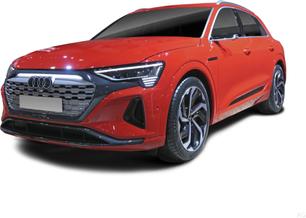
Late last year, Audi gave its large SUV range a freshen up by stocking its showrooms with the Q8 55 e-tron model; a rebadged, facelifted full-sized electric SUV designed to go head-to-head with things like the Mercedes-Benz EQE.
As it turned out, the Q8 55 was destined to become the mid-spec model and now Audi has book-ended the Q8 range with the entry-level Q8 e-tron 50 and the flagship SQ8 e-tron.
And while the previous 55 model was available in Sportback and SUV (station-wagon) forms, the latter has now been dropped.
That leaves the 50 model as an SUV only, while the headline act – and the vehicle we’re testing here – the SQ8 can be had in either body style.
The reason we’re concentrating on the biggest, baddest, most expensive variant, is that’s precisely what Audi is tipping the Australian market will gravitate towards.
In fact, as many as 70 per cent of Q8-platform sales could be the SQ8. That’s in line with the Australian market’s fondness for spending up big on the sportiest version of many makes and models, but it remains a bit of an anomaly in the rest of the car-buying world. Nevertheless, it remains the reason we’re focussing on that variant here.
Of course, electrification has never been more important for a carmaker operating here since the New Vehicle Efficiency Standard was announced recently, and even though the Q8 range will be a small percentage of Audi’s sales here, any EV represent progress towards meeting corporate targets.
The idea of a Tesla that can tow sounds about as likely as an astrophysicist with three Olympic gold medals, who also moonlights as a hand model.
The EV brand has blazed a trail for every other mainstream and premium car manufacturer to jump on the electric bandwagon, and today they’ve still got the biggest batteries and most impressive range ratings, while also having the most extensive extensive network of charge stations made up of Superchargers and destination chargers, covering every state and territory.
They’re not perfect though, often displaying niggling build quality issues and production delays for upcoming models. There’s also a degree of uncertainty bred by a founder who flits between the modern-day space race, manufacturing flame throwers and offering to send miniature submarines to rescue stranded children.
But there’s no questioning the overall impact Tesla has had on the automotive industry, along with the incredible brand awareness and aspiration it’s generated from non-enthusiast Joe Average consumers around the world.
The Model X is also rated to tow, with a decent 2250kg braked rating and an integrated tow bar that folds out of sight when not in use, which both fits its SUV character and encourages you to give it a go.
There’s not doubt large, luxury SUVs like the SQ8 have a lot to gain from electrification in terms of refinement, performance and running costs. The flip-side is the extra mass of the batteries and other electrical gear but, in this case at least, there might be a silver lining there in the way the hulking SUV manages to force the air suspension into agreeable submission.
For our money, the station-wagon variant is the one to buy. It’s cheaper to begin with and with its greater luggage capacity, it simply makes more sense. Which is not to say the Sportback version is compromised in luxury, safety or performance terms, but if practicality doesn’t figure highly in any purchasing decision involving an SUV, then we sense a great disturbance in the force.
Regardless of what’s powering the SQ8, the driving experience is vintage Audi and that’s a good thing, and even that massive kerb mass can’t blunt the sort of chassis dynamics and feedback we’ve come to expect from the brand.
Some buyers will possibly baulk at the projected range and the Audi’s appetite for electrons, but when lined up side-by-side with its major competition, the SQ8 is every chance to emerge as the one to buy. We’ll need a proper comparison for that, of course, but the Audi should be on any short-list of big, deluxe, electric SUVs.
Note: CarsGuide attended this event as a guest of the manufacturer, with accommodation and meals provided.
After nearly 700km of testing with both cars, it’s fair to say that the Tesla is indeed a capable tow vehicle, provided you keep the distances relatively short and plan around charge station locations.
Overall average - Penrith to Bathurst to Penrith
Fuel and energy consumption will always depend on the driving conditions, which is why we chose different routes for each leg of our testing.
Averaged across the two legs, towing the caravan with the Model X used 101 per cent more energy than without, or halved its driving range, which sounds a bit scary.
The LandCruiser by comparison added 63 per cent on average, which is still a big difference, but matters less in the real world when its big fuel tanks would still give you about 760km of driving range, which can be refilled quickly at any diesel-stocked servo.
So you could do a weekend trip with the caravan from Penrith with one supercharge in Bathurst, but it would’ve been highly unlikely to manage the extra 55km if you were leaving from Sydney CBD.
The bottom line is that there’s plenty of things - like smaller camper trailers - lighter than our caravan that will help the Tesla to do the towing job better right now.
Compared to the ‘Cruiser, the Tesla is a lesson in the benefits of a lower centre of gravity and road-focused handling.
As always, bigger batteries and more recharge points will go a long way to rectifying the Tesla’s towing shortcomings, and I'm sure we'll get there eventually.
But no matter what, its acceleration performance under load is simply excellent.
Thanks to our friends at Avida for making this test possible with the use of the 17-foot Avida Wave Tourer Electric Pop-Top single-axle caravan. They can also be reached on 1300 428 432.
Almost a thousand Newton-metres (not to mention 370kW) infers some pretty serious performance and so it is.
When you press down on the throttle pedal, there’s an instant and somewhat furious response from the driveline. And just as the Audi’s touchscreens have been calibrated to respond on a human scale, so too have the major driving controls.
That said, while there’s more acceleration on tap than most drivers will ever have experienced, the SQ8 doesn’t move forward with quite the irresistible force the bald numbers might suggest.
And that’s purely down to the thing weighing the wrong side of 2.6 tonnes. Sure, Audi claims 4.5 seconds and that seems fairly believable, but it’s not quite as ballistic as some other current EVs.
Still, that’s hardly its mission in life, anyway. Top speed, in the interests of thermal management, has been limited to an entirely understandable – not to mention adequate - 210km/h.
But one thing all that kerb mass has (arguably) done is make the suspension work properly. Speaking purely personally, until I’d sampled the SQ8 over a variety of bitumen joins, potholes of all sizes and even clattering level-crossings, I was yet to drive a passenger car on air suspension that worked as well as the brochure claimed.
Historically, air suspension has been okay on smooth roads and even sometimes bigger lumps and bumps. But it usually fell short of expectations on small amplitude, high frequency stuff that made the suspension judder and stutter. Not this Audi.
Even on the 'Dynamic' setting, the ride never falls beyond plush although you will notice a little more stiffness being dialled into it by the computer.
The best advice is to leave it in the 'Comfort' setting where there’s still lots of roll and pitch control, yet an even higher degree of suppleness that fundamentally refuses to be beaten by a lack of post-Covid road maintenance. And this from a car that rides on 22-inch wheels and tyres.
Perhaps compressed air doesn’t scale in a linear manner, making the addition of a couple of tonnes of sprung mass a positive, rather than a negative.
The other thing Audi has done well to maintain is that almost indefinable corporate steering response.
It’s kind of muted this time around in terms of its ability to talk to you, but there’s still an over-arching Audi-ness to it with an instant pointiness without the frenetic feel often associated with a quick ratio and sticky tyres.
Energy consumption is just one element of a tow vehicle though, with stability, braking and acceleration performance being the most important details.
The big ‘Cruiser is always a safe bet for towing heavy loads, but it's fair to say its off-road ability, tall body and short wheelbase mean it could be better on the road, and the Tesla goes some way to proving that.
With all those batteries mounted nice and low, the Tesla is significantly more stable with 1.7 tonnes on the back than the LandCruiser, in all conditions. It’s also helped by that longer wheelbase.
The Tesla’s airbag suspension is another surprise advantage, and while it can be a bit choppy around town over minor bumps, bigger bumps on the highway are soaked up really nicely and it all settles quicker than with the LandCruiser - even with the caravan on the back.
Tesla is famous for instant acceleration at any speed, and this effect remains when towing. The LandCruiser’s twin-turbo V8 (with max torque available from 1600-2600rpm) has long been a benchmark for tow vehicles, but the Model X makes it feel sluggish by comparison.
You know how caravan vehicles are usually the slow ones up hills? This time, we were the ones doing the overtaking, even up the steep bends heading out of Lithgow. To overtake, it just takes the slightest flex of your right foot.
Clearly there’s a big caveat though when it comes to how much energy it’s consuming while you’re enjoying that performance, and it’s deceptive because it doesn’t make any more noise like a conventional engine when you’re pushing it.
You’d also think the weight of the van would overcome the engine-braking effect of the regenerative brakes, but they are still very effective at conserving your brakes downhill and preventing the car from running away from you, and no doubt giving the batteries a bigger boost at the same time.
On that note, the LandCruiser’s cruise control also does a great job of witholding speed on downhill runs, proactively dropping gears to engine brake enough to keep the Avida Wave in check.