What's the difference?
After teasing us with the S3, all-wheel-drive version of its A3 sedan and hatch (Sportback in Audi-speak), Audi has finally given us the full-fat, RS3 variant of the same car. Any time you see an `R’ and an `S’ on the badge of an Audi, you know it’s the full nine yards in terms of all-wheel-drive grip and engine performance. And the RS3 is no different.
The power is enormous, the grip prodigious and the attitude is way tougher than any other A3 variant. It’s also well equipped, safe and nicely put together. But is that extra `R’ worth the added price of admission? And is this more Audi A-Series than you really need?
The other question is, given that the S3 is such a resolved package with its own shot of high-performance, do the numbers stack up for the RS3 version? How much is too much?
Few cars carry the burden of expectation more than the BMW M3 – and, by association – the two-door versions latterly rebadged M4. Porsche 911 definitely. Mazda MX-5 probably. Ford Mustang maybe. Icons all.
Since the arrival of the left-hand-drive-only – thus it never officially came to Australia – E30 3 Series two-door original in 1986, it’s become the benchmark for which all others follow, and regular finalist in any given ‘greatest sports car of all time' listings.
Except… it hasn’t always turned out that way.
After the visceral E30 M3, it’s been a rollercoaster ride of disappointment and elation: by 1992’s patchy E36 arch enemies Audi and Mercedes-Benz were chiming in, only to be swept aside by the exquisite E46 M3 from 2000. But then its 2007 E90 and 2014 F80 successors both missed their marks for reasons we’ll go into later, leaving us with 2021’s G82/3 generation.
Does the latest two-door M-car return to form? We take a look at the M4 convertible, which simultaneously rediscovers the fabric roof and adopts all-wheel drive (AWD) for the first time.
Glorified blow dryer or glorious mind blower? Let’s see.
If conventionally powered cars really are on the endangered list, it’s vehicles like the Audi RS3 that will remind us what we’ve lost. There’s so much fun to be had in this car, that you really need to take it to a track to tap into it safely and responsibly. And there’s the rub.
While there’s no doubting the RS3’s potential, neither is there any doubt that the driveline absolutely dominates the experience. In fact, we reckon the S3 with its more modest (but still ample) performance and friendlier nature is probably the smarter car for the everyday. It’s also cheaper by about $20,000 and while it lacks the aggressive looks, it’s still a charming car. Perhaps all the more charming for its easier-going nature and balance of abilities.
So why buy the RS3? Because it’s the one that will keep you entertained for longer if you’re a serious enthusiast driver. But if you don’t plan to use the car for track days, there’s a strong argument that the RS3 is way more car than you’ll ever need. Of course, that sentiment never stopped performance-car lovers, did it?
We cannot think of a faster or more invigorating four-seater luxury convertible for the money than the new M4 Competition.
Finally, after years of devastatingly fast droptops with remote steering and an unforgiving ride, the G83 generation discovers refinement and sophistication to go with its supersonic speed.
There’s terrific talent on tap here that no rival can even come close to right now. BMW is on a roll and this is the first M4 convertible that can sit proudly alongside the best of its classic M3 ancestors.
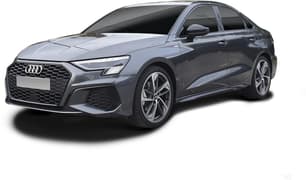
While the overall shape of the RS3 suggests evolution rather than revolution, the RS3 treatment has led to a much sportier look. We still reckon the sedan is the pick of the two body styles, mainly because it looks a bit more aggressive. Certainly, though, an aggressive look is not something either version backs away from, and those deep, wide blacked-out honeycomb grilles front and rear give the thing lots of presence.
So too do the blistered fenders, allowing for the extra track width that gives the RS3 its unique footprint. The front track itself is 30mm wider, but the wider fenders also gave Audi the chance to do some creative aero-management. Unlike, say, the Toyota Supra, for instance, with its faux vents up each side, the RS3’s lower-front vents and aero-slits behind each front fender are fully functional, directing air into the engine bay and away from the brakes respectively.
Another really neat function is the LED daytime running lights’ one-act play when you unlock the doors. As the car unlocks its doors, the LEDs spell out `R’, `S’ and `3’in sequence. Blink and you’ll miss it, but it’s a lovely touch that some manufacturers will never understand.
Hallelujah! The unloved folding hardtop is history and fabric is back in fashion in a BMW 3/4 Series-based convertible for the first time since the demise of the E46 convertible in 2006.
It improves the proportions and aesthetics out of sight while remaining superbly insulated. It’s also 40 per cent lighter to boot while liberating 80 litres of extra luggage space.
The roof requires just 18 seconds to drop away or erect again, and can be done so at speeds of up to 50km/h. And it looks great, with a taut fit that suits the BMW’s lithe lines to a tee. With all four windows dropped, it also does a fab impression of an American-style pillarless hardtop.
Roof up or down, the M4’s muscular styling has a tense sparseness to it that means business, reinforced by that oversized, M-specific kidney grille treatment that, admittedly, isn’t as divisive in real life. The smiley LED light wave out back also brings a friendlier tone, harmonising handsomely with the rest of the car.
This is probably the best-looking BMW convertible since the beautiful E46 era.
Like the rest of the Audi A-series range, the RS3 is available in two body styles, a five-door hatchback and a four-door sedan. The five-door hatchback layout is the most practical of the two RS3 layouts, but both feature plenty of front-seat space and a rear seat that folds 40:20:40.
Paddle shifters are mounted on the steering wheel rather than the column, so they move with the wheel. That can make it difficult to select the correct paddle in a hurry with lots of lock applied.
The Drive modes are operated by a switch low down on the centre-stack that is clearly designed for left-hand-drive cars. It’s too far from the driver and needs to be cycled through in one direction, rather than being able to select the next mode or the previous one.
Beyond that, the interior is a lesson to other car-makers on how to get an interior right. There’s a quality look and feel with the possible exception of the plastic trim below the passenger-side air-vents which looks and feels a bit cheap. There are plenty of cup-holders and cubbies around the cabin with two USB plugs in the front and two in the rear (for charging).
The RS3 loses some space compared to the regular A3 because of the performance hardware. Where the hatch can take 282 litres with all seats in place (1104L with second row stowed), the sedan can swallow 321 litres.
The M4 Convertible is not a paragon of space efficiency, given its footprint.
At nearly 4.8 metres long and 1.9m wide, the M4 Convertible casts a sizeable shadow on the road, which only really pays dividends for front-seat occupants inside.
Ours was fitted with a very handsome pair of $7500, two-tone M Carbon bucket seats up front, a sort of futuristic tombstone design with a fixed headrest that looks like they were created by and for Stormtroopers; they do provide all the electronic adjustability one would need in terms of fore/aft, up/down and lumbar support movement.
But, unless you really need their g-force-bracing support and love their outrageous appearance, they are monumentally obstructive to effortless entry/egress and overall hip comfort if you don’t possess a gymnast’s physique. In fact, at times, they can feel downright torturous, especially in the gusset area due to the pointless (ironically) hard central bulge bit. The standard front seat set-up is perfectly fine, offering all the comfort and support expected in a luxury convertible, with the added bonus of headrest adjustability.
As with all G20/G80 generation 3/4 Series, the M4’s interior is a welcome return to form for BMW, from the excellent driving position and superb build quality, to thoughtful switchgear placement, brilliant ventilation and ample storage. And iDrive is probably the best and most intuitive multimedia system out there, too, needing no special skill or distraction once mastered.
A quick note about the instrumentation. The 4 Series design digital readouts are prettier than the standard 3 Series' ugly standard screen that looks ex-Honda Civic. This one offers alternative views and is easy to read at a glance. But it still makes us pine for good old analogue dials. Remember when BMWs were the world leaders in dial design?
Some familiarisation is also required to figure out the M part of the M4, including the various driving and performance modes; they’re divided into Road, Sport and Track settings. Yet, thankfully, they’re all far simpler to get your head round than before, which required too much fiddly concentration, since – once quickly learnt – everything is possible with eyes-on-the-road promptness. A new M Mode button offers pre-determined shortcuts to whichever drive combinations are desired.
The roof is well insulated, meaning that previous-gen folding hardtop-owning prospective buyers shouldn’t be too sad about the fabric above their heads. On the go, front occupants can enjoy a variety of configurations, starting with snug coupe-style cosiness and security, moving to cool pillarless hardtop-style windows-only down cruising, to the full top-down convertible glory. The latter also brings minimal buffeting at speed unless you’re stuck out in the back. Roof-up vision isn't brilliant, though.
Strangely, with the M Carbon bucket seat options ticked, it’s actually easier for some people to get into the back than the front. Pulling a strap sees the front bucket seats (slowly) whir as far forward as possible to allow sufficient room for people to clamber onto the rear seats.
Once sat, it’s clear that longer-legged people will struggle. Knee room is OK (especially if the front occupants are feeling sympathetic by moving their seats forward), there’s surprisingly adequate head room for your 178cm tester when slightly slouched, big feet can be tucked beneath the front seats and scalps never have to touch the rear glass thankfully.
And at least BMW has tried to make life back there comfier for smaller people, due to rear-facing air vents with climate and directional control, two USB-C ports, a pair of cupholders, a centre armrest and some handy storage. The materials are of a high quality construction, too.
However, the fixed back rest is far too upright, the knees-up posture quickly gets tiresome, the cushion is firm and you’re sat on a slight angle pointing outwards. Claustrophobics won't be too happy either. Annoyingly there aren’t side window buttons either, meaning only the driver can lower or raise them. The two-seater back seat is best saved for short trips or kids.
Happily, once the roof is dropped, the hemmed-in feel vanishes, there’s not too much wind intrusion or buffeting with the side windows up and there’s a sense of shared freedom that only a four-seater convertible can bring. Going the full drop-top experience will ruffle more than hairdos at freeway speeds, though. An optional wind deflector can fix that issue for front-seat occupants, but it goes over the back seats, turning the M4 into a two-seater ragtop.
Further back, the 300-litre boot isn’t accessible from the cabin, meaning you can’t put much inside at all. BMW fits a hinged flap that needs to be down for the roof to work since it cordons off the roof storage part of the boot when folded in; when lifted, there’s a useful amount of space for luggage, and it’s a handy rectangular shape instead of an L-shaped slot, but obviously at the cost of convertible driving. You can’t have both.
Note that, compared to the previous folding-hardtop M4, this boot is some 80L larger.
What you’re buying here is not a car in a different size or luxury category compared with its S3 and A3 stablemates, but a car with a much broader performance envelope. So it’s no surprise to learn that a lot of the extra money goes into that type of hardware.
So rather than the class-standard four-cylinder engine, the RS3 gets a five-cylinder engine measuring 2.5 litres and enough performance to challenge many a supercar of just a handful of years ago. That philosophy also requires bigger brakes, firmer suspension and a more complex, track-oriented version of the electronic rear differential that can turn the car into a drifter or a race-track hero. Wheels and tyres are competition-spec, too.
In turn, those changes have forced other alterations such as the wider fenders and more intricate body kit, the former to physically fit the tyres, the latter to control air-flow for high-speed stability and for thermal management.
Other RS3 additions to what was an already well-equipped car in the S3, include lots of Audi’s trademark honeycomb styling panels around the car, RS3 puddle lighting, LED headlights and daytime running lights, carbon and aluminium interior inlays, RS sports seats with four-way lumbar support and a massage function.
There are two USB ports, wireless phone charging, another pair of USB ports in the rear, Bang and Olufsen stereo, head-up display, tinted glass, heated, folding exterior mirrors and Nappa leather throughout the interior. There’s also Android Auto, a wireless version of Apple CarPlay and digital radio.
The RS3 uses Audi’s celebrated virtual cockpit display with a choice of display layouts for the driver as well as a 10.1-inch touchscreen to control all the connectivity and infotainment settings. It uses the latest version of Audi’s MMI interface.
Like the other A3-based Audis, there’s a price premium for the sedan body over the hatchback, making the five-door RS3 a $91,391 purchase against the sedan at $93,891. Compared with the S3 CarsGuide tested earlier this year, that represents a pretty big jump from that car’s $70,700 (hatch) and $73,200 (sedan). That said, there’s a fair bit more going on in the RS3 in every department, but you get the sense that this comparison will be one nearly every potential buyer will make.
Like most Audis, there’s a range of optional packages, starting in the RS3’s case with the Carbon Package which brings carbon-matte inlays to the interior, side skirts, exterior mirrors and a carbon roof spoiler for the Sportback and a carbon roof-lip spoiler for the sedan. That costs $7400 on the hatch and $6300 on the sedan.
The Matte Aluminium Package is next with a few trim pieces finished in an aluminium material for $2000 extra and there’s also a panoramic sunroof on offer for $2600.
The RS Design Package gets you an Alcantara-covered steering wheel, seat belts in green or red as well as coloured elements to the seat shoulders, floor mats and the air-vent highlights. Yours for $2150.
The most serious option is the RS Dynamic Package which brings carbon-ceramic brakes with a choice of caliper colour as well as an electronic reflash to bring the top speed of the RS3 to 290km/h from its standard (limited) 250km/h. That adds another $13,000 to the price.
One thing that’s nice to see is that Audi has made even the pearl and metallic colours a no-cost option on the RS3. Other manufacturers should take note.
There’s only one M4 Convertible available, in Competition M xDrive guise, and it’s not lacking for much.
We’re looking at a 375kW/650Nm 3.0-litre twin-turbo in-line petrol six-powered four-seater AWD ragtop capable of 0-100km/ in 3.7 seconds, on the way to either a 250km/h or optional 280km/h top speed, if your wallet allows. All from $176,900 before on-road costs. BMW’s serious here.
Standard features include an active M differential, adaptive suspension with auto levelling, an M Compound Brake package and selectable driving modes, underlining the M4's driver focus.
You'll also find leather upholstery, head-up display, adaptive cruise control with full stop/go functionality, automatic parking assist, a surround-view camera, a lap timer and “drift analyser”, paddle shifters, wireless smartphone integration including Apple CarPlay/Android Auto connectivity, emergency services access, three-zone climate control, electric front seats with memory, front seat heaters, ‘air collar’ neck warmer, keyless entry/start with BMW Digital Key, key fob control for windows, roof and boot opening, split-fold rear backrest, M carbon fibre trim, leather steering wheel, a 12.3-inch instrument display, a 10.2-inch control display, 16-speaker Harman/Kardon surround-sound audio system, digital radio, MP3 player, cloud-based satellite navigation, trip computer, wireless charging, ‘Hey, BMW’ assistant, outside connected services assistance, ambient lighting, BMW LED Laserlight auto high beams with active cornering and light sensitivity, rain-sensing wipers, electric heated/folding exterior mirrors, tyre pressure monitors, 19-inch front/20-inch rear wheels/tyres and a tyre repair kit.
Taking care of safety are six airbags, forward collision warning, Autonomous Emergency Braking (AEB) front and rear, with front/rear cross traffic alert, lane departure warning with passive steer assist, lane keep with active assist, blind spot monitor, 360-degree view cameras, parking assist, parking sensors, anti-lock brakes with electronic brake-force distribution and brake assist, stability control, traction control and corner braking, among other features. More details in the safety section below.
Our BMW also included three options that detracted from the M4’s comfort and/or taste: $5000 Frozen Portimao Blue paintwork, $7500 M carbon bucket seats and $8500 M Carbon exterior package, upping the total unnecessarily to $197,900 before ORC.
Rivals in the 2+2-seater ragtop arena are few and far between. With no Audi RS5 Cabriolet in existence, Audi only has the S5 Cabriolet from $126,200, but that’s up against BMW’s M440i Convertible from $135,900. There’s more parity with the ageing Mercedes-AMG C 63S Cabrio from $202,177 and softer Lexus LC 500 Convertible from $213,877, while the cheapest Porsche 911 Carrera Cabrio will set you back a cool $262,900.
Seen in that light, it’s fair to say the standard M4 Competition xDrive is in a league of its own – particularly when you factor in the BMW’s ability to more-or-less equal and even exceed the others at their own game. And that’s something the previous version could not achieve.
So, that’s a surprising yes for value.
While the five-cylinder engine is more or less a carry-over from the previous RS3 model, the end result is still a pretty stunning one. With 2.5 litres of capacity, the turbocharged unit accounts for 294kW of power (the same as the previous model) and 500Nm of torque (up 20Nm).
The transmission is a seven-speed dual-clutch unit that is quite a familiar sight around Audi by now, and the all-wheel-drive system uses a centre differential with an electronic clutch-pack on each rear axle to give the car a Drift mode (although Audi insists you don’t refer to it in those terms) as well as torque vectoring with the ability to shift 100 per cent of rear-axle torque to the either wheel to maximise grip.
There’s now also an RS-specific exhaust system with an active flap to increase or tame exhaust noise according to which drive model is selected. The drive modes themselves stretch form Comfort to Auto to Dynamic, altering shift points, gear-shift aggression, throttle response and suspension firmness as well as that exhaust flap.
Brakes are enormous 375mm front rotors with six-piston calipers, that hardware forcing the fitment of a 19-inch alloy wheel (specific to the RS3) for brake clearance.
Here is a summary of Australian-market outputs and prices for the M3 and M4 convertible autos, with the prices in brackets being approximate inflation-adjusted figures for today.
1999 E36: 236kW/350Nm 3.2L in-line six-cylinder engine (I6), $152,000 ($266,000 in 2022); 2003 E46: 252kW/365Nm 3.2L I6, $158,000 ($240,000); 2008 E93: 309kW/400Nm 4.0L V8, $183,442 ($240,000); 2014 F83: 317kW/550Nm 3.0L twin-turbo I6, $178,430 ($202,000).
In 2022, the G83 M4 Competition lives up to its name in more ways than one, with a 2993cc 3.0-litre double overhead cam direct-injection twin-turbo I6 known as the S58 series, which is itself derived from BMW’s B58 modular family of engines. Its 375kW is delivered at a lofty 6250rpm, while there’s a 650Nm plateau of torque between 2750rpm and 5500rpm.
A kerb weight of 1920kg means the M4’s power to weight ratio is an impressive 195.3kW/tonne, helping its published 0-100km/h time of 3.7s. For a few grand extra, the company will up the top speed by 30km/h, to 280km/h.
BMW says the engine includes cooling and oil supply systems designed for extreme lateral forces at high speeds, while the exhaust uses electrically controlled flaps for a more raucous noise.
Power is channelled to all four wheels continuously via an eight-speed M Steptronic transmission with a trio of shift programs. The AWD system features an active differential to better transmit torque to all four wheels, while drivers can choose one of three, progressively more rear-wheel drive (RWD) biased modes: 4WD, 4WD Sport and 2WD – the latter being a pure RWD set-up.
Other related changes the M4 boasts over regular 4 Series models include special stability and traction control tuning, a double-joint spring strut front axle with unique axle geometry and variable-ratio steering, a five-link rear axle featuring its own kinematics and elastokinematics, M-specific adaptive dampers, a configurable braking set-up according to feel and response, and forged M light-alloy 19-inch alloys up front and 20-inch items out back.
Choosing the AWD-only convertible over the equivalent AWD coupe adds 145kg (and 195kg compared to the RWD coupe), though this is partly offset in two ways over the preceding, folding-hardtop M4 Convertible: firstly, using the soft top drops weight by 80kg; and secondly, while the AWD system does add 50kg, it’s at a lower centre of gravity, thus naturally improving vehicle dynamics.
Which are electrifying, by the way.
Audi’s official combined fuel consumption figure for this car is 8.3 litres per 100km. Obviously, start using all that power and torque and that figure will grow significantly. Based on that, the car emits 190 grams of CO2 per kilometre, and with the 55-litre tank (which looks a bit small on paper) the range should still be around 600km between fill-ups.
The only catch with that is the high-tech nature of the engine means it requires the more expensive, Premium ULP at the bowser.
We managed 12.1 litres per 100km in a mixture of urban, freeway and rural-road driving, including plenty of performance testing. This is a two-tonne M4 convertible capable of supercar speeds, after all. In that context, the economy is more than acceptable. No doubt the stop/start engine function (at idle) helps here.
For the record, the official combined-average claim for this Euro 6-rated BMW is 10.4L/100km, for a carbon dioxide emissions average of 237 grams/km. Thanks to a fuel tank that holds 59 litres of 98 RON premium unleaded petrol, it can manage an average of almost 570km between refills.
First impressions are that this is a typical Audi in the way it fits together beautifully and is made from quality materials. The ergonomics – particularly the virtual cockpit - are spot on and it even smells like an Audi. Noise is well suppressed, the controls feel quality and the front seats are comfy. But from there, the overarching view is dominated by that powerhouse of an engine.
This isn’t just a quick car, it’s actually brutal in the way it builds boost almost immediately and then hurls the car down the road. To be honest, it’s almost too much, and the way the RS3 reels in the horizon will leave some drivers ignoring other sensory inputs in order to keep up with the car. Brutality breeds brutality, too, and the subsequent steering and braking inputs required when the throttle is pinned will not always be the considered, gentle type; they’ll often be gut reactions.
Thankfully, the rest of the driveline and platform has the smarts to make all this work. There’s awesome grip from the Quattro all-wheel-drive system and the car stays flat and steers in a fast, neutral but pin-sharp way. The dual-clutch transmission feels perfect for the engine, too, with ultra-quick shifts that become more aggressive as you ramp up the drive modes. Ride quality is good but we reckon there’s less bandwidth in the various drive mode settings than exists in the same system fitted to the S3 model we drove a few months ago. While the latter offered a broad range of suspension firmness, the RS3 seems to be a bit of a prisoner of its own performance, with Audi leaning all the drive modes towards a firmer setting in the name of body control.
That’s supported by Audi’s decision to offer us some race-tack laps in the RS3 to safely explore its high-end tendencies. At this point, the car emerges as a proper track-day proposition, all that power and control blending into a car that loves being thrown around a circuit. Perhaps the front seats could do with a little more side bolstering at track-cornering speeds, but overall, it’s clear that the RS3’s brief does, indeed, include a degree of race-track use.
Marvellously.
Earlier, we said that the previous M4 (and some earlier M3 generations) never hit the dizzy heights the best like the E46 managed.
The reason why is bandwidth. Not WiFi bandwidth, but rather the newfound breadth of capability that the G83 model has acquired.
Yes, while even the slowest examples of previous M3s and M4s remained thrilling, with blisteringly potent acceleration accompanied by a soaring exhaust soundtrack, the post-E46 models seemed to become almost too obsessed with the pursuit of performance. Thunderous V8s and twin-turbo V6s are all good and well, especially when they provide explosive responses, but there’s more to sports cars than sheer bloody-minded speed.
More specifically, though the handling and roadholding were outstanding, the previous M4’s steering didn’t feel as connected or one with the driver, instead seeming a little remote and detached. Conversely, even with adaptive dampers on offer, the suspension (on Australian roads) lacked sufficient isolation from bumps and thumps, and so was never settled or calm. It was all too nervous and edgy, like a drug-addled athlete who’s indulged in too much partying.
Thankfully, the curse is broken with the latest iteration, even in the heaviest and slowest version like our M4 Convertible as tested, pushing out boundaries to thrilling effect once more.
With the newly-simplified and logically presented M performance modes only a push of a button away, the driver now no-longer has to concentrate on what setting they’re in, and instead just immerse themselves in the experience of accelerating, steering, cornering, braking and controlling this incredible sports convertible.
Tremendously strong in regular Road mode, the M4’s performance certainly lives up to the legend, stepping up into the supercar realm when Sport or Track are chosen, hunkering down as it thrusts towards the horizon with relentless speed and determination, accompanied by the gorgeous twin-turbo six’s revs as they soar towards the red line. The ultra-alert eight-speed auto’s operation is equally seamless, displaying uncanny intuition in its selection of the right ratio at exactly the right time.
These are all incremental improvements over what has come before. But what’s really changed is how rock-solid the BMW feels as it belts along at speed, magnetised to the motorway regardless of weather, its new AWD engineering keeping everything steady and planted. No more tetchiness to unnerve the driver.
Which makes the feel and fluency of the chassis even more remarkable, given that now all four wheels are driven. The very opposite of leaden or inert, the superbly weighted steering is instead light and alive in your palms, as you carve through corners with pin-point precision. Some might find it a bit too eager to change direction at first, but we reckon BMW has judged the balance just right. Its sheer agility is as life-affirming for driving enthusiasts as it is immersive. Bravo, BMW.
With so much grip and control, this is not to say that the driver can’t hang the M4’s tail out every-which-way, since the chassis set-up allows for progressive oversteer, even in Road mode, along with as much drifting as your courage allows where safe. As with the best sports cars, the M4 is as steerable from the seat of your pants as it is using the throttle.
Finally, there’s the M Adaptive chassis tune, that at long last broadens the M4’s repertoire from motorway grand tourer and rural-road blaster to city slicker and urban warrior, thanks to the suspension’s ability to better-absorb a much wider array of terrible road surfaces. Comfort now lives up to its name, with the ride – though still firm – no longer hard or crashy around town, ushering in a new level of civility that won’t fatigue or aggravate you or your occupants. We're so happy to report this progress.
One area where BMW might want to keep improving, though, is the abundance of road noise intrusion over certain coarse chip bitumen. While easily muffled by the sweet sounds of the twin-turbo six, banging audio system or dropping the roof, it now seems more obvious that the rest of the car has smartened up so much.
A small fly in an otherwise hugely satisfying ointment.
The RS3 hasn’t been crash-tested locally, but the A3 on which it is substantially based has been and scored five stars back in 2020. The caveat there is that that result related to the lighter front-wheel-drive version of the car, not the RS3’s all-wheel-drive variant.
The RS3 is well equipped from a safety perspective with seven air-bags including a head-level curtain airbag that protects occupants in both the front and rear seats. There’s also Audi’s Pre-Safe which closes the windows and sunroof and pre-tensions the seat-belts if the car thinks a shunt is imminent. In the RS3’s case, that program has been extended to include autonomous emergency braking which works at speeds up to 250km/h and can identify pedestrians and cyclists up to 85km/h.
There’s also a tyre-pressure monitoring system, lane-change warning, rear cross-traffic warning, lane departure warning with active intervention of the steering, parking cameras front and rear, park-assist, and a 360-degree camera system with various points of view.
There is no specific crash-test data for the BMW G83 M4 Convertible.
However, tested in 2021, the G23 4 Series Convertible it’s based on (and tested in European-spec 320d guise) managed to score a five-star ANCAP rating, and performed strongly across each of the main disciplines – adult protection, child protection, vulnerable road-user and safety assist categories, achieving 96 per cent, 86%, 93% and 73% respectively.
Standard safety features includes six airbags (a driver’s knee airbag, dual frontal, side chest and head-protecting airbags for the first row and side chest protecting airbags for the second row), forward collision warning, Autonomous Emergency Braking (AEB) front and rear, with front/rear cross traffic alert, lane departure warning with passive steer assist, lane keep with active assist, blind spot monitor, 360-degree view cameras, parking assist, parking sensors, anti-lock brakes with electronic brake-force distribution and brake assist, stability control, traction control, corner braking and tyre-pressure monitors, BMW LED Laserlight auto high beams with active cornering and light sensitivity and rain-sensing wipers.
The AEB technology is rated for City, Interurban and Vulnerable Road User, according to ANCAP, and works between 5km/h and 210km/h in daytime and nighttime conditions.
There are also two ISOFIX points as well as two top tethers for straps in the rear seats.
Service intervals for the RS3 are every 12 months or 15,000km, whichever comes first. Audi offers capped-price servicing for the RS3 at $3580 which covers servicing costs for the first five years.
The car is covered by Audi’s five-year/unlimited kilometre warranty. The vehicle is also protected against body-rust perforation for 12 years.
We feel here is where the company drops the ball.
Trailing all of its main luxury car rivals (except Porsche) by two years, BMW only offers a three-year/unlimited kilometre warranty, as well as three years of roadside assistance.
BMW says its vehicles’ servicing is condition-based, depending on how they’re driven and other factors, with a dash warning appearing to let the driver/owner know when it’s time. We advise servicing your M4 annually or at every 10,000km, just to be sure.
No capped-price servicing system is offered. However, as long as the first one is paid for before the first service on a new vehicle, the ‘BMW Service Inclusive Basic packages’ is available at extra cost, covering scheduled servicing for three years/40,000km or five years/80,000km.
No prices are published for M models like the M4, but a normal 4 Series costs from $1800 for the five-year/80.000km package. You can bet an M4’s will cost more.