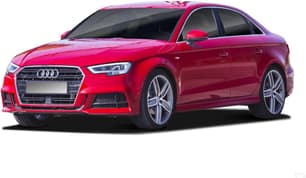
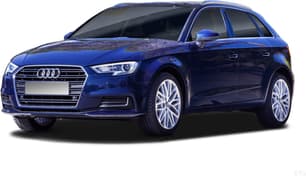
What's the difference?
The idea of paying upwards of $80,000 for a small sedan - even if it were trimmed with the fur of baby seals - seemed laughable not that long ago. Then the Mercedes A45 and CLA45 came along with its poppy-bangy turbo four-cylinder and changed the game forever.
Audi's RS3 joined the game in 2011, to great fanfare but in Sportback form. Whether Audi is being cutesy or not we'll never know, but the five-cylinder turbo fits well between its four and six-cylinder rivals while cranking out the right amount of power and driving all the wheels.
Completing the A3 upgrade that landed late last year, we now have a new, upgraded RS3 to rejoin the fray after the second generation's debut in 2015. And for the first time, RS is slapped on the boot of a small sedan.
BMW has its M-stamped cars, Mercedes has its AMG models and Audi has its performance-focused RS range. All three are taken very seriously, and rightly so, because the vehicles that wear those badges are the most hardcore road cars the three big German brands produce.
Even the smallest and most affordable (though the latter is relative) of them aren’t to be underestimated. Take the Audi RS3 Sportback, for example, which received an update at the end of 2017 that introduced a more powerful five-cylinder engine and new styling.
So, is the RS3 Sportback, with its almost 300kW and all-wheel drive, the ultimate hot hatch? Does it do anything better than its RS3 Sedan sibling? Or is it as unbearable to live with as a German flatmate who has recently discovered body building, spray tans and steroids?
I found out after it became our family car for a week, with the Audi used for day-care drop-offs, work-day commutes and a couple of solo blasts at the weekend.
The RS3 now has the most power in its class and, if you're looking for a sedan, is cheaper than the CLA45 by quite some margin, while also undercutting BMW's epic M2 (yes, that's missing a couple doors, I know). It's an absolute rocket on road and track and has that distinctive five cylinder beat.
The RS3 isn't a particularly sensible car when you look at the price but it's got a decent sized boot, fits four people and is a bit of a sleeper, something Audi is very good at. It's also a bit more fun than its Mercedes rival while offering an all-wheel drive alternative to similarly-sized BMWs.
The RS3 Sportback is going to take some commitment; the ride isn’t comfortable on less than great roads, but the performance payoff is outstanding. And at the same time, you have the convenience and practicality of a regular Audi A3 Sportback.
Like all RS models it’s a good compromise - just hardcore enough to be taking seriously, but just soft enough to live with every day.
The RS3 sedan is based on an S3, which is based in an A3, but, obviously, with a few tweaks. The RS3 sits 25mm lower than the standard car, rolls on 19-inch alloys and rides on the same wheelbase as the hatch.
The usual Audi Sport tweaks are along for the ride too, with a new grille, headlights from the A3 general update and the usual skirts and matte aluminium mirror caps. The new front bumper is a bit snarlier and the grille is gloss black with a 3D effect.
As with most Audi designs, you'll be very hard pressed to spot the differences to lower models. The first and obvious change are the new headlights from the update, now sporting a more jagged lower edge. Bumpers and skirts are tweaked and the wheelarches flared to contain the fat rubber.
Inside is basically the same too, carrying on with Audi's "if it isn't broke" mantra and, to be fair, there's not much to complain about in the cabin. As befits its price, you get a lovely set of RS front seats, the RS steering wheel with Alcantara inserts and other RS-ey accoutrements, and if you want more, there are plenty of boxes to tick at the dealer.
Hell yeah, there is. The RS3 Sportback is the hatch version of the RS3 Sedan, and it looks like a serious weapon - impressive, given it’s based on the incredibly sedate-looking A3 Sportback. Audi is magnificent at doing the Clark Kent-into-Superman trick, transforming its regular models into RS heroes.
There’s that big gloss-black grille with its quattro lettering and the splitter which wraps around under it, making the hatch look wide and low. Check out the images; it looks like an evil hover-car from the front.
The RS3 Sportback looks just as potent from the back, too, with its gloss-black and finned diffuser, meaty tail pipes and a roof-top spoiler that’s so sharp-looking it would surely be confiscated from your carry-on luggage. That front-three-quarter shot shows off the widened wheel arches best, too.
Our test car wore the optional 19-inch anthracite black alloys with the five-arm design (part of the $5900 'RS Performance Package 2'), but I think the standard 19-inch alloys with the matt-titanium finish look tougher. Red brake calipers are standard, but the back matt roof rails are an option.
Our car’s 'Ara Blue crystal' paint is a $2015 option, and so is the 'Panther Black crystal'. The only paint colour you won’t have to pay for is 'Nardo Grey', and while the rest are optional, they cost less than the crystal colours (at $1495), and include 'Catalunya Red', 'Floret Silver', 'Glacier White' and 'Mythos Black'.
If only Audi was as good at transforming interiors as it is a car’s outsides. Although the RS seats look great, the rest of the interior is almost identical to a regular A3 Sportback. I’m serious, I’m staring at a shot I took of the 1.4 TFSI Sportback’s cabin and another I took of the RS3 Sportback’s side by side, and they are pretty much the same, apart from the carbon inlays (part of the optional RS Performance Package), the Alcantara steering wheel and door trim, and the ignition button.
Compared to a regular A3 Sportback, the RS3 version is 22mm longer at 4335mm end-to-end, 15mm wider at 1800mm across, and sits 15mm lower to the ground at 1411mm tall.
What are the RS3 Sportback’s rivals? As a model comparison, there’s the Mercedes-AMG A45 - which looks like it’s ready to bite you - and there’s BMW’s M140i, which is low-key looking but never to be underestimated. An outsider that’s actually so closely related to the RS3 that it would expect an invite to its wedding is the Golf R – it has a less powerful engine, but it’s built on the same platform, shares much of the same technology and costs a whole lot less.
As it's available in both sedan and hatchback, the big difference is mostly the boot size. The sedan's boot will take an okay 315 litres and 770 litres with the seats down, while the hatch's cargo area holds 335 and 1175 litres. You've a choice of four cupholders and four bottle holders as well as a centre console just big enough for a larger-size phone. A netted pocket is also placed in the passenger footwell.
Four adults can squeeze in to the sedan which is slightly less tolerant of taller rear seat passengers than the hatchback version.
There are practical benefits to the RS3 Sportback that don’t come with the RS3 Sedan.
First, legroom is better in the Sportback, but when I sit behind my 191cm-tall driving position, my knees are still digging into that thick seat back. Headroom is good though, thanks to that high, flat roofline.
Both Sedan and Sportback seat three across the second row, but you won’t want to be in the middle seat.
The Sedan has a bigger boot than the Sportback’s 335 litres of luggage space, but the Sportback’s hatch opening is larger and those seats fold down to give you 1175 litres of space. A mini-wagon of sorts.
Cabin storage isn’t spectacular, with a small centre-console bin and two cup holders up front, plus two in the rear fold-down centre armrest. You’ll also find large door pockets up front and two slim ones in the rear.
If you like nets, then make sure you’re sitting down because there are storage nets everywhere; in the front passenger footwell, on the seatbacks and in the boot to stop your oranges rolling away.
For your electrical bits there’s a USB up front and a 12V power outlet, there’s another 12V in the second row and a third in the cargo area.
You spend a lot and you get a fair bit. The RS3 leaves the factory with 19-inch alloys, LED headlights, 'Virtual Cockpit' digital dash, 10-speaker stereo with 7.0-inch touchscreen and MMI (including Apple CarPlay, Android Auto and DAB+), heated RS seats, leather trim, reversing camera, front and rear parking sensors, auto LED headlights, auto wipers and a comprehensive safety package.
Audi's brilliant 12.3-inch digital dashboard, known as Virtual Cockpit, has the RS mode added to it, which means a big rev-counter with digital speed reading (good) a turbo and g-meter (neither of which are especially useful when you're firing down the road at velocity).
As ever, Audi's MMI is controlled through a rotary dial and a 7.0-inch screen that eases out of the dash on startup. You can up the grunt with a 705W B&O system if you fancy it, but the 'basic' one is a bit of alright.
The usual Audi rule applies for options - packages. You can have extended black high gloss for $1600 or matt aluminium for the same amount. The 'RS Performance Package' is $7600 and swaps the alloys for a different design of your choice, adds magnetic ride, carbon inlays and the thumping 14-speaker stereo from B&O. The front wheels also wear 255/30 Pirelli P Zeros.
Some of these bits are available separately, such as the stereo, the wheels, and you can also option the excellent Matrix LED headlights ($1690). Eight colours are also available, with just one ('Nardo Grey') a no-cost option.
Amazingly, you can also spec a whopping set of carbon-ceramic brakes for $9500.
The RS3 Sportback lists for $81,900, which is not just expensive for a small car, but also compared with its Mercedes-AMG A45 rival, too - the other German undercuts it at $78,611. BMW doesn’t have a proper M rival in its 1 Series to go head-to-head with the Audi and can only offer up the M140i at $59,990, while the Golf R is $55,490.
The Audi S3 Sportback is the RS3's far less hardcore 2.0-litre, four-cylinder turbo-powered sibling, and that one costs $73,000.
So, the RS3 must come loaded with heaps of features, right? Not really. You get some great standard stuff such as the 12.3-inch virtual instrument cluster, those awesome leather RS sports seats, which are heated but manually adjustable, the Alcantara RS steering wheel with paddle shifters, adaptive cruise control and auto parking. Then there are the things you’d expect on any car such as sat nav, Apple CarPlay and Android Auto, digital radio, the 10-speaker stereo, keyless entry, dual-zone climate control and LED headlights.
Then there is some disappointment: the standard display screen is tiny at seven-inches (have you seen the giant screens in the $47,200 A200?), Qi charging is a $325 option and you can’t order head-up display even if you want one.
Want ceramic brakes? That’ll be $9500. Which is fine. Tinted rear windows will cost you $910, and roof racks will set you back $780.
There’s a mountain of safety equipment, which you can read all about below.
And if you don’t like grey then you’ll have to pay for every other paint colour. If you’re wondering how much they’ll add to the price, I’ve listed them in the section on design.
There may still be five cylinders under the bonnet, but they're now all-aluminium. Lighter components and various other mods means more power - 294kW, up by 24kW - and torque is a fairly decent 480Nm. The biggest weight-saving was a switch to an aluminium crankshaft. Overall, the weight loss totals 26kg.
The new seven-speed 'DSG' dual-clutch auto sends power to all four wheels. In the RS3, there's a quicker power transfer system courtesy of an electro-hydraulic multi-plate clutch. Between 50 and 100 per cent of power can find its way rearward which is good news for those who like a lively RS.
And lively it is - all of that power sends the RS3 to 100km/h from rest in a supercar-baiting 4.1 seconds, no doubt helped by a 1510kg kerb weight.
The RS3 Sportback is special. It doesn’t just get a tuned version of a regular A3 engine - that would be an insult to the whole RS tradition.
Nope, the RS3 Sportback has a unique 2.5-litre five-cylinder turbo-petrol lurking under the bonnet, complete with red bits on the engine cover (have a look at the images).
Five-cylinder turbos are a big part Audi’s performance history, and the one in the RS3 is the same that’s in the Audi TT RS, and with an identical output of 294kW (just under 400 horsepower) and 480Nm. The previous RS3 had a five-cylinder engine, too, but this new one is lighter, more efficient and more powerful.
How fast is the RS3 Sportback? It’s quick; we’re talking 0-100km/h in 4.1 seconds. The TT RS is about 0.2s quicker, but the RS3 is having to shift 70kg more weight, at 1510kg all up.
Mash the accelerator and Audi’s quattro system sends the drive instantaneously to all four wheels through an active centre differential, with gears being shifted - quicker than you or I could - by a seven-speed dual-clutch automatic. No manual gearbox, I'm afraid.
Audi claims 8.4L/100km on the combined cycle. Our time with the RS3 included some heavy thrashing around Hobart's Baskerville Raceway, so the drive was unrepresentative of anything approaching real world driving.
I drove the RS3 for a week and put about 200km on the clock, but my actual fuel-testing route took in 81km and covered commuting from my house to the CBD in peak-hour traffic, plus a loop through the national park. For that fuel test I used 11.18L of 98RON (measured at the pump), which gave me fuel consumption of 13.8L/100km. The trip computer reported an average of 12.7L/100km.
Can you guess what Audi’s figure is for a combination of urban and open roads? Officially, the fuel economy should be 8.4L/100km, which is doable with motorways and conservative driving added into the mix.
One of the best things about a five-cylinder engine is the noise it makes. It's distinctive and forms a key part of the RS3's character while referencing Audi Quattros of the 1980s. Sporty German cars have a delightful habit of producing obnoxious pops and bangs from the exhaust and, as ever, the RS sports exhaust is bi-modal, meaning you can go for stealth or glory. Only thing is, this new engine seems less exuberant than the one it replaces, which is a pity.
Loud or not, the 294kW unit is an absolute cracker - not as smooth and deep-chested as the BMW six but nowhere near as highly strung as the Mercedes' four-pot turbo.
The RS3 also runs a few mods over the A3 - both front and rear tracks are wider, the former by 20mm and the latter 14mm. Tyres are 235/35s all around unless you go for an RS pack and the fronts jump to 255/30s and they're lovely sticky Pirelli P-Zeros (as fitted for our drive).
We had the chance to try the car on track and on some brilliant roads around Hobart. The RS3's wheelbase is identical to the hatchback's (a few mm down on the 'normal' sedan), so with the extra track, it's a proper quick brick and, to my eyes, better looking than the Sportback. We'll know for sure when it arrives late this year.
On the road it's terrific fun, slinging itself between corners while keeping the body in check. It's quite happy to change direction with a flick of the small, flat-bottomed steering wheel but don't get too excited on the throttle. Give it a bit, wait for the power shift to kill the mild understeer, then really get on it.
On the track it's terrific fun, but probably a little soft. But who cares? The blare from the five cylinder turbo was pretty good to listen to and even with all the systems on, didn't mind squirming a bit under braking.
That power-on understeer - again, mild - was magnified in the environs of the track but what was also magnified was my view of the steering. Audi has gone for a good weight in dynamic mode, without pointless heft but having enough feel for you to stay connected. The steel brakes took the pounding of the track well.
And the best bit? The RS3 has a very impressive ride. If anything, it's more sorted than the S3 we tried in our recent Torquing Heads review. The magnetic ride is a nice-to-have but I really enjoyed the standard car. Unless you're super-keen, you don't need it.
If you’re going to live with the RS3 Sportback then you’re going to need to be committed.
The standard wheels are fairly big at 19-inches, the rubber is super low profile and the suspension is on the ‘ouch’ side of firm. So unless the roads around your home are super smooth, the ride is going to be less than comfy.
Our test car was fitted with the RS Performance Package 2, which adds Audi’s 'Magnetic Ride', but even with that clever adaptive damper system set in its cushiest Comfort mode, the ride is still firm. I don’t need to tell you that, with my wife and four year old in the car, the dampers were always in Comfort, and even then my captive audience complained.
For reasons unknown even to me, I personally spent way too much of my time with the dampers in Sport. And combined with our car’s Pirelli P Zero 235/30 R19 tyres at the front and 235/35 R19 at the rear, the ride on Sydney’s patchwork, potholed streets teetered on unbearable. On one mission to the supermarket about 5.0km away, I developed a headache just because of the jarring ride.
But when I was finally on a smooth and twisty bit of country road I quickly forgot the pain of travelling though the city. To be honest, out there in the hills on amazing roads, there were times when I wished the suspension was firmer and that the car was tauter.
Composed, controlled, confident and sharp, the RS3 Sportback is agile, with great turn-in and steering that’s always telling the driver through the wheel everything that’s going on. There’s a moment of turbo lag, but the power comes barging in before you can whinge about it.
Dynamic mode sharpens the throttle response, quickens the shifts, adds weight to the steering and firms up that suspension even more. The exhaust note also become throatier; snarling and crackling on the down-shifts. The traction is outrageous, too, and the grip from those Pirelli P Zeros is outstanding.
The RS3 seats are as good to sit in as they look – comfortable under you, supportive around you. But I’m not a fan of Alcantara steering wheels; they’re grippy if you’re wearing racing gloves but feel slippery in dry bare hands. Also, have you seen how they wear? Google it and prepare to be disgusted.
The RS3 comes with a decent array of safety gear. Six airbags, ABS, stability and traction controls, adaptive cruise with traffic jam assist (semi-autonomous stop-start traffic driving), road sign recognition, rear-cross traffic alert, blind spot monitoring, and lane departure warning. It scores a maximum five star ANCAP rating.
The rear seat also has three top-tether child seat anchorages and two ISOFIX points.
The RS3 Sportback has a five-star ANCAP rating. Along with seven airbags, there’s an impressive amount of advanced safety equipment including AEB, lane-keep assistance, blind-spot warning, rear cross-traffic alert and road-sign recognition.
For child seats, you’ll find three top-tether mounts across the second row and two ISOFIX points on the outboard seats.
You’re not going to find a spare wheel, the RS3 has puncture repair kit.
Audi offers a three-year/unlimited kilometre warranty with service intervals of 12 months or 15,000km, whichever comes first. Roadside assist is part of the package, lasting for the first three years of the car's life.
Annoyingly, there is no up-front service plan for RS models, so you'll be rolling the dice on service costs.
The RS3 Sportback is covered by Audi’s three-year, unlimited-kilometre warranty. Servicing is recommended every 12 months or 15,000km. It’s a bit disappointing that RS models aren’t eligible for the servicing plan that can be purchased for regular models.