What's the difference?
The 2025 Audi Q3 Sportback is a small but not-too-small SUV that sits within a close-knit segment. The Q3 Sportback attempts to spice up the premium end of this small SUV market by offering a design-focused 'coupe' body style, but is it enough for it to go 'tyre to tyre' against its main rival, the new BMW X2?
It's other rivals are also renowned for their luxury and on-road prowess - think the Mercedes-Benz GLA and Lexus UX. However, the changes for the new Q3 are small and its rivals have all benefitted from a recent refresh.
In this review we explore how the top-model Sportback S line 40 TSFI quattro handles being an urban dweller.
If there’s one brand that can lay claim to be the best in the ‘cheap and cheerful’ category, it’s probably Suzuki. Not only have its cars been consistently affordable and basic, but also broadly loved by owners.
Now, with small SUVs becoming more and more prominent, Suzuki is bringing a new sub-$30K hybrid light SUV to the market - the Fronx.
Weird name aside, the Fronx promises a fair bit on paper. But can it deliver on the road? We jumped in for a quick spin at its Australian launch to find out.
The Audi Q3 Sportback S line 40 TFSI quattro is a quiet achiever.
Not as flashy or performance driven as some of its rivals, it still manages to tick almost every box when it comes to comfort and features. Like most models in the class, space in the back seat is modest but for a top-spec non-performance model, the price is alright and it’s lovely to drive.
If you’re considering a small car, particularly if an SUV is the goal, a Suzuki should in most cases be on the shopping list. Back-to-basics motoring is key to the brand’s identity. Its most popular model is a tiny ladder-frame 4X4, for example. Hi Jimny.
The Fronx doesn’t break new ground in any practical sense, but it does come in with a decent price and list of features that should sway plenty of small-car fans in the showroom.
It’s decent to look at, comfortable for the segment, and easy to get used to and drive. The numerical rating on this review betrays just how likeable the car is.
It’s not extremely refined and it starts to lose its dynamic shine on rough roads, but in an urban setting the Fronx should excel.
Note: CarsGuide attended this event as a guest of the manufacturer, with meals provided.
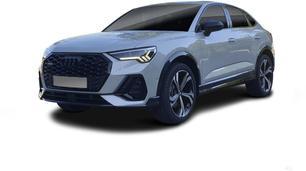
The Q3 Sportback blends the practicality of an SUV with a sports-car presence due to its wide 2022mm stance and coupe-styled rear. With the black accents across the body, big 20-inch alloys and sharp Matrix LED headlights, the Q3 Sportback more than holds its own against the sporty prowess of its rivals.
The cabin establishes that it sits within the premium market with its leather mix upholstery and flashy-looking tech that headlines an angular dashboard. However, it's understated compared to its rivals, which all boast a stronger cabin presence.
Overall, it's not a ‘look at me car’ but the longer you look, the better it gets.
‘Fronx’ as a name doesn’t exactly scream ‘cute’, but the little SUV has a pretty classically Suzuki design. This is not a complaint at all.
The Fronx is 3995mm long, 1765mm wide and 1550mm tall, but despite its diminutive dimensions the brand has opted to lean into a ‘coupe’ style with a sloping roofline that creates a relatively sporty look, especially for something with a two-digit power figure.
So while some of Suzuki’s designs have been divisive in Australia (Ignis, anyone?) the Fronx takes a slightly more conservative approach by leaning into more design trends than just the coupe-back SUV shape.
For example, its tail-lights span the width of the tailgate rather than simply flanking the boot as was standard for decades.
The LED daytime running lights at the front are also arranged in a slim, high-up position with a set of headlights below.
Inside is arguably more conservative than out, as the Fronx goes with a fairly standard formula in terms of its layout, with few premium materials (the synthetic leather on the seats feels cheap for example) or adventurous design elements to be found.
But that’s not such a bad thing.
The Q3 Sportback offers plenty of head- and legroom up front, with access that is accommodating because of the wider door apertures.
Like its rivals, the back seat offers modest space for my 168cm height, but it might be a squeeze if you taller. The middle seat suffers the most with legroom due to the tall transmission tunnel – keep this seat for kids only.
However, all other seats offer well-rounded comfort with decent-padding, side bolsters and the front get extendable under-thigh and lumbar supports, as well as heat functions.
The rear row also gets directional air vents, reading lights, two USB-C ports and a 12-volt socket. Longer trips will be comfortable for four occupants but five will elicit some grumbles.
Storage is good for the class with a glovebox that can fit a manual, a medium-sized middle console and a large phone tray. There are four cupholders and four drink-bottle holders throughout the car, and the rear row also get two map pockets.
The boot offers class leading space with its 530L capacity and only the BMW X2 beats it (by 30L). Storage options open up again with the 40/20/40 split of the rear row. The top model gets a powered tailgate with gesture control and temporary spare tyre.
Technology looks high-end and the touchscreen multimedia system is easy enough to use once you get your head around the menus. The built-in satellite navigation is top notch and the directions are pulled through to the digital instrument cluster.
The Q3 now gets wired/wireless Apple CarPlay and wired Android Auto. The CarPlay maintained a steady connection this week. Charging options are great with a total of four USB--C ports, two 12-volt sockets and a wireless charging pad to choose from.
Because for all the conservative, even outdated, styling in the cabin, the fact is it’ll be refreshingly familiar to someone who’s getting out of a car from perhaps even before the year 2000.
Suzuki’s place at the budget end of the new-car market means its customers are likely either quite young and buying their first new car, or relatively old and looking for a cheap, rarely used runabout as the ‘last car’.
For the former, a lack of techy distractions is paramount. For the latter, ease of use wins over cutting-edge tech in most cases. Which is why it’s probably okay that the Fronx’s multimedia touchscreen and software wouldn’t feel out of place almost a decade ago.
It can be a tad fiddly to use at speed, but it’s still more straightforward than the ‘iPad-like’ systems Tesla has made popular, and there are physical controls for important functions like climate control.
There’s also a row of ever-present haptic buttons for volume controls and navigation shortcuts.
The ergonomics of the interior are quite basic, but there are no red flags in terms of visibility, reach, or placement.
The head-up display is a bonus, but the physical dials on the dash rather than a digital driver display are clear enough, despite again feeling nabbed from a time before head-up displays even existed.
Space for the front passengers is decent, it’s not cavernous but it’s far from cramped. Elbow rests and seating positions allow for a relaxed ride.
The back seat is a slightly less comfortable place, but at 178cm I can sit behind my own seating position without my knees touching the seat in front, and my head has just enough space above to accommodate the top of a mullet.
Behind that, luggage capacity in the boot is 304 litres, or 605 litres with the rear 60/40 split seats folded.
There’s also no space-saver spare tyre, just a repair kit as standard.
There are four variants for the Q3 before you hit the high-performance model, and our test vehicle is the top S line 40 TFSI quattro model, which is priced from $70,800, plus on-road costs, making it the most affordable compared to its rivals.
Its closest rival is the Lexus UX300h AWD F Sport with a price tag of $73,210, then the BMW X2 20i M Sport at $75,900, and the Mercedes-Benz GLA 250 4Matic sits at the top at $79,700.
Our test vehicle has also been fitted with an upgraded Sonos 3D surround sound system and sunroof for an additional $3900.
As one would expect for a top model, the S line is well-equipped and includes electric and heated front seats, leather upholstery and high-end technology throughout, which includes a 10.1-inch touchscreen multimedia system, a 12.3-inch digital instrument cluster, satellite navigation, wireless Apple CarPlay, wired Android Auto, Audi Connect app with over-the-air updates, four USB-C ports, a 12-volt socket and a wireless charging pad.
Practical features include keyless entry and start, adaptive LED headlights, a frameless auto-dimming rearview mirror, rain-sensing wipers, a powered tailgate (with gesture control) and a park assist feature.
It's features list mostly mirrors that of its rivals, but it does miss out on ventilated front seats.
There’s only one variant of the Fronx, and it lands at $28,990 before on-road costs. It’s also relatively stacked when it comes to features, and Suzuki is even working on a sub-$30K drive-away offer for its on-sale date in September this year. We’d expect that means about $29,990 DA, though that’s to be confirmed down the track.
For something at that price point, features aren’t lacking. While things like wireless phone charging and wireless Android Auto and Apple CarPlay have become almost expected for even entry-level cars in Australia, the Fronx also features heated synthetic leather seats and a leather steering wheel.
It’s the first Suzuki in Australia to feature a head-up display, and there’s also a standard surround-view parking display thanks to a set of cameras.
The Fronx’s 9.0-inch multimedia touchscreen is joined by a small 4.2-inch driver display nestled between physical dials for the speedometer and tachometer. Exterior lighting is LED front and rear, with auto headlights and manual levelling.
The only extra-cost option for the Fronx is a choice of ‘premium’ single- or two-tone paint - Arctic White Pearl is the standard no-cost colour. Single-tone paint is $745 extra, while two-tone options are $1345, which is a lot pricier than many premium paint options in the market.
The Fronx comes in at the same price as a mid-to-high spec Hyundai Venue, Kia Stonic or Chery Tiggo 4, but some rivals like the Mazda CX-3 or Toyota Yaris Cross (with its Hybrid drivetrain) are more expensive even in their lower variants.
Our test vehicle keeps it's tried and tested 2.0-litre four-cylinder turbo-petrol engine, which produces 132kW of power and 320Nm of torque. Those outputs are slightly less than most of its nearest rivals and it sports a slower sprint time of 7.8 seconds.
The Q3 Sportback is a quattro, which means it has an all-wheel drive and it boasts a silky-smooth seven-speed auto transmission.
While it doesn't induce strong sports-car vibes on road, it’s not a car you'd ever have the audacity to call slow.
The Fronx is powered by a 1.5-litre four-cylinder engine with mild-hybrid assistance, driving the front wheels via a six-speed automatic transmission.
Its outputs are quoted at 76kW and 137Nm, not exactly high-grade stuff and part of the reason the Fronx feels like it takes more than 10 seconds to hit 100km/h.
The official combined fuel cycle figure is 8.2L/100km, but the real-world usage is at 8.6L after doing a mix of open-road and urban driving. Considering the lack of restraint shown for really giving this model a real 'go' on the open-road, the fuel usage is respectable.
Based on the official combined fuel cycle and 60L fuel tank, you should see a theoretical driving range of up to 732km, which is good for any longer road trips you might want to tackle.
Suzuki claims fuel consumption at 4.9L/100km. With its 37-litre fuel tank, the Fronx should be able to manage more than 600km on a single tank, though theoretically its maximum range given its claimed fuel efficiency is 755km.
The power delivery for the Q3 Sportback S line model is effortless. It doesn’t have the thrum or burbling of a turbo, but the power is well and truly there whenever you need it. So, while not as ‘powerful’ as some of its rivals, you don’t feel like you’re missing out.
The low and wide stance of the Q3 Sportback translates to nimble and direct handling – you can take corners at speed with almost no roll and the steering sits within the goldilocks zone for firmness.
A downside is the cabin noise, which is fairly loud with road and wind no matter the speed – but you don't have to raise your voice. You'd expect a bit of noise with the big wheels, but you always hope for more refinement at this grade level.
The Q3 isn’t difficult to park, but it does take a moment to get your bearings on how it fits a space, as it’s bigger than you might expect. The 360-degree camera is super clear, which takes out a lot of the guesswork.
The car feels like an extension of you as a driver which elevates the overall on-road experience despite not being a performance model. This would be well-suited for a driver who wants great on-road performance without feeling like someone who is in a mid-life crisis.
How you plan to use the Fronx will make a big difference in whether what you’re about to read is a good thing or not.
The Fronx is a light SUV for a start, so expecting brilliant handling, effortless acceleration and a dead-quiet cabin is going to mean you’re disappointed.
But if you want something easy, engaging and fun, the Fronx might work for you.
Our brief test loop wasn’t entirely indicative of what the Fronx is likely to face day-to-day. With limited time and no preset drive program, the roads within a 20-or-so minute drive of Nagambie, Victoria had to suffice.
The Fronx fared well on the average road, it turned out, with the 1064kg Suzuki managing to feel planted enough to hurl along 100km/h back-roads without complaints. It rides on the same platform used recently by the Suzuki Baleno, something I’ll admit to not having driven.
The rougher roads didn’t faze the light SUV too much, though consistently uneven surfaces made it feel unsettled in some cornering.
Its steering and suspension give enough feedback to make the right inputs easily, though the nature of its light weight and minimal accoutrement in terms of driver assistance make the Fronx feel very rudimentary from the driver’s seat.
At low speeds around the centre of town, the Fronx manages the state’s terrible roads well, though taking off from intersections can be laborious. Much like overtaking, the drivetrain will complain.
And don’t expect its mild hybrid system to do a lot in the way of hard work - or any work at all, really. You could take the hybrid badge off the car, let someone have a drive, and they’d be none the wiser.
From the limited observations on the launch, the Fronx would feel best at home in suburbia or a metropolitan centre more so than on the Hume Highway or the towns dotted alongside it.
Essentially, this is not a refined road trip car for the highway, but its no-fuss approach to getting around means you shouldn’t be surprised if you start seeing them in the car parks at universities or bowls clubs.
The Q3 has a maximum five-star ANCAP safety rating from testing done in 2018 and it scored highly with the adult protection score sitting at 95 per cent, child protection score at 88 per cent, and safety assist systems score at 85 per cent, and it's vulnerable road sits at 76 per cent.
Unfortunately, the Q3 only features six airbags, which is fairly low for this day and age and misses out on a front centre airbag.
Standard safety equipment is robust and includes blind-spot monitoring, driver attention alert, a First Aid kit, a warning triangle, tyre pressure monitoring, rear cross-traffic alert, lane keeping aid, lane departure alert, traffic sign recognition, intelligent seatbelt warning, adaptive cruise control with stop/go function, park assist, a 360-degree camera and front and rear parking sensors.
There are two ISOFIX child seat mounts and three top tethers but two seats will fit best.
The Q3 has AEB and forward collision warning with car, pedestrian and cyclist detection. This system is operational from 5-85km/h (and up to 250km/h for car detection).
A big part of many buyers’ decisions about a new car is safety, and the Fronx is pretty basic on this front.
Six airbags cover front and sides for the front passengers, and there are curtains down the sides of the car, but there’s no front centre airbag and no ANCAP rating has been applied to the Fronx as yet.
In terms of active safety, the Fronx has listed among its standard features auto emergency braking (AEB), ABS and brake assist, lane departure warning, hill hold control, weaving alert, blind spot monitoring, traffic sign recognition, rear cross traffic alert and a surround-view parking camera with front and rear sensors.
There are also outboard ISOFIX seat fastenings in the second row.
The only safety system that activated during the test was a lane departure warning, but only when (under normal conditions) it would have been necessary as the car approached the road’s centre line.
The Q3 comes with a five-year/unlimited-km warranty, which is a normal term for the class.
You can pre-purchase a five-year servicing plan, which costs $3330 overall, or $666 per service which is competitive for the premium segment.
Servicing intervals are reasonable at every 12 months or 15,000km whichever occurs first.
Suzuki has a five-year, unlimited kilometre warranty for its new cars, which is a little behind the curve compared to many budget-friendly brands these days.
Suzuki does have a five-year servicing schedule, with intervals every 12 months or 15,000km, whichever comes first. Total cost is $2005 over the five years, with services averaging $401, which is not particularly cheap.