What's the difference?
Audi’s littlest and most affordable SUV, the Q2, has been updated with new looks and tech, but something else has snuck in with it. Or should I say roared in? It’s the SQ2, with a whopping 300 horsepower and a snarling bark.
So, this review has something for everybody. It’s for those who want to know what’s new for the Q2 in this latest update - those thinking of buying a cool-looking little SUV from Audi - and for those who want to wake their neighbours up and frighten their friends.
Ready? Let’s go.
If you’re after a small performance-focused hatch or small SUV, there’s no shortage of solid offerings from semi-premium and premium brands like Audi, BMW, Cupra, Mercedes-Benz, Volkswagen and more.
Another high-end brand dipping its toes in the segment is Lexus. Yes, Lexus. The Japanese luxury brand that’s famous for reliable and comfortable cars like the ES and RX.
It might be surprising that Lexus could build something like the LBX Morizo RR, but let’s not forget the many go-fast models in its back catalogue - the LFA supercar, the LC coupe and drop-top, IS F and GS F sedans and the RC F coupe.
At the urging of famed Toyota Motor Corporation (Lexus’ parent company) Chairman Akio Toyoda, Lexus has birthed a firecracker based on its humble, yet fun, LBX small SUV.
Akio has had a hand in developing the Morizo RR as well. Hence the name. Akio is head road tester for the carmaking giant, and a seasoned racer in his spare time. He uses the ‘Morizo’ alias when racing. The ‘RR’ stands for ‘rookie racer’.
Using the same powertrain found in Toyota’s GR Yaris and Corolla hot hatch cousins, the LBX has a lot of promise. But has Lexus done enough to bother those largely European rivals?
The Q2 is good value and great to drive – especially the SQ2. The exterior looks new, but the cabin feels older than the larger Q3, and most other Audi models.
More standard advanced safety tech would make the Q2 even more appealing, as would a five-year, unlimited-kilometre warranty. While we’re at it, a hybrid variant would make enormous sense.
So, a great car, but Audi could offer more to make it an even better proposition for buyers.
Lexus has managed to combine two cars in one. A fast, impossibly fun back-road blaster perfect for weekends on your favourite winding roads, and a competent, compact city SUV that will easily handle urban runabout duties every day of the week.
It’s this duality that struck me the most. I would happily live with the Lexus LBX Morizo RR.
If you need a bit of space, maybe look elsewhere. But if you’re passionate about dynamic driving, and value comfort and a premium experience, this little rocket is hard to beat.
Note: CarsGuide attended this event as a guest of the manufacturer, with accommodation and meals provided.
This updated Q2 looks almost identical to the previous one and really the only changes are subtle styling tweaks to the front and back of the car.
The front air vents (they aren’t real air vents on the Q2, but they are on the SQ2) are now larger and pointier and the top of the grille is lower. Around the back, the bumper now has a similar design to the front, with those pointy polygons set wide apart.
It’s an angular little SUV, full of sharp-edged shapes like some kind of acoustical wall in an auditorium.
The SQ2 just looks more aggro, with its metallic-trimmed air vents and beefy quad exhaust.
The new colour is called Apple Green and it’s not really like any colour on the road – well not since 1951, anyway when this hue was hugely popular on everything from cars to telephones. It’s also very close to Disney’s “Go Away” green – look it up and then ask yourself if you should be driving a car that’s kind of invisible to the human eye.
I digress. Other colours in the range include Brilliant Black, Turbo Blue, Glacier White, Floret Silver, Tango Red, Manhattan Grey and Navarra Blue.
Inside, the cabins are the same as before, apart from the larger, sleeker media display, and there are some new trim materials, too. The 35 TFSI has silver inlays with a diamond paint finish, while the 40TFSI has aluminium door sills.
The Q2 has beautiful quilted Nappa leather upholstery, which goes beyond just covering the seats and to the centre console, doors and armrests.
All options offer well laid out and premium feeling cabins, but the disappointing part is that it's an older Audi design, which started out in the third-generation A3, launched in 2013, and still exists on the Q2, even though most Audi models, including the Q3, have the new interior design. This would bug me if I was thinking about buying a Q2.
Have you thought about a Q3? It’s not that much more in price, and it’s a tad bigger, obviously.
The Q2 is tiny, at 4208mm end to end, 1794mm wide and 1537mm tall. The SQ2 is longer at 4216mm long, 1802mm wide and 1524mm tall.
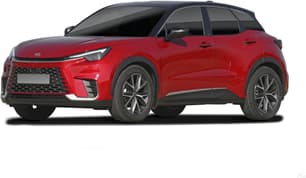
The regular LBX is a spunky little car with a lot of road presence. I’ve been a fan of the exterior design since first seeing one in the metal. Short overhangs, nuggety proportions, well designed tail-lights and a pert rear end - it all works for me.
For the Morizo RR, Lexus has wisely exercised some restraint when it comes to exterior flourishes. It is nowhere near as wildly styled as the Yaris GR, for example. And that makes sense. This is, after all, a Lexus.
It’s a smart move, too. It’s subtle but still has intent.
The Morizo RR gains styling tweaks unique to the grade including 19-inch forged aluminium wheels, red brake calipers, a different front and rear bumper design, a rear spoiler, air intakes front and rear and a dual exhaust.
Inside, the main differences are the inclusion of red stitching, sports seats, some unique inserts, and the use of synthetic suede on the centre console, dash and doors.
The LBX interior design is functional and premium with nice materials throughout.
The Q2 is basically a current model Audi A3, but more practical. I’ve lived with the A3 Sedan and Sportback and while rear legroom is just as confined in those as it is in the Q2 (I’m 191cm and need to squish my knees behind my driving position) getting in and out is easier in the SUV, with its elevated ride height and taller door apertures.
The easier access helps enormously when helping kids into their child seats. In an A3 I need to kneel on the footpath to be at the right level to put my son into the car, but not with the Q2.
The boot space of the Q2 is 405 litres (VDA) for the front-wheel-drive 35 TFSI and for the SQ2 it’s 355 litres. That not bad, and the large hatch makes for a big opening, which is more practical than a sedan’s boot.
Inside, the cabin isn’t enormous, but rear headroom is good, thanks to the fairly high roof.
Cabin storage isn’t terrific, although the front door pockets are big and there are two cupholders up front.
Only the SQ2 has USB ports in the back for rear passengers, but all Q2s have two USB ports up front for charging and media – plus all have wireless charging for phones.
The LBX is a compact little SUV so if you’re after something to fit a family of four, look elsewhere. But if you don’t need the space, it’s a great city car.
Up front it’s easy to find the right driving position thanks to all of the adjustability of the seat and steering wheel.
Those sports seats are supportive and hug the body, but not too much as some of Lexus’ European rivals do. They’re also very comfortable - almost edging firm but never uncomfortable.
The Lexus multimedia system is functional and has an easy-to-navigate menu set-up, but lacks any pizzazz. Better graphics would help with engagement.
Storage wise, there’s a wireless charger slot at the bottom of the centre stack, a cupholder with a narrow slot for another device next to it, and a deep but narrow secure central storage bin with another cupholder.
You might not fit big bottles into the door bins as it’s pretty tight.
I wasn’t sure about Lexus’ one-touch interior and exterior door handles when they first rolled them out, but I now think it adds a classy point of difference to its rivals.
That second seating row is tight, especially for taller folk. I had just enough legroom (but plenty of toe room) sitting behind my 183cm (6'0") driving position, but I wouldn’t want to sit back there for a long road trip. Headroom, however, is ample. My noggin didn’t even scrape the headliner. You’d struggle to fit three adults back there but a couple of kids should be fine.
Amenities include a pair of USB-C ports and two map pockets, but the rear row lacks any adjustable air vents or a fold-down centre arm rest. And the bottle holders in the rear doors won’t fit much at all.
The rear row folds 60/40 and if you need to haul lots of luggage or shopping, you’ll definitely need to lower that rear row because the boot is small.
Lexus says it can swallow 266 litres, which is tight. There’s no spare wheel of any kind, just a tyre repair kit.
The Q2 entry grade is the 35 TFSI and it lists for $42,900, while the 40 TFSI quattro S line is $49,900. The SQ2 is the king of the range and lists at $64,400.
The SQ2 has never been to Australia before, and we’ll get to its standard features in a moment.
Aussies have been able to buy a 35 TFSI or 40 TFSI since the Q2 arrived in 2017, but now both have been updated with new styling and features. The good news is the prices have only gone up by a few hundred bucks, compared to the old Q2.
Standard on the 35 TFSI are LED headlights and taillights, LED DRLs, leather seats and steering wheel, dual-zone climate control, Apple CarPlay and Android Auto, eight-speaker stereo with digital radio, front and rear parking sensors and a rear-view camera.
That was all standard on the previous 35 TFSI, but here’s what’s new: an 8.3-inch media screen (the old one was seven inches); a proximity key with push button start (great news); wireless phone charging (brilliant), heated exterior mirrors (more helpful than you’d think), ambient interior lighting (aww… pretty); and 18-inch alloys (heck yes).
The 40 TFSI quattro S line adds sports front seats, drive-mode selection, a power tailgate, and paddle shifters. The previous one had all that, too, but this new one has the sporty S line exterior body kit (the previous car was just called Sport not S line).
Now, the 45 TFSI quattro S line may appear not to get much more than the 35 TFSI, but the extra money is getting you more grunt and an awesome all-wheel-drive system – the 35 TFSI is front-wheel-drive only. If you love driving and can’t afford the SQ2, then $7K extra for the 45 TFSI is absolutely worth it.
If you have saved all your pennies and the SQ2 is what you’re zeroing in on, then here’s what you get: Metallic/pearl effect paint, 19-inch alloys, matrix LED headlights with dynamic indicators, the S body kit with quad exhaust, sports suspension, Nappa leather upholstery, heated front seats, 10-colour ambient lighting, stainless-steel pedals, auto parking, a fully digital instrument cluster, and a 14-speaker Bang & Olufsen stereo.
Of course, you get an incredible high-output four-cylinder engine, too, but we’ll get to that in a moment.
The regular Lexus LBX line-up consists of three hybrid grades (Luxury FWD, Sports Luxury FWD and AWD) running from $47,550 to $56,990, before on-road costs.
Naturally the Morizo RR takes its place as the flagship of the LBX line-up and is priced accordingly. It will cost you $76,490 which is close to $20K more than the entry grade.
Purely looking at SUVs, rivals could include the BMW X1 M35i ($92,300) or Volkswagen T-Roc R ($64,290), while performance hatchback competitors might include the Mercedes-AMG A35 ($87,900) or VW Golf R ($70,990). Either way, the Lexus sits somewhere between the two, but closer in price to the VWs.
There are other offerings that cost quite a bit more than the Lexus.
For that money you get leather-accented sports seats, aluminium pedal trims, 19-inch forged alloy wheels, a 9.8-inch multimedia touchscreen, wireless Apple CarPlay and Android Auto, sat nav, a 12.3-inch digital driver display, dual-zone climate control, a powered tailgate and heated front seats.
Other gear includes a 13-speaker Mark Levinson premium audio system (with a sub-woofer), five USB-C ports, access to 'Lexus Connected Services', synthetic suede trim, auto power-folding and dimming exterior mirrors, an auto-dimming interior rear view mirror, eight-way power driver’s seat adjustment, rain-sensing wipers and keyless entry and start.
Two-tone paint will set you back an extra $1750.
On top of the long safety features list (see the Safety section), there’s nothing obvious missing from the features list. Lexus has always offered sharp value-for-money and that remains the case with the Morizo RR.
There are three grades and each has a different engine.
The 35 TFSI has a new 1.5-litre four-cylinder turbo-petrol engine making 110kW and 250Nm; the 40 TFSI has a 2.0-litre turbo-petrol four making 140kW and 320 Nm; and the SQ2 has a 2.0-litre turbo-petrol as well, but it puts out a very impressive 221kW and 400Nm.
The 35 TFSI is front-wheel drive, while the 45 TFSI quattro S line and SQ2 are both all-wheel drive.
All have a seven-speed dual clutch automatic transmission – nope you can’t get a manual. There are also no diesel engines in the line-up.
I drove all three cars and, from an engine perspective, it’s like turning the ‘Smile Dial’ up from Mona Lisa in the 35 TFSI, to Jim Carrey in the SQ2, with Chrissy Teigen in between.
Powering the LBX Morizo RR is an excellent 1.6-litre turbocharged three-cylinder petrol engine, which is the same unit found in the Toyota GR Corolla and Yaris hot hatches.
The Lexus loses some power and torque compared with those models so the outputs are 206kW and 390Nm. The Toyota cousins offer 221kW/400Nm each.
This engine is paired with an eight-speed torque converter automatic transmission and it has electrically controlled all-wheel drive with a Torsen limited-slip differential.
You can race from zero to 100km/h in just 5.2 seconds.
Audi engines are superbly modern and efficient – even its monster V10 can shut down cylinders to save fuel, and so can the new 1.5-litre four-cylinder engine in the 35 TFSI. Audi says that over a combination of urban and open roads, the 35 TFSI should use 5.2L/100km.
The 40 TFSI is thirstier at 7L/100km, but the SQ2 demands a bit more at 7.7L/100km. Still, not bad.
What’s not good is the lack of a hybrid, PHEV or EV variant of the Q2. I mean the car is small and ideal for the city, and therefore a perfect candidate for an electric version. Not having a hybrid or EV is why the Q2 model range doesn’t score well for its overall fuel economy.
While the hybrid versions of the LBX are known for their fuel efficiency, it’s less of a focus for the Morizo RR performance model.
It has an official combined (urban/extra-urban cycle) fuel figure of 9.2 litres per 100 kilometres, which is more than twice the figure of the hybrid.
CO2 emissions sit at 209g/km and the LBX has a 50-litre fuel tank. You will need to fill up on the expensive stuff though as the Morizo RR requires 98 RON fuel. Theoretical range between fills is around 540km.
When it comes to the driving part, Audi can almost do no wrong – everything the company makes, whether it’s low powered or rip-your-face-off fast, has all the ingredients for engaging driving.
The Q2 range is no different. The entry-grade 35 TFSI has the least grunt and, with its front wheels pulling the car along, it’s the only one in the family that’s not blessed with all-wheel drive, but unless you’re doing laps at a track you’re not going to be wanting more power.
I drove the 35 TFSI for more than 100km on the launch, through the country and into the city, and in all situations, from overtaking on highways to merging and slow traffic, the most affordable Q2 performed well. That 1.5-litre engine is responsive enough and the dual-clutch transmission changes swiftly and smoothly.
Superb steering and good visibility (although that rear three-quarter view is slightly obstructed by the back pillar) makes the 35 TFSI easy to drive.
The 45 TFSI is a good mid-point between the 35 TFSI and the SQ2 and comes with a very noticeable bump in oomph, while the extra traction from the all-wheel drive is a reassuring addition.
The SQ2 isn’t the hardcore beast you might think it is – this thing would be super easy to live with daily. Yes, it has firm sports suspension, but it’s not overly hard, and that engine, which nudges almost 300 horsepower, doesn’t feel like a Rottweiler on the end of a leash. If anything, it’s a Blue Heeler that loves to run and run, but is happy to take it easy and get fat.
The SQ2 is my pick of the bunch, and not just because it’s quick, agile, and has an intimidating growl. It’s also comfortable and luxurious, with sumptuous leather seats.
I had high expectations for the LBX Morizo RR and I’m pleased to say they were met.
What a phenomenally capable little car.
Lexus is at pains to point out that its mechanical cousins - the Toyota GR Corolla and Yaris - are motorsport bred and therefore more raw and hardcore.
The premium brand knows it needs to be able to attract new buyers with a car like this, while also satisfying its loyal base.
Lexus did this by building a hot hatch (okay, it’s an SUV) that you can easily live with day to day.
I spent an enjoyable few hours behind the wheel of the Morizo RR on a stunning Autumn day in Victoria’s Yarra Ranges driving on some incredible roads. The twists, bends, undulations and more showcased how tight this car is.
First up that engine is an absolute gem, and I don’t miss the extra kilowatts found in the Toyota models. There’s very little turbo lag and the LBX picks up pace quickly but in a focused, fun manner.
The engine note is also a delight to behold, especially when you push it hard. Although on coarse chip roads a fair bit of road noise creeps in, to the point that it's boomy.
The transmission is a perfect pairing for the engine, too, offering slick shifts without holding gears unnecessarily. I didn’t miss the manual box found in the Toyotas, either. But the paddle shifters and a true manual mode (it won’t shift unless you flick the paddle) adds to the experience.
The brakes are strong but not too pinchy and the steering is as sharp as you’d hope, while offering just enough weight.
Then there’s the grip. The all-wheel drive system “automatically distributes the front-rear torque according to road conditions and grip”, according to Toyota.
That AWD grip always inspires confidence during dynamic driving in a car like this and the LBX sticks to the tarmac like nobody's business. Despite some damp sections of road higher up the ranges, no slip was detected. It feels glued to the road.
If that’s not enough, the Lexus surprises with its compliant and even comfortable ride quality. Many hot hatches (or hot SUVs) have a firm ride due to a chassis set-up geared to performance driving.
Somehow Lexus has ensured the damping settings shield the occupants from the worst bumps. Only deep potholes make their presence felt.
And that’s the beauty of this car. It feels so beautifully engineered, with a clear focus on performance, but it’s not a brutal experience. You never feel like you could easily lose control in this thing. You can punt it into a tight bend and feel confident it will stay the course.
The Q2 was given the maximum five-star ANCAP rating when it was tested in 2016, but by 2021 standards it is light on advanced safety tech.
Yes, AEB with pedestrian and cyclist detection is standard on all Q2s and the SQ2, and so is blind-spot warning, but there’s no rear cross traffic alert or reverse AEB, while lane-keeping assistance is only standard on the SQ2, along with adaptive cruise control.
For a car that will most likely be purchased by younger people, it doesn’t seem right that they’re not being protected as well they would be in more expensive Audi models.
For child seats, there are two ISOFIX points and three top-tether anchor mounts.
A space-saver spare is under the boot floor.
ANCAP awarded the hybrid versions of the LBX a maximum five-star rating in 2024, but the turbo-petrol Morizo RR is unrated.
The standard safety list is lengthy and includes auto emergency braking with pedestrian (day/night), cyclist (day/night) and motorcyclist (day) detection, intersection collision avoidance, adaptive cruise control, emergency steering assist, lane trace assist with lane departure warning, speed sign detection, blind spot monitoring, rear cross-traffic alert, safe exit assist, Lexus 'Emergency Driver Stop' (automatically decelerates the car within its lane if the system detects the driver has become incapacitated), front and rear parking sensors, a reversing camera with camera washer and seven airbags including a front centre bag.
The pressure for Audi to move to a five-year warranty must be hugely intense, with Mercedes-Benz offering one, along with pretty much every other mainstream brand. But for now, Audi will only cover the Q2 for three years/unlimited kilometres.
As for servicing, Audi offers a five-year plan for the Q2 costing $2280 and covering every 12-month/15000km service over that time. For the SQ2, the cost is only a fraction higher at $2540.
Lexus covers the LBX Morizo RR with its five-year, unlimited kilometre warranty and capped-price servicing for five years at a cost of $695 a service.
The schedule for servicing is tight at every six months or 10,000km, whichever occurs first, so you’ll be at the dealership a bit with this one. These are the same servicing terms as the GR Corolla and Yaris.
Lexus’s 'Encore' owner benefits program includes some cool stuff, too, like a valet parking service at certain venues, and you can even swap your Lexus for a different model for a set amount of time with the On Demand service.
Lexus Encore also offers exclusive access to events and venues, as well as special offers at hotels and restaurants.