What's the difference?
The Audi A1 2020 range offers something for everyone, and in the case of this particular variant, it’s the one you buy if you want as much grunt and gear as you can get.
It’s the top-of-the-range Audi A1 40 TFSI model, which gets the zestiest engine, the lengthiest equipment list, and offers performance to match some hot-hatches out there. It’s essentially an Audi-ised version of a VW Polo GTI.
This test wasn’t so much about the wow-factor, though. We put it through its paces as an urban runabout to see how it coped as a real-world city car.
If one is good, two must be better, right? Or twice as good. The question is whether that simple equation adds up for BMW's upgraded 1 and 2 Series siblings – the former, a range of five-door hatches, the latter, a line-up of cabriolets and coupes, with a major addition in the shape of the full-house, performance-focused M2.
Prices are up, and changes are mostly under the skin, so you're not getting big visual bang for your extra bucks. But the new and improved 2 has plenty to offer when it comes to added spec and tech.
BMW invited us to the new car's Australian launch program along Tasmania's wet and wild west coast.
If you’re eager for a sporty compact hatchback with premium design and luxury car badges, the Audi A1 40 TFSI is a very, very strong contender. It’s fast, fun, and functional for a little hatchback. It’s just very expensive, and for most people the $10K cheaper 35 TFSI model will tick most of the boxes. I’d recommend you drive it before signing on for the top-spec model.
The BMW 2 Series coupes and convertibles combine understated good looks with great dynamics and top-shelf quality. Extra equipment, especially the iDrive6 multimedia system, has brought it up to speed in terms of tech and value, while the M240i sets the compact performance benchmark. And if you really want to push the envelope, the M2 is right there at the top of the under $100k performance pyramid.
I don’t think I’ve seen a better transformation between generations than the current A1. In its previous guise it was bubbly and cute, but now it’s an angular brute.
This version’s S line sports body kit and funky 18-inch alloy wheels certainly help in that regard, but even the standard lighting signatures - LEDs front and rear - make it stand out as anything but a cutie pie city car.
The good news is that it hasn’t grown too much, either. Sure, it is a bit bigger, measuring 4029mm (on a 2563mm wheelbase), 1740mm wide and 1409mm tall. The last one was smaller (3973mm long on a 2469mm wheelbase, 1746mm wide and 1422mm tall), but this one isn’t elephantine in its proportions and so remains simple to park and squeezy enough to be considered a Light Car by industry standards.
And there are some really, really playful colours available. Like this Turbo Blue (which is only for this spec), and Python Yellow. There’s also black, green, red, three different greys, and two whites. The only issue is that flat white (Cortina White) is the only no-cost paint option. The rest will set out back $490 (for Tioman Green or the blue you see here) or $990 (for the rest).
And then you can option the paint with a black roof, for $1380 combined with blue or green, or $1880 in all the other colours. The black exterior styling pack adds black highlights around the grille and on the front and rear bumpers. Those little Audi four-ring stickers on the rear doors are standard on this spec.
But to be honest, it stands out no matter what colour you choose, and that’s enough to get people’s heads turning on the street. And the interior design? Well, it has some good and bad points. See the interior pictures below to make up your own mind.
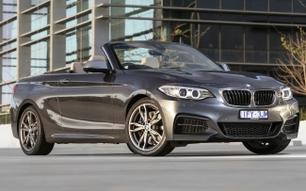
The biggest visual clue to the revised 2 Series is the circular design bi-LED headlights, now standard on the 2 Series entry 220i, and mid-range 230i models, while hexagonal adaptive LEDs are standard on the top-shelf M240i.
But BMW couldn't leave those little light-emitting diodes alone, with LED front fog lights joining one-piece L-shaped LED tail-lights across the range.
Luxury Line-equipped cars feature a subtly revised nose treatment with larger intakes and a reshaped 'kidney' grille. There are also four new alloy wheel designs – a 17-inch alloy fitted standard to the 220i Luxury Line, and three optional M alloys for M Sport models (all no-cost options on the M240i).
The 230i M Sport features black, high-gloss bars in its kidney grille, as well as a black chrome finish for the exhaust finishers.
On the inside, there's the addition of a 'Black Panel' digital instrument cluster, which remains matt with the ignition off, and lights up with sharp graphics, configurable across conventional speed and rev readouts, as well as gear position, engine-efficiency data, vehicle settings and nav guidance.
There are also high-gloss finishes across the centre stack and front console, and even greater attention to detail around panel joins, trim stitching and switchgear.
But the hero is the latest iDrive6 multimedia system, run through an 8.8-inch colour touchscreen (6.5-inch on 220i), providing access to live content, radio and audio, navigation and maps, phone functionality, and vehicle settings through a simple and customisable app-style interface. The iPhone really as inspired car companies.
The M2 boasts M-specific instrument display content and a go-fast red needle on the tachometer.
There are elements of the A1’s cabin design that are tremendous. And other bits that are not so tremendous.
The bad bits include the fact you’re paying about $50,000 on the road for a car that has hard plastic just about everywhere the eye can see.
The good bits are that the textured plastics on the dash are beautiful, and so are the designed elements on the doors. I love the door handles, I love the metallic finish, I love the layout and I love the way it makes you forget that you’re in a luxury-branded car with hard plastic all around you.
The media screen and digital dashboard help, too - it feels technical and premium in the driver’s seat as a result. The graphics are crisp and clear, the menus are mostly easy to navigate, but I had some issues getting Apple CarPlay to work. It has wireless CarPlay, and I had it plugged in, so perhaps that was confusing things.
But the Audi media system also includes Audi Connect in this spec, meaning there are realtime map, traffic and hazard updates, plus a Wi-Fi hotspot, fuel prices, parking, weather and Google maps and services. It’s high-tech, and if that’s what you like, this is definitely going to please you more than a Mini Cooper.
Practicality is good, with bottle holders in all four doors, cup holders between the front seats and a covered centre console and wireless charging bay in front of the shifter. In the back, storage is sparse: aside from the door pockets, there’s nothing - no cup holders, no map pockets.
There is enough space for four adults in the A1, so if you plan to take your mates to brunch or if you’ve got young kids, you should be comfortable enough in here.
I had the driver’s seat set for my own height (182cm) and I was able to slide in to the rear seat without much fuss at all, with adequate knee and toe room, and decent headroom too. Try and fit three across the back and it’ll be uncomfortable, unless those three are very slim.
There are dual ISOFIX child-seat anchor points and three top-tether points, and the seat structure is pretty flat, making fitment of these types of seats simple enough.
The boot capacity is good for a car of this size at 335 litres, which is a solid 20 per cent bigger than before. You won’t find a spare under the boot floor, though, as all A1s have an inflator kit. The back seats fold down to allow 1090L of cargo capacity, but there’s a ledge you have to contend with if you’re trying to load larger items in. Maybe skip the IKEA trips in this one, then.
Surprisingly, at a little over 4.4 metres long, the 2 Series (Coupe) is around 10cm longer than its 1 Series hatch stablemate (M240i +15cm), but aligns with its just under 1.8m width, and 1.4m height.
It seats four, with plenty of room up front and multiple storage options, including two cupholders in the console with an oddments tray behind, a 12-volt outlet, a lidded storage box between the seats with USB connection, a reasonably sized glove box, and segmented bins in the doors big enough for large water bottles.
While it was coupes only on the launch drive, we know the convertible has a pair of cupholders in the back, but not so in the coupe, and while headroom in the soft-top is okay (especially with the roof down) it's a squeeze in the hardtop.
More a 2+2 than a full four-seater, getting into the rear is an athletic exercise, and once installed, leg and headroom for this 183cm tester is tight. That said, kids up to teenager-size would be fine.
Boot volume is 390 litres (a 3 Series Coupe is 480 litres), with run-flat tyres on the 220i and 230i meaning there's no spare (or repair kit) under the floor, but the performance-focused M240i and M2, pack a 'BMW Mobility Kit' (compressor and tyre sealant to cover minor damage) in line with their high-performance (non-run-flat rubber).
A 60/40 split-folding rear backrest liberates extra load space, and a 'Through Loading System' with luggage compartment dividing net, and 40/20/40 split-folding rear seat is optionally available (220i & M2 Pure - $350 / 230i - $385 / M240i & M2 - $500).
And if you're keen on towing the 220i can pull 680kg of unbraked trailer, and 1500kg braked, with the minimum number stepping up to 715kg for the 230i. The M240i and M2 are no-tow zones.
The Audi A1 40 TFSI model is far from affordable if you’re looking at city-sized hatchbacks.
The list price for this model is $46,450 plus on-road costs, and for that you don’t even get leather trim! And heated seats? Optional...
You can option the S-line interior package to get a flat-bottomed steering wheel and leather seat trim, but as standard, even on this top-spec variant, you get cloth seats and a boring old round wheel.
As tested our A1 40 TFSI was $49,720 before on-roads (making for a circa-$55K drive-away price as you see it), because it had the optional blue paint ($490) and black roof ($890), plus the black exterior styling package ($790) and 18-inch Audi Sport wheels ($1100).
It already has 18-inch wheels as standard, plus the S-line exterior body styling pack with sportier front and rear bumpers, sill trims and a rear spoiler.
Plus there are LED headlights and tail-lights, dual-zone climate control, a 10.25-inch digital dashboard, a 10.1-inch multimedia touchscreen with Android Auto, digital radio, built in sat-nav, built-in Wi-Fi and wireless Apple CarPlay.
That’s in addition to push-button start, keyless entry, 2xUSB ports (USB-A and USB-C) ambient lighting, an auto-dimming rearview mirror, wireless phone charging, front and rear parking sensors, semi-autonomous self parking, auto lights and auto wipers, heated and folding mirrors with kerb-side dipping, and a few safety spec items you’ll find in that section below.
The 2 Series coupe and convertible line-up ranges across four-cylinder, turbo-petrol models, in 220i Luxury Line, and 230i M Sport grades, with the six-cylinder M240i sitting at the top of the main line-up. Then for the more single-minded enthusiast, there's the hardcore M2; after a year on-sale it's now BMW Australia's best-selling M car (and it's easy to see why; it's fantastic).
Depending on the model, prices have risen by between $1100 and $1900 across the main range, largely because of the extra equipment, especially the tricky iDrive6 multimedia system.
At $52,990 for the coupe and $59,900 for the convertible version, the 220i Luxury Line is the entry-point to the 2 Series range. Equipment highlights include 17-inch light-alloy wheels, the previously mentioned LED headlights and fog lights, 'Driving Assistant' functionality (combines camera-based 'Lane Departure Warning and Approach' and 'Pedestrian Warning with the City Brake Activation'), digital radio, 'Navigation System Business' with 'iDrive6' accessed via a 6.5-inch display, dual-zone climate control air, reversing camera, a leather sports steering wheel, sports front seats, 'Dakota' leather upholstery, plus front and rear parking sensors.
Next rung on the 2 Series ladder is the 230i M Sport in Coupe ($63,000) and Convertible ($73,000) form, which adds M Sport suspension, aero, and brakes, 'Variable Sport Steering', 18-inch alloy rims, high-gloss 'Shadow line' exterior trim, a BMW Individual anthracite roofliner, a leather-wrapped M Sport steering wheel, cloth/Alcantara upholstery in the coupe, 'Dakota' leather and front seat heating in the convertible, electric (front) seat adjustment, plus 'Navigation System Professional' with iDrive6 and a customisable 8.8-inch touchscreen.
As its name implies, the M2 Pure ($93,300) makes spec sacrifices in the name of light weight.
Opt for the M240i as a Coupe ($76,800) or Convertible ($85,800), and you're getting more than extra performance from the 3.0-litre turbo six. On top of the lengthy equipment list detailed above, you'll also pick up 18-inch alloys in 'Bicolour Jet Black', 12-speaker, 360W harman/kardon surround sound audio, 'Adaptive M Suspension', 'Adaptive LED Headlights', the Dakota leather trim, and front-seat heating.
As its name implies, the M2 Pure ($93,300) makes spec sacrifices in the name of light weight, including manual seat adjustment and a base (yet, still seven-speaker) audio package, but one of the biggest pay-offs is a standard six-speed manual gearbox. Save the manuals!
It also features 19-inch BMW M light alloy wheels, an M rear spoiler, quad exhaust pipes in high-gloss chrome, bi-LED headlights (with variable light distribution, including cornering lights), 'Dakota' leather upholstery, carbon fibre trim finishers, an M leather multi-function steering wheel, cruise control (with braking function), 'Driving Assistant', 'Rear Park Distance Control', and a reversing camera.
The full-fat M2 Coupe ($99,900) reinstates electric seat adjustment, plugs in the 12-speaker, 360W harman/kardon sound system, and adds 'Comfort access' (keyless entry and start), 'Adaptive LED Headlights' (with variable light distribution), and 'Selective Beam with anti-glare High-Beam Assistant'.
A vast array of individual options and packages covers everything from steering-wheel heating to a smoker's kit (naughty), and (amazingly, given it's standard on the Hyundai Accent) Apple CarPlay (220i & M2 Pure - $436 / 230i - $479 / M240i & M2 - $623).
This 40 TFSI model is the big humdinger in the range. It has the donk, right?
Yeah, it’s a 2.0-litre four-cylinder turbo-petrol engine, which is a full litre bigger in capacity than the base model car. And it’s the same engine fitted to the Polo GTI - a proper hot hatch!
It doesn’t quite have double the power and torque of the entry-level 30 TFSI model, but it does have solid outputs of 147kW (at 4400-6000rpm) and 320Nm (from 1500-4400rpm). That’s enough to slingshot this A1 from 0-100km/h in a hot-hatch-rivalling 6.5 seconds, according to Audi.
Unlike the lower grades, it runs a six-speed dual-clutch automatic, which it needs because it has so much torque. The 30 and 35 TFSI variants have a seven-speeder. All of them, including this one, are front-wheel drive.
There is no quattro/all-wheel drive A1 this time around, and there won’t be an S1, either. So this is it if you want your kicks in a compact car from the Ingolstadt-based brand.
The 220i is powered by a 2.0-litre 'TwinScroll' turbo-petrol four, featuring 'Valvetronic' variable valve control and 'Double-VANOS' variable camshaft control, and developing 135kW at 5000rpm, and 270Nm between 1350-4600rpm.
Using a retuned version of the same engine (lower compression ratio, more turbo boost), the 230i pumps out a solid 185kW at 5200rpm, and a grunty 350Nm from just 1450-4800rpm.
The same (8HP50) eight-speed auto transmission is used across the board, pushing drive to the rear wheels only.
Then, the M240i is powered by a 3.0-litre, six-cylinder, turbo-petrol, pushing out no less than 250kW at 5500rpm, and a thumping 500Nm between 1520-4500rpm.
The same (8HP50) eight-speed auto transmission is used across the board, pushing drive to the rear wheels only, and happily, a six-speed manual gearbox is a no-cost option on the M240i.
The full-house M2's 3.0-litre turbo six produces 272kW at 6500rpm, and 465Nm from just 1400-5650rpm (500Nm from 1450-4750rpm on overboost), driving the rear wheels through a seven-speed dual-clutch auto, although a six speed-manual is a no-cost option (and standard on the M2 Pure).
Claimed fuel consumption is rated at 6.4 litres per 100 kilometres. You might see close to that on a highway drive, but if you’re primarily city-dwelling like me, then expect higher.
I saw an average of 10.1L/100km during my urban review of the A1 40 TFSI. That was with stop-start engaged the whole time, and the occasional squeeze of the accelerator to test out the claimed acceleration.
Fuel tank size for the A1 is just 40 litres, so if you’re doing what I did with this grade of A1, you can expect to visit the servo every 400km or so.
Claimed fuel consumption for the 220i Coupe, on the combined (ADR 81/02 - urban, extra-urban) cycle, is 5.9L/100km, emitting 135g/km of C02 in the process. The 220i Convertible rates 6.1L/100km (140g/km).
The 230i Coupe is line-ball with that at 5.9L/100km (134g/km), and the the 230i Convertible at 6.2L/100km (142g/km).
The price of performance starts to bite with the M240i consuming 7.1L/100km (163g/km) in coupe form, and 7.4L/100km (169g/km) as a convertible.
Then, as you might expect, the M2 is thirstiest of all, the dual-clutch auto consuming 7.9L/100km (185g/km), while the six-speed manual version slurps 8.5L/100km (199g/km).
Auto start-stop is standard, fuel tank capacity is 52 litres across the board, and although technically these engines can run on anything from 91-98RON unleaded, BMW recommends 95RON premium as a minimum.
You shouldn’t be surprised to know that the A1 40 TFSI feels a lot like a Polo GTI to drive. It’s quick, it’s entertaining, it’s refined… it’s just about 50 per cent more expensive.
That mightn’t matter to you or factor into your considerations. I just want to point out that you can get a car that’s just as good to drive as this one, and still with a premium German brand attached to it, for a lot less.
The A1 does have it’s own spunk, though. It has a more masculine character, more aggressive styling, and more delightful interior design.
But it also has steering that is predictable and easy to judge, helping it feel nimble and grippy. From tight twisty roads to roundabouts, you’re going to be having fun in the A1 if you’re tooling around town.
It feels planted and grippy - aside from some front-wheel spin during take-offs if the tyres are cold - and you might notice the suspension can be a touch noisy as it pitter-patters over inconsistencies in the road surface, but the ride is firm yet controlled, offering enough comfort over potholed city roads and speed humps for this tester. And there are several of each of those obstacles on my daily drive to work.
The engine is a sweetheart, offering brilliant linearity to its power delivery. It pulls hard from low in the rev range, meaning you’ll be able to zip through traffic without much hassle at all. The powertrain is super responsive to inputs at speed, especially if you put it in Dynamic mode, which also allows you to hear some pops and crackles from the exhaust system.
That said, there is some vibration, shuddering and hesitation at low speeds, which is a combination of the stop-start system kicking in and out, a small amount of turbo-lag from the engine and some shuffling behind the scenes from the dual-clutch transmission. You might find the lurchy nature of the first-gear take-offs to be a bit hard to get used to, especially if you spend a lot of time in bumper-to-bumper traffic.
While this is an Urban Guide review focused on city driving, I thoroughly recommend you find a quiet stretch of twisty road outside the city limits. You won't be disappointed.
Four 2 Series variants were offered for the launch drive program, a 230i Coupe (which BMW nominates as the most popular model in the range), M240i Coupe, M2, and M2 Pure.
Claimed 0-100km/h acceleration of 5.6sec for the 230i M Sport Coupe is quick, with the convertible stopping the clocks three tenths later.
Peak torque of 350Nm is plenty, and with that number available from 1450-4800rpm the mid-spec 2 Series is an entertaining drive.
It's M Sport (strut front, five-link rear) suspension keeps the body well buttoned down in quick going, while the beefier M brakes provide strong and progressive stopping power.
Even a firm squeeze of the throttle can't side-step some hesitation as the turbo spools up before right foot pressure translates into forward momentum, but despite the sporty tune, ride quality is good (even riding on notoriously harsh 18-inch run-flat rubber), while response and road feel from the variable-ratio steering are excellent.
The eight-speed auto is beautifully slick, with manual changes, via wheel-mounted paddles, sharp and positive.
Add the grippy leather sports wheel, snug sports front seats, and racy cloth/Alcantara trim (leather in the convertible), and you have a comfortable, nicely balanced and fun-to-drive package.
Accelerating from 0-100km/h in 4.6sec (convertible 4.7sec), the M240i effortlessly achieves 'genuinely rapid' status. Yes, it's fast, but never furious, in the sense that even under the pressure of enthusiastic peddling it remains civilised and composed.
Maximum torque of 500Nm is not to be sneezed at, and when you realise that mountainous maximum is actually a flat-top plateau stretching from only 1520rpm up to 4500rpm, satisfying urge is never far away. And the flexible 3.0-litre turbo-six is an aural treat as it howls its way towards a 7000rpm rev ceiling.
The standard 'Adaptive M Suspension' offers settings from 'Comfort' through to 'Sport+', but even in the most forgiving mode the car remains taut and communicative.
The 18-inch rims, shod with Michelin Pilot Super Sport rubber (225/40 front / 245/35 rear) don't upset the ride as much as you'd expect, although coarse-chip surfaces send rumble through to the cabin.
In terms of ergonomics and general function, the new iDrive6 system is simple and intuitive to use, the current BMW dash and console layout is a model of efficiency, but the two-stage (depress small button on stubby lever, then shift) process to select drive or reverse can be a frustratingly hit-and-miss affair if you need to get going quickly.
Then, the M2 is all business, with a properly focused feel, and the ability to accelerate from 0-100km/h in a claimed 4.5sec for the six-speed manual, and just 4.3sec for the seven-speed dual-clutch. Try not to smile as that g-force shoves you back in your seat. You won't succeed.
Although peak power arrives at a relatively high 6500rpm, maximum torque of 465Nm (500Nm for limited periods on overboost) is ready for action across a broad spread from 1400-5650rpm, so the M2 has adrenalin flowing through its veins at all times.
An electronically controlled 'Active M Differential' manages torque distribution across the rear axle to optimise power down, with the ability to send anywhere from zero to 100 percent of drive to either back wheel.
The 'M Servotronic' steering, switchable through comfort and sport modes, is feelsome and linear in its response, the mega 'M Compound Brake' package (borrowed from big-brother M4) is professional grade, and while the seven-speed dual-clutch may shift faster, snicking up and down the manual's six ratios is a rare pleasure.
Rolling on 19-inch, ultra-high-performance Michelin semi-slick rubber (255/35 front / 275/35 rear) the M2 is never going to waft like a limousine, but if you're signing on for this kind of performance and dynamic ability, some ride harshness over less than perfect surfaces goes with the territory.
The Audi A1 range scored a five-star ANCAP crash test rating in 2019, and it comes kitted out with some impressive safety tech.
There’s auto emergency braking (AEB) that works up to 250km/h for cars, and up to 65km/h for pedestrians and cyclists. There’s also lane departure warning and lane keeping assistance.
You don’t get adaptive cruise control as standard, even on this expensive top-spec model. You can option it but you shouldn’t have to.
There’s no blind-spot monitoring or rear-cross traffic alert, which mightn’t seem like a big issue for a little car, but you’d be surprised how handy that tech can be when you’re reversing out of a parking space or trying to merge.
And while the previous A1 never came with a reversing camera, the new one does - it has guidance lines displayed on the screen, and there are front and rear parking sensors, too. Very handy for the urban jungle.
All A1s have six airbags (dual front, front side and full-length curtain).
Across the mainstream 2 Series line-up (220i to M240i) driver-assistance tech including AEB, forward-collision warning, pedestrian-detection and lane-departure warning is standard.
There are also 'Approach Control Warning', 'Attentiveness Assistant', and 'Pedestrian warning' systems, plus 'Dynamic braking lights, DSC, ABS, 'Braking Assistant', 'Cornering Brake Control' (CBC), 'Dynamic Traction Control' (DTC), cruise control with braking function, a reversing camera, 'Park Distance Control' (PDC) rear (front and rear on 120i and up), and run-flat safety tyres (including a run-flat indicator) for the 220i and 230i. Tyre pressure monitoring is standard on the M240i and M2.
There are two child restraint top tethers across the back seat, with ISOFIX anchor points in each position.
On the passive safety side, all 2 Series models feature airbags for the front, side and head, as well as 'Intelligent Emergency Call' assistance.
The current BMW 2 Series Coupe/Convertible hasn't been tested by ANCAP or EuroNCAP.
While the VW Polo GTI that this spec of A1 shares plenty with is backed by a five-year/unlimited kilometre warranty plan, the Audi-badged compact hatch still has a lesser three-year/unlimited kay cover.
The A1 requires servicing every 12 months or 15,000km (just like a Polo), and there’s a pre-pay service pack you can roll into your finance if you so choose.
That service plan covers either three years/45,000km of driving ($1480) or five years/75,000km ($1990). In the case of the five-year plan, Audi is actually better value than the Polo GTI (which costs $2200 for pre-pay).
Where is the Audi A1 built? You might be surprised to learn the answer is Spain.
Concerned about reliability? Got questions over resale, problems, issues, faults, recalls or something else? Check out our Audi A1 problems page.
BMW uses 'condition-based' servicing, with the car effectively telling you when it's time to visit the workshop, but the 'BMW Service Inclusive' program offers distance and time options to fix maintenance costs (on a 'Basic' or 'Plus' plan) for up to 10 years/200,00km.
For example, a five year/80,000km service package for the 2 Series costs $1340 for the Basic option (oil service/top-up, annual vehicle check, microfilter, air filter, fuel filter, brake fluid, spark plugs), and $3550 for the Plus pack (adds brake pads and discs, wipers rubbers, and clutch disc and plate).
The standard BMW warranty covers three years/unlimited km.