What's the difference?
Aston Martin says the 2024 Vantage is designed to put the brand back where it belongs. And by that, it means thrust into the same conversation as Ferrari and Lamborghini when it comes to the ultimate in driver-focused supercars.
Which is why everything – and I mean everything – about this new model has been tightened, tuned or turned way the hell up in pursuit of performance.
Really, it has been a no-stone-left-unturned approach here. And the result, the brand reckons, is a car that delivers not just more power and more torque, but a near-telepathic connection between car and driver, too.
Well, that’s the promise anyway.
So how does the Vantage stack up in the battle for supercar supremacy? I was quite looking forward to figuring that out, to be honest.
Lexus is returning to its roots and playing to traditional strengths with the 2021 LS update, as the Japanese luxury brand braces itself for the imminent release of an all-new Mercedes-Benz S-Class.
On sale now from $195,953 before on-road costs, the facelift ushers in a raft of comfort, refinement, driveability and technological upgrades, striving to deliver the quietest and most luxurious experience in the upper luxury sedan segment.
The blink-and-you'll-miss-it makeover runs to redesigned headlights, wheels, bumpers and tail-light lenses, as well as the inevitable multimedia screen update, improved seating revised trim and better safety.
Along with an all-in equipment list and unparalleled levels of ownership benefits, the goal is to emulate the dramatic differences that existed between the LS and its mostly German competition more than 30 years ago, which helped make Lexus a disruptor, decades before the term was even coined.
The MY21 range will continue offering two grades – the racier F Sport and opulent Sports Luxury – in either V6 twin-turbo petrol LS 500 or V6 petrol-electric hybrid LS 500h powertrain choices, as per the XF50-generation's Australian debut back in late 2017.
The question is: has Lexus gone far enough with its limousine flagship?
It’s either a comfortable race car or a bonkers grand tourer, but it’s that best-of-both worlds positioning that makes this new Vantage so appealing. Think of it as like a supercar for proper grown-ups, and one you don’t need to grunt and groan to extract yourself from.
Note: CarsGuide attended this event as a guest of the manufacturer, with travel, accommodation and meals provided.
One might be surprised to learn that, without having driven the latest S-Class, rival large luxury sedans have struggled to juggle comfort and refinement with agility and speed. Even in this modern age of adaptive dampers and air suspension. The Germans, in particular, seem to struggle at times.
The latest Lexus LS, however, walks the line with impressive confidence and poise, prioritising the former yet without dropping the ball with the latter. Just keep in mind that the 500h Sports Luxury manages the balance best.
The bar may just about be raised with the bestselling Stuttgart's arrival from March, but even then, with its extensive and complete specification, outstanding hybrid efficiency/performance combination and remarkable build quality and presentation, Japan's master luxury sedan deserves to find more buyers in this country.
Well done, Lexus.
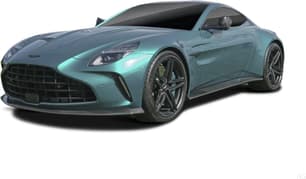
Ok, so the first thing you notice is this massive grille, which I now know is exactly 38 per cent bigger than before. That’s mostly for cooling, sucking in great lung-fulls of air – and any stray pets unlucky enough to wander into its path, I’d imagine — to keep that engine humming.
That air has to go somewhere, and the new bonnet vents complete the engine-cooling.picture.
Then there are 21-inch alloys are wrapped in performance rubber, and I love the swollen haunches at the rear tyres, giving the Vantage a mean and menacing vibe. At the rear, a very new and very loud quad-exhaust completes the picture.
In the cabin you'll find nothing in the way of hand-me-down Mercedes switchgear, which makes for change. This is all Aston Martin, and actually it all feels really nice.
The twin-screen setup looks tech-savvy and premium, the materials are all nicer than you'd find in something more track-obsessed, and even the optional race seats managed to be both snug-fitting and comfortable.
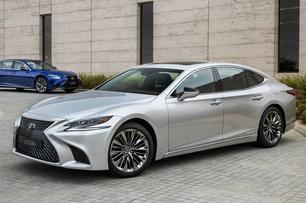
The XF50 series is a long and imposing machine, but is also arguably the most Toyota-looking LS in history, sharing design cues with most larger sedans the company builds – and yes, even the Camry. This is a departure from the Mercedes aping ‘90s and '00 generations. If the latest S-Class can look like a 200 per cent enlarged CLA, why not?
The most obvious – and pleasing – changes are realised when the headlights are switched on, revealing the BladeScan tech. In the F Sport, the redesigned bumpers' air intakes are noticeably larger and have jazzier pattern inserts, as part of a broader exercise in differentiating the grades with what's perceived as ‘sportier' elements throughout the car. The divisive ‘Spindle' grille theme remains.
Out back – arguably the most Toyota-esque part of the LS – are piano black tail-light inserts to differentiate new from old.
If Lexus is about presenting nuanced styling evolution as to not spook the demographic, then the MY21 flagship sedan succeeds brilliantly.
You’ll be shocked to hear that Aston Martin didn’t dedicate too much of its limited track time to extolling the practicality perks of its new Vantage, mostly because there simply aren’t that many of them.
But the most obvious one, I think, is that most of the people in the market for a $400k-plus vehicle in this category are likely to be, well, of a certain vintage, and it’s for these people that the more traditional layout of the Vantage will no doubt appeal.
See, the engine is up front, and the doors open in the usual fashion, making getting in and out of the cabin easy, and free of the human-origami antics sometimes required to climb in and out of a scissor-door supercar.
But there have been practical improvements made to performance here, too. There’s 30 per cent more power, 15 per cent more torque, new cooling, better aerodynamics, retuned suspension and anti-roll tech, new brake booster tuning, improvements to the ESP system, more body stiffness. And it goes on.
This is more like it.
While nowhere near the apex of striking interior design, with a dashboard that – again – is quite clearly from the contemporary Toyota way of thinking, the LS is massive inside, heaving with standard luxury and obsessively crafted in a few key touchpoint areas.
The brand makes a big noise about the floating door-sited armrests and their very obviously expensive craftspersonship, but it is eye-catching and satisfying to drink in the detailing, extending in and around into the dash seamlessly, carrying on the flowing, salubrious themes of sculptured multi-dimensional shapes. In 1989 journos were handing out similar platitudes in the original LS.
If the techno-overload of a Mercedes MBUX or Tesla's OTT tablet leave you cold, this enhances the luxury experience by adding a rich, cosy, warm ambience – though the instrumentation binnacle is familiar; all we can see is the first IS 250 of 1999, complete with its single, watch-face inspired analogue dial.
Here, of course, it's digitised and multi-configurable to accommodate sat-nav, multimedia and other vehicle-related needs, but it is a oddly nostalgic, given the brand's first BMW 3 Series rival is now almost forgotten. Still, it's interesting and isn't that what eccentric rich people who don't want to drive the cliché luxury behemoths desire?
With endless adjustability, the seats are sumptuous to the point of subsuming, in the way you'd imagine a limousine to be, but because of their bolstered support, they also can be manipulated into gently cupping you enough to stop you sliding about when throwing the Lexus about with gay abandon – more on that later on.
It doesn't need mentioning that the fit and finish is fabulous, with the enveloping luxury continuing out in the back seat. The Sport Luxury's airline-style recliners are enough to turn doubters into doe-eyed believers, with their restful, relaxing, relieving, refreshing and revitalising ways – well, to an extent that an airport massage-chair minus the coin box and dodgy stains can, in any case. But the fact remains: ensconced deep into that leather-lined luxury, slumber beckons. Namaste!
And that's the point of LS. It creates a sanctuary from the outside elements at least as effectively as Audi A8s, BMW 7s and Merc S' have costing upwards of 50 per cent more. The cabin is spacious, soothing and secure. On our extended drive of both 500 models, this was made abundantly clear with two stints behind the wheel of the visually similar ES 300h.
Quiet and refined, that car felt loud and coarse compared to the smooth silence of its supersized sibling. Mission accomplished, Lexus.
Let’s start with the big number, and that is the $410,000 you’ll need to park the new Vantage on your driveway. Interestingly, I was also on the launch of the previous Vantage, back in 2018, and that one was just under $300k. That’s quite the jump.
Anyway, for that spend you get a whole bunch of improved performance, obviously, but also quite a bit in terms of cabin tech and comfort. This isn’t a stripped-back supercar, and that’s a good thing, I reckon.
It starts outside with 21-inch five-spoke forged wheels wrapped in Michelin Pilot Sport rubber, matrix LED headlights and LED tail-lights, while in the cabin, there’s a 10.25-inch central screen with Apple CarPlay, a second 10.25-inch screen in front of the driver, an 11-speaker stereo, and wireless phone charging.
Value, refinement and customer care are Lexus' traditional brand pillars.
Lexus broke through with recession-ravaged consumers at the dawn of the 1990s by firstly presenting an attractively conservative S-Class sized sedan at smaller E-Class prices, and then adding an uncannily hushed cabin of exquisite build quality, silky V8 performance, the entire kitchen sink of gadgetry and unheard-of ownership privileges, like tickets to events, free parking at selected venues and home/work vehicle pick-up at service time.
If such a strategy worked then, why not an expanded version now? After all, while sales started off slowly in Australia three decades ago, in the vital US market its impact was immense. Lexus eventually gained traction locally, but nowadays the LS lags significantly behind the leading S-Class; in 2020, it managed a three per cent share compared to Mercedes' 25.5 per cent – or just 18 registrations versus 163.
Sadly, the V8s haven't returned, but the facelift does bring a richer interior with high-quality materials to elevate comfort levels, backed up by redesigned seating and overhauled adaptive suspension dampers that also promote a cushier ride while not compromising steering/handling performance.
Meanwhile, new ambient lighting and (at last) touch-display capability for the 12.3-inch central screen and Apple CarPlay/Android Auto connectivity do at least play catch up with the rest of the industry, let alone its direct rivals.
The same applies with the fresh safety gains for the series that include a digital rear-view mirror, Lexus Connected Services (with automated collision notification, SOS call and vehicle tracking), Intersection Turning Assist (that helps keep the driver from turning into on-coming traffic or brakes the car if, whilst turning, a pedestrian crosses the road), far-broader functionality of the autonomous emergency braking systems (including greater rear-cross-traffic warning and intervention), full-speed stop/go adaptive cruise control with traffic flow capability, improved road-sign recognition, better lane-keep and assist tech and a next-gen adaptive high beam tech dubbed BladeScan with stronger lighting and anti-glare performance parameters.
These come on top of the standard adaptive dampers, height-adjustable rear air suspension, front/rear cross-traffic alert, sunroof, gesture-activated powered boot lid, soft-close doors, puddle lights, 23-speaker premium audio, digital radio, DVD player, head-up display, satellite navigation, climate control with infrared body temperature sensitivity, heated/vented front and rear outboard seating, powered seats with memory, heated steering wheel, electric rear blind and a four-camera surround-view monitor.
The F Sport from $195,953 differs from the Sport Luxury from $201,078 (both before on-road costs) with its 10 airbags, dark 20-inch alloys and exterior trim hues, brake-package boost, rear-wheel steering, variable gear ratio, unique instrumentation and dark-metallic interior themes and bolstered front seats, while the LS 500 adds active anti-roll bars front and rear.
Going Sports Luxury changes things up somewhat, with two extra airbags (rear-seat cushion items), special noise-reduced alloys, rear-zone climate control, Semi Aniline leather, a front-seat relaxation system, rear-seat tablet-style screens, powered reclinable heated/vented rear seats with ottoman and massage, rear centre armrest with touchscreen climate/multimedia control, side sunshades and – in LS 500 only – a rear cooler box.
On the owner-benefit front, ‘Encore Platinum' introduced last year builds on the regular Encore's valet servicing with benefits like free use of a Lexus for business or leisure travel within select Australian and now-New Zealand destinations (one-way only – sorry, Kiwis) for up to four times annually and lasting the first three years of ownership. There's also eight yearly free valet parking at certain shopping malls and other venues, several celebrity-laden social events/activities and discounted Caltex fuel.
With all these features as standard, the LS costs several tens of thousands of dollars less than most full-sized luxury sedan rivals with broadly similar performance outputs and optioned up with equivalent luxuries, before the Encore Premium privileges. However, while the Lexus' four-year/100,000km warranty also betters most competitors by one year, it is mileage capped while others' regimes aren't, and none beat Mercedes' five-year/unlimited program.
Though prices are up by nearly $2000, it's fair to conclude the extra kit and improvements help offset them, but it's also worth remembering that earlier last year, Lexus hiked LS prices by up to nearly $4000, and not too long before Encore Platinum was announced...
The 4.0-litre twin-turbo V8 is still borrowed from Mercedes-AMG, but this is the new-generation unit, making 489kW and 800Nm. It gets modified cylinder heads and bigger turbos, helping generate the extra grunt.
That’s fed through an eight-speed ZF automatic and channeled through to the rear tyres. The race to 100km/h? That 3.5 seconds. Meanwhile, the flying top speed is around 325km/h.
The LS is powered by two versions of a 3.5-litre V6 petrol engine.
Around 75 per cent of buyers choose the 500, which employs Lexus' V35A-FTS 3445cc double overhead cam 24-valve twin-turbo V6 petrol engine, delivering 310kW of power at 6000rpm and 600Nm of torque from 1600-4800rpm. Powering the rear wheels via an updated AGA0 10-speed torque-converter automatic transmission with driver-adaptive tech, it can reach 100km/h in 5.0 seconds flat, on the way to a 250km/h top speed.
For the facelift, it receives a revised twin-turbo set-up with reduced lag, new pistons and a lighter, one-piece aluminium intake manifold to save weight and cut noise paths while retaining existing outputs.
The 500h, meanwhile, gains software updates for more electrical assistance at lower revs for stronger acceleration times and feel. It employs the 8GR-FXS engine – a 3456cc naturally-aspirated variation with a higher compression ratio (13.0:1 versus the 500's 10.478:1), developing 220kW at 6600rpm and 350Nm at 5100rpm.
Being a series-parallel hybrid, there is a 132kW/300Nm permanent magnet motor and 650-system volt lithium-ion battery, making for a combined power output to 264kW. It now can run longer on pure electric – up to 129km/h compared with 70km/h before. Sending drive to the rear wheels via the L310 continuously variable transmission with a four-speed shift device and a 10-speed simulated shift control operation to mimic more natural auto responses, it requires 5.4s to hit 100km/h, and manages the same top speed as its 500 counterpart.
Both autos, by the way, have more aggressive Sport and Sport+ shift ratio software, while the M manual mode has paddle shifters.
Kerb weight varies from 2215kg (500 Sports Luxury) to 2340kg (500h Sports Luxury).
There’s the official figure, which is 12.1L/100km on the combined cycle, and then there’s the real-world figure. It’s not really fare to judge fuel use when you’ve just stepped off a racetrack, but rest assured it was a large number, which is to be expected really.
The Aston’s 73-litre fuel tank prefers 98RON fuel, too.
The LS 500 returns a combined 10.0 litres per 100km, or 14.2L/100km urban and 7.6L/100km extra urban. Thus, the combined carbon dioxide emissions rating is 227 grams per kilometre, but can range from 172-321g/km. A theoretical average range of 820km is possible.
Moving on to the hybrid, the LS 500h manages a combined 6.6L/100km, or 7.8L/100km urban and an impressive 6.2L/100km extra urban. Its combined CO2, therefore, is 150g/km, and can drop as low as 142g/km and rise as high as 180g/km.
The Hybrid's average range should be about 1240km.
Both models require premium unleaded petrol as a minimum - 95 RON in the LS 500 and 98 RON in the Hybrid.
A key goal has been on reducing the stop/start frequency of the 500h's petrol engine during high-speed driving to increase both refinement and response.
It's funny, I never felt like the old Vantage wanted for power, but now I suddenly wonder how we ever made do with it. This feels like the engine and the outputs that should have always been, such is the way it suits the nature of Aston’s most performance-focused model.
Everything is about the driver here. From the suspension tune to the gearbox mapping and the increase in stiffness everywhere. You’re supposed to feel like the main character, and you do.
Aston Martin have come under fire in the past for delivering cars that are a treat to look at, but didn't quite deliver the drive experience to match the appearance, and it's something the brand says it is actively rectifying with with the Vantage, and the Astons that will follow it.
The mission, it says, is to be spoken of in the same sentence as the Italian supercar makers when it comes to delivering driver engagement, and this 2024 Vantage is a considerable leap in that direction.
It is, above all else, fun. From the multi-stage ESP settings that you can pair to your bravery, to the retuned and raucous exhaust and the blistering acceleration.
More than that, it feels light and lithe on a racetrack, and super communicative, the front wheels talking through your wrists, and the back tyres through, well, the bit of you that hits the bottom half of the racing seat...
It is plenty fun, right across the park. The power is immense, but somehow it doesn't feel terrifying, partly because you're so dialled-in to the drive experience, and partly because the carbon brakes fitted to our test car were able to slow the Vantage so savagely it's as though we'd dropped anchor out the back window.
The Vantage does have a split personality, though, and it's one that really shows itself once you venture out onto the road. It's quiet, comfortable even, at suburban speeds, leaning more into grand tourer than bonkers track-day special.
The only downside being that, should you sit behind the wheel long enough, it becomes easy to forget you're driving something "super" at all. Well, until your right foot finds its way back to the accelerator, that is...
No matter what it says on the badge, the LS is first and foremost a large, heavy and imposing luxury sedan. Its sporting capabilities are relative.
Keeping that in mind, the updates for the MY21 version are a success, since the largest Lexus passenger car is uncannily quiet and refined, as you might hope and expect. The ride quality is largely cushioned and free of bump intrusion inside, with a sense of gliding over most road surfaces as if they were blemish-free.
We much prefer the Sport Luxury version, and the 500h in particular, because it can run silently in electric mode for periods, and somehow feels more lavish and plusher to ride in.
Whether that's psychosomatic or actual is debatable, for essentially both the 500 and Hybrid share the same multi-link front and rear platform, adaptive dampers and rear air suspension set-up, but the impression is that this grade is the choice for those wanting to feel ultimate luxury and peace.
On paper, the 500 F Sport should be the driver's choice, since it has the racier look and set-up, as well as 600Nm of tree-trunk-pulling torque.
The thing is, it doesn't necessarily feel all that athletic, and maybe that's because the whole existence of this model is based around isolating its occupants as comfortably as possible. This is no criticism, and the LS certainly envelopes everybody as a great limo ought to, but don't expect Audi S8 levels of steering crispness or handling agility.
Anyway, if you need to feel as if you are a princess in exile escaping villains with bazookas out the back of a Kombi, then the LS does an exceptional job in keeping the 2.3-tonne-plus mass in motion, cornering safely and precisely where it is pointed to, without losing too much composure or traction in tight, fast bends. This is quite a feat, really, for the big Lexus can be hurried along a mountain pass through narrow passages like a much smaller sedan, and without being bumped out of line or off course.
Again, for all-out performance, the 500h feels stronger, especially when called on to pull ahead instantly at speed, because the electric assistance is palpable compared to the regular 500's twin-turbo V6. Both are obviously very, very fast and sufficiently responsive to throttle inputs – and it's a sign of the brand's engineering prowess that their internal serenity means the speed isn't obvious until you're looking at the speedo – but there isn't even a whiff of lag in the Hybrid. That said, once on the go, that twin-turbo V6 in the 500 soars.
Considered in this context, you have to say that the MY21 LS is an exceptionally sumptuous and sophisticated limousine with the speed, safety, security and capability of taking you from point A to B without drama or noise.
Or, for that matter, excitement.
You’ll never see a Vantage crash-tested by ANCAP, but it does arrive with a solid safety package.
There are front and side airbags, plus a heap of active safety stuff like AEB, forward collision warning, adaptive cruise, lane keep assist, lane departure warning, lane change assist with centring and front and rear cross-traffic alert.
Neither the ANCAP organisation nor Euro NCAP has crash-tested an LS for this or previous generations. And, for that matter, nor has the American NHTSA or IIHS, due to low sales.
Standard safety items include 10 to 12 airbags (depending on model, with dual front, front-side and curtain items), AEB with pedestrian and cyclist detection, forward collision warning, driver attention alert, Lane Keep Assist, a Front Lateral Side Pre-Collision System, Active Steering Assist, radar-based adaptive cruise control, Parking Support Brake, Road Sign Assist (detects certain speed signs), a four-camera Panoramic View Monitor, Blind Spot Monitor, Lexus Connected Services, Electronic Stability Control, traction control, anti-lock brakes with electronic brake-force distribution and brake-assist, and parking sensors all-round. The BladeScan adaptive LED headlights with anti-dazzle tech is also fitted.
The LS' AEB functions between 5km/h and 180km/h.
Additionally, two rear-seat ISOFIX points as well as three top tethers for straps are supplied.
Aston Martins in Australia are covered by a three-year/unlimited-kilometre warranty, but you can extend that for one or two years, at a price. You’ll be visiting the service centre annually, too.
Lexus offers a four-year 100,000km warranty, which is considered one of the worst in the industry for mileage distance, due to the low number. Most rivals offer unlimited kilometre warranties, as well as more years in some cases.
However, it does come with a three-year program covering standard logbook services completed at an authorised service centre, with the first three annual/15,000km services for the LS costing $595 apiece.
A complimentary pickup and return service from home or workplace is available, as are a loan car, exterior wash and an interior vacuum during servicing. It's all part of the Lexus Encore Owners Benefit program, offered for three years and includes 24/7 roadside assistance.
Finally, the Encore Platinum brings the aforementioned travel destination free Lexus vehicle program (four times a year over three years) in Australia and NZ, as well as numerous valet parking and events privileges, limited to a several annually, and discounted fuel at participating outlets.