What's the difference?
What makes the Aston Martin Vanquish a luxury car? Everything.
Its over-the-top performance and opulence makes its very existence the definition of a luxury car. Nobody on the planet has any need for this car, you only buy the Vanquish because you want it - and that makes it one of the most luxurious vehicles on sale today.
Its very existence is tied directly to what’s under the bonnet, the last V12 remaining in Aston Martin’s showroom, and the fact that some customers can simply not bring themselves to drive anything without 12 cylinders.
So, what’s it like driving the apex of luxury? Read on to find out…
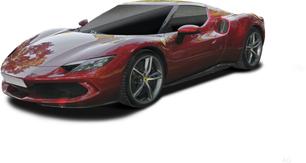
I know, picture Ferrari and you'll likely be conjuring images of potent V12 or V8 engines, a scenery-shaking exhaust bark on start-up and a fuel bill that would make a Sheikh wince.
But this one, the 296 GTS, doesn't have, or do, any of those things. In fact, it doesn’t so much explode into life as it does kind of whirr gently, as though you’ve just switched on a photocopier.
And yet, people I trust on these matters reckon this just might be the best Ferrari to have ever worn the badge. So, I guess we better get to figuring out what the hell is going on with this plug-in Prancing Horse.
The definition of luxury is having something you want, rather than something you need. And the Vanquish is definitely something you don’t need, but will desperately want once you’ve experienced it. It’s opulence on wheels, the kind of car you buy mostly because you can. Because owning a V8-powered Aston Martin wouldn’t cut it in your circle of friends. Or because you just want the very best things in life, cost be damned.
Anyone who says electrification somehow muddies the Ferrari formula is wrong. This plug-in Prancing Horse is among the most potent and direct vehicles I’ve ever driven, and the electric motor only adds to the experience.
While the engine is the unique heart of the Vanquish, the design is the first element that grabs your attention. Even for a brand renowned for its GT cars with imposingly long bonnets, the Vanquish stands out.
That’s because the designers deliberately added 80mm of space between the front axle and the A-pillar (the front windscreen pillar) to elongate the bonnet even more for what it calls a “rakish and indulgent” profile.
The lines flow across the length of the Vanquish, from its trademark grille to its Kamm Tail, giving it a look that is somehow simultaneously classically Aston Martin - with elements of its multiple generations of GT cars - while also being contemporary.
Some of the modern touches are derived from Formula One, as the brand looks to leverage its racing team, with bonnet louvres to help cool the engine without unsettling the air-flow too much.
Aston Martin’s Chief Creative Officer Marek Reichman calls the Vanquish “an iconic halo model” and explained the design was deliberately pushing “beyond the expected, rational, and thoughtful.” Which sums up this dramatic piece of automotive art quite nicely.
It is hard not to swoon when you gaze upon the 296 GTS, and I say that with no bias - I don’t think all Ferraris have looked this good.
But this is Ferrari at its dreamy, sweeping best, from the tarmac-kissing front — which generates so much downforce and cooling it negates the need for active aero — to its swollen haunches and the glass-topped engine window.
So what’s the difference between this and the GTB? Largely it is the ability to drop the folding roof, meaning you can feel the wind in your hair and that exhaust in your soul. To be honest, though, I reckon it looks better top up...
It’s a cockpit-style driver’s set-up inside, and there’s lots I love and some things I don’t. But let’s start with the steering wheel, which might be one of the best in existence.
It feels magic under the touch, as do the giant flappy paddles which remain fixed in place as you turn the wheel.
It’s also surprisingly comfortable in the figure-hugging sports seats, though climbing in and out of them is not necessarily something you want to do in front of a crowd.
Downsides? There is plenty of tech in the 296 cabin, but it’s all controlled from the steering wheel, making it fiddly and annoying to use.
Also, there are F1-levels of complexity on the control-everything steering wheel, and if I’m being honest, there are some buttons or switches, the function of which I still don’t fully understand.
Despite measuring nearly five metres long, the Vanquish is a surprisingly small car from a practicality perspective. Because the added wheelbase is ahead of the cabin, it remains strictly a two-seater, with no room for rear passengers.
There’s limited small item storage, too, aside from a couple of cupholders and a lidded console box. Although, on the plus side, the lack of rear seats creates room for some small shelves in case you need to store some loose items.
It also has a surprisingly small 248-litre boot, which means limited storage for anything, including luggage, for a road trip in what would otherwise be a great road trip car.
As for the multimedia system, while not at the cutting edge (although Aston Martin will debut Apple CarPlay Ultra in its DBX model) the system works well for this type of car.
It’s unlikely too many under 25s will be grabbing this $700K luxury GT, so the fact the media system has a touchscreen and an array of physical buttons is a welcome detail.
As for the 1170-watt, 15-speaker Bowers & Wilkins sound system, it performs incredibly well, as you would probably expect. Like the car it has loads of power but excellent attention-to-detail with fantastic clarity, too.
What do you want to know around practicality? We’re talking two seats, about 200 litres of cargo space total and a couple of smallish storage spaces in the cabin. And… that’s about it.
Next question, please.
The Vanquish sits at the top of the range for now, at least until the new Valhalla supercar arrives in Australia, and has an eye-watering starting price of $737,000.
Not only does that not include on-road costs, which will likely push the price closer to seven-figures, there’s also the plethora of options and customisation you can choose from that will add to the amount you pay.
Not that the standard specification is bad. For $700K you do get 21-inch alloy wheels, carbon ceramic brakes, 16-way adjustable sports seats, keyless ignition, a 10.2-inch touchscreen multimedia display, Apple CarPlay, Bluetooth, wireless phone charging and a 1170-watt 15-speaker Bowers & Wilkins sound system.
Of course, on top of all that you get a bespoke chassis and a unique twin-turbo V12 engine, that puts the Vanquish in the same class as the Ferrari 12Cilindri, which starts at $803,500 - making the Aston Martin look competitive.
Okay, hold your breath for a moment. The 296 GTS lists at $668,146, which is a sizeable jump over the hard-top GTB, which is more like $551,800. But what price a little open-air freedom?
What you get for that investment is a two-part (solid) folding roof, of course, but also what might be Ferrari’s most high-tech offering to date, with a plug-in hybrid system delivering potent performance rather than a usable EV driving range, a mega-clever braking system and an almost telepathic six-way 'Chassis Dynamic Sensor' designed to link the car’s key functions to make the experience, and the driver, somehow better.
Elsewhere, there are sports seats, Matrix LED headlights, 20-inch alloys, keyless entry and a very cool engine start touch-button on the even cooler steering wheel.
Oh, and there's wireless charging and Apple CarPlay, both thankfully standard in Australia, the latter controlled through the steering wheel and digital driver display.
It's all beautifully finished and a joy to behold and sit in.
The engine is undoubtedly the star attraction of the Vanquish, with the twin-turbo 5.2-litre V12 being the last of its kind in the British brand’s line-up now that the DB12 has switched to an AMG-sourced twin-turbo V8.
While that engine is arguably better with its excellent performance, smaller dimensions and lighter weight, the fact remains that for many of Aston Martin’s long-time buyers, it’s V12 or nothing.
It also helps that the V12 produces an extremely potent 614kW and 1000Nm, which is way ahead of the 611kW/678Nm the Ferrari 12Cilindri makes. So you get bragging rights at the golf club with your Ferrari mates.
The engine features a unique titanium exhaust and is paired with an eight-speed automatic transaxle that drives the rear wheels.
That is enough to propel the Vanquish to a top speed of 345km/h, making it the fastest production car the brand has ever produced, with a 3.3 second 0-100km/h time.
Now we're talking. The powertrain here is both tremendous and terrifying, pairing a 3.0-litre twin-turbo-petrol V6 with a rear mounted electric motor, and a 7.5kWh battery, to deliver a total 610kW and 740Nm. That power is fed through an eight-speed dual-clutch auto transmission.
Those are, frankly, scary numbers, and enough, Ferrari says, to dispatch 100km/h in just 2.9 seconds, and to push on to a top speed of 330km/h.
To say the Vanquish isn’t the most fuel frugal vehicle on the market is an obvious statement, but even its claimed 13.7L/100km is best described as optimistic.
That’s not surprising given its size and performance, but with an 82-litre fuel tank that’s a driving range of less than 600km, at best.
In the real world, during our time in the Vanquish, the car’s trip computer was indicating that we stayed in the high teens; although that featured limited freeway/extra-urban driving.
As well as the ability to start up and slink away silently, the Ferrari 296 GTS’s little battery will deliver a 25km EV-only driving range, and contribute to the overall claimed fuel use of just 6.5L/100km.
Charging is AC only, and the the brand reckons it takes around 90mins to top up using an 11kW charger. The self-charging is on-point, though, with the Ferrari able to quickly recoup energy from braking and the like to top up the battery without needing to plug in.
As cars go, few can match what the Vanquish offers. Even in my 20+ years of driving every type of car imaginable, the Vanquish stands out as being something distinct, bold and special.
Sitting behind the wheel, the bonnet looks like it stretches out to the horizon and you feel like you’re sitting on the back axle of the car. And yet, when you start driving, the Vanquish feels like it shrinks around you.
At normal speeds it feels like a classic grand tourer, relaxed, refined and easy to drive. Obviously it's a firmer ride than your average luxury car, but that’s a small price to pay for the breadth of capability this car offers.
Because once you get out of the urban environment, the Vanquish becomes something else entirely. On a winding road this British beast is surprisingly agile for such a big car.
The steering feels direct and the front end responds with much more precision and poise than you should reasonably expect from a car with such an exaggerated bonnet.
No, it doesn’t have the dynamic aggression the more compact Vantage offers, but it manages to take elements of that car and combine it with the GT nature of the DB12 to give you the best of both Aston Martin’s coupes.
Of course, the catch is it’s much too fast for Australian roads and isn’t really designed to be a track day car, so in Australia - without autobahns or more liberal views on speeding - the Vanquish in many respects doesn’t make sense.
But that is arguably its driving essence, you buy it because you know what it’s capable of, even if you’ll rarely use it, and that is an absolute luxury.
The engine is undoubtedly a highlight, and we’ll get to that in a moment, but I first want to talk about the steering in this car.
It might sound like a weird point to get hung up on, but it is sensational, and maybe the best I’ve ever experienced. Generally speaking, super-responsive steering can risk feeling overly sharp and uncomfortable when cruising, but somehow the 296 manages to feel super natural, super responsive, and super engaging, without every feeling sharp or darty. It’s just predictable, responsive, and spectacular.
Honestly, it is a highlight of a drive experience filled with highlights, with another being the dual-nature of this drop-top supercar. Long before I got anywhere near a twisting road I needed to navigate the usual nightmare that is Sydney, tackling traffic, suburbia, freeways, tunnels and expansion joints galore, and the 296 never felt uncomfortable.
Instead, the 296 slipped into a comfortable kind of lope, never jarring or rough, and eminently easy to get along with. And yet, when you arrive on the right road that veil of sensibility drops, and the Ferrari quickly reminds you of its potential.
For a start, the acceleration is properly, startlingly aggressive. Engage the 'Qualification' drive mode (which unlocks the full might of the Ferrari's electrified powertrain) and flatten your right foot, and you'll find the world suddenly hurtling past your windows, and your knuckles will no doubt whiten as you feel the rear tyres fighting for traction against the onslaught should you try it on anything but the straightest of roads.
It's addictive, but it's just one element of a near-perfect combination on offer here, with the 296 GTS the stiffest Ferrari drop-top to date, which becomes immediately clear as you start to attack corners with ever-growing confidence.
Grip, stability and stiffness in spades, the GTS delivers. And all accompanied by an exhaust howl so angry and evil it’s hard to believe it’s being generated by a V6.
It’s a thing of very near perfection.
There’s no ANCAP rating given the extreme low-volume nature of the Vanquish. However, it does come with complete airbag coverage for both occupants and a laundry list of safety acronyms.
These include autonomous emergency braking (AEB), forward collision warning (FCW), adaptive cruise control (ACC), traffic sign recognition (TSR), lane keep assist (LKA), lane departure warning (LDW), blind spot assist (BSA) and rear cross-traffic assist (RCTA).
In addition there’s driver attention assist, to make sure you stay alert in such an expensive machine, and door exit assist, so you don’t open the long doors into a passing car or cyclist.
Importantly, none of these systems are intrusive or annoying, so credit to Aston Martin for integrating them smoothly.
Not much chance of the 296 GTS being crash-tested in Australia — you’d be able to hear the Italians weeping across the ocean.
You do get front and side airbags parking sensors, a reversing camera, auto high beam and tyre pressure monitoring.
Despite the extraordinary price tag the Vanquish is covered by a very standard three-year/unlimited kilometre warranty. It’s a surprising, and some might argue disappointing, short period of coverage for a car that is not only expensive but should have a long life.
However, it does redeem itself in some way by including the first five years of servicing into the cost of the car. Ferrari offers seven for its models, so Aston Martin is still behind the market, but included servicing feels right for a car costing nearly $1 million once you put it in traffic.
Standard is a three year warranty, but you can extend that for up to five years. Then, if your car has less than 90,000km on the clock, you can opt into the 'New Power15', which gives you up to 15 years total warranty coverage and is fully transferable.
The first seven years scheduled maintenance is free-of-charge.