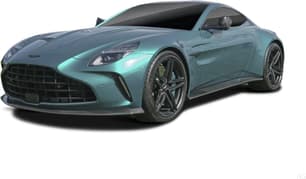
What's the difference?
What makes the Aston Martin Vanquish a luxury car? Everything.
Its over-the-top performance and opulence makes its very existence the definition of a luxury car. Nobody on the planet has any need for this car, you only buy the Vanquish because you want it - and that makes it one of the most luxurious vehicles on sale today.
Its very existence is tied directly to what’s under the bonnet, the last V12 remaining in Aston Martin’s showroom, and the fact that some customers can simply not bring themselves to drive anything without 12 cylinders.
So, what’s it like driving the apex of luxury? Read on to find out…
Aston Martin says the 2024 Vantage is designed to put the brand back where it belongs. And by that, it means thrust into the same conversation as Ferrari and Lamborghini when it comes to the ultimate in driver-focused supercars.
Which is why everything – and I mean everything – about this new model has been tightened, tuned or turned way the hell up in pursuit of performance.
Really, it has been a no-stone-left-unturned approach here. And the result, the brand reckons, is a car that delivers not just more power and more torque, but a near-telepathic connection between car and driver, too.
Well, that’s the promise anyway.
So how does the Vantage stack up in the battle for supercar supremacy? I was quite looking forward to figuring that out, to be honest.
The definition of luxury is having something you want, rather than something you need. And the Vanquish is definitely something you don’t need, but will desperately want once you’ve experienced it. It’s opulence on wheels, the kind of car you buy mostly because you can. Because owning a V8-powered Aston Martin wouldn’t cut it in your circle of friends. Or because you just want the very best things in life, cost be damned.
It’s either a comfortable race car or a bonkers grand tourer, but it’s that best-of-both worlds positioning that makes this new Vantage so appealing. Think of it as like a supercar for proper grown-ups, and one you don’t need to grunt and groan to extract yourself from.
Note: CarsGuide attended this event as a guest of the manufacturer, with travel, accommodation and meals provided.
While the engine is the unique heart of the Vanquish, the design is the first element that grabs your attention. Even for a brand renowned for its GT cars with imposingly long bonnets, the Vanquish stands out.
That’s because the designers deliberately added 80mm of space between the front axle and the A-pillar (the front windscreen pillar) to elongate the bonnet even more for what it calls a “rakish and indulgent” profile.
The lines flow across the length of the Vanquish, from its trademark grille to its Kamm Tail, giving it a look that is somehow simultaneously classically Aston Martin - with elements of its multiple generations of GT cars - while also being contemporary.
Some of the modern touches are derived from Formula One, as the brand looks to leverage its racing team, with bonnet louvres to help cool the engine without unsettling the air-flow too much.
Aston Martin’s Chief Creative Officer Marek Reichman calls the Vanquish “an iconic halo model” and explained the design was deliberately pushing “beyond the expected, rational, and thoughtful.” Which sums up this dramatic piece of automotive art quite nicely.
Ok, so the first thing you notice is this massive grille, which I now know is exactly 38 per cent bigger than before. That’s mostly for cooling, sucking in great lung-fulls of air – and any stray pets unlucky enough to wander into its path, I’d imagine — to keep that engine humming.
That air has to go somewhere, and the new bonnet vents complete the engine-cooling.picture.
Then there are 21-inch alloys are wrapped in performance rubber, and I love the swollen haunches at the rear tyres, giving the Vantage a mean and menacing vibe. At the rear, a very new and very loud quad-exhaust completes the picture.
In the cabin you'll find nothing in the way of hand-me-down Mercedes switchgear, which makes for change. This is all Aston Martin, and actually it all feels really nice.
The twin-screen setup looks tech-savvy and premium, the materials are all nicer than you'd find in something more track-obsessed, and even the optional race seats managed to be both snug-fitting and comfortable.
Despite measuring nearly five metres long, the Vanquish is a surprisingly small car from a practicality perspective. Because the added wheelbase is ahead of the cabin, it remains strictly a two-seater, with no room for rear passengers.
There’s limited small item storage, too, aside from a couple of cupholders and a lidded console box. Although, on the plus side, the lack of rear seats creates room for some small shelves in case you need to store some loose items.
It also has a surprisingly small 248-litre boot, which means limited storage for anything, including luggage, for a road trip in what would otherwise be a great road trip car.
As for the multimedia system, while not at the cutting edge (although Aston Martin will debut Apple CarPlay Ultra in its DBX model) the system works well for this type of car.
It’s unlikely too many under 25s will be grabbing this $700K luxury GT, so the fact the media system has a touchscreen and an array of physical buttons is a welcome detail.
As for the 1170-watt, 15-speaker Bowers & Wilkins sound system, it performs incredibly well, as you would probably expect. Like the car it has loads of power but excellent attention-to-detail with fantastic clarity, too.
You’ll be shocked to hear that Aston Martin didn’t dedicate too much of its limited track time to extolling the practicality perks of its new Vantage, mostly because there simply aren’t that many of them.
But the most obvious one, I think, is that most of the people in the market for a $400k-plus vehicle in this category are likely to be, well, of a certain vintage, and it’s for these people that the more traditional layout of the Vantage will no doubt appeal.
See, the engine is up front, and the doors open in the usual fashion, making getting in and out of the cabin easy, and free of the human-origami antics sometimes required to climb in and out of a scissor-door supercar.
But there have been practical improvements made to performance here, too. There’s 30 per cent more power, 15 per cent more torque, new cooling, better aerodynamics, retuned suspension and anti-roll tech, new brake booster tuning, improvements to the ESP system, more body stiffness. And it goes on.
The Vanquish sits at the top of the range for now, at least until the new Valhalla supercar arrives in Australia, and has an eye-watering starting price of $737,000.
Not only does that not include on-road costs, which will likely push the price closer to seven-figures, there’s also the plethora of options and customisation you can choose from that will add to the amount you pay.
Not that the standard specification is bad. For $700K you do get 21-inch alloy wheels, carbon ceramic brakes, 16-way adjustable sports seats, keyless ignition, a 10.2-inch touchscreen multimedia display, Apple CarPlay, Bluetooth, wireless phone charging and a 1170-watt 15-speaker Bowers & Wilkins sound system.
Of course, on top of all that you get a bespoke chassis and a unique twin-turbo V12 engine, that puts the Vanquish in the same class as the Ferrari 12Cilindri, which starts at $803,500 - making the Aston Martin look competitive.
Let’s start with the big number, and that is the $410,000 you’ll need to park the new Vantage on your driveway. Interestingly, I was also on the launch of the previous Vantage, back in 2018, and that one was just under $300k. That’s quite the jump.
Anyway, for that spend you get a whole bunch of improved performance, obviously, but also quite a bit in terms of cabin tech and comfort. This isn’t a stripped-back supercar, and that’s a good thing, I reckon.
It starts outside with 21-inch five-spoke forged wheels wrapped in Michelin Pilot Sport rubber, matrix LED headlights and LED tail-lights, while in the cabin, there’s a 10.25-inch central screen with Apple CarPlay, a second 10.25-inch screen in front of the driver, an 11-speaker stereo, and wireless phone charging.
The engine is undoubtedly the star attraction of the Vanquish, with the twin-turbo 5.2-litre V12 being the last of its kind in the British brand’s line-up now that the DB12 has switched to an AMG-sourced twin-turbo V8.
While that engine is arguably better with its excellent performance, smaller dimensions and lighter weight, the fact remains that for many of Aston Martin’s long-time buyers, it’s V12 or nothing.
It also helps that the V12 produces an extremely potent 614kW and 1000Nm, which is way ahead of the 611kW/678Nm the Ferrari 12Cilindri makes. So you get bragging rights at the golf club with your Ferrari mates.
The engine features a unique titanium exhaust and is paired with an eight-speed automatic transaxle that drives the rear wheels.
That is enough to propel the Vanquish to a top speed of 345km/h, making it the fastest production car the brand has ever produced, with a 3.3 second 0-100km/h time.
The 4.0-litre twin-turbo V8 is still borrowed from Mercedes-AMG, but this is the new-generation unit, making 489kW and 800Nm. It gets modified cylinder heads and bigger turbos, helping generate the extra grunt.
That’s fed through an eight-speed ZF automatic and channeled through to the rear tyres. The race to 100km/h? That 3.5 seconds. Meanwhile, the flying top speed is around 325km/h.
To say the Vanquish isn’t the most fuel frugal vehicle on the market is an obvious statement, but even its claimed 13.7L/100km is best described as optimistic.
That’s not surprising given its size and performance, but with an 82-litre fuel tank that’s a driving range of less than 600km, at best.
In the real world, during our time in the Vanquish, the car’s trip computer was indicating that we stayed in the high teens; although that featured limited freeway/extra-urban driving.
There’s the official figure, which is 12.1L/100km on the combined cycle, and then there’s the real-world figure. It’s not really fare to judge fuel use when you’ve just stepped off a racetrack, but rest assured it was a large number, which is to be expected really.
The Aston’s 73-litre fuel tank prefers 98RON fuel, too.
As cars go, few can match what the Vanquish offers. Even in my 20+ years of driving every type of car imaginable, the Vanquish stands out as being something distinct, bold and special.
Sitting behind the wheel, the bonnet looks like it stretches out to the horizon and you feel like you’re sitting on the back axle of the car. And yet, when you start driving, the Vanquish feels like it shrinks around you.
At normal speeds it feels like a classic grand tourer, relaxed, refined and easy to drive. Obviously it's a firmer ride than your average luxury car, but that’s a small price to pay for the breadth of capability this car offers.
Because once you get out of the urban environment, the Vanquish becomes something else entirely. On a winding road this British beast is surprisingly agile for such a big car.
The steering feels direct and the front end responds with much more precision and poise than you should reasonably expect from a car with such an exaggerated bonnet.
No, it doesn’t have the dynamic aggression the more compact Vantage offers, but it manages to take elements of that car and combine it with the GT nature of the DB12 to give you the best of both Aston Martin’s coupes.
Of course, the catch is it’s much too fast for Australian roads and isn’t really designed to be a track day car, so in Australia - without autobahns or more liberal views on speeding - the Vanquish in many respects doesn’t make sense.
But that is arguably its driving essence, you buy it because you know what it’s capable of, even if you’ll rarely use it, and that is an absolute luxury.
It's funny, I never felt like the old Vantage wanted for power, but now I suddenly wonder how we ever made do with it. This feels like the engine and the outputs that should have always been, such is the way it suits the nature of Aston’s most performance-focused model.
Everything is about the driver here. From the suspension tune to the gearbox mapping and the increase in stiffness everywhere. You’re supposed to feel like the main character, and you do.
Aston Martin have come under fire in the past for delivering cars that are a treat to look at, but didn't quite deliver the drive experience to match the appearance, and it's something the brand says it is actively rectifying with with the Vantage, and the Astons that will follow it.
The mission, it says, is to be spoken of in the same sentence as the Italian supercar makers when it comes to delivering driver engagement, and this 2024 Vantage is a considerable leap in that direction.
It is, above all else, fun. From the multi-stage ESP settings that you can pair to your bravery, to the retuned and raucous exhaust and the blistering acceleration.
More than that, it feels light and lithe on a racetrack, and super communicative, the front wheels talking through your wrists, and the back tyres through, well, the bit of you that hits the bottom half of the racing seat...
It is plenty fun, right across the park. The power is immense, but somehow it doesn't feel terrifying, partly because you're so dialled-in to the drive experience, and partly because the carbon brakes fitted to our test car were able to slow the Vantage so savagely it's as though we'd dropped anchor out the back window.
The Vantage does have a split personality, though, and it's one that really shows itself once you venture out onto the road. It's quiet, comfortable even, at suburban speeds, leaning more into grand tourer than bonkers track-day special.
The only downside being that, should you sit behind the wheel long enough, it becomes easy to forget you're driving something "super" at all. Well, until your right foot finds its way back to the accelerator, that is...
There’s no ANCAP rating given the extreme low-volume nature of the Vanquish. However, it does come with complete airbag coverage for both occupants and a laundry list of safety acronyms.
These include autonomous emergency braking (AEB), forward collision warning (FCW), adaptive cruise control (ACC), traffic sign recognition (TSR), lane keep assist (LKA), lane departure warning (LDW), blind spot assist (BSA) and rear cross-traffic assist (RCTA).
In addition there’s driver attention assist, to make sure you stay alert in such an expensive machine, and door exit assist, so you don’t open the long doors into a passing car or cyclist.
Importantly, none of these systems are intrusive or annoying, so credit to Aston Martin for integrating them smoothly.
You’ll never see a Vantage crash-tested by ANCAP, but it does arrive with a solid safety package.
There are front and side airbags, plus a heap of active safety stuff like AEB, forward collision warning, adaptive cruise, lane keep assist, lane departure warning, lane change assist with centring and front and rear cross-traffic alert.
Despite the extraordinary price tag the Vanquish is covered by a very standard three-year/unlimited kilometre warranty. It’s a surprising, and some might argue disappointing, short period of coverage for a car that is not only expensive but should have a long life.
However, it does redeem itself in some way by including the first five years of servicing into the cost of the car. Ferrari offers seven for its models, so Aston Martin is still behind the market, but included servicing feels right for a car costing nearly $1 million once you put it in traffic.
Aston Martins in Australia are covered by a three-year/unlimited-kilometre warranty, but you can extend that for one or two years, at a price. You’ll be visiting the service centre annually, too.