What's the difference?
Alfa Romeo. A brand with more re-boots than success stories. Yet one which driving enthusiasts the world over can’t seem to shake the allure of.
Of course, these are not cars for just everyone. Most mainstream buyers are scared away by what I like to call the three Rs. Rust. Reliability. Resale.
Alfa’s tumultuous (and often overstated) past is one it has trouble putting behind it. Reputations are hard earned and easily lost, and besides, the majority of the voting public aspire to own something German, which they see a lot more of on the road.
It doesn’t help that Alfa also dragged its feet on committing to a five-year warranty in Australia (in early 2022), hardly a statement of confidence in its product.
You’re probably wondering by now why anyone would buy one, and why it’s the car which most enthusiasts wish they were brave enough to own.
Well the Giulia is the Alfa Romeo. The low-slung, sporty, sexy car which a few of us out there still use as a reference-point for how to make a sedan in 2023 good-looking, and how to make one drive like it has heart.
The brand can throw all the SUVs at us it wants, but for those who see Alfa Romeo for the brand it should be, this car is it.
Parting sorrow, perhaps, the version we’re looking at for this review may be one of the last - under its new Stellantis management, Alfa has said it will leave this fantastic, promising Giorgio platform behind it in a move to be more electrified.
Travel with me, dear reader, as we celebrate a car which is the culmination of Alfa’s past, at a moment before it steps into the future.
James Cleary road tests and reviews the new Ferrari 488 Spider with specs, fuel consumption and verdict.
It’s almost inevitable. Tell someone you’re a motoring journo and the first question will be, ‘So, what’s the best car you’ve ever driven?’
Without getting into an esoteric analysis of what the word 'best' actually means in this context, it’s clear people want you to nominate your favourite. The fastest, the fanciest, the car you’ve enjoyed the most; the one that’s delivered a clearly superior experience.
And if I enter the room of mirrors (where you can always take a good hard look at yourself) the answer is clear. From the thousands of cars I’ve had the privilege of sliding my backside into, the best so far is Ferrari’s 458 Italia, an impossibly pure combination of dynamic brilliance, fierce acceleration, howling soundtrack and flawless beauty.
So, the opportunity to steer the open-roof Spider version of its successor, the 488, is a significant one. By rights, the best should be about to get better. But does it?
The Giulia is a love letter to the increasingly lost art of the sporty executive sedan. As refined as it is beautiful and oh-so elegant to drive, it’s a reminder of why we always love Alfa Romeo, even when the odds are against it.
Emotional cars like this are hard to come by and they will soon be gone, replaced by something new. The future is not necessarily worse, but it will be different, so if a sporty European sedan with a combustion engine is calling out to you don’t miss your opportunity to drive the Giulia while it still exists in this form.
The Ferrari 488 Spider is a brilliant machine. It's properly supercar fast, in a straight line and around corners. It looks stunning, and attention to design detail, engineering refinement and overall quality oozes from its every pore.
Is it the best car I’ve ever driven? Close, but not quite. Others may disagree, but for what it’s worth, I think the Ferrari 458 Italia, in all its high-revving, naturally aspirated glory is still the sweetest ride of all.
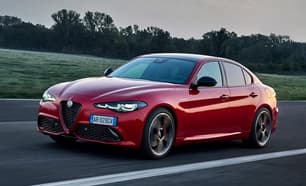
Like any good Alfa Romeo should be, the Giulia is a work of art. It’s sleek, sharp, and immaculately proportioned.
This most recent update has artfully refined a formula too good-looking to mess with. The increasingly dorky headlamps from the previous car have been swapped out for a more contemporary all-LED set, with a three-bar DRL pattern.
The grille has also been tweaked for this update for a more modern style, and the Veloce is now graced with the iconic and more aggressive sport two-tone alloy wheels in the traditional five-hole 'tele-dial' style.
It’s effortlessly attractive, and instantly recognisable as an Alfa on the road. I can’t think of a better way to stand out in today’s executive sedan landscape.
The interior has received less of an upgrade for the 2024 model year, with the same core parts. The major change is the old-school analogue instrument cluster being swapped out for a slick 12.3-inch digital unit.
The puzzling thing about this is the 8.8-inch central multimedia screen hasn’t been upgraded in-kind, making a strange contrast between the sharp and fast digital instruments, and the laggy and dull multimedia panel.
At least it effortlessly sits behind the curvaceous design of the dash as to not interrupt a good shape.
There are of course plenty of other touches which I love. The leather seats look and feel the part, as do the real metal paddle shifters which float behind the simple yet refined and sporty steering wheel.
The push-to-start button on the wheel is reminiscent of other Italian sports machines, while the tasteful smattering of leather, gloss plastic, and textured surfaces keep the premium feel on-track.
Some areas I’m not so keen about: Some of the interior plastics, particularly for buttons and toggles, feel cheaper than they should, and the door cards are oddly basic considering how much attention has been given to every other part of this car’s look and feel.
Launched in 2015, the 488 is the fourth mid-engine V8 Ferrari based on the aluminium space-frame architecture unveiled with the 360 Modena back in 1999, and unlike its Pininfarina-penned predecessors, was designed in-house at the Ferrari Styling Centre, under the direction of Flavio Manzoni.
The key focus this time around was aero performance, including the additional breathing and cooling needs of the 488’s 3.9-litre twin-turbo V8 (relative to the 458’s 4.5-litre naturally aspirated unit); hence the car’s most obvious visual identifiers - substantial air intakes in each flank.
Measuring 4568mm nose-to-tail, and 1952mm across, the 488 Spider is marginally longer (+41mm) and wider (+15mm) than its 458 equivalent. That said, it’s exactly the same height at just 1211mm tall, and the 2650mm wheelbase is unchanged.
Ferrari is a past master when it comes to sneaky concealment of spectacular aero trickery, and the 488 Spider is no exception.
Inside, the design is all about simplicity and focus for the person with the steering wheel in their hands.
Upper elements of its F1-inspired double front spoiler direct air to the two radiators, while the larger lower section subtly pulls flow under the car where carefully tuned ‘vortex generators’ and a yawning rear diffuser (incorporating computer-controlled, variable flaps) dial up downforce without a significant drag penalty.
The ‘blown’ rear spoiler manages air from intakes at the base of the rear screen, its specific geometry allowing a more pronounced (concave) profile for the main surface to increase upward deflection and maximise downforce without the need for an oversize or raised wing.
Those side intakes are divided by a central, horizontal flap, with air from the upper section directed to exits over the tail, pushing the low-pressure wake directly behind the car further back to again reduce drag. Air flowing into the lower section is sent to the turbo engine’s air-to-air intercoolers to optimise intake charge. All brilliantly efficient and tastefully incognito.
Putting the engine in the centre of the car and fitting only two seats doesn’t just pay off dynamically, it delivers the perfect platform for visual balance, and Ferrari has done a superb job of evolving its ‘junior supercar’ with a nod to the line’s heritage and an eye on extending its reach.
The tension across its multiple curved and contoured surfaces is beautifully managed, and the Spider’s crouching stance screams power and single-minded purpose.
Inside, while the passenger might be enjoying the ride, the design is all about simplicity and focus for the person with the steering wheel in their hands.
To that end, the slightly angular wheel houses a host of controls and displays including a very red start button, driving mode ‘Manettino’ dial, within-thumb’s-reach buttons for indicators, lights, wipers and ‘bumpy road’ (more on that later), as well as sequential max rpm warning lights across the top of the rim.
The steering wheel, dash, doors and console are (optionally) carbon-rich, with the familiar buttons for Auto, Reverse and Launch Control, now housed in a dramatic arching structure between the seats.
The compact instrument binnacle is dominated by a central rev-counter with digital speedo inside it. Readout screens for on-board info across audio, nav, vehicle settings, and other functions sit either side. The seats are grippy, lightweight, hand-crafted works of art, and the overall feeling inside the cockpit is an amazing mix of cool functionality and special event anticipation.
The Giulia is an old-school low-slung sports sedan. Many will prefer the SUV sensibilities of the Stelvio, with its bigger hatch-opening boot, and its higher ride height can better accommodate less mobile passengers, and makes it easier to fit child seats and the like.
For those willing to trade those things away for a superior drive experience, the Giulia is still solid to live with every day, but has a few drawbacks.
For example, those strangely basic door cards offer only a tiny map pocket with a nook I’d hardly describe as a bottle holder.
The centre console offers two larger bottle holders with variable edges, but there’s also not much else in the way of storage in the cabin aside from a smaller-than-average glove box and armrest console box.
The big win for me is the physical dial set and shortcut buttons for all the key climate functions, making it easy to operate while you’re concentrating on driving.
At least the seats are well bolstered, and front passengers are treated to plenty of adjustability. Visibility is okay, and it was easy for me to find a comfortable driving position at 182cm tall.
The rear seat is a similar story. It’s tighter, and you have to duck down below the roofline to get into it.
Once inside, I was pleasantly surprised to find enough room for my knees and somewhere for my feet to slide behind my own driving position, although the centre position is all but useless thanks to an enormous raise for the driveshaft.
Headroom is passable, but you wouldn’t want to be much taller than me.
There are, again, tiny bottle holders in the doors, and a further two in the drop-down armrest. Rear seat passengers get dual adjustable air vents on the back of the centre console, one USB 2.0 outlet, and elastic nets on the backs of the front seats.
The boot measures 480 litres which is up there with a lot of mid-size SUVs, but because it’s a sedan, access is more limited, and it won’t accommodate as many awkwardly-shaped objects.
Okay, so how do you approach practicality in a car that’s so obviously not engaged with the concept?
Best to say there’s cursory consideration in terms of cabin storage, with a modest glovebox, small pockets in the doors, and a pair of piccolo-sized cupholders in the console. There’s also a net and some general oddments space along the bulkhead behind the seats.
But the saving grace is a generous, rectangular boot in the nose, offering 230 litres of easy-to-access load space.
Another attribute fitting broadly under the heading of practicality is the retractable hardtop which smoothly unfolds/retracts in just 14 seconds and operates at speeds up to 40km/h.
The Giulia we’re looking at for this review is the mid-spec Veloce, which costs $74,950 before on-road costs, sitting above the base Ti ($68,450) and below the top-spec Quadrifoglio ($153,700).
Natural rivals from Germany include the Audi A4 45 TFSI ($77,869), BMW 320i M Sport ($80,200) and Mercedes-Benz C200 ($89,900) all of which suddenly make the attractive Alfa look like a not-half-bad deal.
But then there’s always the Genesis G70 (from $63,000 in equivalent turbo 2.0L form) to bring the value equation back to reality.
Standard stuff at this grade includes 19-inch alloys, an 8.8-inch multimedia touchscreen and a 12.3-inch digital instrument cluster (new for the 2024 model year), dark contrast exterior highlights, leather seat trim with heated front seats and steering wheel, aluminium interior detailing and shift paddles with extended leather trim on the dash, updated LED headlights and DRLs, dual-zone climate, push-start ignition and keyless entry, tinted rear windows, and a 14-speaker Harman Kardon audio system.
Performance-wise, the Veloce also scores a limited-slip rear differential to match its punchy engine.
The tech feels a bit old, and the interior has a dated ambiance to it compared to the more open and digitised spaces of its rivals, but there’s something to be said for how organic the Alfa feels. More on this later.
Let’s get the big number out of the way. The Ferrari 488 Spider costs $526,888 before on-road costs.
Included in that not inconsequential figure is the ‘E-Diff3’ electronically-controlled differential, ‘F1-Trac’ traction control, ASR & CST, ABS, an anti-theft system, carbon-ceramic brakes, Magnaride shock absorbers, dual-zone climate control, racy leather seats, bi-xenon headlights with LED running lights and indicators, keyless start, Harman multimedia (including 12-speaker, 1280-watt JBL audio), 20-inch alloy rims, tyre pressure and temperature monitoring, and… a car cover.
But that’s just the starting point. Any self-respecting Ferrari owner will need to put a personal stamp on their new toy and the prancing horse is happy to oblige.
If you want an exterior colour to match your favourite polo pony’s eyes, no problem, the Ferrari Tailor-Made program will do whatever it takes. But even the standard options list (if that makes sense) offers more than enough scope to make an already spectacular four-wheel statement even more distinctive.
Our test car featured six new Mazda3’s worth of extras. That’s just under $130k, with the highlights being more than 25 grand in exterior carbon-fibre, $22k for the special, two layer, iridescent effect ‘Blue Corsa’ paint, over $10k for chrome painted forged rims, and $6790 for Apple CarPlay (standard on the Hyundai Accent).
But you’ve got to remember an inverse logic applies here. While some may see $3000 for cavallino rampante shields on the front wings as somewhat pricey, to a proud Ferrari owner they’re badges of honour. In the yacht club carpark, showing off their latest acquisition, you can script the satisfied boast - ‘That’s right. Two grand. Just for the floor mats!’
The Veloce might not pack a Ferrari-derived six-cylinder engine like the Quadrofoglio, but its smaller 2.0-litre four-cylinder turbocharged petrol engine hardly wants for power.
Packing 206kW/400Nm it outpunches six cylinders of old easily, and is still capable of sprinting to 100km/h in a hot-hatch baiting 5.7 seconds to a Vmax of 240km/h.
It even sounds fantastic, as it flies up the rev-range living up to every bit of the Alfa promise. Peak power arrives at 5250rpm, but peak torque hits at 2250rpm.
Smooth shifts are provided courtesy of an eight-speed traditional torque converter automatic transmission.
The 488 Spider is powered by an all-alloy, mid-mounted 3.9-litre, twin-turbo V8, featuring variable valve timing and dry sump lubrication. Claimed outputs are 492kW at 80000rpm and 760Nm at a usefully low 3000rpm. Transmission is a seven-speed 'F1' dual clutch driving the rear wheels only.
The 2.0L turbocharged engine has an official combined cycle fuel consumption figure of just 6.1L/100km, although I saw 9.0L/100km in my time with it.
I’ll admit it was being enthusiastically driven, and treated to lots of urban commuting.
The Giulia has a 58-litre fuel tank and requires mid-shelf 95 RON premium unleaded fuel. Its approximate range on a full tank at the official consumption is 951km.
Put simply: The Giulia is a celebration of Alfa Romeo. Yes. Even with a humble 2.0-litre turbocharged engine and an automatic transmission, this is a deeply emotional car. A riveting experience from behind the wheel.
Fly round corners, your eyes wide, exclaiming ‘magnifico!’ as the Giulia gracefully leans in, the rear LSD, sporty tyres, and wonderfully tight steering working together in harmony as you eke out just a smidge of tyre roar.
Laugh out loud to yourself, as you plant the accelerator, hear the muted rumble of the surprisingly angry little engine, and feel the turbocharger kick in half a second later as you power out.
‘Eccezionale!’ You’ll think, as you feel the click of the immensely satisfying metal paddle-shifters, and the transmission responds in-kind, the engine roaring up the revolutions with enthusiasm.
Sure, the Veloce grade is not as raw, or as wild, or near as fast as the top-grade Quadrofoglio, but all of the exciting spirit of that car is still here, and at a little over half the price, too. The Veloce is an absolute delight to drive.
It has such poise, makes such a fine sound, and does it all so gracefully. This is how you make a car feel as one with the driver.
Even the ride is deeply impressive. It’s not too harsh or noisy, while gifting the chassis just the right amount of lean in the corners and allowing enough play for it to remain controlled over bumps.
Not only does it work well when you’re driving as it's clearly intended to be driven, but around town it’s quiet and refined inside, living up to the promise of a luxury sedan.
The seats and bolstering are great, the visibility isn’t too bad, and while I’ll complain about the slightly laggy software on the multimedia screen, the digital dash is responsive and the physical climate controls are welcome.
It’s not all perfect. If it were, I think it might cease to be an Alfa Romeo and start sprouting BMW badges.
For example, our test car, with less than 2000km on the odometer, had various inconsistent rattles emanating from the plastic garnish around the digital dash, and somewhere behind the back seat.
Regardless, driving this car has made me a little sad Alfa will be putting this wonderful platform behind it in pursuit of more electrified goals.
I can only hope wherever the Giulia nameplate goes next, it retains the spirit of this version.
We had the rare opportunity of driving the 488 Spider on road and track with Ferrari Australasia handing us the keys for a rural run from Sydney to Bathurst, followed by some private bonding time on the roads around town, then a batch of unrestricted hot laps on the Mount Panorama circuit in the lead up to this year’s 12 Hour race (which the scuderia won in emphatic style with the 488 GT3).
On the freeway, cruising at 110km/h with roof open, the 488 Spider is civilised and comfortable. In fact, Ferrari claims normal conversation at speeds over 200km/h isn’t a problem. Top tip (no pun intended) is to keep the side glass and small electric rear window raised to minimise turbulence. With the roof up, the 488 Spider is every bit as quiet and refined at the fixed roof GTB.
The 458 Italia atmo V8’s rising fortissimo howl is one of the world’s greatest mechanical symphonies.
Even with the multi-mode Manettino in its regular ‘Sport’ setting and the seven-speed ‘F1’ dual-clutch gearbox in auto, all it takes is a gentle crank of the right ankle to despatch pesky road users with the temerity to impede the 488’s progress.
On the quiet, open and twisting roads around the outskirts of Bathurst we may have flicked the switch to ‘Race’, slipped the gearbox into manual and given the 488 Spider a nudge. In some sweeping corners on Mount Panorama we might have even tested Einstein’s theory that matter bends the fabric of space and time. In short, we were able to get a good feel for the car’s dynamic abilities, and they are monumental.
Relative to the 458, power is up a lazy 17 per cent (492 v 418kW), and turbo-fed torque leaps a staggering 41 per cent (760 v 540Nm), while kerb weight is trimmed by 10kg (1525 v 1535kg).
The result is 0-100km/h in 3.0 seconds (-0.4sec), 0-400m in 10.5 (-0.9sec), and a maximum velocity of 325km/h (+5km/h).
If you must know, given fuel efficiency and emissions performance was the key driver behind Ferrari’s move to a turbo powerplant, all this is balanced by claimed 11.4L/100km combined economy (down from 11.8 for the 458).
A full blown launch in this car is like lighting the wick on an Atlas rocket, with a seemingly never-ending surge of thrust pinning your back to the seat, and each pull of the column-mounted carbon gear paddle delivering a seamless and near instantaneous shift. Ferrari claims the 488’seven-speed ‘box shifts up 30 per cent quicker, and down 40 per cent faster than the 458’s.
The lofty summit of the twin turbo’s torque mountain arrives at just 3000rpm, and once you’re up there it’s a table top rather than a peak, with more than 700Nm still on call at close to 7000rpm.
Maximum power arrives at 8000 (perilously close to the V8’s 8200rpm rev ceiling), and the delivery of all this brute force is impressively refined and linear. To improve throttle response, the compact turbos incorporate ball-bearing-mounted shafts (rather than the more common sleeve bearing type), while the compressor wheels are made from TiAl, a low-density titanium-aluminium alloy. As a result, turbo lag simply isn’t in the 488’s vocabulary.
And what about the sound? On its way to 9000rpm the 458 Italia atmo V8’s rising fortissimo howl is one of the world’s greatest mechanical symphonies.
Maranello’s exhaust engineers allegedly spent years fine-tuning the 488’s aural output, developing equal length tubes in the manifold to optimise harmonics before gas flow reaches the turbos, to get as close as possible to the high-pitch wail of a naturally aspirated Ferrari V8.
All we can say is the 488’s sound is amazing, immediately turning heads on contact... but it ain’t no 458.
Using the 488 Spider’s incredible dynamic ability to translate forward momentum into lateral g’s is one of life great pleasures.
Supporting the double wishbone front and multi-link rear suspension set-up is a host of high-tech widgets including the tricky E-Diff3, F1-Trac (stability control), High-Performance ABS with Ferrari Pre-Fill, FrS SCM-E (magnetorheological shock absorbers), and SSC (side-slip control).
Combine that with the active aero quietly turning the car into a four-wheel suction cup, plus ultra-high performance Pirelli P Zero rubber, and you have amazing grip (the front end especially, is incredible), perfect balance and stunning corner speed.
Our Mount Panorama blat confirmed the 488 Spider remains poised and throttle steerable through corners and curves at ludicrous speeds.
Chasing gears into the top of the ‘box up mountain straight made the lights on the upper rim of the steering wheel look like a fireworks display. The Spider transmitted its every move across the top of the circuit through the lightweight seat, and the very fast blast into The Chase at the bottom of Conrod Straight was other-worldly. Set the car up on entry, keep squeezing the throttle, grease in just a fraction of steering lock, and it just blazes through like a high-speed hovercraft, at 250km/h-plus.
More time back outside Bathurst confirms feel from the electro-hydraulic rack and pinion steering is brilliant in the real world, although we did notice the column and wheel shaking in our hands over bumpy backroads.
The quick fix there is a flick of the ‘bumpy road’ button on the steering wheel. First seen on the 430 Scuderia (after then Ferrari F1 hero Michael Schumacher pushed for its development), the system de-links the shock absorbers from the Manettino setting, providing extra suspension compliance without sacrificing engine and transmission response. Brilliant.
Stopping power comes courtesy of a ‘Brembo Extreme Design’ system derived from the LaFerrari hypercar, which means standard carbon-ceramic rotors (398mm front, 360mm rear) clamped by massive calipers - six piston front, four piston rear (our car’s were black, for $2700, thank you). After multiple stops from warp speed to walking pace on the circuit they remained firm, progressive, and hugely effective.
The same safety equipment suite is standard on every Giulia variant.
Advanced active gear includes auto emergency braking, lane keep tech, blind-spot monitoring with rear cross-traffic alert, driver attention alert, and adaptive cruise control.
It also scores front and rear parking sensors, and a reversing camera with guidelines.
The Giulia’s maximum five-star ANCAP safety rating expired at the end of last year, as it was originally rated back in 2016. The facelifted model is ‘unrated’ relative to ANCAP’s current standards.
In terms of active safety the various driver aids mentioned above do their part to avoid a crash, and if the worst comes to worst dual front and side airbags are in place.
The 488 Spider has not been rated for safety performance by ANCAP.
Alfa finally updated its warranty to a more industry-standard five-years and unlimited kilometres in 2022.
Service intervals occur at 12 monthly or 15,000km intervals for the 2.0-litre turbocharged variants. Pricing was not available for the model year 2024 version yet in the brand’s online calculator, but to give you an idea for the pre-facelift version, pricing came in between $345 and $1065 per visit, averaging $573 per year for the first five years of ownership. Not cheap, but not as expensive to run as you might expect.
One thing you might want to keep in mind is depreciation. Boring, I know, but even late model examples of the Giulia and Stelvio have been hit particularly hard by the depreciation stick according to residual values we searched up on Autotrader.
For reference, the Genesis G70 and BMW 3 Series have both fared much better in equivalent 2.0-litre turbo forms.
The Ferrari 488 Spider is covered by a three year/unlimited km warranty, and purchase of any new Ferrari via the authorized Australian dealer network includes complimentary scheduled maintenance, through the ‘Ferrari Genuine Maintenance’ program for the first seven years of the vehicle’s life.
Recommended maintenance intervals are 20,000km or 12 months (the latter with no km restrictions).
Genuine Maintenance attaches to the individual vehicle, and extends to any subsequent owner within the seven years. It covers labour, original parts, engine oil and brake fluid.