What's the difference?
Since 1949, Abarth has been giving the venerable Italian brand, Fiat, a patina of performance, based largely on giant-killing feats in small modified cars like the Fiat 600 of the 1960s.
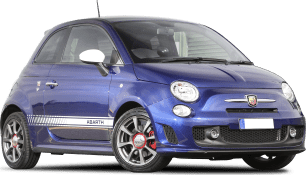
More recently, the brand has been revived to boost the fortunes of the smallest Fiat on sale in Australia. Known formally as the Abarth 595, the tiny hatch packs a bit of a surprise under its distinctive snout.
If you’re someone still convinced the newcomer Chinese brands don't have what it takes to shake up the Australian new car market, this might just prove you wrong.
It’s the 2025 XPeng G6 Long Range, and it’s a lot like the Tesla Model Y, only cheaper – and, in some ways, much better.
Don't believe me? Read on and I'll prove it.
It’s tough to be kind to the Abarth 595. Based on a platform that’s more than a decade old, the car has been left behind by its rivals in many ways, including basic ergonomics and its value equation.
The larger engine does work well in this smaller package, and its road-holding ability belies its size. However, only die-hard fans of the Abarth brand will be able to cope with the uncomfortable seating position and a complete lack of even the most perfunctory features that cars costing $10,000 less are able to offer.
You never know quite what to expect when you jump into the first model from a brand-new brand, but the XPeng G6 was a pleasant surprise. And at this price, with these features, it should really give Tesla Model Y shoppers something to think about.
Despite being based on a design that’s a decade old, the Abarths still stand out. Based on the classic Fiat 500 shape of the 1950 and '60s, it’s more cute than cut-throat, with a narrow track and tall roof giving it a toy-like presence.
The Abarth attempts to beef things up with deep front and rear bumper splitters, go-fast stripes, new headlights and alternate-colour wing mirrors.
The 595 rides on 16-inch rims, while the Competizione runs 17s.
Inside, it’s definitely different to most mainstream cars, with colour-coded plastic panels on the dash and a very upright seating position, along with a dual-tone steering wheel.
It’s a love-it-or-hate-it proposition. There’s no middle ground here.
There’s more than a little Tesla Model Y in the XPeng’s exterior design, with the two sharing the same kind of soft-edged, swept-back SUV styling.
It helps make the XPeng look familiar and inoffensive, and while I wouldn’t go so far as to call it ground-breaking, I think it has enough exterior flourishes to break up the body work, and I don’t mind the way it looks, and the way it sits on those big alloys.
Inside, it’s a spacious and pretty stylish space. This giant screen is super responsive, and is easy enough to navigate, with the key functions (like climate) glued to the bottom of the screen so you don't have to paw through menus to access them. The idea begins to fail when you have Apple CarPlay or Android Auto active, though, as you have to revert back to the car's home screen to access anything.
The XPeng uses its steering wheel controls to access air-con fan and temp controls as a kind of shortcut, but confusingly they change to distance adjustment when you’ve got the cruise control on. An easier, and much better solution would be to bring back buttons.
I also don't love the stalk-style gear selector, which doubles as a cruise control activator, and, with a double pull, as your autonomous helper. It just feels super old-school in a vehicle this modern.
What is a massive win though is the driver screen. Tesla fans can scream minimalist aesthetics all they want, but the drive experience is simply better when you can see your speed and other key info right in front of you.
This is another area where the Abarth falls down. First and foremost, the seating position for the driver in both cars is utterly compromised.
The seat itself is mounted far, far, too high, and has little adjustment in any direction, and there is no reach adjustment in the steering wheel column to allow a taller (or even an average height) driver to get comfortable.
The more expensive Competizione we tested was fitted with a set of optional sports bucket seats from racing company Sabelt, but even they are mounted literally 10cm too high. They are also ultra firm, and even though they look supportive, lack decent side bolster support.
The tiny multimedia screen is okay to use, but the buttons are miniscule, while there’s a complete lack of storage places in the front.
There are two cupholders under the centre console, with two more in between the front seats for rear seat passengers. There are no bottle holders in the doors and no storage for rear seaters.
Speaking of the rear seats, they are the very definition of cramped, with little headroom for moderately sized adults and precious little knee or toe room. There are two sets of ISOFIX baby seat mounting points, though, should you fancy wrestling your wriggling toddlers through the narrow aperture.
The seats flip forward to reveal more cargo space (185 litres with the seats up, and 550 litres when the seats are down), but the seat backs don’t fold flat into the floor. Under the boot floor is a can of sealant and a pump, but no space saver spare.
In truth, it was a long day testing this car… at 187cm, I simply could not get comfortable in it at all.
At 4753mm in length, 1920mm in width and 1650mm in height, the XPeng fits into the fast-growing mid-size electric SUV space.
And it ticks a lot of practicality boxes, like with its 571-litre boot, swelling to 1374 litres with the seats folded. But its real party trick is in the back seat, where the space is properly massive.
I have another mid-size SUV, powered by a petrol engine, at the moment and our baby seat presses against the back of the passenger seat. In this it feels like I could fly a kite in the space between them.
It’s the same for passengers, too. Honestly, the real estate on offer is massive, and that includes for the middle-seat rear passenger, where the lack of a bulky tunnel eating into legroom means adults can sit there comfortably.
There's a pull-down divider separating the back seat that's also home to two cupholders, and there are twin USB connections, as well as air vents (though no temp controls).
There's no spare tyre, though, which means fiddling with the repair kit should you get puncture, or waiting for roadside assist.
The range has been stripped back to just two cars, and costs has come down slightly, with the 595 now starting at $26,990, plus on-road costs.
A new 5.0-inch touchscreen multimedia system (with digital radio), a leather wrapped steering wheel, TFT dash display, rear parking sensors, alloy pedals, 16-inch alloy rims, and (front-only) adaptive dampers are standard on the base 595.
A convertible, or more accurately, a rag-top (cabriolet) version of the 595 is also available for $29,990.
The 595 Competizione is now a whopping $8010 cheaper at $31,990 with a manual gearbox, leather seats (Sabelt-branded sports buckets are optional), 17-inch alloys, a louder Monza exhaust, as well as front and rear adaptive Koni shocks, and Eibach springs.
Unfortunately, what stands out more on the Abarths is what they don’t come with. Auto lights and wipers, cruise control of any sort, driver aids including AEB and adaptive cruise… even a rear view camera is missing.
What’s more puzzling is that the Abarth’s architecture, though a decade old, has provision to accept at least a rear view camera.
Abarth’s explanation that the car’s home market doesn’t see these inclusions as important doesn’t really hold water, either.
In terms of value, the lack of basic content sends the Abarth to the bottom of a competitive pile that includes both the Ford Fiesta ST and the Volkswagen Polo GTI.
Okay, first things first – what the hell is XPeng? It's been around for about 10 years in China, but only made its way to Australia last year. It was founded by some former car company execs and tech tycoons — one of whom is telecommunications billionaire He Xiaopeng, which is where that name comes from.
Anyway, this one is the XPeng G6, which launched in Australia with two trims – the Standard Range, which is $54,800, before on-road costs, and the one we’ve tested, the Long Range, which is $59,800. The difference is in the battery size, of course, but we’ll get to that in a minute.
As of now, the new Model Y can be ordered for $63,400 for the Standard Range or $73,400 for the Long Range, which makes the XPeng a whole heap cheaper.
Outside, you get LED lighting all around (including the DRLs), a massive glass roof, auto door handles, an auto-opening boot, a V2L connection, which allows you to use your XPeng’s battery to power whatever you plug in and big 20-inch wheels wrapped in Michelin rubber.
You also get some cool high-tech features, accessed through the XPeng app, like the ability to drive your car out of tight parking spots remotely.
Inside, there are synthetic-leather seats that are heated, a heated steering wheel, dual-zone climate, a massive 18-speaker sound system (with speakers in the headrest), wireless charging and two very handy screens — a responsive 15-inch central screen with Android Auto and Apple CarPlay, and a 10.2-inch digital dashboard.
There’s also more safety stuff than you can shake a crash test at, but we’ll come back to that in a second.
The Abarth 595 pair use the same 1.4-litre 'MultiJet' four-cylinder turbo engine in differing states of tune. The base car makes 107kW/206Nm, while the Competizione makes 132kW/250Nm, thanks to a freer-flowing exhaust, a larger Garrett-branded turbocharger and an ECU re-tune.
The base car can do 0-100km/h in 7.8 seconds, while the Competizione is 1.2 seconds quicker; the optional 'Dualogic' automatic is 0.2sec slower to the mark in both cars.
A five-speed manual gearbox is standard, and neither car is fitted with a limited slip diff.
This G6 is a rear-wheel drive affair, with a single electric motor housed at the rear axle. It produces 190kW and 440Nm in Standard Range form or 210kW/440Nm in Long Range guise, which don’t sound like massive numbers — especially given the 2.0-tonne-plus weight of this XPeng – but it gets up and moving just fine.
The 100km/h sprint is a claimed 6.2 seconds, while the top speed is 200km/h.
Over 150km of testing, the Competizione consumed a dash-indicated 8.7 litres per 100km, against a claimed combined fuel economy figure of 6.0L/100km. Our brief test of the 595 revealed a similar number, against the same claimed figure.
The Abarth will only accept 95 octane fuel or better, and its small 35-litre tank is good for a theoretical 583km between fills.
The Long Range version of the G6 nabs a 87.5kWh battery (compared to 66kWh in the Standard Range), unlocking a claimed driving range of 570km.
The official power use figure is 17.5kWh/100km, but I did a fair bit of driving on all sorts of roads and my number was more like 14kWh.
When it does come time to charge, the G6 is set up for 280kW DC fast charging which means, should you find the right fast charger, a 10-80 per cent charge should arrive in just 20 minutes. Home charging will take a lot longer, of course – we’re talking overnight plugged into a regular wallbox.
Ergonomics aside, the combination of torquey engine and lightweight car is always a good one, and the 1.4-litre turbocharged four is a good match with the front-drive Abarth.
There’s always enough mid-range urge to give the Abarth the hurry-up, and the longer-legged five-speed gearbox is a good match for the engine.
It also grips and turns surprisingly well, despite the Sport button adding too much artificial weight to the Abarth’s steering feel.
That same button also firms up the front dampers on the 595 and all four on the Competizione, which works well on smoother terrain, but stiffens it too much over more undulating surfaces.
Around town it can be hard to strike a good balance between ride and comfort. The difference between soft and firm is much more pronounced in the Competizione, but it will still get tiring if your commute is a bumpy one.
The turning circle, by the by, is ridiculously large for such a small car, making u-turns - already compromised by the lower front bumper - unnecessarily fraught.
The Monza exhaust on the Competizione gives it a bit more presence, but it could easily be louder (or at least more crackly) again; you’re not buying this car to be a wallflower, after all.
How much you love your time behind the wheel of the XPeng G6 comes down to what you're looking for from your mid-size electric SUV.
Speed and sportiness? There's not much of either. But it does serve up tons of space and technology, surprising refinement and a calm and cosseting ride.
And I think you can mount a pretty solid argument that all of that is pretty important in a mid-size SUV, more so than the ability to carve corners.
I did some solid driving in the G6, including a round trip from Sydney to the start of the NSW South Coast, taking in every road type and surface imaginable, and XPeng proved super comfy, pretty quiet and very, very easy the entire time.
Sure, it's not one of those EVs that makes the scenery blur when you put your foot down. Its outputs and acceleration are a bit more user-friendly than that. But it also doesn't ever feel underpowered, with the plenty of poke away from the lights and even some in reserve for freeway overtakes at 110km/h.
The steering, even in its 'Dynamic' mode, is fairly soft, and you can never magic away the weight of the XPeng in corners, where that compliant suspension does allow for some roll, but it also doesn't feel entirely disconnected from the road below in that disconcerting way some vehicles can.
So, if comfort is mission critical in your SUV space, the XPeng delivers.
Oh, and I know that big screens aren't that uncommon these days, but the multimedia unit in the XPeng is a treat. It's super fast, even when scrolling across maps, and it's relatively user friendly, too.
Despite a lack of electronic safety aids – and, somewhat amazingly in the current age, a rear-view camera – the Fiat 500 that forms the Abarth's basis still carries the maximum five-star rating from ANCAP it was awarded in 2008, by dint of its seven airbags and bodyshell strength.
It wouldn’t have the same luck if it were judged under new ANCAP regs coming into force in 2018, though.
The XPeng G6 wears a maximum five-star ANCAP safety rating from assessment in 2024, owing mostly to a flood of active safety features that arrive as standard, including AEB (with pedestrian, backover, cyclist, motorcycle and crossing detection), lane departure warning, lane keep assist, speed sign recognition, driver monitoring and more.
But it could also lay claim to a unique record – the first Chinese EV in which the safety systems don't make you want to make you pull your hair out with their incessant chiming and bonging.
Only on the freeway, where an intermittent chiming incorrectly warned me I was leaving my lane, were the safety systems at all overzealous. Otherwise, they were entirely liveable.
If a crash is unavoidable, the airbag count runs to seven (dual front, front side, side curtain and front centre) and multi-collision brake is standard, to minimise the chances of a secondary crash following an initial impact.
A three-year/150,000km warranty is offered as standard on the Abarth 595 range, with a suggested service interval of 12 months or 15,000km.
Abarth importer Fiat Chrysler Automobiles Australia offers three fixed-priced services for the 595 range at 15,000, 30,000 and 45,000km, with the first costing $275.06, the second $721.03 and the third $275.06.
I'm scoring the regular warranty offering here, which is five years or 120,000km, with the battery covered for eight years or 160,000km. Keep an eye out for deals, though. At the time of writing XPeng was offering a 10-year warranty on both, for example.
Service intervals are 12 months or 20,000km. The cheapest individual service is $238, but over five years the total cost is $2064, averaging out to more like $410 per year.