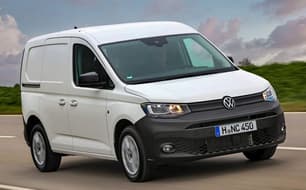
What's the difference?
The venerable VW Caddy was launched in 1979 and after five generations and more than four decades of service, it remains one of the world’s most popular range of small vans.
In Australia’s light-commercial vehicle market, the Caddy’s work-focused Cargo model competes in the small van (under 2.5-tonne GVM) segment against the Renault Kangoo and Peugeot Partner.
The VW range offers Cargo (SWB), Cargo Maxi (LWB) and Crewvan (LWB) models with a unique choice of petrol/diesel engines and manual/auto transmissions.
We recently revisited this German workhorse to find out why it remains such a strong seller in Australia from a business perspective.
Hybrid campers tread the line between caravan comfort and camper trailer-manoeuvrability and are touted as somewhat of a new thing; almost an evolution of comfort as more people look for a perfect camping experience.
But camper-trailers like the Cub Longreach LE prove that the concept has been around for decades.
It hasn't always been called the Longreach, but this high-walled, super-sized, off-road camper-trailer was one of the first to offer caravan-like comfort and space in a product that'll go anywhere off-road*. (* In terms of reasonable use and having obviously scrutinised your camper's warranty conditions before setting off to make sure you're covered for that sort of usage.)
The 2019 LE takes the comfort levels even further, so we grabbed one for a night to check it out.
It’s not hard to see why the Caddy Cargo maintains its enduring favouritism in the small van class. It has outstanding workhorse capabilities, unmatched five-star safety and drivetrain choice, combined with a spirited car-like driving experience, be it unladen or with a heavy payload. It’s not perfect, but it's also hard to fault in a workhorse role.
This isn’t the camper for everyone – my guess is that plenty of people look at this and find it too sparse, too basic. I kinda get it.
But there are very few campers which offer the same amount of open, internal space, or that are as easy to set up.
That the Longreach, albeit with a few different names, has lasted so long on the Cub Campers' product roster is a testament to its versatility and ability to accommodate a small family on off-road camper trips.
It's arguably one of the forerunners of the hybrid camper scene, and it's now starting to evolve with campers' desires for more comfort.
The Caddy’s 1508kg tare weight and 2250kg GVM results in a 742kg payload rating, of which up to 100kg can be legally carried on the roof where external anchorage points are provided for roof racks or rails.
It’s also rated to tow up to 1500kg of braked trailer, although its relatively low 75kg tow-ball download (TBD) limit could present a challenge, given that TBD is typically about 10 per cent of trailer weight. So, a 150kg TBD rating would be better.
Volkswagen also does not publish a GCM (Gross Combination Mass) rating, so we don’t know how much it can legally carry and tow at the same time.
The cargo bay, which offers up to 3.1 cubic metres of load volume, is accessed through a kerbside sliding door or asymmetric rear barn-doors.
Its 1797mm length and 1614mm width with 1230mm between the rear wheel-housings provides good versatility, given it can carry an 1165mm-square Aussie pallet or 1000 x 1200mm Euro 3 pallet, two 800mm x 1200mm Euro pallets, or two 720 x 830mm bread-roll containers.
However, with the sliding side-door’s 695mm opening, all of these would need to be loaded through the rear barn-doors which offer 180-degree opening for easy forklift or loading dock access. The load floor is protected by a thick moulded-rubber liner and there are six load-anchorage points.
The cargo bay walls and doors are lined to mid-height and there are two bright LED roof lights and a handy 12-volt socket.
Driver and passenger have ample cabin storage with large-bottle holders and bins in each front door, a handy pull-out compartment to the right of the steering column, numerous bins embedded in the dash-pad, full-width overhead shelf, a large glovebox and a centre console with dual small-bottle/cup holders and numerous storage nooks.
For a rear-fold camper-trailer, the space inside couldn't be more practical. The long body and high sides mean that when the camper is open and set up, it has a lot more space than most. Behind the bed, for instance, there is enough space for Cub to have fit a small dinette.
The dinette has cushioned benches for two and a swivel table that can also become a counter over the rear floor area.
The camper's length also means that the rear floor area is massive. It is easily big enough to lie a couple of kids on, or if your nest is empty, to set up some camp chairs and a table to enjoy a covered living area.
It is still a rear-fold camper-trailer, though so, despite the fact it has nearly twice the space of other hybrid-style campers, it's very sparsely furnished. There's no internal kitchenette or anything like that.
Its compact external dimensions are deceptive, as the cabin has ample headroom and it’s not hard for even tallish drivers (I’m 186cm) to find a comfortable position, even though the close-fitting bulkhead restricts backrest recline adjustment and the base cushion rake is fixed.
Small vans are the closest you’ll get to a car-like driving experience in light commercials and, given the Cargo’s unique turbo-diesel powertrain, it has unmatched torque output that provides energetic performance.
The shift calibrations of its seven-speed dual-clutch automatic ensure vigorous response in city and suburban driving, given that for most of the time they keep the engine operating between 1500-2500rpm, where its 320Nm of torque is served at full strength.
Combined with nicely weighted steering and four-coil suspension that provides an ideal balance of responsive handling and supple bump absorption, it’s an enjoyable and engaging vehicle to drive. The Sport drive mode and sequential manual-shifting options raise the fun level.
The gearing also ensures low-stressed highway driving with only 1600rpm required to maintain 110km/h, at which speeds the solid bulkhead minimises cargo bay noise that mostly emanates from the rear tyres. However, tyre noise can still be intrusive on certain grades of coarse bitumen.
To test its payload rating, we forklifted 650kg into the cargo bay through the rear barn-doors, which with driver equalled a total payload just shy of its 742kg payload limit. The rear suspension compressed almost 60mm under this weight, with long jounce rubbers positioned inside the rear coil springs providing additional load support and, in effect, a second stage of springing.
The Caddy took this heavy load haul in its stride on city and suburban roads, gliding over bumps without a hint of bottoming-out. The payload’s effect on engine, steering and braking performance was minimal and its handling composure was maintained regardless of speed or road conditions.
It also made light work of our 13 per cent gradient, 2.0km-long set climb at 60km/h, and although engine braking on the way down required some assistance from the quartet of disc brakes to keep speeds in check, they handled this task with ease.
Our only criticism of the driving experience is that, given the substantial blind-spot over the driver’s left shoulder caused by the cargo bay’s solid walls, a Cargo buyer must pay extra to get blind-spot monitoring and rear cross-traffic alert as part of an options pack. We reckon these active features are crucial to safe van operation (any solid-walled van that is) and should be standard.
Cub Campers are famously good to tow, and even the largest of them lives up to the reputation.
As big as it is, the Longreach LE is quite light thanks to the effort Cub puts into engineering. As a result, it's not a strain, even for older dual-cabs like the D22 Navara.
And because it isn't any higher or wider than a modern SUV, there was very little wind-drag or buffeting as we cruised along the highway.
Cub developed the camper's Australian-made and -designed independent, coil-spring suspension and the set-up yields excellent ride in any conditions.
For the LE, Cub has added an extra shock-absorber each side to improve its performance even on the most corrugated roads.
An AL-KO off-road ball hitch is standard but can be upgraded to the Click-Lock version if you'd prefer that or need a more low-profile hitch.
In reverse, the long drawbar makes it an easy camper to manoeuvre around a campsite, plus it has enough size that the tow-vehicle driver never really loses sight of it while positioning it.