What's the difference?
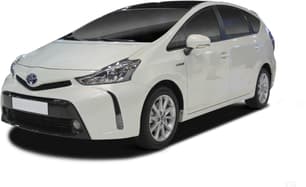
I could use three words to describe this car: Toyota, family, hybrid… A fourth word comes to mind, which begins with 'b' and ends in 'oring'…
That might seem harsh, but this isn’t what I’d describe as an aspirational purchase. If you do aspire to a Prius V, though, you’re probably either a hardcore Toyota fan, someone who has a large family, or someone who likes hybrids.
But then again, if you are a potential Toyota Prius V buyer, you could also be one of the smarter examples of our species. While only about 3000 Aussies have chosen a Prius V since it went on sale in 2012, it’s a very, very clever option for family buyers who want to do their bit for the environment, not to mention their own hip pocket.
The Prius V is the most affordable seven-seat hybrid vehicle on the market, and in terms of price, it competes with mainstream models like the Honda CR-V, Mitsubishi Outlander and Nissan X-Trail. But what about space? Practicality? Performance? Let’s take a deeper look, shall we?
This is probably the most important new car launch of the year.
The 2026 Toyota RAV4 needs to be bang-on exactly what customers want, because it’s not only Toyota’s most popular model globally, it was the most popular new car in the world last year.
It’s also Toyota Australia’s second-most popular model behind the Toyota HiLux the highest-selling non-ute in the nation.
Crucially, The HiLux has just been launched in a new generation albeit not a revolutionary change, and it somewhat overlaps with the generation changeover of the RAV4.
Toyota is also facing a significant sales dip, the first quarter of sales for the brand in 2026 is down 23 per cent compared to the same time last year. It’s a bigger dip than the industry as a whole, as its market share is down from 19.9 per cent to 15.7 per cent in the same periods.
The new RAV4’s launch must bring strong sales as the vast majority of the brand’s dip is thanks to the mid-size SUV’s changeover.
But as well as an influx of new competitors, the RAV4 must also contend with a lack of ANCAP safety rating for its first few months on sale.
Has Toyota done enough to convince Australia its family SUV is still worthy of its position as the best-selling passenger car getting around? We headed to its Australian launch in Tasmania’s north to find out.
No, the Prius V isn’t exciting. But it does what it’s designed to do - move families in decent comfort without using much fuel. And if that’s what gets your (hybrid) motor running, then you really ought to take a closer look.
The RAV4 is undeniably better than the last generation, and brings with it a level of driving refinement the most popular car in the world should have.
It also levels up its tech without falling into the overcomplicated, messy systems newcomers to the market think will impress buyers. While the base GX is a sound option, the few extra mod cons in the GXL are worth the extra cash.
But its lack of ANCAP rating is surely a point of anxiety for Toyota, and while the safety systems seem sound, we can’t definitively say this RAV4 is as safe as Toyota claims it is.
If you’re willing to trust Toyota on that, you’ll find a very enjoyable car that’s uncomplicated and efficient. But if those five stars from ANCAP matter to you, give it a few months and see how the new RAV4 performs before you put your money down.
The world was a different place when the Toyota Prius V came out. Back then, the iPhone 4s was at the cutting-edge in phone design, Gangnam Style was smashing it on the charts, and car design was in a very different place.
There are some signature Prius elements, with a swept, aerodynamic looking roofline and sleek front-end styling. The facelift that was applied to the Prius V in 2015 saw sharper lines and more aggression, but it arguably doesn’t have a lot of aesthetic appeal given the way Toyota has evolved its design since then.
It isn’t a traditional people-mover, because it has regular doors at the back rather than sliding doors to allow simple access to the third-row seats. It’s more like a hatchback that’s been stung by a bee, looking a bit bloated. But as one pint-sized tester put it this week, it’s one very big little car.
The inside is a bit of a marvel in terms of space management. This car measures just 25mm longer than a Corolla sedan (4645mm long), and it's only 1775mm wide (the same as a Corolla sedan) and 1590mm tall, because it needs a bit more room to fit seven people in. And it can.
Each RAV4 in the range is more visually distinct than before, but most variants feature a similar honeycomb grille that’s a departure from the ‘safe’ design language Toyota is known for.
The outlier is the Edge variant, which gets a more traditional front-end treatment as well as its 20mm wider wheel tracks to go along with the intended purpose of light off-roading.
Despite the fact Toyota has clearly tried not to change the new RAV4 too much in too many ways compared to the last generation (and why would you when it was already so popular), the new design feels a little more adventurous.
It includes elements of Toyota’s latest design language including the ‘c-shaped’ headlights and more streamlined tail-lights but retains the overall size and shape of the RAV4.
The RAV4 is 4600mm long, 1855mm wide and 1680mm tall, a very similar size to before and as such its interior feels similarly spacious.
Inside, the layout is tidy with a little more visual distinction for controls than the last-gen RAV4.
Updated, sleeker buttons and controls replace the ageing fixtures and large screens make the mid-size SUV feel much more up to modern standards.
The cabin of the Prius V highlights the notion of versatility. There are two rows of seats at the back, with the middle row sliding and folding to allow easy third-row access. And I mean easy - even me, a 183cm-tall human - can clamber into the back seats without too much in the way of old-man noises.
The space in the back row is limited, though, particularly for knee room and foot space. It is best left for children, then. But the second row has three individually slide-able seats, meaning if you really need to fit seven adults in, you theoretically could.
That second row is nicely useable. The fact the seats are sculpted individually means they feel made for a proper family getaway, and even with them set as far forward as they can go (to allow maximum legroom in the third row) I could sit in the outboard seats without much discomfort. The sun-blinds that are built into the back doors are a really welcome touch for parents and adults alike.
What isn’t so great is the lack of rear air-vents - there aren’t any face-level vents in either the second or third rows, meaning things could get stuffy on a hot day.
But the practicality side of things is reasonably well sorted, with useable cup holders in the rear wheel arch moulds, plus there’s a 12-volt outlet in the third row, too. The middle row has bottle holders in the doors, and there are map pockets in the front seatbacks.
Up front there is more smart storage; a pair (yep, two) of gloveboxes adorns the dashboard, and there’s a pop-out cupholder on the passenger side, too. Two more cupholders grace the centre console (which itself is very shallow, because the hybrid batteries sit inside it), plus a small storage box - presumably for your keys to sit. A small shelf sits at the bottom of the centre stack, and that’s where you’ll find a USB port to connect to the media screen above.
That 6.1-inch touchscreen is fine, but pretty ancient. It has some small menu buttons, won’t allow you to input phone numbers or connect to Bluetooth when the car is moving, and you (or your fellow front passenger) can’t manually enter sat nav details when you’re driving. There is voice control, but it’s painful. Forget Apple CarPlay and Android Auto, too - neither is available in the Prius V.
While the boot space is pretty limited with seven seats in place - Toyota claims 180 litres of capacity in that configuration - there’s still enough room for a suitcase or two.
But with five seats in play it makes quite a bit more sense, more easily fitting family things like prams with its 485L of cargo capacity. And remember, there are no batteries under the boot floor eating into space, and you get a space-saver spare wheel as well.
But despite the sleeker look inside the new RAV4, Toyota hasn’t fallen into the trap of shoving as many digital features into the system as possible.
Many newcomer brands create confusing digital environments by having menus upon menus filled with options and features, but Toyota has avoided this by retaining a simple, almost siloed system.
In the multimedia display, navigation, media, phone and settings are the key shortcuts visible down the side of the screen, though a customisable home screen allows you to make the system your own.
It’s far preferable to the many sub-menus and confusing layouts some manufacturers (especially newcomers) use, and means you’re able to focus on driving.
There are also still plenty of physical controls for the key functions of the car, no need to go into digital settings to sort your drive mode or climate.
The new system, dubbed 'Arene' by Toyota, is a much-needed update for the RAV4, bringing it into the current decade when it comes to tech.
Its voice command system is still a little too keen to interrupt, but the general function is extremely easy to get acquainted with.
The interior is also physically extremely sensible, with good vision and light thanks to a low dashboard and large windows, well-considered ergonomic positioning, comfortable seats and storage options.
The centre console storage bin lid is also able to be opened from either side, or removed and flipped between a hard plastic surface or cushioned elbow rest, though a bit of non-slip surface on the plastic side wouldn't go astray.
Behind the front seats, the second row passengers don’t have a massive amount of amenity, but are far from cramped. The vents, armrest with cupholder, bottle storage in the door and document holder on the backs of the seats are all quite standard, though the outboard seats are heated in the top spec Cruiser.
Behind that, a huge 705L of space in the boot includes a netted pocket if you opt for the Edge grade, plus there's a proper spare wheel under the boot floor. Wins all round.
Not only is the Prius V the most affordable seven-seat hybrid car on the market, it’s also the cheapest Toyota with seven seats.
It undercuts the Tarago, Kluger and Land Cruiser Prado by a decent margin, with pricing starting at $37,590 for the base grade model and stretching to $45,380 for the top-of-two-tier i-Tech flagship. Should you bother spending up on that version? In short, no.
That’s because the regular Prius V has a pretty strong standard equipment list. Push-button start, keyless entry, sat nav with SUNA live traffic updates, a reversing camera, climate control and a head-up display are all standard. You also get 16-inch alloy wheels, which have a set of plastic wheel covers over the top (great for kerb touch-parkers).
The i-Tech sees the addition of Bi-LED headlights with auto-levelling (as opposed to the halogens with LED daytime running lights you see on the base model), plus fake leather seats (not cloth), heated front seats, a dual-pane panoramic glass roof (which doesn’t open), an auto-dimming rear-view mirror, and a semi-automated parking system.
Plus, whether you choose the entry grade or the high-spec, you get Toyota’s 'Safety Sense+' system - read the details in the safety section below.
Colour options for the Prius V are quite broad. There are nine rather sedate hues to choose from, with eight of them being 'premium colours' that attract an additional cost ($450).
And, as with most Toyota models, there is a range of additional factory-backed accessories that you can choose, such as a bonnet protector, boot scuff guard and even door handle protective film (to stop rings from scratching them up), but things like roof racks/roof rails or a roof pod are unavailable.
The RAV4 is more expensive than it was before. Of course it is.
That’s because it comes with more stuff, and it’s got new oily bits and more software to play with, plus everything gets more expensive anyway, right?
There are five trim levels, most with 2WD or AWD options and the base GX starts from $45,990, before on-road costs, in 2WD guise - a few thousand more than before.
Standard kit isn’t mind-blowing compared with a lot of newcomers to the market, but for an established model like the RAV4 it’s expected.
The GX (which can be had in AWD for $49,340) comes with 17-inch dark grey alloy wheels, LED headlights, dual-zone climate control, a 10.5-inch touchscreen display for multimedia, a 12.3-inch digital instrument cluster, fabric upholstery, six-speaker audio and five USB-C ports plus wireless Apple CarPlay and Android Auto.
If you opt for all-wheel drive, you also get downhill assist control and 'Trail' and 'Snow' drive modes.
Importantly, the RAV4 comes with a spare wheel, though on the GX it’s just a space-saver which costs $300 to upgrade to a full-sizer.
The $48,990 GXL adds 18-inch alloy wheels, privacy tinting, an eight-way powered driver’s seat, rain-sensing wipers and a wireless smartphone charger. That one’s $52,340 in AWD guise.
The Edge is $55,340, comes in AWD-only, and has its own front-end design plus 18-inch dark matt grey metallic alloy wheels on a 20mm wider track, plus a larger 12.9-inch touchscreen, premium trim, heated seats, illuminated entry and a power tailgate. It’s the variant Toyota says is more aimed at light off-roading than its siblings.
The XSE is also AWD-only and starts at $58,340, with 20-inch black alloy wheels, better LED headlights, a surround view parking monitor and two-tone paint. It also has synthetic leather and suede sports front seats with contrast stitching and three-stage front seat heating and ventilation, plus a sunroof. Front and rear bumpers feature integrated skid plates on the XSE.
The Cruiser is available as a 2WD from $56,990, or AWD from $60,340, and adds 20-inch machined black alloy wheels, high-grade LED headlights, leather-accented seat trim, a head-up display, digital rearview mirror, heated outboard rear seats, powered tailgate with kick sensor, another wireless smartphone charger and a premium nine-speaker JBL audio system.
Powering the Prius V is a 1.8-litre four-cylinder engine, which uses a CVT auto and combines with a lithium-ion battery pack and two electric motors. It’s what’s known as a series parallel hybrid set-up.
The system can allow the car to run using both the battery and engine, or just the battery, or have the regenerative braking system feed the battery pack more juice. That tech isn’t necessarily cutting edge today, but it was when the car launched (waaaaay back in 2012).
The engine can produce 100kW of power and 142Nm of torque. The electric motor can produce 73kW on its own, but the maximum combined power output is still 100kW.
The 2.5-litre four-cylinder engine with series-parallel hybrid is less powerful than before, but Toyota says it did this for better efficiency and has made up for it with improvements to the battery and electric motors.
The figures are now 143kW and 221Nm (in 2WD and AWD variants), the power down from 160kW in the last generation. All RAV4s still use a continuously variable transmission (CVT).
Basically, lower numbers, but performance on par with the current RAV4 Hybrid according to Toyota.
Obviously if you are considering a hybrid, you’re looking to take advantage of excellent fuel consumption. And the Prius V doesn’t disappoint.
The claimed consumption is just 4.4 litres per 100km. In the real world, you can expect to use about 5.5L/100km if you’re light on the throttle, and 6.5L/100km if you thrash it.
You can’t skimp on the fuel when you get to the bowser, though - the Prius V insists on running using 95 RON premium unleaded.
The new RAV4’s efficiency is of much interest, obviously, and with figures claimed at 0.2L less per 100km over the last RAV4, it’s another case of incremental improvements.
The 2WD comes with a claimed 4.5L/100km, the AWD with 4.6L. During testing we saw numbers as low as 6.8L and 6.9L, respectively, and that was giving it the beans in some pretty twisty mountain roads.
Keep in mind the RAV4 needs 95 RON minimum now, rather than the 91 RON it could deal with before.
If you’re a car geek like me, you likely find driving as efficiently as you can fun. If so, you'll love this. You can watch the car switching between EV mode - which it will use for up to about 30km/h, but only for a couple of minutes - and hybrid power. And honestly, if you’ve never driven a hybrid you might think it sounds dumb, but being a fuel miser can be fun!
But the fun factor is pretty much limited to being a cheapskate on fuel. It really isn’t that fun to drive otherwise, but that’s not what it’s designed for.
Still, the drivetrain does a decent enough job for most families - it builds pace pretty easily, and while the refinement and power could be better, if you’re not aiming to break records on the school run, you shouldn’t be too disappointed.
The ride is mostly good, though it can be a little sharp over patchy surfaces, and the steering is decent, if a little lifeless. My biggest issue is the brake pedal response, which takes some getting used to. Sometimes it feels like it won’t stop quick enough.
That, and the adaptive cruise control doesn’t slow to a stop on the highway - it cuts out at about 30km/h, so you’ve gotta be on your toes if the traffic starts to build up.
If you want the latest and greatest in hybrid family friendliness, you really ought to wait for the new-generation RAV4, which - admittedly - mightn’t have seven seats, but it will have a hybrid drivetrain offered. And it’ll be much more modern inside and out.
Put it this way - the RAV4 doesn’t feel like it’s lacking power. Despite the lower output, the new generation car doesn’t seem to struggle with having enough pick-up to keep moving along, even in spirited driving.
The first time I properly took off it surprised me with how punchy the response was. And from there on the new RAV continued to impress.
It’s one of a few things that, dare I say, makes the RAV4 rather fun to drive.
Like its predecessor, it’s built on the 'TNGA' platform, which underpins pretty much everything Toyota builds these days.
It’s a well-sorted basis for a car, making even this relatively large family SUV feel nimble.
Some changes to the suspension help here, too. New geometry and spring and damper rates mean the RAV4 is sharper and better controlled than before.
That control comes with the trade-off that it’s not always cloud-soft, but given Australian preferences and the need to keep the rubber on our rough as guts roads, Toyota has the balance right here.
It also hasn’t seemed to matter massively whether the RAV4 is front- or all-wheel drive even in the wet on twisty Tassie roads. The 2WD requires a little more care being flung into corners but the mid-sizer holds its own well enough.
There’s clearly more ability in the RAV4 than it’ll make known, almost as to keep the driver behaving safely just in case, while being confident in knowing the RAV4 is more capable than many will ever find out.
It’s handled high speeds, sharp corners and unsealed roads to a higher degree than anyone would reasonably expect of a family SUV.
It helps that the steering, throttle and braking are all well-calibrated. Planting your foot brings urgency without a jolt, there’s no guesswork in the steering and the brakes won’t have you lurching at a tap but can pull you up rather rapidly if needed.
It’s easy to drive, which is pretty big compliment and surely one of the key goals for the engineering team.
Every Prius V still carries the same maximum five-star ANCAP safety rating that it was stamped with in 2015, even though the car was actually tested in 2012.
The range is covered with the safety systems you’d expect, including electronic stability control, ABS, electronic brake distribution, plus there’s a reversing camera, too. Rear parking sensors are a dealer-fit accessory.
There was a bit of back-and-forth between myself and Toyota Australia over airbag coverage. The company stated on its public site that the car had curtain airbag coverage all the way to the third row, but no image to support that. I’ve since had it confirmed by Toyota Australia that it does definitely have third-row airbag coverage, which is a great added piece of mind element for family buyers (plus there are dual front, driver knee and front side airbags, too).
Airbags are one thing, but what about the other safety kit? Well, every Prius V has Toyota’s Safety Sense plus system, with auto emergency braking (AEB), pedestrian detection, adaptive cruise control, auto high beam lights and lane-departure warning.
Toyota doesn’t have an ANCAP rating for the RAV4 yet, which is a massive problem for the brand, especially for its fleet buyers.
The systems in place seem pretty sound, and the brand says it’s the safest RAV4 yet.
We have no reason to doubt that, but we can’t just take a manufacturer at their word, that’s why ANCAP exists.
Eight airbags, AEB pre-collision, emergency steering assist, full-speed active cruise control, front and rear cross traffic alert, lane trace, automatic high beam, parking support brake and blind spot monitor are all standard across the range, which is a plus.
It’s also all quite well programmed.
From behind the wheel, you’ll notice persistent but gentle steering wheel nudges when approaching the shoulder, and occasional chimes for driver distraction when using the main screen, but otherwise it’s very well calibrated and cements the experience Toyota has with making its systems easy to use.
It’s cheap to run a Prius V in terms of its fuel use, and it’s cheap to run in terms of its maintenance, too. Toyota lists its charges at just $140 per visit to the dealer under the Service Advantage offer, though you’ll need to take it in every six months or 10,000km.
The warranty cover is three years or 100,000km for the car, but the hybrid battery attracts an eight-year/160,000km cover of its own.
Toyota’s standard five-year/unlimited kilometre warranty is not just disappointing compared to other mainstream brands, but should be much higher given the brand is the biggest in the country (and world) and trades on its reputation for reliability.
The warranty can be extended to seven years from delivery if you maintain your logbook servicing with Toyota dealerships, but even then it falls short of Nissan and Mitsubishi’s 10-year (also servicing-conditional) warranties.
Capped-price servicing costs $325 per service and is available for five years or 75,000km, with intervals every 12 months or 15,000km.
Toyota boast a long-established national network of around 300 dealers covering all states and territories including major cities and key regional and rural centres.