What's the difference?
I could use three words to describe this car: Toyota, family, hybrid… A fourth word comes to mind, which begins with 'b' and ends in 'oring'…
That might seem harsh, but this isn’t what I’d describe as an aspirational purchase. If you do aspire to a Prius V, though, you’re probably either a hardcore Toyota fan, someone who has a large family, or someone who likes hybrids.
But then again, if you are a potential Toyota Prius V buyer, you could also be one of the smarter examples of our species. While only about 3000 Aussies have chosen a Prius V since it went on sale in 2012, it’s a very, very clever option for family buyers who want to do their bit for the environment, not to mention their own hip pocket.
The Prius V is the most affordable seven-seat hybrid vehicle on the market, and in terms of price, it competes with mainstream models like the Honda CR-V, Mitsubishi Outlander and Nissan X-Trail. But what about space? Practicality? Performance? Let’s take a deeper look, shall we?
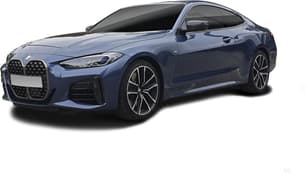
BMW's new 4 Series blasted onto the world stage with a chonky schnozz on it that only a mother could love. If BMW didn't want anyone to look at the rest of the car, it did a cracking job of it, because everyone had something to say about the big gnashers now grafted to the 4's front end.
I was nervous about it, too, because the 4 Series has always been so elegant and the current 3 Series - on which it is based - is quite nice to look at. It also threatened to overshadow just how good a car the BMW 4 should be, based as it is on the excellent 3 Series.
And, of course, one also had to wonder if a sports coupe like this would be any good around town. Limited vision? Hard to get in and out of? A true four-seater, or just a squishy 2+2? So many questions.
No, the Prius V isn’t exciting. But it does what it’s designed to do - move families in decent comfort without using much fuel. And if that’s what gets your (hybrid) motor running, then you really ought to take a closer look.
The BMW 420i is a terrific car if you're after a bit of style and sophistication. Not everyone will warm to your car's nose, but if you get it de-chromed, like this white one, it really does look pretty good. It's a car that uses very little fuel, moves along smartly and is brimming with a decent amount of tech, even if it could do with a bit more safety gear at this price.
I reckon this car is settling well into the automotive landscape and ignoring it because of a few loudmouths think the grille is too big would be a terrible waste.
The world was a different place when the Toyota Prius V came out. Back then, the iPhone 4s was at the cutting-edge in phone design, Gangnam Style was smashing it on the charts, and car design was in a very different place.
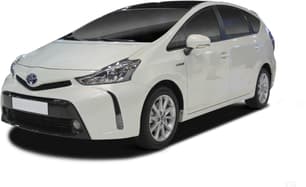
There are some signature Prius elements, with a swept, aerodynamic looking roofline and sleek front-end styling. The facelift that was applied to the Prius V in 2015 saw sharper lines and more aggression, but it arguably doesn’t have a lot of aesthetic appeal given the way Toyota has evolved its design since then.
It isn’t a traditional people-mover, because it has regular doors at the back rather than sliding doors to allow simple access to the third-row seats. It’s more like a hatchback that’s been stung by a bee, looking a bit bloated. But as one pint-sized tester put it this week, it’s one very big little car.
The inside is a bit of a marvel in terms of space management. This car measures just 25mm longer than a Corolla sedan (4645mm long), and it's only 1775mm wide (the same as a Corolla sedan) and 1590mm tall, because it needs a bit more room to fit seven people in. And it can.
The internet exploded when it became clear the big kidney grille was for real. To be fair, BMW did itself absolutely no favours by ensuring the photos of the 4 Series made the twin grille look Easter Island statue sized.
And it persisted in doing them naked, without number plates to break up the look. In the flesh, it all works, the nose is striking but not completely overblown.
BMW coupe elegance reigns supreme in profile, however, with excellent proportions, and even in base form the wheels are the right size. The slim tail-lights and sculpted tail complete the look. It's a car I think most people love looking at. Hardly anyone mentioned the grille.
The cabin is excellent, as are all of the newer BMW interiors. It's not really a base model, given the price, but the mix of Alcantara and synthetic leather is very pleasing.
The big screens for the media and instruments headline the cabin with high-tech style and while it's not avant-garde, it's sharp and feels premium, which is just as well.
The cabin of the Prius V highlights the notion of versatility. There are two rows of seats at the back, with the middle row sliding and folding to allow easy third-row access. And I mean easy - even me, a 183cm-tall human - can clamber into the back seats without too much in the way of old-man noises.
The space in the back row is limited, though, particularly for knee room and foot space. It is best left for children, then. But the second row has three individually slide-able seats, meaning if you really need to fit seven adults in, you theoretically could.
That second row is nicely useable. The fact the seats are sculpted individually means they feel made for a proper family getaway, and even with them set as far forward as they can go (to allow maximum legroom in the third row) I could sit in the outboard seats without much discomfort. The sun-blinds that are built into the back doors are a really welcome touch for parents and adults alike.
What isn’t so great is the lack of rear air-vents - there aren’t any face-level vents in either the second or third rows, meaning things could get stuffy on a hot day.
But the practicality side of things is reasonably well sorted, with useable cup holders in the rear wheel arch moulds, plus there’s a 12-volt outlet in the third row, too. The middle row has bottle holders in the doors, and there are map pockets in the front seatbacks.
Up front there is more smart storage; a pair (yep, two) of gloveboxes adorns the dashboard, and there’s a pop-out cupholder on the passenger side, too. Two more cupholders grace the centre console (which itself is very shallow, because the hybrid batteries sit inside it), plus a small storage box - presumably for your keys to sit. A small shelf sits at the bottom of the centre stack, and that’s where you’ll find a USB port to connect to the media screen above.
That 6.1-inch touchscreen is fine, but pretty ancient. It has some small menu buttons, won’t allow you to input phone numbers or connect to Bluetooth when the car is moving, and you (or your fellow front passenger) can’t manually enter sat nav details when you’re driving. There is voice control, but it’s painful. Forget Apple CarPlay and Android Auto, too - neither is available in the Prius V.
While the boot space is pretty limited with seven seats in place - Toyota claims 180 litres of capacity in that configuration - there’s still enough room for a suitcase or two.
But with five seats in play it makes quite a bit more sense, more easily fitting family things like prams with its 485L of cargo capacity. And remember, there are no batteries under the boot floor eating into space, and you get a space-saver spare wheel as well.
As a sports coupe, it's hardly a practical all-rounder but it's not a squishy 2+2 either. The rear seats are sculpted for maximum headroom and have the added bonus of holding onto rear passengers.
Six footers won't be super-comfortable but it's bearable for short trips. There are two ISOFIX points back there, too.
The front seats electrically fold out of the way for ingress and egress, but it's not an elegant process.
Front-seat passengers score two cupholders and bottle holders in the doors and a black hole for your phone and its wireless charging pad.
The boot takes an impressive 440 litres and the rear seats split and fold like good little soldiers.
Not only is the Prius V the most affordable seven-seat hybrid car on the market, it’s also the cheapest Toyota with seven seats.
It undercuts the Tarago, Kluger and Land Cruiser Prado by a decent margin, with pricing starting at $37,590 for the base grade model and stretching to $45,380 for the top-of-two-tier i-Tech flagship. Should you bother spending up on that version? In short, no.
That’s because the regular Prius V has a pretty strong standard equipment list. Push-button start, keyless entry, sat nav with SUNA live traffic updates, a reversing camera, climate control and a head-up display are all standard. You also get 16-inch alloy wheels, which have a set of plastic wheel covers over the top (great for kerb touch-parkers).
The i-Tech sees the addition of Bi-LED headlights with auto-levelling (as opposed to the halogens with LED daytime running lights you see on the base model), plus fake leather seats (not cloth), heated front seats, a dual-pane panoramic glass roof (which doesn’t open), an auto-dimming rear-view mirror, and a semi-automated parking system.
Plus, whether you choose the entry grade or the high-spec, you get Toyota’s 'Safety Sense+' system - read the details in the safety section below.
Colour options for the Prius V are quite broad. There are nine rather sedate hues to choose from, with eight of them being 'premium colours' that attract an additional cost ($450).
And, as with most Toyota models, there is a range of additional factory-backed accessories that you can choose, such as a bonnet protector, boot scuff guard and even door handle protective film (to stop rings from scratching them up), but things like roof racks/roof rails or a roof pod are unavailable.
The 420i starts at $71,900. That's a fair bit of money, I think you'll agree.
You get 19-inch wheels, a 10-speaker stereo, LED headlights with auto high beam, head-up display, power front seats, lighting package, auto-parking with reverse assistant, synthetic leather and Alcantara interior, 'Live Cockpit Professional' (fully digital dash), wireless phone charging and digital radio.
The massive 10.25-inch touchscreen may be smaller than the 12.3-inch digital dashboard, but it still looks huge. BMW's Operating System 7.0. is a cracking set-up, and you can control it via either touch or the 'iDrive' rotary dial on the console. It also has Apple CarPlay and Android Auto. Both of them, wireless. You don't read that every day.
You also get 'BMW ConnectedDrive', with some remote services that last for three years. The subscription includes things like the endearingly weird 'Caring Car' and the far less weird real-time traffic information.
The 4 Series is available in eight colours. 'Alpine White' is the only freebie while 'Black Sapphire', 'Arctic Race Blue', 'Portimao Blue', 'San Remo Green' and 'Mineral White' are $1538 each (or part of the 'Visibility Package'). 'Tanzanite Blue' and 'Dravit Grey' are a hefty $2962.
My car for the week had the $6300 Visibility Package (metallic paintwork, sunroof, BMW Laserlight, Ambient Light, which is worth it for the amazing Laserlights alone), the $2860 'Comfort Package' (lumbar support, electric boot, heated front seats, 'Comfort Access' with 'BMW Digital Key') and an $800 black pack. All this took the price to $81,860.
Powering the Prius V is a 1.8-litre four-cylinder engine, which uses a CVT auto and combines with a lithium-ion battery pack and two electric motors. It’s what’s known as a series parallel hybrid set-up.
The system can allow the car to run using both the battery and engine, or just the battery, or have the regenerative braking system feed the battery pack more juice. That tech isn’t necessarily cutting edge today, but it was when the car launched (waaaaay back in 2012).
The engine can produce 100kW of power and 142Nm of torque. The electric motor can produce 73kW on its own, but the maximum combined power output is still 100kW.
The 420i’s 2.0-litre turbocharged four-cylinder, codenamed B48, spins up 135kW/300Nm. Driving the rear wheels through an eight-speed ZF automatic transmission, you'll go from zip to the 100km/h mark in 7.5 seconds, which is brisk, if not staggering.
Obviously if you are considering a hybrid, you’re looking to take advantage of excellent fuel consumption. And the Prius V doesn’t disappoint.
The claimed consumption is just 4.4 litres per 100km. In the real world, you can expect to use about 5.5L/100km if you’re light on the throttle, and 6.5L/100km if you thrash it.
You can’t skimp on the fuel when you get to the bowser, though - the Prius V insists on running using 95 RON premium unleaded.
BMW's official combined-cycle figures seem to be slowly moving towards reality. The 420i's sticker figure of 6.4L/100km was met with an indicated 6.8L/100km, which was excellent going for almost exclusively suburban and urban running.
It's a solid result, but being a BMW, it's premium unleaded only for its 59-litre tank.
With my generally unsympathetic (but not psychopathic) right foot, that means a real-world range of over 800km between fills.
If you’re a car geek like me, you likely find driving as efficiently as you can fun. If so, you'll love this. You can watch the car switching between EV mode - which it will use for up to about 30km/h, but only for a couple of minutes - and hybrid power. And honestly, if you’ve never driven a hybrid you might think it sounds dumb, but being a fuel miser can be fun!
But the fun factor is pretty much limited to being a cheapskate on fuel. It really isn’t that fun to drive otherwise, but that’s not what it’s designed for.
Still, the drivetrain does a decent enough job for most families - it builds pace pretty easily, and while the refinement and power could be better, if you’re not aiming to break records on the school run, you shouldn’t be too disappointed.
The ride is mostly good, though it can be a little sharp over patchy surfaces, and the steering is decent, if a little lifeless. My biggest issue is the brake pedal response, which takes some getting used to. Sometimes it feels like it won’t stop quick enough.
That, and the adaptive cruise control doesn’t slow to a stop on the highway - it cuts out at about 30km/h, so you’ve gotta be on your toes if the traffic starts to build up.
If you want the latest and greatest in hybrid family friendliness, you really ought to wait for the new-generation RAV4, which - admittedly - mightn’t have seven seats, but it will have a hybrid drivetrain offered. And it’ll be much more modern inside and out.
One of the main things that sets a BMW sedan or sedan-based coupe apart is that they're good everywhere, except perhaps in quicksand.
As the platform has matured and BMW's persistence with run-flat tyres has yielded improvements in tyre construction, the 3/4 Series platform (and many others - the internal name for the platform is CLAR) has once again become the benchmark for ride and handling.
For some people reading this, that's a lot of blah blah blah but the main point is, it's a terrific thing to drive whether you're dawdling along in traffic, dealing with traffic calming or bombing down your favourite deserted road.
The Bridgestone tyres on the 420i aren't as ultimately grippy and sticky as the alternative rubber on the 430i but they work well in town and are quiet on the 80km/h roads so prevalent in Sydney.
The steering is absolutely lovely, providing just the right weight at any given speed and throwing in the road feel to inspire confidence.
Ride around town is compliant but with the whiff of fun if you decide to push things outside of the city.
Its capabilities are still more than worthwhile day-to-day, however, because the way it handles the need to duck in and out of spaces in traffic is extremely handy.
The 2.0-litre four-cylinder is as smooth as rival Audi's. It doesn't sound like much (with a few vestigial pops in Sport mode) but it's certainly got the power to get you out of sticky situations and a transmission that's willing to play ball, whether in Sport or Normal.
Without the adaptive suspension of its 430i and M 440i brethren, this is a very smooth, easygoing sports coupe, with just enough sportiness to keep you interested, if you're that way inclined.
Every Prius V still carries the same maximum five-star ANCAP safety rating that it was stamped with in 2015, even though the car was actually tested in 2012.
The range is covered with the safety systems you’d expect, including electronic stability control, ABS, electronic brake distribution, plus there’s a reversing camera, too. Rear parking sensors are a dealer-fit accessory.
There was a bit of back-and-forth between myself and Toyota Australia over airbag coverage. The company stated on its public site that the car had curtain airbag coverage all the way to the third row, but no image to support that. I’ve since had it confirmed by Toyota Australia that it does definitely have third-row airbag coverage, which is a great added piece of mind element for family buyers (plus there are dual front, driver knee and front side airbags, too).
Airbags are one thing, but what about the other safety kit? Well, every Prius V has Toyota’s Safety Sense plus system, with auto emergency braking (AEB), pedestrian detection, adaptive cruise control, auto high beam lights and lane-departure warning.
The 4 Series comes with six airbags, ABS, stability and traction controls, forward AEB, forward collision warning, lane-departure warning, reverse cross-traffic alert and reversing camera.
The 4 Series hasn't been tested by ANCAP or Euro NCAP and the 3's five-star rating can only be a guide because of the very different structure of the 4.
Sports cars rarely fare well in the sometimes complex rules so carmakers tend to keep them away from the clutches of crash testers.
It’s cheap to run a Prius V in terms of its fuel use, and it’s cheap to run in terms of its maintenance, too. Toyota lists its charges at just $140 per visit to the dealer under the Service Advantage offer, though you’ll need to take it in every six months or 10,000km.
The warranty cover is three years or 100,000km for the car, but the hybrid battery attracts an eight-year/160,000km cover of its own.
BMW offers a ho-hum length of three years and 100,000km of warranty coverage. Mercedes has gone to five years so one wonders why BMW (and Audi) hasn't joined its German rival.
Servicing is entirely reasonable at $1650 for a five-year/80,000km package that covers the 12 month/16,000km servicing regime.
At $330 per service, it includes things many carmakers don't, such as brake fluid and spark plugs.
You can go full noise with the 'Plus Package', which costs $4500 and chucks in brake pads, rotors and even windscreen-wiper replacement. That doesn't seem like terribly good value to me unless you drive like a lunatic.