What's the difference?
The idea of a Tesla that can tow sounds about as likely as an astrophysicist with three Olympic gold medals, who also moonlights as a hand model.
The EV brand has blazed a trail for every other mainstream and premium car manufacturer to jump on the electric bandwagon, and today they’ve still got the biggest batteries and most impressive range ratings, while also having the most extensive extensive network of charge stations made up of Superchargers and destination chargers, covering every state and territory.
They’re not perfect though, often displaying niggling build quality issues and production delays for upcoming models. There’s also a degree of uncertainty bred by a founder who flits between the modern-day space race, manufacturing flame throwers and offering to send miniature submarines to rescue stranded children.
But there’s no questioning the overall impact Tesla has had on the automotive industry, along with the incredible brand awareness and aspiration it’s generated from non-enthusiast Joe Average consumers around the world.
The Model X is also rated to tow, with a decent 2250kg braked rating and an integrated tow bar that folds out of sight when not in use, which both fits its SUV character and encourages you to give it a go.
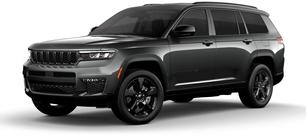
The Jeep Grand Cherokee has always been big. But if you want to carry more than five people, not big enough. Which is where the all-new, fifth-generation model comes in.
It’s the Grand Cherokee L. Jeep’s first-ever seven-seat version of its flagship SUV.
It’s set to compete with top-spec versions of mainstream models like the Hyundai Palisade and Toyota LandCruiser Prado, as well as premium full-size family trucksters like the Land Rover Discovery and Volvo XC90.
Jeep invited us to the Grand Cherokee L’s Australian launch to get a first taste of how it measures up to local conditions.
After nearly 700km of testing with both cars, it’s fair to say that the Tesla is indeed a capable tow vehicle, provided you keep the distances relatively short and plan around charge station locations.
Overall average - Penrith to Bathurst to Penrith
Fuel and energy consumption will always depend on the driving conditions, which is why we chose different routes for each leg of our testing.
Averaged across the two legs, towing the caravan with the Model X used 101 per cent more energy than without, or halved its driving range, which sounds a bit scary.
The LandCruiser by comparison added 63 per cent on average, which is still a big difference, but matters less in the real world when its big fuel tanks would still give you about 760km of driving range, which can be refilled quickly at any diesel-stocked servo.
So you could do a weekend trip with the caravan from Penrith with one supercharge in Bathurst, but it would’ve been highly unlikely to manage the extra 55km if you were leaving from Sydney CBD.
The bottom line is that there’s plenty of things - like smaller camper trailers - lighter than our caravan that will help the Tesla to do the towing job better right now.
Compared to the ‘Cruiser, the Tesla is a lesson in the benefits of a lower centre of gravity and road-focused handling.
As always, bigger batteries and more recharge points will go a long way to rectifying the Tesla’s towing shortcomings, and I'm sure we'll get there eventually.
But no matter what, its acceleration performance under load is simply excellent.
Thanks to our friends at Avida for making this test possible with the use of the 17-foot Avida Wave Tourer Electric Pop-Top single-axle caravan. They can also be reached on 1300 428 432.
Jeep’s aim with this car is to lift the Grand Cherkee to a more premium level, and that’s about brand equity and badge credibility as much as it is the vehicle itself.
The seven-seat L has stepped up in price, but also in practicality, refinement and equipment, while maintaining serious off-road ability.
Does it have what it takes to tempt people away from, say, the German Big Three? That’s a tough ask, but this Jeep certainly has more of what it takes to make that a real possibility.
For mine, the entry-level Night Eagle is the pick. Well equipped, heaps of safety and plenty of off-highway prowess.
Note: CarsGuide attended this event as a guest of the manufacturer, with travel, accommodation and meals provided.
Energy consumption is just one element of a tow vehicle though, with stability, braking and acceleration performance being the most important details.
The big ‘Cruiser is always a safe bet for towing heavy loads, but it's fair to say its off-road ability, tall body and short wheelbase mean it could be better on the road, and the Tesla goes some way to proving that.
With all those batteries mounted nice and low, the Tesla is significantly more stable with 1.7 tonnes on the back than the LandCruiser, in all conditions. It’s also helped by that longer wheelbase.
The Tesla’s airbag suspension is another surprise advantage, and while it can be a bit choppy around town over minor bumps, bigger bumps on the highway are soaked up really nicely and it all settles quicker than with the LandCruiser - even with the caravan on the back.
Tesla is famous for instant acceleration at any speed, and this effect remains when towing. The LandCruiser’s twin-turbo V8 (with max torque available from 1600-2600rpm) has long been a benchmark for tow vehicles, but the Model X makes it feel sluggish by comparison.
You know how caravan vehicles are usually the slow ones up hills? This time, we were the ones doing the overtaking, even up the steep bends heading out of Lithgow. To overtake, it just takes the slightest flex of your right foot.
Clearly there’s a big caveat though when it comes to how much energy it’s consuming while you’re enjoying that performance, and it’s deceptive because it doesn’t make any more noise like a conventional engine when you’re pushing it.
You’d also think the weight of the van would overcome the engine-braking effect of the regenerative brakes, but they are still very effective at conserving your brakes downhill and preventing the car from running away from you, and no doubt giving the batteries a bigger boost at the same time.
On that note, the LandCruiser’s cruise control also does a great job of witholding speed on downhill runs, proactively dropping gears to engine brake enough to keep the Avida Wave in check.
In driving the new Grand Cherokee the first thing you recognise is the Pentastar V6’s characteristic induction sound. That’s not to say it’s overly loud, just familiar.
But in terms of what it delivers, nearly 90 percent of the engine's peak torque is available from 1800 to 6400 rpm, so you’ve got that mid-range pulling power which is as nice on the highway as it is around town, but also good for people that are into towing.
The eight-speed auto is nice and smooth, as well, and even though it’s a conventional torque-converter unit, manual shifts through the steering wheel paddles are quick.
Suspension is multi-link front and rear, with the top-spec Summit Reserve picking up air suspension and active damping. Major components are alloy to reduce unsprung weight but you can certainly feel the scale of this car.
It’s 5.2 metres long and weighs roughly 2.2 tonnes, so you’re guiding this sizeable machine along the road. It’s not an involving drive, we’re not in sports car territory here. But it feels stable and predictable in cornering, and body control is well buttoned-down.
The electrically-assisted steering’s weight is nice from parking speeds right up to freeway velocity, but road feel through the wheel is relatively modest.
In terms of the seating position, you do feel as though you’re sitting up and on, rather than down and in the front seats. But when it comes to support, after hours behind the wheel, including off road, the front chairs remained comfortable.
This is a big vehicle, that will often have a boat, van, or something else substantial hitched to the back of it, and the brakes are suitably specified.
Big discs are ventilated all around, clamped by two piston calipers at the front and singles at the rear, and on the off-road section of the launch drive we were by necessity leaning on the brakes for long periods of time.
You could occasionally smell that they were working hard, but the pedal remained firm all day, without a hint of fade.
Speaking of off-highway performance, as part of its development program Jeep tested this new Grand Cherokee in remote parts of Australia, with more than 60,000 km under the wheels of various prototypes. Likely a big help in setting up the local spec.
And that spec is, four-wheel drive in all models, as well as a single-speed transfer case in the Night Eagle and Limited, with the latter also featuring the ‘Selec-Terrain’ traction management system, controlling torque split (up to 100 per cent of drive to either axle), as well as the brake calibration, steering, suspension, throttle, transmission, transfer case, traction control, stability control, and ABS settings.
The Summit Reserve boasts a two-speed transfer case, with low-range reduction, as well as traction management and air suspension with electronic adaptive damping.
The air suspension incorporates five height settings - Normal, Off-road 1 (40mm lift), Off-road 2 (60mm lift), Park (46mm lower), and when in sport, Aero (21mm lower).
In typical Jeep fashion we attacked challenging fire and forestry trails on the launch drive and a couple of things emerged.
First, on street-focused tyres this car does incredibly well off-highway. And second, the ‘Quadra-Trac II’ 4x4 system with low-range capability in the Summit Reserve, combined with the crawl control function, makes a significant difference. You find yourself feeling that bit more composed and confident tackling very rough sections.
Also in the Summit Reserve, a low-set, forward facing camera allows you to see what’s actually happening at the front wheel via the central media screen, and in the Off-road 2 setting the car feels like it’s up on stilts and able to tackle anything in its way.
And for those that really want to get amongst it, the body clearance data is below.