What's the difference?
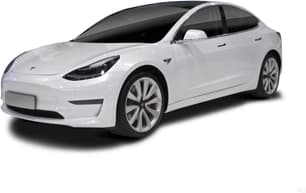
If the Tesla Model 3 Performance appeals to you, you're probably a different kind of electric car buyer.
Instead of outright range and efficiency, you're probably prioritising performance - I mean it's in the name of this spec of Model 3, after all. And this grade essentially takes the regular Model 3 and makes it a bit mental.
Let's go through how it does that.
Forget the Volkswagen Beetle - could the Tesla Model 3 be the new People’s Car?
I’ll leave you to join the dots between the men behind each of the two vehicles in question, but the Tesla Model 3 is the first ‘affordable’ EV from the breakout US brand.
Affordable is relative, of course - and we wanted to find out whether the entry grade variant - the Model 3 Standard Range Plus - is the Tesla you should be buying.
It is fun. It is fast (actually, it's incredibly quick). It is functional. But it's also flawed.
The interior ergonomic quirks may be something you get used to, or you might actually appreciate. But the quality of workmanship - or lack thereof - is something that is harder to overlook, especially for a car at this price point.
I believe the Telsa Model 3 Standard Range Plus is the best Model 3 you can buy. Apart from its brittle, unpolished ride, it offers a lot of capability and capacity for occupants and luggage, and enough usable battery range to allow you to escape the city if you want to.
It might seem harsh for the design score to be so low, but this is more about quality and physical fit and finish than the aesthetic of the car. I actually like the look of the Performance model, even if it is a bit amorphous at the front.
But it was the panel gaps and joins that were of most concern to me. If this particular model had come down the production line of one of the German brands, it would have been sent to the recycling centre. The workmanship for a car of this price is appalling.
One shouldn't be able to fit the tip of their finger in the gap between the front and rear doors. Nor should one be able to see a shadow on the rear door based on poor fitment of the front door. It was so poor on our test car, it made me think of a vehicle that had been crashed and put back together... and not very well.
This type of shoddy workmanship makes you wonder what other corners may have been cut. It has been widely reported that Model 3s were being assembled in a makeshift marquee-style tent in order for the company to hit its ambitious build targets.
The interior isn't without its fit and finish issues, either. Our car had a squeaky centre console (even though it had less than 700km on the odometer), and some of the plastics inside weren't fitted as well as they should have been.
See the interior images below for a closer look.
I love those wheels. Love them. LOVE THEM. They are futuristic but somehow retro, too. And the fact is that they’re functional too, as they help cut down aerodynamic drag. Plus they’re smaller than the ones on the sportier car (18s as opposed to 20s).
The rest of the car? Ummm, I like elements of it - the glasshouse is attractive, the side profile is pleasant, and the rear is reminiscent of the Model S, but not copycat. The front? Well, it lacks a bit of character to my eye, and to everyone in the CarsGuide testing team, too.
You might want to have a look at my Model 3 Performance review as reference here - because the car we had in that test was very poorly pieced together. This base model car was a bit better, with more acceptable panel gaps and fit/finish, though still not as uniform as you’d see from one of the German luxury brands.
The interior quality was slightly better on this example of Model 3, too, but the fact there is still a level of variance between cars could be concerning to people who worry about quality. Like me. I worry about quality.
Check out the interior images below for a glimpse at the cabin and its minimalist design.
The Model 3 is a bit of a storage marvel.
It has a boot, which measures 425 litres and has 60:40 split fold seats, plus a hidden storage compartment rear of the back axle for cables or other luggage. But there's also the 'frunk' (front trunk) which is large enough to house some backpacks or shopping bags (there are even curry hooks to stop the bags moving around too much) and it increases total storage to 542L.
Then in the cabin you have door pockets with bottle holders all around, a set of cup holders in the rear centre armrest, plus another set of cupholders and what can best be described as a cupboard between the front seats. There is a deep well of storage, between front occupants' legs, and a smaller section up between the seats, too. Plus there's a glovebox which operates using the touchscreen, because of course it does.
Space for adults is good up front, and the seat comfort and adjustment is pretty decent, too. The back seat space isn't great - there's limited toe room, the knee room could be better (anyone my height - 182cm - will feel a little cramped behind someone of a similar size) and you sit in a bit of a knees-up position, too. Headroom, too, isn't terrific - the roof angle is almost coupe-like, meaning you need to watch your noggin on entry and exit, and because it's all glass above, anyone with a bald spot might feel the sun a touch too much.
Now, about that screen...
It's a 15.0-inch unit that is located centrally, and it allows you control of basically everything in the car aside from the gear selection, engaging the cruise control or Autopilot (two quick taps of the gear selector - just don't get confused and tip it back into Neutral at speed...) and also the windscreen washers - oh, and there's a volume scroller on the steering wheel, thank goodness for that.
Everything else can be done using the touchscreen, from setting your side mirrors and the electric steering wheel adjustment (which will save to your profile), and you can Bluetooth stream music or connect via USB. The lack of Apple CarPlay and Android Auto is questionable though.
If you're into games, there's a selection of arcade options to choose when you're parked, and there are other things like Santa Mode, Mars mode for the maps, and even a whoopee cushion app...because farts are funny.
Honestly, I dislike this gimmickry because I know the company could have been spending its time, money and resources making a better-built car, rather than a nerdy amusement park cockpit.
But I can see the point that 'no-one else is doing cars like this', and that it will have appeal to people who are maybe a little more light-hearted about the idea of spending $100,000 on a toy.
If you’re aware of the Model 3, you’ll know it has some storage advantages that conventional cars can’t really match.
That’s because it has no engine in its engine bay. Suffice to say that Tesla calls the area under the bonnet the ‘frunk’ (front trunk), and it gives you 117 litres of cargo storage. That’s in addition to the regular trunk - or boot - which has 425L of cargo capacity, and also has a hidden storage section below the floor to store cables or luggage. All told, the total is 542L.
The cabin is practical, too. There are door pockets with bottle holders all around, cup holders in the rear centre armrest, plus cupholders between the front seats. Then there’s the storage caddy between the front seats, which is huge, and there’s a glovebox which opens using the touchscreen. Why? Because it can, I guess.
Occupants have electric seat adjustment and heating up front, while in the back the seat is fixed and not heated (it is in the models above). Rear occupants still get air vents and two USB ports (plus there are two more up front), but the actual space in the back is tight for larger adults.
Sitting behind the driver’s seat in my position (I’m 182cm) there’s limited toe room, and knee room could be better - plus you sit in a bit of a knees-up position, too. Headroom isn’t terrific because of the angle of the roof (watch your head getting in and out) and as it is purely glass above, it could get hot back there.
The centrally-mounted 15.0-inch touchscreen has its pros and cons. A lot is controlled using the touchscreen, from setting the position of the side mirrors and the steering wheel (which you can save to your driver profile), to the Bluetooth audio streaming and phone connectivity. It doesn’t have Apple CarPlay and Android Auto.
You might appreciate that the screen can also act as an entertainment source - there are games you can play and different modes you can engage (including a whoopee cushion and Mars mode for the sat nav). That’ll appeal to a certain type of buyer, but it doesn’t to me.
For the driver, the gear selector stalk doubles to engage the cruise control or Autopilot (two quick taps of the gear selector) and there’s a windscreen washer stalk, plus there is a volume scroller on the steering wheel. But the fact you have to look to the top edge of the screen for your speed readout - there is no head-up display - could be a concern for people who live in places around Australia where the police will ping you for less than 3km/h over the limit.
The all-wheel drive Performance variant tops the Model 3 range at $91,200 before on-roads.
That's a comparative performance bargain if you're thinking of it as a competitor to the likes of the outgoing BMW M3 ($141,610), Audi RS4 Avant ($152,529) and Mercedes-AMG C63 ($160,540).
This is what it says on the label - the most performance-oriented model in the line-up, with blistering acceleration figures we'll cover off in a sec.
It also adds 20-inch wheels, performance brakes, a carbon-fibre lip spoiler on the boot, lowered sports suspension, aluminium pedals, a higher top speed (up from 233km/h to 261km/h) and Track Mode setting.
It also has the "Premium Interior" with a 14-speaker premium audio system, in-car internet service with music and media streaming and satellite view mapping. That's all controlled by the 15-inch multimedia touchscreen that doubles as the car's dashboard, and it has Bluetooth plus controls for the dual-zone climate control. There are four USB ports (2x front, 2x rear).
Other standard gear includes LED front lighting, a fixed glass roof, auto-dimming mirrors (with auto folding and heating for the side mirrors), a key card (but no proximity entry), driver profile setups, and smartphone app controllability.
A couple of omissions: there is no Apple CarPlay or Android Auto phone mirroring, which could be a deal breaker for some. Plus you don't get wireless phone charging, and you can't get a 360-degree surround view camera system, and nor is there a head-up display (which you get standard on a $25k Mazda 3).
The Australian Tesla Model 3 line-up kicks off with this rear-wheel drive Standard Range Plus, priced at $66,000 (before on-roads - drive-away pricing varies state by state).
Standard equipment on the entry grade car includes 18-inch aero alloy wheels, 12-way power adjustable and heated faux-leather front seats, a 15.0-inch multimedia touchscreen that doubles as the car’s dashboard with Bluetooth and built-in sat-nav, dual-zone climate control, LED front lighting, and a fixed glass roof.
There are four USB ports, auto-dimming mirrors (with auto folding and heating for the side mirrors), a key card (but no proximity entry), driver profile setups, and smartphone app controllability.
Options available include metallic paint (from $1400 to $2800 depending on colour) and there’s Tesla’s Full Self Driving Capability option ($8500) which will include a tech rollout later in 2019 encompassing auto lane change, auto parking, the ability to recognise and act upon red lights and stop signs, automated driving on city streets, the company’s Summon system (where your parked car will come and find you autonomously) and navigation-linked Autopilot.
Rivals you might consider against the Tesla Model 3 Standard Range Plus include the Hyundai Kona Electric (from $59,990), Hyundai Ioniq Electric (from $44,990), Renault Zoe (from $47,490), Nissan Leaf (from $49,990). None of those electric cars can match the range of the Model 3, though.
If you believe Telsa, the Model 3 is actually a competitor to established luxury car nameplates like the BMW 3 Series (from $64,900), Mercedes-Benz C-Class (from $63,700) and Audi A4 (from $56,100).
How backwards is it that Tesla is one of the most high-tech companies on the planet, yet still offers outputs in horsepower and pound feet? This grade of Model 3 has a combined output from its front and rear motors of 450 horsepower (335kW) and 471 lb-ft of torque (638Nm).
That's from 0rpm, which is important - and because it's all-wheel drive, the Model 3 Performance has a 0-100km/h claim of just 3.4 seconds.
The maximum speed for this variant is 261km/h.
Tesla is strangely secretive about the battery pack and power outputs of the Standard Range Plus, but our research suggests this variant’s rear-wheel-drive powertrain consists of a 55kWh battery pack and an electric motor capable of producing 225kW - but at the time of writing, Tesla refused to confirm the outputs of this grade of Model 3. It has a single-speed (reduction gear) transmission.
The Standard Range Plus has a quoted 0-100km/h time of 5.6 seconds. It is capable of a top-speed of 225km/h.
Battery range. We all know fun is only fun if it isn't over too quickly...
The claimed range based on NEDC standard testing for this spec of Model 3 is 560 kilometres - that's 100km more than the entry-grade car because this model has a bigger battery pack. According to the Green Vehicle Guide, it will use an average of 20.7kWh/100km.
So what sort of range have we seen on test? Well based on my driving - which included some, ahem, rigorous testing of the acceleration and a few jaunts up and down a hilly, twisty section (and more than 150km of highway driving), I calculated a real-world range of 387 kilometres based on covering 309km and using 56kWh to do so.
Charging is dependent on your circumstance. Most people will get a home charger installed, and you can choose between different outputs (single phase, three phase) which will change the rate of charge. If you're going to buy a Tesla, be sure to speak to the company about your options to recharge it at home.
You can use the brand's Supercharger network, at a cost of $0.42 per kWh (about $25 and a bit over an hour from empty to full - or about a quarter of tank of 98RON premium unleaded in a similarly sized luxury performance car).
Nothing at this price point has anywhere near the claimed battery range as the Model 3 Standard Range Plus.
It has a claimed NEDC range of 460km, according to Tesla’s site, and according to the Green Vehicle Guide, the entry-level version is said to have a claimed energy consumption figure of 18.8kWh per 100 kilometres.
We saw consumption on test of 18.48kWh/100km, and that calculated out to a real-world driving range of 298km.
Given the claimed official range is 460km, it’s well short. Another way of looking at it is that on test it would have achieved just 64.8 per cent of its NEDC claimed range.
Sit-ups. Crunches. Squats.
Do some of those before you go getting into the Model 3, because you'll need your core strength if you plan to launch the car from 0-100km/h regularly.
In Sport mode, the acceleration is frightful. It's truly gobsmacking, so much so that it might make passengers feel ill if they're not expecting it. That it happens in near-silence is a compounding factor, as the only noise is a whirr from the electric motors and the whoosh of the wind as you cut through it.
It's a great party trick (like all those silly screen games!) but you won't be able to use it all the time, as it does eat battery range every time you do.
There are practical benefits of this level of immense acceleration - if you find yourself needing to get out of the way of an oncoming car, for instance, or if you just need to overtake a slow moving vehicle over a short opportunity. It's immensely helpful.
But what's more, the fact you can select Chill mode and have a considerably more sedate driving experience - presumably with the benefit of added range - is an advantage. It dulls things dramatically, but not too much.
There are other modes. The steering has Comfort, Standard and Sport variations, all of which have different weight and response to suit. I think Comfort is the best and most natural of the three - the Model 3 has quick a fast steering rack, and a lighter action makes for better involvement. Standard is just a touch too heavy, and Sport is numb.
Part of that, of course, comes down to the fact the AWD system means the front tyres have to steer and put power down at the same time, and like any AWD model, there's a compromise to the feeling of the way the car corners. I prefer the entry-grade RWD model from a purist perspective.
And in urban driving, you will note that the turning circle is bigger than you might think of a car of this size. At 11.8m, it takes more turning room than any of the equivalent luxury cars.
While we know its main wow factor is straight-line speed, it goes through corners well. The Michelin Pilot Sport 4 S rubber is superbly sticky in the twisty stuff, and the mechanical grip is great too, though you can feel the weight of the car (1847kg) in tighter bends. There's some road noise to contend with a higher speeds on coarser road surfaces, too.
We didn't sample Track mode, but based on my drive in Sport mode through a twisty mountain pass, I'd suggest I'd want more than just a mode to choose - I'd want more braking power (these were okay, but not as good as I'd hoped), more supportive seats (these are okay, but they don't hold you in place like you might want), and I'd want better steering.
The ride comfort of the Model 3 Performance was surprisingly just a touch better than the standard base model car, and that's despite it having 20-inch wheels and lowered sports suspension. It could have something to do with extra weight helping tie it down a little more, but I will say this - it's still not a terrific ride, as it tends to bobble over repetitive bumps, and can clunk down on sharp edges.
If you genuinely do a lot of urban driving and don’t often head out of town, or you’re considering a Tesla as a second car, you could actually save some money and buy a Hyundai Ioniq. I mean, if you can deal with that badge.
But a lot of people want to buy a Tesla because they’re true believers, they buy into the mindset, they appreciate what the brand stands for, or they just want an electric car with lots of range. Or all of the above.
And while we didn’t experience mind-bending range on this test based on the route we drove (158km of urban, country, coastal and highway driving, with just 42 per cent of the battery left and a calculated range of a bit under three hundred kays), the fact is that it does have the best real EV range you can get at this price point at the time of writing.
The fact is, though, that we had enough range to go for a lovely drive all day down south of Sydney and into the Southern Highlands, and still had enough battery remaining for the return trip in to town.
That drive included a jaunt up a mountain pass, and the rear-wheel drive layout of the Model 3 was its most engaging element. Sure, we didn’t thrash it or drift it, but the balance it displayed in linking tight corners together was impressive. And in RWD guise, the steering is more pure and predictable, where in the AWD model there’s a level of numbness as the front wheels have to both drive and steer.
The acceleration may not be as insane as in the Performance model (which does 0-100km/h in just 3.4 seconds), but with acceleration of 5.6sec the Standard Range Plus is hardly a slouch. In fact, that’s in the realm of some pretty impressive sports cars. That's part of the reason we think it has 225kW of power (and maybe about 400Nm of torque, too)... but old Mr Musk keeps his cards close to his chest.
But the fact you can have the car run in Chill mode, which makes it considerably more sedate and manageable in its acceleration, or in Sport mode, which is considerably quicker (almost like you flick a switch), is an advantage. Plus if you want more performance, you can get it if you pay for it - a lot of the other electric cars out there don’t have go-fast variants, so if that’s your thing, then Tesla will no doubt appeal to you.
Our biggest annoyance with this grade of Model 3 was the ride comfort. The suspension offers up a brittle, crunchy ride at times, especially over lumpy urban roads and pockmarked country patches.
Part of that comes down to the lack of any adaptive element to the suspension dampers, which can be flummoxed by repetitive bumps and ripples in corners. Some of it is also down to the 18-inch wheels - plenty of EVs have smaller, skinnier wheels and tyres to help with aero efficiency, but the Model 3’s standard rims are larger than you get on a Hyundai Kona EV, for instance.
Tesla scored a five-star ANCAP safety rating for the Model 3 range, and of particular note was the car's 94 pert cent score for Safety Assist tech, which is the highest ever. It also got 96 per cent for adult occupant protection.
All Model 3s come with six airbags (dual front, front side, full-length curtain), plus an advanced safety suite consisting of autonomous emergency braking (AEB) that works at city and highway pace and has pedestrian and cyclist detection. There's also blind-spot monitoring, lane departure warning, lane keeping assist, and that's all wrapped up in the 'A' word... Autopilot.
There's also the brand's "Full Self-Driving Capability" option ($8500) available apparently later in 2019, which includes auto lane change, auto parking, the ability to recognise and act upon red lights and stop signs, automated driving on city streets, the company's Summon system (where your parked car will come and find you autonomously) and navigation-linked Autopilot. You can option this after the fact, but it could cost more.
There are dual ISOFIX child seat anchor points and three top-tether restraints, but parents take note: because the rear seat has integrated headrests, your baby seat may not be able to be fitted as tightly as you'd like in the outboard rear seats. This is a common complaint when the headrests aren't removable.
The Model 3 achieved a five-star ANCAP safety rating in 2019, and as part of the breakdown it scored 94 pert cent for Safety Assist tech (the highest ever for that part of the ANCAP testing regime), and it also scored 96 per cent for adult occupant protection.
There are dual ISOFIX child seat anchor points and three top-tether restraints, but parents take note: because the rear seat has integrated headrests, your baby seat may not be able to be fitted as tightly as you’d like in the outboard rear seats. This is a common complaint when the headrests aren’t removable.
All Model 3s come with six airbags (dual front, front side, full-length curtain), plus an advanced safety suite consisting of autonomous emergency braking (AEB) that works at city and highway pace and has pedestrian and cyclist detection. There’s also blind-spot monitoring, lane departure warning, lane keeping assist, and that’s all wrapped up in the ‘A’ word… Autopilot.
The aforementioned “Full Self-Driving Capability” option ($8500) adds even more safety and more than a hint of added convenience, too, if that’s what appeals to you. And while it’s best to option it when you lay down your deposit, you can have it retrofitted at a later date, possibly at a higher cost.
Tesla backs the Model 3 with a less-than-excellent four year/80,000km warranty for the car itself, which doesn't really instill confidence - especially considering it was quietly rolled back from eight years/160,000km.
You get a longer warranty on the powertrain, though - for the RWD model it's eight years/160,000km, while AWD versions have eight years/192,000km cover.
Tesla doesn't offer maintenance plans anymore - it used to have a selection of three- or four-year cover plans, but the brand says its maintenance requirements are so minimal it doesn't need to have that level of cover anymore.
But there is an inspection checklist that customers should abide by. Every two years the cabin air filter and brake fluid should be seen to, while the High Efficiency Particulate Air (HEPA) filter requires checking every three years, and the air conditioner needs service every six years, too.
There are wheel balance/alignment/tyre rotations to consider, too.
The Model 3 has a four year/80,000km warranty for the car itself, which isn’t as good as it used to be (the brand recently quietly rolled warranty cover back from the previous eight years/160,000km).
The powertrain warranty for this RWD model it’s eight years/160,000km - if you option up to an AWD version, you get eight years/192,000km cover.
Tesla doesn’t offer maintenance plans anymore - it used to have a selection of three- or four-year cover plans, but the brand says its maintenance requirements are so minimal it doesn’t need to have that level of cover anymore.
The brand does have an inspection checklist customers should abide by. Every two years the cabin air filter and brake fluid should be seen to, while the High Efficiency Particulate Air (HEPA) filter requires checking every three years, and the air conditioner needs service every six years, too.
There are wheel balance/alignment/tyre rotations to consider, too.