What's the difference?
Ask any opinionated car enthusiast why it is that they hate electric cars, and you’re going to hear the same word revving them up - “noise”.
Sure, EVs might be fast, and even the most old-world-loving petrol head (are we going to have to come up with a new term, soon? Power crazed? Amp-head? Copper top?) will grant you that they can be fun to drive, but the argument is that you just can’t love a car as much if it doesn’t make shouty sounds.
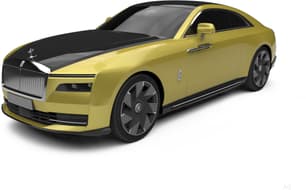
But there is one bunch of well-heeled car lovers who will demur on this topic, and for whom the idea of switching a big, stupidly powerful V12 engine for whispering electric motors seems to be no issue at all - Rolls-Royce fans.
They have, allegedly, been knocking down the doors at Goodwood, demanding that Rolls build them an EV, and finally it has arrived, in the stunning shape of the Spectre, and the orders are pouring in.
We flew to the Napa Valley in California to try it out.
It can be easy to dismiss electric cars as an imperfect solution to the world’s problems. But that would be missing one big point - they’re really, really fast.
Carmakers twigged that not everyone was enamoured with the environmental credentials of electric vehicles (EVs), especially luxury brands, and thus pivoted to the new sales tacit of performance and prestige.
Which is why Audi’s current performance flagship vehicle is not a mid-engined V10-powered replacement for the R8, but rather the all-electric RS e-tron GT. And for the new model year they have not only updated the range, bringing (you guessed it) more power, but also added a new hero model - the RS e-tron GT Performance.
It leads a new three-pronged line-up for the four rings brand, with the RS e-tron GT Performance sitting above the RS e-tron GT and the new S e-tron GT; the latter effectively replacing the previous ‘entry-grade’ model known only as the e-tron GT.
These arrive as part of a mid-life update for the model, with some minor styling tweaks (inside and out) along with enhancements to the battery and changes to the specifications.
The new range has just arrived in Australia and Audi will be hoping it can turn around the sales performance, which saw the outgoing e-tron GT and RS e-tron GT find just 84 customers in 2024. That was a decline of 75 per cent on 2023 sales, and nearly 200 less than the closely related Porsche Taycan.
Personally, I was very much taken with the looks, and the feels, of the new Rolls-Royce Spectre, which delivers everything you’d expect from this brand, and seems to have lost nothing by switching to electric propulsion. The trick, it seems, in turning your brand into an EV one is to have made your cars silent in the first place.
But the real verdict comes from the people hurling their Spectre orders at the company, which has received so many of them it’s being forced to ramp up production. And 40 per cent of pre-orders are from new customers. Honestly, it’s as if they were all just waiting for an EV to drop a million on.
While it may be a very different beast to the R8 supercar, it’s hard to argue that the e-tron GT offers performance that isn’t equal to anything Audi has previously produced. The immense acceleration and power, coupled with the brilliant and clever handling make this updated range, especially the RS pair, feel like something special.The fact that it will save you visiting a petrol bowser and might help cut harmful emissions is just a bonus.
Note: CarsGuide attended this event as a guest of the manufacturer, with travel, accommodation and meals provided.
Making a vehicle as enormous as the Spectre look good is no mean feat, but Rolls has done a hell of a job, from most angles. The massive Pantheon Grille is something to behold in the metal, and because it doesn’t need to let air into an engine bay, it’s been designed for airflow, as has so much else. Rolls achieved a drag coefficient of 0.25, which is good for extending EV range, and they even spent more than 800 hours in a wind tunnel working on making the Spirt of Ecstasy hood ornament as aerodynamic as possible (she’s had her wings clipped, apparently).
The modern take on the classic grille combined with a chesty bonnet and very cool DRLs give the Spectre a look of classic modernity from the front, while the proportions over all give it a great side profile.
Apparently the design brief was based on some majestic cliffs, the Seven Sisters of Sussex, and the car definitely has that level of grandiosity.
The only weak point is the rear, which had to be sheer for aero reasons - and features the narrowest legally possible rear lights, which are supposed to look like “islands in a lake”, apparently. To me, driving behind one, the rear view is just a little dull.
The luscious interior is meant to be an example of “Automotive Haute Couture”, meaning hand made and stupidly expensive, and Rolls also humbly refers to it as a “cosseting art lounge”. It all sounds a bit over the top until you sit in it, and discover that it really does feel beyond special.
While there are some big changes underneath, on the surface the design tweaks are quite subtle.
There are some tweaks to the front grille, headlights, lower bumper and air intakes, but overall the look isn’t dramatically different. The more noticeable styling change is between the S and RS models, with the latter looking more sporty and dynamic thanks to a unique lower bumper design and the larger alloy wheels, which have a sportier look.
The biggest design changes are arguably the introduction of the switchable transparency roof on the RS and the option to use matt carbon camouflage.
The former is another shared element between the RS e-tron GT and Taycan, and it uses a special glass that can switch between being clear or opaque depending on whether you put a current through it. Cleverly, Audi is offering the option to have individual sections alternate between the two states, so you can customise it to your preference.
As for the grandly named matte carbon camouflage, it wasn’t highlighted in Audi’s presentation, but it’s the same material the Lamborghini developed over a decade ago and calls ‘forged carbon’ instead.
Unlike traditional carbon-fibre, which is made from injecting resin into sheets of fabric-like carbon fibre weave, forged composite uses a malleable paste of carbon sheets and resin. This technique is quicker to make and easier to shape into complex pieces, but lacks the visual impact of conventional carbon-fibre.
The biggest design change internally is the new steering wheel, which is a not-quote-squared-off rim that feels nice in your hand without being too thick. The RS models feature two new large red buttons - ‘RS’ and ‘Boost’ - which allow you to select the drive modes and activate the short boost function, respectively.
If you’re looking for the modern EV style interior, you can forget it, because Rolls says it didn’t want “any of that funky stuff” in the Spectre, so no giant screens in here. Indeed, I switched into a Rolls-Royce Ghost at one stage to be driven somewhere and the interior was almost exactly the same, although the new car gets a more modern fully digital dash.
There’s plenty of room for water bottles and oddment storage and the sense of space for the driver and front passenger is suitably grand, but the rear seats are really for spoilt teenagers rather than Rolls owners. They’re not uncomfortable, at all, but they just feel a bit squeezed, you wouldn’t ask to be chauffeured in a Spectre, clearly it’s a Rolls you’d choose to drive yourself.
The boot is wide, deep and long with a volume of 380 litres.
Practicality is an important consolidation for the e-tron GT, it may have replaced the two-seater R8 as Audi’s definitive performance hero, but it’s a four-door sedan so it needs to be more family friendly. It’s especially relevant for Audi, as the brand has a history of brilliantly combining family needs with fast cars, namely its iconic wagons, the RS4 and RS6 Avants.
Audi also has a strong reputation for some of the best interior design in the industry, and the e-tron GT is arguably amongst its best work (at least in this reviewer’s opinion). It looks modern and stylish without leaning too far towards being different simply because it’s an electric car.
The new steering wheel fits the new design well, framing the digital driver’s display nicely. The display itself has a new RS-specific display for the higher-end models.
There’s a central infotainment touchscreen, but underneath this particular Audi skips the climate control touchscreen in favour of a digital readout and physical switchgear; a welcome relief for some, no doubt.
As for the seats, all three trim levels get the same style of sports seat trimmed in Nappa leather with a honeycomb stitch pattern. There are different finishes, both black and red leather, and some with contrasting stitching available through the optional design package. The RS performance package gets a unique ‘serpentine green’ stitching to stand out.
Small item storage in the front is adequate but not generous, which does make the e-tron GT feel more like a sports car at least, even if it doesn’t help practicality.
As for the rear, space is surprisingly good given the external dimensions and the nature of it being a low-roof sedan (rather than an SUV) with batteries underneath the floor. That’s largely because Audi has split the battery pack to allow for extra room in the rear for passengers’ feet, combating a common problem with electric sedans.
Headroom is adequate, and will be tight for anyone much taller than 180cm, but it will do the job of transporting the family in relative comfort. It is, by no means, the most spacious or family friendly model in the Audi range, but it does play its role as both a performance car and roomy sedan.
The boot is measured at 405 litres in the S but shrinks to 350L in the RS models, but both have the same 77L space under the bonnet, so space is (again) reasonable without being generous.
Australian pricing for the Rolls-Royce Spectre starts from $770,000 before on-road costs, and on the point of whether that represents value, well not to me, but certainly the huge number of orders Rolls claims to have been hit by suggests otherwise.
You do get a lot of car for your money, because the Spectre is vast and weighs almost three tonnes, and there’s no doubt that the interior is nicer than most people’s houses, or even the nicest hotel you’ve ever seen, and that the top-notch umbrellas hidden in each door are a nice touch.
One of the nifty and unexpected features the Spectre offers is a “Rolls-Royce Sound”, which you can toggle on and off. With the fake noise off, the car is freakishly quiet - apparently during testing they achieved a level of EV silence so incredible that people found it “disturbing” and had to engineer some sound back in - but with it on you get just the most subtle of guttural sounds. Every other company so far has gotten fake noise wrong, but Rolls has nailed it with the Spectre; it’s just loud enough, but suitably restrained as well.
You also get the wondrous Starlight Headliner, which uses optic fibre cables to paint the night sky on the roof, complete with shooting stars, and in the Spectre you can now have the stars fitted to the inside of its massive coach doors as well.
The 2025 range begins at $209,900 for the S e-tron GT, steps up to $264,900 for the RS e-tron GT and hits $309,900 for the new RS e-tron GT Performance (all prices exclude on-road costs).
While there is more power and equipment, that’s still a significant leap in price, with the previous e-tron GT starting at $181,784 ($28,116 cheaper) and the RS e-tron GT priced from $250,484 ($14,416 cheaper).
This pushes the Audi close to its most direct rival, the Porsche Taycan. Despite what the brands try to say publicly, the reality is these two are very closely related mechanically. Porsche now has two models cheaper than the S e-tron GT (the $174,500 Taycan RWD and $184,500 Taycan 4), while the Taycan 4S is priced just above it at $215,700.
Porsche’s rival to the RS e-tron GT is the $260,300 Taycan GTS, while it has the $306,900 Taycan Turbo to challenge the new RS e-tron GT Performance - plus the Turbo S and Turbo GT above it for those craving more power.
While the Audi isn’t bad value, it isn’t surprising that people in the market for an electric performance car from Germany are leaning towards the Taycan instead of the e-tron GT given the pricing structure.
In terms of specification difference between the three variants, the S e-tron gets 20-inch alloy wheels, adaptive air suspension, all-wheel steering, HD Matrix LED headlights with Audi laser lights, and a panoramic fixed glass roof.
Moving up to the RS e-tron GT adds unique 21-inch wheel design, a panoramic glass sunroof with a new switchable transparency, performance brakes with a carbide coating, and an RS-specific instrument cluster design.
The RS e-tron GT Performance crowns the range with its own 21-inch alloy wheels, active suspension and a specific RS Performance exterior electric sound system as standard.
There are a range of option packages too for all three models, which bundle extras together. The Sensory package ($6000) and Design package ($3800) are available for the S, the RS can be had with the Gloss carbon exterior styling package ($6000) and RS design package ($4500), and the new RS Performance has the matte carbon camouflage exterior styling package ($10,000) and a unique version of the RS performance design package ($4500).
For the first time ever, this Rolls-Royce has no magnificent engine, no throbbing 12 cylinders, no, it has two separately excited synchronous motors, one on each axle for seamless all-wheel drive. The front motor makes 190kW and 365Nm while they’ve sensibly sent more grunt to the rear, which gets 360kW and 710Nm. Either motor on its own would be enough to power a normal car. The total figures are 430kW and 900Nm, which is supercar like.
The battery is made up 804 cells, weighs 700kg and has a net capacity of 102kWh, and the designers used it as a sound-deadening agent for road noise, because it’s so massive.
The Spectre can hit 100km/h in 4.5 seconds, which feels very fast indeed when you’re piloting something that weighs 2890kg and is 5.5m long.
The key number for the new model is 680kW - that’s what the new RS e-tron GT Performance produces from its dual electric motors. That makes it the most powerful production car Audi has ever offered, which is quite an achievement when you look back at some of the cars this brand has built over the years.
That power upgrade is an extra 205kW over the pre-facelifted RS e-tron GT, and comes with a whopping 1027Nm of torque.
The RS e-tron GT has been upgraded too, now making 630kW/865Nm, a 155kW improvement on the old model. Which is a good thing, because the new S e-tron GT has even more power than the original RS, underlining just how much Audi has focused on power for this mid-life enhancement. The new S packs a 500kW/717Nm punch, compared to the 475kW/830Nm the previous RS offered.
The Spectre is rated at 520km on the WLTP scale, but Rolls claims it can do a lot better (like 600km). Efficiency is claimed to be 21.5kWh per 100km.
We drove 210km and had 300km of indicated range left at the end, which is pretty close to the claim.
The Spectre can be charged at up to 200kW on a DC fast charger, on which it will take 35 minutes to go from 10 to 80 per cent charge.
On an 11kWh home system it will take 10 hours and 45 minutes to go from zero to 90 per cent charge.
Another one of the significant unseen changes for this update is the battery. Audi has overall the battery for this latest e-tron GT, so it now has higher energy density (168.3Wh/kg), more size (105kWh v 97kWh), faster charging (10-80 per cent in 18 minutes) and reduced weight (down 9kg).
Despite all the extra power, driving ranges for the three models are still all beyond 500km. The S e-tron GT has a claimed range of 558km, the RS e-tron GT can manage up to 522km and RS e-tron GT Performance can run 528km on a single charge, according to Audi.
As for the charging itself, Audi claims it now takes just 18 minutes to get from 10 to 80 per cent using an ultra-fast DC charger.
The short answer to this question is that the Spectre drives just like a Rolls-Royce, but that answer is deceptively simple, because, for an electric vehicle, that’s actually a hell of an achievement.
Most EVs do not feel like cars to drive - the electric Hyundai Kona is not much like a petrol one at all - but what Rolls set out to do with its first EV was to make a vehicle that feels, handles and accelerates just like one of its famous and fabulously over-powered combustion-engined Ghosts, Phantoms or Wraiths.
This meant it had to be “Silent”, which it nails with ease - and the important thing to remember here is that even its V12 cars were always incredibly quiet, unless you really misbehaved. And it had to be “Effortless”, another brand pillar. Again, nailed it, because a Roller has never bothered with things like shift paddles, Sports modes or even the option to do anything but stick it in D for Drive and go.
The sensation Rolls owners demand is endless, otiose acceleration, particularly off the line, and the Spectre delivers this in a typical EV fashion, but also one that’s very familiar to anyone who’s driven a Ghost, for example. It’s just a sense of overwhelming, prole-crushing progress, and it’s magnificent.
The third and final brand pillar is “Waftability” and despite all the weight that it’s carrying (imagine how far over three tonnes this thing would have gone if they didn’t build their cars out of aluminium), the Spectre rides with a kind of hovercraft air of being just above, or barely in touch with, the ground. Bumps are no longer your concern, sir.
As mentioned, Rolls could have chosen a limousine-style vehicle as its first EV, but it has made a driver’s car instead - no CEO will sit in the back of a coupe like the Spectre. So it had to deliver when it comes to being fun, or at least a little frisky at times, when driven.
Again, quite incredibly, despite its mass and weight, it does reward enthusiastic driving and can carve up even relatively narrow winding roads with aplomb, displaying very little body roll or pitching. The steering is almost absurdly light - because it must be “effortless” - but there’s still enough feedback to keep you interested.
Most of the time, of course, the essentially laid back aura of being in a Rolls-Royce will seep into your body and brain and you will simply cruise along, patting yourself on the back for being so rich and clever.
And now, with an EV option finally available, you can tell yourself you’re saving the planet as well (as long as you don’t think about the 28 other cars in your garage).
Befitting its role as Audi’s performance hero, the new range drives with a level of speed and precision you would expect from such a car.
Even the new S e-tron GT has a level of acceleration that not every sports car could keep up with (the official 0-100km/h claim is 3.4 seconds), which would be impressive on its own but is a standout when you consider this is a four-door sedan.
It also helps that the adaptive air suspension and all-wheel steering (which can help both low speed manoeuvring and high speed changes of direction) make for an incredibly responsive and agile handling vehicle.
And then you drive the RS e-tron GT Performance and the driving experience is a step up again with its 2.5s triple-digit sprint time. That’s largely because of the new active suspension system it uses, which features a hi-tech array of cameras, radars and sensors to ‘read’ the road ahead of it and adjust the ride accordingly.
The result is arguably one of the best riding, most comfortable electric performance cars on sale today. Typically the need to control so much weight, from the batteries, means the ride is often too firm. But with the active suspension, Audi has somehow managed to make the ride both compliant (on 21-inch wheels) but also very well controlled, which allows you to really drive with precision even at speed.
But it’s not just the suspension, as mentioned earlier, the RS models also get a new ‘Boost’ button on the steering wheel that offers an extra 70kW of power for 10 seconds. Along with the surge of extra performance there’s a large countdown timer on the digital dashboard when you press it to really give you a sense of urgency and speed.
Thankfully, with so much power the e-tron GT range has plenty of stopping power. The S comes equipped with steel brakes, which do a fine job. But for the faster RS models, you get a carbide coated rotor and you can option ceramic brakes for more resilient stopping power.
The Spectre has not been crash tested for ANCAP. Its safety offerings include adaptive cruise control, lane-change assist, lane departure with active steer, a reversing assistant - "to support with parking and long reverses, eg country lanes or driveways, Spectre will reverse the previous 200m driven" - and collision warning with active braking.
Rolls tell us the Spectre has "Four airbags (does not need more)". So that's good news.
Audi has equipped the e-tron GT trio with a respectable level of safety features, including adaptive cruise control with stop and go functionality, park assist plus, front and rear autonomous emergency braking, active lane assist, side assist with exit warning, collision avoidance assist and a 360-degree camera system for parking assistance.
Given its low sales volume, ANCAP has not crash tested the e-tron GT (or the structurally similar Taycan), so there is no score. But overall its level of equipment and Audi’s reputation and experience means we have no safety concerns over this particular model.
Now, I would assume you'd get a lifetime warranty at Rolls prices, but apparently you get only four years, but it is unlimited mileage.
The Spectre's battery is covered by a 10-year warranty.
An extended service and warranty package is "TBC".
Rolls also offers 24/7 roadside assistance, and if your battery goes flat the company will take your Spectre to the nearest charging station.
A "regional flying doctor" is on standby 24/7 in extreme cases if Spectre “fails to proceed”.
Audi offers its standard five-year/unlimited kilometre warranty for the three e-tron GT variants, but the battery gets a specific eight year/160,000km warranty. The five years of coverage is fairly standard for the luxury car segment, but short of the increasingly common seven-year warranties for mainstream brands.
As for the servicing, that’s included in the cost of the car, with Audi covering the first six years of maintenance for no additional charge. It helps that service intervals, without a complicated and oily engine, are stretched to two years or 30,000km.