What's the difference?
The Polestar 2 was one of the first electric vehicles (EVs) in Australia to break through to the mainstream, however it has always been relegated to the Tesla Model 3’s shadow.
As a result Polestar is constantly playing catch up, releasing update after update for this premium-pushing electric liftback. The most notable was a major mid-life update in 2024.
Two years after this, Polestar has just rolled out the 2026 model year (MY26) update which introduces a range of subtle changes, largely under the surface.
It comes as Polestar is now introducing newer models, there’s mounting pressure from legacy carmakers who are only now catching up to EV tech, and Australians are moving away from buying passenger cars to SUVs.
Has this latest update improved the appeal? Read on to find out.
Jeep's Renegade might be late to the mini-SUV party but it comes with a pretty impressive back catalogue to suggest that this is a SUV that can cash the cheques its name can write.
The top of the range Trailhawk can write even bigger cheques than the lower models, bringing with it a range of off-road tech toys to let you really get down and dirty.
This latest update for the Polestar 2 is lovely, but driving the original is a reminder of how solid this car has always been if you overlook the inherent impracticalities of being an EV on a combustion-engine platform.
The fact you still get steady flow of over-the-air software updates bringing new features, plus you can now upgrade to the new Qualcomm processor chip, saving some coin and getting a second-hand model that’s a couple of years old isn’t a bad option at all.
Note: CarsGuide attended this event as a guest of the manufacturer, with meals provided.
Rugged, dependable and good off-road are the most obvious qualities of the Trailhawk. It stands out from the rest of the mini-SUVs by being able to do the S and the U with plenty of vigour.
It's just a shame that its on-road manners can't match that of its big brother, the Cherokee. Unless you're planning on proper off-roading, the Trailhawk might not be quite what you're looking for.
I’ve always been a fan of the Polestar 2’s exterior design and unlike many new cars it has aged like fine wine over the years. You need to remember the Polestar 2 dates back to 2016 when it was first revealed as a Volvo concept.
It still has clean lines, iconic lightning signatures, plus a tough stance that evokes just a touch of muscle car.
While it has taken me a while to come around to the new blanked-out grille insert, it suits the character of this car given it’s an EV. It also aligns with the wider Polestar design language.
For 2026 there haven’t been any major changes to the exterior. There’s a new sandy-like ‘Dune’ exterior paint colour replacing the silver ‘Jupiter’, plus a new 20-inch forged alloy wheel design for the Long range Dual motor Performance.
Inside, the Polestar 2 looks fundamentally the same as it did when it first launched, in the best and worst ways.
I appreciate how traditional car-like the layouts of the steering wheel, digital instrument cluster and touchscreen multimedia system are. Sure it doesn’t scream ultra high-tech anymore like some of its rivals, but there’s still an understated premium feel to it.
The same can be said for the rest of the Polestar 2’s interior. Everything feels purposeful in a minimalist way which helps make for a clean design.
Speaking of purposefulness, the optional Bowers and Wilkins sound system features a prominent tweeter on top of the dashboard. It looks stunning and is functional, helping to create an incredibly punchy and full sound stage in the cabin.
One of the few finishes I dislike in the interior is the glossy piano black on the steering wheel buttons. You interact with these frequently and it doesn’t take long for fingerprints to present themselves.
There’s now a new synthetic leather upholstery finish for those who opt for the $4700 Plus package. It’s quilted which helps emulate a premium puffer jacket-like look.
Although it’s expensive, the $4400 ‘Bridge of Weir’ Nappa leather upholstery is beautiful and required if you want ventilated front seats. You can only get black and white finishes, which is fine, but bringing back a tan or caramel option would be delicious.
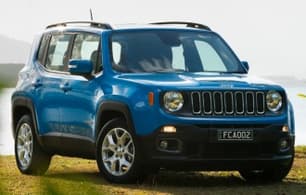
In what is absolutely not a coincidence, the Renegade immediately conjures up the Wrangler. Upright grille from the Willys Jeep (references abound here), round headlights, squared off wheel arches to mimic the Wrangler's guards, short overhangs and big rear view mirrors.
The 17-inch wheels look completely lost in the wheelarches which are even more cavernous owing to the Trailhawk's 50mm of extra ride height. The wheels are also a bit cheap looking but will probably survive the belting the car is intended to take.
Less rugged is the interior, despite a fairly self-conscious effort to make it look and feel chunky. The front seats are flat and unsupportive with the rears just as lacklustre making sure everyone is sliding around together. Luckily, front passengers get a dash-mounted grab handle.
It seems quite well put together, however, but with carpets and easily-marked plastics, you'll hope your passengers don't bring the mud in with them too often. And the "Since 1941" stamped into the steering wheel can go.
The dashboard is reasonably clear and has plenty of information to share via the screen between the dials but whoever thought marking the redline with a water splash graphic in bright orange should probably rethink their design decisions.
Storage is limited to two cupholders up front, door pockets in each door and nets on the front seat backs.
The 2026 Polestar 2 starts at $62,400, before on-road costs, for the Standard range Single motor and extends all the way to $85,080, before on-road costs, for the Long range Dual motor with the Plus and Performance packages.
This is more expensive than the similarly premium-pushing Tesla Model 3 ($54,990 to $80,900, before on-roads), as well as the more budget-oriented BYD Seal ($46,990 to $61,990, before on-roads).
Despite this, Polestar currently has some major deals and offers on new 2026 Polestar 2 stock to the tune of up to $13,000 off the drive-away price. This can see you drive away in a brand-new model for as little as $55,763, drive-away, in Victoria, which is around $5000 less than a base Model 3 RWD.
There’s a catch though… options. There is a slew of option packages and singular options available and they add up quickly.
Most notable is the new $3500 14-speaker Bowers & Wilkins sound system that must be bought in conjunction with the 'Plus package' which is $4700 on all trims besides the Long range Dual motor as it’s already standard.
Annoyingly, a heat pump is part of the $1500 'Climate package' which also brings heated rear seats, a heated steering wheel and heated wiper nozzles. So many carmakers now include heat pumps as standard fare in EVs as they help reduce energy consumption during colder months.
Beyond this, there’s a standard base of equipment which is fine for the price point. Highlights include LED headlights, a 12.3-inch digital instrument cluster, 11.2-inch touchscreen multimedia system, wired Apple CarPlay and Android Auto, wireless charger, dual-zone climate control and heated front seats with electric adjustment.
The Renegade range starts at $28,000 for the 1.6-litre Renegade Sport manual front-wheel drive, climbing between $2000 and $3000 through the Sport Auto, Longitude Auto, Limited Auto with a final jump of $4000 to the 2.4-litre auto-only Trailhawk.
Standard is a nine-speaker stereo with Bluetooth and USB, 17-inch alloys, dual-zone climate control, reversing camera, rear parking sensors, keyless entry and start, cruise control, electric front seats with heating, satellite navigation, automatic bi-xenon headlights, auto wipers, leather trim, roof rails, front and middle bash plates, full size spare, heated leather steering wheel, privacy glass, trailer sway control and tyre pressure monitoring.
The lairy Omaha orange is $500, part of an eleven colour palette with only two no-cost paint options (black and white).
You can add lane departure warning, auto-parking and a black painted roof for $500 each, a removable and retractable roof called My Sky Roof for $2200 or a more conventional electric sunroof for $1900.
The Beats-branded nine-speaker stereo is run via Fiat-Chryser's UConnect system, accessible through the 6.5-inch touchscreen. While it improves with every attempt, it's still quite clunky and when the sat-nav is added, becomes a bit of a mess.
Thankfully, not every function has been crammed into the touchscreen interface, so you'll spend more time with your hands on the wheel rather than working out which bit of the screen has the climate control.
No changes have been made to the Polestar 2’s electric motor set-up for 2026.
Both the single-motor versions have been rear-wheel drive now for a few years and produce either 200kW or 220kW, depending on the battery pack.
The Long range Dual motor adds a front-mounted electric motor bringing total system outputs to 310kW and 740Nm. It’s capable of doing the 0-100km/h sprint in 4.5 seconds.
The $8980 Performance pack (available only on the Long range Dual motor) bumps the total system power output to 350kW. It also reduces the 0-100km/h sprint to 4.2 seconds.
The Trailhawk is powered by Fiat's 2.4-litre four naturally-aspirated four-cylinder producing 129 kW and 230 Nm. Jeep reckons you'll get 7.5L/100km on the combined cycle. Our mostly city driving with a longish motorway run produced an 11.0L/100km average over a week.
The transmission is a nine-speed ZF automatic driving all four wheels.
The Trailhawk also has Jeep's five mode Selec-Terrain system which should cover pretty much every eventuality – Auto, Sport, Mud, Sand and, just for the Trailhawk, Rock. The Trailhawk is rated to tow 400kg unbraked and 907kg braked.
While outright practicality isn’t the Polestar 2’s strong suit, once you get on the road this melts away almost instantly.
This EV is and has always been a driver’s car that’s engaging and rewarding to steer. It’s a shame that many people’s first experience with it was likely in the second row as a rideshare with a driver that has a bad case of taxi foot.
Surprisingly, during the media launch drive program we had the opportunity to sample the original MY22 Long range Single motor and compare it back-to-back to the MY26 models. It’s rare this kind of thing happen.
This is notable because single-motor versions made the switch from front- to rear-wheel drive back in 2024.
While the MY22 example feels like a bulldog yet still capable of carving up corners, it holds up well if you ignore the odd cabin rattle and creak. You can also feel a marked difference with how the rear guides the latest MY26 Long range Single motor instead of the front when pushed.
This isn’t apparent in calmer, everyday driving situations. If you’re not a car person you likely wouldn’t be able to tell the difference.
The rear-mounted electric motor produces an adequate amount of oomph, allowing you to get up to speed with ease. Like all EVs you get snappy acceleration from a standstill, which is thrilling.
This is dialled up to 11 in the Long range Dual motor Performance. Although the Model 3 Performance is technically faster, it still feels like this Polestar 2 is quick enough.
In the fully loaded all-wheel drive trim you’re able to carve corners enthusiastically. It’s incredibly confidence-inspiring to chuck into corners as there’s grip for days and a bucketload of power to back it up.
Although the regenerative braking system is pretty powerful already, the Performance pack adds chunky Brembo physical brakes for added peace of mind. Perhaps Tesla could take note of this?
The aforementioned Performance pack also adds manually adjustable Öhlins dampers with a ‘Polestar Engineered’ performance chassis. It’s an incredible package with a dialled-in feel, though if you want to adjust the dampers you need to jack up the car.
If you’re not keen on outright performance, the regular Polestar 2’s suspension set-up still holds its own but has an added level of all-around comfort. It’s an improvement from the original which was a little too firm.
Across the line-up the steering is direct and makes this car feel nimble regardless of where or how you’re driving. You’re able to select from different steering feels which increase or decrease the resistance.
Given EVs have no engine noise, they can sometimes have more noticeable road and wind noise out on the open road. Thankfully the Polestar 2’s cabin is quiet enough, that is unless you’re driving on coarse-chip roads.
The Trailhawk name suggest that things are going to get muddy – compared to the rest of the range, the range-topper rides 50mm higher and has exposed, easy-to-reach tow hooks in the fairly unlikely event you get stuck. It also has a 20:1 low-range crawl ratio and Active Drive 4x4 which means it can switch between front and all-wheel drive. It'll also wade through almost half a metre of water. It's a genuine mud-plugging proposition and will take on some much bigger machinery out in the bush.
On the road, where we spent all our time in the Renegade, it's not what you'd call particularly inspiring. There's a number of sources of noise that contribute to a less than quiet cabin and having to constantly correct your course at freeway speeds adds to the tiring nature of the Renegade.
It's much better at lower speeds, pottering around but then again, its nine-speed transmission needs a lot more work on the shift mapping because it seems to forget which gear it needs to be in when you sink the right foot. If you don't need the Trailhawk's extra off-road goodies, consider the 1.4 litre Limited or Longitude.
The Polestar 2 received a maximum five-star ANCAP safety rating based on testing conducted in 2021.
Standard safety equipment includes eight airbags, autonomous emergency braking (AEB), blind-spot monitoring, rear cross-traffic alert, adaptive cruise control, lane-keep assist, lane centering, front and rear parking sensors as well as a surround-view camera system.
This amount of safety tech is pretty standard fare now, but I particularly like how well they are tuned. It’s more noticeable in a world where new cars from new carmakers continually chime at you even though you’re driving normally.
There are ISOFIX child seat anchorages on the two outboard rear seats, plus top-tether points on all three rear seats.
Seven airbags (including driver's knee bag), traction and stability controls, roll mitigation, blind spot monitoring, ABS and brake assist.
The Renegade does not yet have an ANCAP star rating although it scored five EuroNCAP stars in 2014.