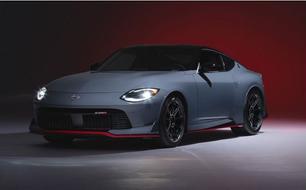
What's the difference?
The Nissan Z is a real blueblood.
With Datsun, Nissan introduced the world to Japanese cars via a gruelling round-Australia rally in 1958 that had the country captivated. Within 10 years the 1600 made them respectable, but it was the 240Z of 1970 that also made them desirable.
Seven generations later, today’s RZ34-series Z – along with the Toyota/Subaru GR86/BRZ and Mazda MX-5 – embodies that nation’s tradition of affordable yet charismatic sports cars.
They’ve always been ripe for modifying as well, with Nissan leaning on its performance arm Nismo for 40 years. Which is exactly what the Z Nismo is all about, stepping up to take on the Toyota GR Supra, BMW M240i and Ford Mustang GT.
The old 370Z Nismo was a true corker. Let’s find out if this one does the family proud.
The idea of a Tesla that can tow sounds about as likely as an astrophysicist with three Olympic gold medals, who also moonlights as a hand model.
The EV brand has blazed a trail for every other mainstream and premium car manufacturer to jump on the electric bandwagon, and today they’ve still got the biggest batteries and most impressive range ratings, while also having the most extensive extensive network of charge stations made up of Superchargers and destination chargers, covering every state and territory.
They’re not perfect though, often displaying niggling build quality issues and production delays for upcoming models. There’s also a degree of uncertainty bred by a founder who flits between the modern-day space race, manufacturing flame throwers and offering to send miniature submarines to rescue stranded children.
But there’s no questioning the overall impact Tesla has had on the automotive industry, along with the incredible brand awareness and aspiration it’s generated from non-enthusiast Joe Average consumers around the world.
The Model X is also rated to tow, with a decent 2250kg braked rating and an integrated tow bar that folds out of sight when not in use, which both fits its SUV character and encourages you to give it a go.
The Nismo turns up the wick just enough to justify its $20K premium over the brilliant regular Z.
Visual changes inside and out are one thing, but with tangible boosts in performance, handling and braking – with no detriment to ride quality or comfort – as a result of properly engineered upgrades, the RZ34 version deserves its place in Nissan’s sports car hall of fame.
Note, though, that good as it is, the Nismo is also a potent reminder of how solid a foundation the standard Z also is… especially in manual gearbox guise.
After nearly 700km of testing with both cars, it’s fair to say that the Tesla is indeed a capable tow vehicle, provided you keep the distances relatively short and plan around charge station locations.
Overall average - Penrith to Bathurst to Penrith
Fuel and energy consumption will always depend on the driving conditions, which is why we chose different routes for each leg of our testing.
Averaged across the two legs, towing the caravan with the Model X used 101 per cent more energy than without, or halved its driving range, which sounds a bit scary.
The LandCruiser by comparison added 63 per cent on average, which is still a big difference, but matters less in the real world when its big fuel tanks would still give you about 760km of driving range, which can be refilled quickly at any diesel-stocked servo.
So you could do a weekend trip with the caravan from Penrith with one supercharge in Bathurst, but it would’ve been highly unlikely to manage the extra 55km if you were leaving from Sydney CBD.
The bottom line is that there’s plenty of things - like smaller camper trailers - lighter than our caravan that will help the Tesla to do the towing job better right now.
Compared to the ‘Cruiser, the Tesla is a lesson in the benefits of a lower centre of gravity and road-focused handling.
As always, bigger batteries and more recharge points will go a long way to rectifying the Tesla’s towing shortcomings, and I'm sure we'll get there eventually.
But no matter what, its acceleration performance under load is simply excellent.
Thanks to our friends at Avida for making this test possible with the use of the 17-foot Avida Wave Tourer Electric Pop-Top single-axle caravan. They can also be reached on 1300 428 432.
Nissan does plenty of things really well, and the Nismo is no exception.
Firing up the VR30DDTT 3.0-litre twin-turbo V6 is also a reminder of how brilliant the brand’s six-cylinder engines are. They tingle all the right sensory areas, starting with the baritone rumble at idle.
What a portent of what’s to come!
Nismo’s massaging of the engine, combined with upgraded clutch packs and a retune of the nine-speed auto’s software, results in stronger, hungrier and angrier acceleration, no matter which of the three driving modes you’ve selected. Even in Normal, the Nissan leaps off the line. In Sport, its appetite for speed is palpable. In Sport+, this thing is eating up the tarmac. Somehow, in an EV era where 4.5s to 100 is ho-hum, the (electronically enhanced but who cares) guttural exhaust bellow seems to amplify the action and thrills.
And spills. For five of our seven days together, the heavens poured. Now, in Normal mode, the Nismo was as benign and controlled as you’d hope in wet conditions, the driver-assist tech metering out just enough torque and braking to seamlessly keep the car humming along. Ever-present but always nuanced, they’ll help make your commute a safer and more relaxing one.
Selecting Sport loosened things up markedly, with the driver needing to be ready to counteract with steering, seating and throttle, though still with a safety net to keep the car from going totally out of whack; Sport+, meanwhile, is not for amateurs or the distracted. This is serious, tail-wagging waywardness that should only be fully explored with experience and care.
Later in the week, Launch Mode in Sport+ on cold but dry bitumen also requires super concentration, as we discovered attempting to extract the fastest acceleration time. Sideways in a straight line at 100km/h-plus is not for the faint hearted.
Beyond all-out performance and drama, the Nismo soars with weighty yet linear and precise steering, resulting in satisfying, hunkered-down handling that is the hallmark of a great sports car. Really tight turns can be taken at impressive speeds, but there’s about 1.7 tonne of muscle to manipulate, so the real fun can be found blasting along a snaking set of more open corners, where the Z’s inherent thrust, poise and grip come into play, all to the symphony of that bi-turbo V6.
That the suspension can feel both firm and supple at the same time is another arrow in the Nismo’s bow.
Nissan isn’t pretending this is anything but a rousing and rapid grand tourer with track aspirations, so the fact there’s also comfort and sophistication to be enjoyed just shows the sheer bandwidth of this particular Z.
Downsides? There’s always a wall of sound, be it mechanical or noise intrusion from the rubber and/or bitumen. The Nismo is rarely quiet. The extended front spoiler seems to summon up speed humps and bumps you never knew existed. The adaptive cruise control’s inability to resume in heavy stop/start traffic betrays this car’s 350Z-era tech. And the lack of a manual transmission, we reckon, is a missed opportunity for an even greater degree of interactive sports car driving.
Still, the Nismo delivers exactly what the brand promises, and continues to improve a firm favourite for speed and drama.
But the gap between Nismo and regular model is smaller than the one that existed in the preceding 370Z, which means that – if $100K driveaway is too steep – you’re already driving something elevated in the standard Z. Particularly if you yearn for a manual.
It’s all good.
Energy consumption is just one element of a tow vehicle though, with stability, braking and acceleration performance being the most important details.
The big ‘Cruiser is always a safe bet for towing heavy loads, but it's fair to say its off-road ability, tall body and short wheelbase mean it could be better on the road, and the Tesla goes some way to proving that.
With all those batteries mounted nice and low, the Tesla is significantly more stable with 1.7 tonnes on the back than the LandCruiser, in all conditions. It’s also helped by that longer wheelbase.
The Tesla’s airbag suspension is another surprise advantage, and while it can be a bit choppy around town over minor bumps, bigger bumps on the highway are soaked up really nicely and it all settles quicker than with the LandCruiser - even with the caravan on the back.
Tesla is famous for instant acceleration at any speed, and this effect remains when towing. The LandCruiser’s twin-turbo V8 (with max torque available from 1600-2600rpm) has long been a benchmark for tow vehicles, but the Model X makes it feel sluggish by comparison.
You know how caravan vehicles are usually the slow ones up hills? This time, we were the ones doing the overtaking, even up the steep bends heading out of Lithgow. To overtake, it just takes the slightest flex of your right foot.
Clearly there’s a big caveat though when it comes to how much energy it’s consuming while you’re enjoying that performance, and it’s deceptive because it doesn’t make any more noise like a conventional engine when you’re pushing it.
You’d also think the weight of the van would overcome the engine-braking effect of the regenerative brakes, but they are still very effective at conserving your brakes downhill and preventing the car from running away from you, and no doubt giving the batteries a bigger boost at the same time.
On that note, the LandCruiser’s cruise control also does a great job of witholding speed on downhill runs, proactively dropping gears to engine brake enough to keep the Avida Wave in check.