What's the difference?
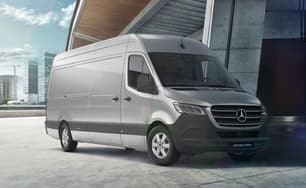
The Mercedes-Benz Sprinter has long been a formidable competitor in the Light Duty (3501-8000kg GVM) division of Australia’s highly competitive Heavy Commercial vehicle market.
The popular range offers a choice of panel van, cab-chassis and minibus body styles, four turbo-diesel engine variants (plus an all-electric drivetrain), three wheelbase lengths and for panel vans plus the choice of two roof heights.
An extensive overhaul of the Sprinter range in 2024 brought extra safety technologies, new comfort and convenience features and other benefits, which Mercedes-Benz claims can help drivers work more efficiently. We recently put one of the latest models to the test.
Cub Campers is Australia’s oldest camper-trailer manufacturer and one of the oldest businesses in the caravan and camping industry, having just celebrated 50 years of operation in 2018.
The company can lay claim to inventing the soft-floor camper trailer, pioneering the rear-fold and championing off-road campers when everyone else was concerned with the on-road market. Amongst all that, though, it was late to the game when it comes to forward-fold campers, not releasing the Frontier until early in 2016, well after the flood of Chinese manufactured versions became immensely popular. So why did Cub wait so long and was it worth it?
Given the original Sprinter was released in 1995, it’s not surprising the current third-generation model feels like it’s benefitted greatly from decades of continuous refinement. Although the list price difference between our test vehicle and its closest Chinese rival is substantial, the 417 MWB Panel Van is hard to fault in terms of driver comfort, safety and all-round competence. It really is very good.
All in all, the Frontier is the best forward-fold camper on the market, although it is also the most expensive. If you were making a buying decision purely based on features, you’d probably look elsewhere, but if you are prepared to pay a little more because this camper-trailer is Australian made, you get a very functional camper that’s easy to set up, reliable, strong and light.
With its 2215kg kerb weight and 4100kg GVM, our test vehicle has a sizeable 1885kg payload rating.
It’s also rated to tow up to 2000kg of braked trailer and with its 6100kg GCM (or how it can legally carry and tow at the same time), that means it can tow its maximum trailer weight while hauling its maximum payload to ensure optimum versatility.
The cargo bay, which offers a cave-like 9.0 cubic metres of load volume and internal lighting front and rear, has internal dimensions of 3316mm length (with bulkhead), 1732mm width and 1719mm height.
So, with 1350mm between the rear wheel-housings, it can comfortably fit two standard 1165mm-square Aussie pallets or up to four 1200 x 800mm Euro pallets, held in place by a choice of 10 floor-mounted load-anchorage points.
The cargo bay is accessed through a single kerbside sliding door with a wide 1260mm opening, or symmetrical rear barn-doors with large handles on each pillar to assist operator access.
The barn-doors also have internal storage bins and open to a full 180-degrees to assist forklift and loading dock access. Thoughtfully, their hinge design also holds the doors firmly open at 180 degrees, to minimise the chance of wind gusts slamming them shut with potential injury to the operator.
There’s also plenty of cabin storage starting with two tiers of bins in each door, with the highest being spacious enough to hold large bottles.
There's also a deep shelf on the passenger side lower dash, a large lidded compartment in the central dash-pad and overhead shelves with lockable storage on the passenger side. Plus, the dash offers a total of eight cup/small-bottle holders.
The base cushion of the two-passenger bench seat is also hinged at the front, which allows it to tilt forward and provide access to a large hidden storage area beneath.
A crew of three can travel in relative comfort (for a commercial van that is) thanks to a central seating position that provides a sturdy hoop-handle for support, sufficient knee clearance from the dash even for tall people, and a reasonably flat and spacious floor area.
The cabin also features the latest next-gen 'MBUX' multimedia system with 10.25-inch touchscreen, which for the first time offers wireless connectivity for Apple CarPlay and Android Auto.
There’s also digital radio and enhanced functionality including an optional navigation upgrade with seven years of map updates.
The real appeal of a forward-fold camper-trailer is the internal configuration. Because the bed folds out over the front of the camper, the trailer body is configured with a wrap-around lounge and dinette area, that also converts into a bed. It brings a certain level of caravan comfort to a camper-trailer-sized package. Cub’s execution is quite good. The lounge is comfortable and the dinette table is highly adjustable up and down or around and around. It converts into a bed more simply than any other on the market I’ve seen.
The downside of the forward-fold concept is the quantity and access of storage. Very little of the internal storage is easy to get to, and in truth there’s very little of it. That’s what happens when you put a couch in a trailer, sorry. There are hatches under the seats, but even they are limited by the slide-out kitchen and battery box across the back, plus, they’re not as easy to get to as a drawer. It’s the same in every manufacturers version, though. However, the Frontier has one unique features that makes it stand out – a series of pigeon holes under the foot of the bed which provide the only easy-to-access internal storage in any forward-fold I’ve come across so far.
Large handles on the doors and overhead shelves assist climbing aboard and there’s enough adjustment in the well-bolstered seat and leather-rimmed steering wheel to find a comfortable position.
Driver views from all angles are excellent thanks to well-designed mirrors along with cameras supported by active aids like blind-spot monitoring etc.
The cabin, with its high roof relative to seat height, has a spacious and airy feel and all controls are reasonably intuitive and easy to reach.
Unladen ride quality is surprisingly supple for a vehicle with a 6.0-tonne-plus GCM rating, combined with excellent steering feel that strikes a fine balance between minimal turning effort at low speeds (for loading etc) and firm handling response at higher speeds.
The drivetrain is also energetic, pulling strongly and cleanly from 1000rpm even though its maximum torque is tapped higher in the 1700-2400rpm zone. The automatic transmission has admirable refinement, with near-seamless shifting between its nine ratios.
The Sprinter is also impressively quiet at speeds up to 80km/h. Tyre and wind noise (the latter mainly around the large door mirrors) naturally increase at highway speeds, but remain far from intrusive. And with the engine requiring less than 2000rpm to maintain 110km/h, it’s well-suited to highway work.
To test its load-carrying ability, we forklifted 1.3 tonnes into the cargo bay which with driver equalled a payload of 1.4 tonnes. That's still almost half a tonne less than its limit.
Not surprisingly, it handled this load with ease, as handling and braking were largely unaffected and the ride quality became smoother thanks to such a big increase in sprung weight. Even so, the rear springs only compressed about 30mm.
It easily conquered our 13 per cent gradient, 2.0km-long set climb at 60km/h with this load onboard, as the auto downshifted to fourth gear to tap maximum torque when hauling this load to the summit.
Engine-braking on the way down, in a manually-selected second gear, wasn’t as robust but not unexpected given a 2.0-litre engine trying to restrain 1.4 tonnes of payload on a steep descent. Even so, the quartet of disc brakes efficiently kept speeds in check.
Overall, it was an impressive performance. However, we did note that the speed sign recognition function was not working for the duration of our test. And some welcome enhancements would be a driver’s left footrest and a fold-down inboard armrest for the driver’s seat, as fitted to its smaller Vito sibling.
The Frontier is quite good under tow. Cub designed and manufactures its own coil-spring independent suspension and has paid quite close attention to the balance and dynamics of the trailer.
As it’s not overly heavy, it’s not a handful, even on the beach, and behind the Mitsubishi Triton I tested it with, it was barely a struggle. On the road, the camper is well behaved, easy to see over and around and because it’s not very long, it’s not very daunting.