What's the difference?
It is hard to immediately think of a country more suited to the convertible life than Australia. Even our coldest states (you know who you are…) are blessed with more warming sun than almost anywhere else on the civilised parts of the planet, so you’d think we’d be swanning about in dropped-top bliss almost year round.
But it’s actually in the UK (despite being cold, grey and almost always underwater) that convertibles really fly out of dealerships, with sun-starved Brits buying more than anyone else in the world. Weird, right?
Still, here they remain something of an oddity, sold in small numbers to drop-top diehards. At least partly because the convertibles of old were almost always slightly worse than their hardtop equivalents.
But Mercedes - which makes more convertibles than most - claims to have mastered the soft-top formula with the E400 4Matic, a car it says offers all the perks of open-air motoring without any of the dynamic or practical downsides.
Some VW models, like the Golf, are household names. No doubt about it. But this? Well, it's probably not one of them. Or not yet.
This is the Arteon, the German's brand's flagship passenger vehicle. Put it this way, if VW's tag line is premium for the people, then this is the most premium. And the people? Well, they're the ones who might normally be shopping for a BMW, Mercedes or Audi.
The name, by the way, comes from the the Latin word for art, and it's a nod to the design focus that's been employed here. It comes in a shooting brake, or wagon, body shape, as well as this, the Liftback. And a quick spoiler alert, it looks pretty good, right?
But we'll get to all that. As well as the big question - can it mix it with the premium-brand big boys?
A convertible that doesn't feel like one when the roof is in place is no easy task to build, but it's one Merc's engineers have pulled off with the E400 4Matic Cabriolet. Effortless power, a tonne of technology and a comfy, leather-wrapped cabin all make Merc's drop-top E-Class a strong proposition.
The value, driving dynamics and appearance are on point for a premium play here. If you can forgo the badge snobbery attached to the German big three, then you'll find lots to like about Volkswagen's Arteon.
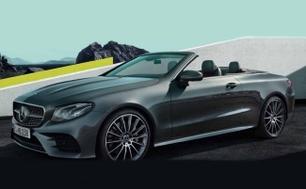
Elegance. That's the word that springs to mind when you first clamp eyes on the E400 Cabriolet. While the Coupe version has a crouched-over sportiness about its exterior design, the convertible is all about big and boat-like proportions, especially with the fabric roof opened.
Like nearly all drop-tops, the E400 looks best with the cabin open to the elements, and the side profile especially paints a picture of well-heeled wafting, with only the AMG alloys and body styling hinting at the performance on offer under the bonnet.
Inside, expect perfectly executed modern luxury, with soft leather seats, touchpoints that melt under the fingers and a sprinkling of woodgrain trim. All of which feel like old-world luxury, nicely juxtaposed by the huge twin-screen display that dominates the dash.
It's really all about the looks here, and while the Shooting Brake is particularly handsome, the regular Arteon looks premium and polished, too.
VW tells us injecting a bit of sportiness was a key aim here, both inside and outside, and that's particularly true of the R-Line model, which rides on bigger 20-inch alloys, compared to the 19s on the Elegance, with their own bespoke design.
The body styling is more aggressive, too, but both trims get lashings of chrome along the body work, and a sleek, swept-back style that looks more premium than overtly sporty.
In the cabin, though, you can see that this is an important car to VW. The touchpoints are almost all soft to the touch, and it's both understated and tech-saturated at the same time, including the swipe-to-adjust function for the stereo and climate, with new touch-sensitive sections added to the centre console and steering wheel.
It feels, dare we say it, premium. Which is likely exactly what VW was going for...
It's a two-door, four-seat convertible, so practicality isn't at the very top of its list of strengths.
That said, life is peachy for upfront riders, both of whom will travel in spacious luxury. There are two cupholders hidden beneath a woodgrain cover underneath the climate controls - also home to a power outlet - as well as a clever double-hinged central storage bin that can be opened by either the passenger or driver, and which opens to reveal two USB points.
There's room in the doors for bottles, too, and the entertainment system can be controlled via a touchpad controller mounted above the traditional click wheel - although, to be honest, using it is harder and more time consuming than simply pretending it doesn't exist.
Climbing into the back (and we mean climb - there are no rear doors) is made easier by the fact you can fold and slide the front seats automatically by pulling a lever mounted near the headrest. Once there, though, you'll find space is a little tighter, and you feel weirdly cocooned, owing to the huge raised tunnel that runs through the middle of the cabin, and the low roof line.
There are two cupholders that live in the space where the middle seat would normally go, and there's a little bottle-holder cubby to the left of both backseat riders. There are air vents back there, too, but no temperature controls.
The front doors are huge and really very heavy, requiring considerable heft to open them.
The boot space is predictably a little limited, with 385 litres on offer. There's also a little flip-down separator, which shows you how much room the roof will need to come down, reducing boot space to 310 litres. Speaking of which, the soft-top can be lowered in just 20 seconds, and at speeds up to 50km/h.
One practicality quirk, though. The front (and only) doors are huge and really very heavy, requiring considerable heft to open them, especially if you're parked on a slight angle. Honestly, I was reduced to kind of pushing them open with my foot at times.
Interestingly, both body styles share near identical dimensions, with the Arteon stretching 4866mm in length, 1871 in width, and 1442mm in height (or 1447mm for the Shooting Brake).
Those numbers translate to a seriously spacious and practical cabin space, with an acreage of room for backseat riders. Sitting behind my own 175cm driving position, I had heaps of space between my knees and the seat in front, and even with the sloping roofline, plenty of headroom, too.
You'll find two cupholders in a pull-down divider that separates the back seat, and a bottle holder in each the four doors. Backseat riders also get their own air vents with temp controls, as well as USB connections, and phone or tablet pockets on the rear of each front seat.
Up front, the theme of space continues, with storage and cubbies sprinkled throughout the cabin, as well as USB-C connections for your phone or devices.
All that space means a sizeable boot area, too, with the Arteon serving up 563L with the rear seats in place, and 1557L with the back pews folded. The Shooting Brake ups those numbers - thought not any as much as you might think - to 565L and 1632L.
At $157,400, the Cabriolet is the most expensive model in the E400 family, and is roughly $20k more than the sedan and $10k more than the coupe variants.
That money buys you a comprehensively kitted-out ride - as it really should - with the E400 Cabriolet arriving with 20-inch AMG alloys, LED headlights (made up of 84 LEDs) with high-beam assist, proximity unlocking with push-button start, air suspension and Merc's AIRCAP - a lip above the windscreen that's designed to push air up and over the cabin when the roof is down.
Inside, you'll find leather seats, dual-zone climate control and the clever 'AirScarf' system, which pumps hot air onto your neck when the roof is down (and it's cold out). You'll also nab heated front seats, power windows front and back and an automatic belt feeder, which saves you reaching over your shoulder to get to your seatbelt. So exhausting.
On the tech front, expect a killer 590W, 13-speaker Burmester stereo, controlled by the seriously impressive widescreen cockpit; two 12.3-inch screens that spill from about the centre of the dash all the way to the driver's binnacle, and control everything from navigation to Apple CarPlay and Android Auto.
There's a whole bunch of safety stuff, including semi-autonomous technology, but we'll drill down on that under the Safety sub-heading.
The Arteon carries an unsurprisingly premium price tag in the VW family, but it can still be cheaper than an entry-level equivalent from some of the German premium brands.
Or, in the words of VW, the Arteon "challenges the luxury car makers without becoming one ourselves."
And you do get a lot of stuff. In fact, a panoramic sunroof, and some metallic paints, are the only cost options here.
The range is offered in 140TSI Elegance ($61,740 Liftback, $63,740 Shooting Brake) and 206TSI R-Line trims ($68,740/$70,740), and the former is offered with VW's Virtual Cockpit digital instrument cluster, along with a head-up display and a central 9.2-inch touchscreen that pairs wirelessly with your mobile phone.
Outside, you get 19-inch alloy wheels and full LED headlights and tail-lights. Inside, you'll find ambient interior lighting, multi-zone climate control, keyless entry and push-start ignition, as well as full leather interior trim with heated and ventilated front seats.
Also worth calling our here are the digital buttons on the dash or steering that control everything from the stereo to the climate, and work a bit like a mobile might, you can swipe left or right to control the volume or switch tracks, or change the temperature.
The R-Line model is the sportier-feeling option, and adds 'carbon' leather interior trim with bespoke bucket-style sports seats, 20-inch alloy wheels, and a more aggressive set of R-Line bodywork.
It's a fabulous engine, this twin-turbocharged V6 - even if it doesn't feel quite so lively in Cabriolet form as it does in the hardtop equivalents.
The 3.0-litre unit produces 245kW/480Nm, sending it to all four wheels via a nine-speed automatic transmission, linked to the standard 4Matic all-wheel drive system.
There are two drivetrains on offer here — the 140TSI with front-wheel drive in the Elegance, or the 206TSI with all-wheel drive in the R-Line.
The former's 2.0-litre turbo-petrol produces 140kW and 320Nm, which is enough for a sprint to 100km/h in around 7.9 seconds.
But the lust-worthy engine tune is definitely the R-Line, in which the 2.0-litre turbo-petrol ups the grunt to 206kW and 400Nm, and drops the sprint time to a brisk 5.5 seconds.
Both pair with VW's seven-speed DSG automatic.
Mercedes claims 7.4L/100km on the combined cycle (but you can expect to be pushing nine litres in real-world conditions), with emissions pegged at 170g per kilometre of CO2.
The 66-litre tank will only accepts 95RON fuel.
Volkswagen says the Arteon Elegance will need 6.2L per hundred kilometres on the combined cycle, and will emit 142g/km of C02. The R-Line needs 7.7L/100km on the same cycle, with emissions pegged at 177g/km.
The Arteon is fitted with a 66-litre tank, and a PPF or petrol particulate filter, which strips some of the nasties out of the vehicle's emissions. But, VW says, it's “very important" that you only fill your Arteon with premium feel (95RON for the Elegance, 98RON for the R-Line) or you risk shortening the life of the PPF.
Sure, the E400 Cabriolet can drive itself, but we’re equally pleased to note that it’s still a lot more fun handling the steering duties yourself.
And that is mostly due to that fabulous engine; quiet and effortless at city speeds, rorty and enthusiastic at pace, and genuinely angry with the drive setting switched to their most hardcore Sport+ mode.
We’ve already spent time in the sedan version, and while this Cabriolet is heavier (1935kg vs 1820kg) and slightly slower to 100km/h (5.5sec vs 5.2sec) it doesn’t immediately feel it behind the wheel, with a similar and satisfying lurch into the future when you plant your foot.
But hard charging is not what this car is about, and the E 400 is at its peachy best when rolling about the city or the ‘burbs with the top down, and the warm summer air washing through the cabin.
In its normal drive settings, the steering is light but engaged, and the ride on offer from the standard air suspension is outstanding, cosseting the cabin from all but the very worst road imperfections, while the torque from the V6 serves up effortless, unobtrusive acceleration.
With the roof up, Merc’s designers have done a stellar job of hiding the fact this thing is a convertible at all. It’s a solid-feeling cabin with the fabric roof fastened, and the cabin is quiet and free from wind noise.
Full disclosure: we only spent time behind the wheel off the R-Line variant for this test, but even still, I feel pretty comfortable suggesting that it's the punchy powertrain you want.
Surely the very first hurdle any company hoping to play with the premium-brand big boys must clear is that of easy, effortless momentum? It's difficult to feel like you've made the premium choice when you're engine is straining and striving under acceleration, right?
And on this, the Arteon R-Line shines, with plenty of power underfoot whenever you need it, and a delivery style which means you rarely, if ever, fall into a hole waiting for the power to arrive.
For mine, the suspension might be a touch too firm for those seeking a truly wafting drive experience. For the record, it doesn't bother me — I always prefer to know what's happening underneath the tyres than be entirely removed from the experience — but a result of this sporty-feeling ride is the occasional registering of bigger bumps and road imperfections in the cabin.
The flip side of the firm(ish) ride is the ability for the Arteon - in R-Line guise - to swap personalities when you engage its sportier settings. Suddenly there's a snarl to the exhaust that's absent in its comfortable drive modes, and you're left with a vehicle that tempts you to head for a twisting back road to see what it's about.
But in the interests of science we instead headed for the freeway to put the Arteon's autonomous systems through their paces, with the brand promising Level 2 Autonomy on the highway.
While the technology still isn't perfect — some braking can occur when the vehicle's not entirely sure what's happening ahead of it — it's also pretty impressive, taking care of the steering, accelerating and braking for you, at least until you're reminded its time to put your hands back on the wheel.
It's also bloody big, the Arteon, with more space in the cabin - and especially the backseat - than you might be thinking. If you have kids, they'll be positively lost back there. But if you cart adults on the regular, then you'll hear no complaints.
There are few cars on the road as overloaded with safety technology as the E400 Cabriolet.
The standard stuff is all there, of course. There's a 360-degree parking camera, as well as nine airbags (dual front, dual pelvic/thorax for front-seat passengers, dual sidebags for rear passengers, dual head bags in the doors and a knee airbag for the driver), rollover protection and tyre-pressure monitoring, as well as braking and traction aids.
But the E400 adds some really clever technology, including Merc's Driving Assistance Package Plus, which adds active lane keeping, blind-spot assist, cross-traffic alert and evasive steering assist.
It's this suite of systems that allows the E400 to navigate freeways autonomously, including changing lanes on demand. At the moment, the system will warn you to keep your hands on the wheel every so often, but you can sense a time when that will no longer be required. And that time is soon.
The E-Class range scored the maximum five-star ANCAP safety rating when crash tested in 2016.
Essentially, if VW makes it, the Arteon gets it. Think front, side, full-length curtain and driver's knee airbags, as well as VW's complete IQ.Drive safety suite, which includes a Fatigue Detection system, AEB with pedestrian detection, Park Assist, parking sensors, rear traffic assist, lane change assist, adaptive cruise control with lane guidance - which is essentially a level 2 autonomous system for highways - and an around view monitor.
The new model is yet to be crash-tested, but the last model scored a five-star rating in 2017.
Expect the usual three-year, unlimited-kilometre warranty, with service intervals pegged at 12 months or 25,000km. Mercedes' capped-price servicing scheme limits maintenance costs to $2280 for the first three years of ownership.
The Arteon is covered by VW's five-year, unlimited-kilometre warranty, and will require servicing every 12 months or 15,000kms. It will also get VW's capped price servicing offer.