What's the difference?
If you're after a hot hatch with a boot, you can't have one because it wouldn't be a hatch anymore.
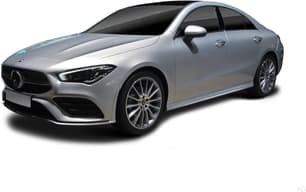
What you can have is this little beast - the new, second-generation Mercedes-AMG CLA 45 S, a small coupe-style sedan sharing its high-performance DNA with the hot as bubbling lava A 45 S hatch.
Packing 300kW – that's just over 420hp – and 500Nm its 2.0-litre engine is claimed to be the most powerful series production turbo four ever made.
And Australian deliveries are scheduled for early 2020, with a likely price tag in the mid-$90k bracket.
Mercedes-AMG invited us to the car's global launch in Madrid, Spain, where we got behind the wheel on road and track.
ONE of the great motoring successes of the past decade has been the Mercedes-Benz GLA, catapulting the brand to unparalleled prominence in the premium small SUV field and kicking off the posh little coupe-hatch crossover craze.
Cynics might say that it is essentially a jumped-up A-Class hatchback, much like the Subaru XV is basically an Impreza in stilettos. But while the small German crossover is built on the same MFA2 platform as its smaller transverse-engined Benz brethren, no body panels are shared, granting it a distinct look and personality. Unlike the little Suby…
The H247-series GLA launched in Australia in 2020 is second-generation, featuring a longer wheelbase and appreciably more space, but a shorter overall length than the popular original from 2013. It's also substantially taller.
Here we take a long, hard look at the bestselling GLA 250 4Matic.
The Mercedes-AMG CLA 45 S is more glorious madness from the hot-rodders in Affalterbach. A design and engineering master-class putting a slightly more mature spin on the fast and furious small AMG formula. But only slightly. It's brilliantly outrageous.
With Mercedes-Benz’s vast number of SUVs, there is room for an urban luxury crossover niche, and the GLA delivers in spades.
Indeed, in 250 4Matic guise, it is that rare thing – a high-riding hatch with dynamics to shame most dedicated pocket-rockets. It really is a hoot if you find the right road, regardless of weather conditions. The Benz has towering talent.
However, even without desirable options like adaptive dampers and a full suite of driver-assist safety technology, the GLA is expensive, does not quite carry off the price tag from an interior quality point of view, and struggles to maintain the degree of comfort and refinement expected from a Mercedes – with or without the $3K necessary to score adaptive dampers.
Still, especially because of the way the GLA looks, goes, stops and steers, if you can afford it, you’ll be rewarded. There’s never been a more rounded GLA.
Claimed to blaze from 0-100km/h in 4.0 seconds the second-generation CLA 45 has the performance credentials of a mid-engine supercar, wrapped in a relatively unassuming three-box body. And while it might look mild-mannered from a distance, this devil's differences are in the detail.
Like it's A 45 sibling the CLA 45 S features AMG's now signature Panamericana grille with 12 vertical louvres, a winged front spoiler treatment, extra aero bits around the front air intakes and 'Power Dome' bumps in the bonnet.
The side skirts are wider, and the 19-inch twin five-spoke rims are standard. While at the back the diffuser treatment is more pronounced than the hatch, but the fat 90mm exhaust pipes are the same, and the lip spoiler is on the boot lid rather than the roof.
The interior is virtually identical to the hatch, the biggest difference being the four-door coupe's frameless doors.
A combination of Merc's 'Artico' faux leather and 'Dinamica' microfibre trim is accented with racy yellow highlights, with a nappa leather and Dinamica AMG Performance wheel and sports pedals completing the picture.
And the twin widescreen MBUX instrument and media display boasts AMG-specific read-outs on everything from gear selection, warm-up menu, car set-up, a G-metre, race timer and engine data. The standard 'Track Pack' even includes specific circuit layouts and data.
Looking like a mini-me GLC, today's GLA trades some of its predecessor’s edgier design elements like the slammed roof and exaggerated broad-shouldered stance for a more amorphous if elegant appearance. Even with the cliché plastic cladding around the squared-off wheel arches, it’s still a looker.
The net result is arguably the most attractive of all the MFA2 A-Class offshoots. It sits well within the Mercedes hierarchy of SUVs, bringing a swoopy coupe-like silhouette compared to the ultra-upright GLB.
Along with being 30mm wider, it’s also visibly taller than before, with a handy 213mm of ground clearance compared to just 157mm last time around. And the wheelbase has been stretched to the benefit of rear-passenger room – a bugbear of the old GLA. That's progress.
At just under 4.7m long (248mm longer than the A 45 S hatch), a bit under 1.9m wide, and fraction over 1.4m tall the A 45 S in the dimensional bullseye for a compact four-door.
The CLA A 45 S driver is presented with the same sleek 'MBUX' widescreen display found in the Mercedes-Benz A-Class, and storage runs to two cupholders in the centre console, a lidded bin/armrest between the seats (including twin USB ports), decent door pockets with room for bottles and a medium-size glove box.
In a swap to the rear, sitting behind the driver's seat set to my (183cm) position, I enjoyed adequate knee and foot room, although headroom isn't as generous.
A centre fold-down armrest incorporates two cupholders, again there are generous pockets in the doors with room for bottles, and adjustable ventilation outlets are set into the back of the front centre console is a welcome inclusion. No map pockets on the racy, hard shell sports front seats, though.
There are three belted positions across the rear, but the adults using them for anything other than short journeys will have to be good friends and flexible. Best for two grown-ups, and three kids will be fine.
Boot volume is a healthy 460 litres (VDA), expanding further with the 40/20/40 split-folding rear seat down. There are tie-down hooks, a 12-volt outlet and elasticised storage pockets either side of the load space to further enhance useability. But beware, the Merc-AMG CLA 45 S is a no-tow zone.
Compared to before, the 2021 GLA is some 122mm taller, so ushers in a higher hip point for loftier seating – reducing that jumped-up hatch feel. Headroom improves obviously, as does rear legroom, a corollary of a 30mm wheelbase stretch (to 2729mm).
Wide apertures also make entry into and out of the German-built GLA child's play, though the solid heft of their doors is serious business at this end of the segment, very satisfyingly Teutonic and totally on-brand. This is something you won’t enjoy in a Subaru XV.
Then you s-c-r-a-p-e the underside of the front doors on the pavement literally every time you swing it to get out, and wonder whether Mercedes engineers have ever been to Australia. This fail drove us spare. Heaven help the GLAs in towns and cities with bluestone sidewalks. Maybe all that extra AMG packaging is the culprit.
Still, most of the other basics are spot-on and can’t really be faulted; cosy yet spacious for four adults – especially up front, ample vision, an excellent driving position aided by heaps of seat and steering wheel adjustability, cosseting front sports buckets that you just sink into, torrents of ventilation from those delectable turbine vents and stacks of storage. Collectively they make the GLA a welcoming, opulent place to travel in. Only the hapless fifth occupant squished between the outboard rear-seat passengers might think otherwise. But nobody buys this Benz for carting people around. That's the GLB's job.
Several years ago, Daimler poached a senior Audi designer and since then Mercedes’ dashboards have morphed into a multi-coloured multimedia diorama of touchscreen technology that threatens to completely take over the universe. Choose the right combination of colours and lighting and it's like your very own White Night on wheels. Starting with 2018’s A-Class, the striking, spangly MBUX system that underpins all this has come to be widely admired and imitated. For aesthetics anyway, with its vivid hues, panoramic displays and simple, tiled applications, it’s been a real trip.
Anyway, back to reality. From a tactility and functionality point of view, there’s still work to be done.
Access to the multimedia (including our GLA's banging optional audio system) and car settings areas is possible via a mildly fiddly finger-pad arrangement down forward in the centre console, or smaller yet much more annoying thumb sensor tabs on the wheel spokes. These are not easy to modulate on the move. Additionally, their menus can be confusing to navigate through and sometimes counterintuitive in operation. Mercedes obviously realises this as a quick-guide pamphlet is provided on old-fashioned cardboard paper. How quaint.
Eventually all areas can be mastered over time, but the functionality is complicated and may overwhelm the not-so-tech savvy. Additionally, the ‘Hey, Mercedes!’ voice control is impressive for getting MBUX to perform basic multimedia and vehicle settings-related changes, but it too-often erratic, unreliable and ultimately frustrating for more complicated commands. Perhaps elocution lessons on behalf of the operator may help.
But not as much as the profound disappointment we endure from the cheapness of some of the materials, the wincing cellophane-like sounds when pressing on some of the surfaces such as the door cards, or that emanate after a particularly bumpy section of bad roads. Sheeny reflections and hard textures in a car optioned with extras that total up to nearly $82,500 just don’t cut it.
At least in this latest-gen GLA, the rear seat area seems much improved over the previous models, with more space, comfy and supportive seating (remember ours featured the $607 sliding function that ought to be standard) and a reclining backrest. All amenities are present, with deep pockets, fresh air from twin vent outlets, reading lights and thoughtfully placed armrests – but, again, the latter’s extendable cupholders feel brittle and cheap.
Further back, the 435-litre cargo area is sufficiently sized and practical for smaller family use (at last), aided by a 40/20/40 backrest fold and that slide-able cushion to extend capacity further. There is no spare wheel, but a tyre inflation kit is fitted in lieu.
Overall, then, better than before, with that fundamental rock-solid heft, luxurious aura and alluring premium-car aroma. The dazzling MBUX screen-related visuals, too, are endlessly entertaining to explore when the vehicle is not moving, but the GLA’s cabin is still not quite up to Mercedes’ reputation for exacting over-engineered excellence.
Or even to the standards of some mainstream alternatives.
The new CLA 45 is launching in the premium S variant only (a 'base' non-S version is offered in other markets). The outgoing model was tagged at $93,800, before on-road costs, prior to its discontinuation in January this year, and Mercedes-Benz Australia has hinted strongly that a price increase is likely. So, expect a list price in the mid-$90k range.
We'll cover active and passive safety tech in the safety section, and although final Australian specification is yet to be confirmed you can expect the stand ard features list to include the 19-inch alloys, 'Artico' faux leather and 'Dinamica' microfibre trim upholstery, the 'MBUX' widescreen cockpit display (two 10.25-inch digital screens) and 'MercedesMe' voice recognition, heated and electrically-adjustable sports front seats, auto adaptive LED headlights, LED tail-lights and DRLs, keyless entry and start, auto-dimming rear-view mirror, dual-zone climate-control, sat-nav, multi-function sports steering wheel, active cruise control, rain-sensing wipers, Active Parking Assist' (with ultrasonic proximity sensors front and rear), rear privacy glass, plus premium audio with digital radio, as well as Apple CarPlay and Android Auto.
The latest GLA’s evolved dimensions is presumably to put some space between it and its GLB 5+2-seater SUV fraternal twin, giving Mercedes-Benz blanket SUV market coverage. From GL (for Geländewagen, or off-road vehicle) A, B, C, E and S (as well as the G-wagen icon that started it all back in '79), there’s a premium option for everybody… if not every budget.
In the GLA’s case, the entry-level 200 front-driver starts from $55,100 (before on-road costs); moving up to the $66,500 250 4Matic, and then to two performance powerhouses – the AMG 35 4Matic and supernaturally fast AMG 45 S 4Matic+ flagship, from $82,935 and $107,035 respectively.
Even the base GLA 200 includes new and improved autonomous emergency braking (AEB) among other safety-related technologies, as well as the brand’s glamorous MBUX multimedia system with wireless Apple CarPlay/Android Auto, digital radio, satellite navigation, reverse camera, climate control, wireless phone charging, powered tailgate, automatic parking, auto high beam, rain-sensing wipers and 19-inch alloys.
All the extra techy stuff doesn’t come for free though – prices jump almost $10,000 over the less-powerful previous-generation GLA 180 that the 200 replaces – though we expect the former badge to return in time.
In contrast, the GLA 250 4Matic is ‘only’ $3500 more expensive than its predecessor, gaining a terrific 2.0-litre four-cylinder turbo instead of a Renault-Nissan-sourced 1.3-litre turbo, all-wheel drive (with an Off-Road Engineering Package that gives the car some very light off-road capability), and other niceties such as heated electric front seats with memory function, a panoramic sunroof, more direct steering and lowered suspension (for a sportier drive).
Note that adaptive cruise control costs extra – a curious oversight at this price point. It’s part of a $1531 optional Driving Assistance Package, which also includes Active Lane Change Assist, extended semi-autonomous driver assistance in traffic jams (meaning full stop/go capability) and route-based speed adaptation. Do it.
Our test car had it, along with a $915 Vision Package (includes fancier adaptive headlights and a 360-degree camera), $1915 Sports Package (with AMG styling upgrades inside and out, perforated disc brakes, privacy glass, shift paddles and lowered ‘Comfort Suspension’), a Night Package (less brightwork, more black finishes) and sports direct-steering with corresponding wheel), $1531 20-inch AMG Black alloys, a $1915 Communications Package with upgraded audio and head-up display among a litany of other gear, $2838 AMG Exclusive Package with adaptive dampers, cooled as well as heated front seats, an ‘Energising Comfort’ ambience-enhancing 'experience' and special leather upholstery, $1531 Patagonia Red metallic paint and $607 rear-seat fore/aft adjustment. Total cost after the added luxury car tax: $82,446. Gulp.
Not cheap in anybody’s language. Nor, for that matter, are the GLA’s rivals, which owe their existence to the original’s spectacular sales trajectory and the trail that this blazed last decade.
Lexus’ loaded UX 250h hybrid AWD and Audi Q3 Sportback 40TFSI quattro slip slightly below the standard GLA 250 for both pricing and power, while the BMW X2 M35i and its Mini Countryman JCW cousin, along with Jaguar’s E-Pace E250, also offer in-the-same ballpark pricing but quite a bit more space as well as pace.
It’s also worth noting that Volvo’s XC40 T5 AWD conspicuously undercuts all from just $57,000, though now we’re talking about putting square pegs into round holes. Speaking of which…
The A 45 S's all-new 2.0-litre (M139) engine is claimed to be the most powerful series production turbo four ever made, pumping out 310kW at 6750rpm and a monumental 500Nm, peaking between 5000-5250rpm. . That's up from an already impressive 280kW/470Nm on the out-going model.
It's an all-alloy, closed deck design fed by a combined direct and port fuel-injection system, with a single, twin-scroll turbo featuring low-friction roller bearings for quick spool up.
It's transversely mounted, but compared to the previous model has been spun 1 80-degrees on its vertical axis so the turbo's near the firewall and the intake system sits at the front to simplify and shorten ducting on the intake and exhaust sides.
The cylinder linings are treated with Merc's patented 'Nanoslide' coating, which delivers an ultra-hard, mirror-like surface for less friction and greater durability. And 'Camtronic' variable valve control sits on the exhaust side.
Drive goes to all four wheels via an eight-speed 'AMG Speedshift DCT 8G' dual-clutch auto, with manual shift paddles attached to the steering wheel.
Mounted transversely, Mercedes’ M260 1991cc 2.0-litre four-cylinder petrol engine features a twin-cam, 16-valve design, a twin-scroll turbocharger and variable-valve timing, to help deliver 165kW of power at 5500rpm and 350Nm of torque at a low 1800rpm. With an impressive 97.2kW per tonne, it can hit 100km/h in 6.7 seconds, on the way to a 240km/h top speed.
All four wheels are driven by an eight-speed dual-clutch transmission (DCT), though most of the torque at lower speeds or during reduced throttle loads is delivered to the front wheels until extra traction is required out back. The gearbox is one of the very best of its type we’ve experienced – seamless, strong and largely lag-free.
Claimed fuel economy to the combined cycle NEDC (New European Driving Cycle) standard is 8.1L/100km, the engine emitting 186g/km of CO2 in the process. Figures for the Australian (ADR 81/02) standard will be issued at the time of the car's local launch in early 2020.
Stop-start is standard, minimum fuel requirement is 98 RON premium unleaded, and you'll need 51 litres of it to fill the tank.
Our combination of furious hot-lapping on the circuit and relatively enthusiastic open road driving on the launch program means we'll wait until we test the car on home soil to log a real world average.
Weighing in at 1668kg (kerb), and with a bluff nose and high ground clearance also not helping, we didn’t expect great fuel economy, particularly given how hard and fast the GLA 250’s performance bandwidth is. It’s tempting to just blast your way from point A to point B.
However, at the pump we averaged 9.8 litres per 100km, which isn’t too bad at all considering the available muscle. The official figure is 7.5L/100km, for a carbon dioxide emissions rating of 170 grams per kilometre. With a 51-litre fuel tank, the theoretical range is around 680km.
Note that the GLA 250 requires 95 RON premium unleaded petrol as a minimum.
Mercedes-AMG invited us to the Jarama race circuit just outside Madrid in Central Spain, and the twisting B-roads nearby, to sample its latest pride and joy.
In the AMG tradition the engine is assembled by hand, by one technician. And hats off to the spanner twirlers, they do a great job. It's a spectacular unit. Torque delivery is shaped to mimic a naturally aspirated engine, with the maximum figure arriving between 5000-5250rpm.
But that's not to say it's hollow in the mid-range. Around 90 per cent of that peak number is available from below 3000rpm and low-end throttle response is brilliantly crisp and linear, helped in no small part by roller bearings on the turbo for a quicker spool up.
Merc-AMG claims 4.0 seconds for the sprint from 0-100km/h, which is supercar fast and with drive going to all four wheels entertainment is the name of the game.
The eight-speed dual-clutch auto is positive and sharp, especially in manual mode where shifts flick through in much less than the blink of an eye.
And as the A 45 S beefs up the A-Class on the outside, it's the same underneath the skin with body reinforcement including an alloy sheering plate under the engine, a front strut tower brace, extra reinforcement between side members and A-pillars, and diagonal struts on the front and rear of the underbody.
So, the strut front, four-link rear suspension has an extra stiff platform to hang from, and the three-mode 'Ride Control' active damping can transform the ride from soft and compliant to tightly buttoned down.
The speed-sensitive, electromechanical steering is specifically tuned for this car, and it points accurately with good road feel and pleasantly firm weight in Sport and Sport+ modes.
Rubber is Michelin Pilot Sport 4 S, and it grips hard. On the fast and technical Jarama circuit they performed flawlessly, helping the A 45 S transform its prodigious power into maximum forward velocity without fuss.
The icing on the dynamic cake is 'AMG Dynamic Select' with six modes from 'Comfort' to 'Race' adjusting the engine, transmission, steering, suspension, and exhaust.
On top of that 'AMG Dynamics' uses the ESP and torque vectoring (by braking) to vary the level of stability and slip through four levels from 'Basic' up to 'Master'.
We played with all the toys including 'Race Start' and a 'Drift Mode' made possible by a new rear axle featuring two multi-disc clutches - one for each rear wheel.
Torque is split variably between front and rear axles with a default setting of 50/50 rising to around 70 per cent to the rear when pushing hard. Drive is also continuously managed across the rear axle, and like a swan gliding across the lake all the action happens seamlessly out of sight, turning you into a track hero in the process.
The first-gen A45's exhaust was a mass of pops, bangs and crackles, while this car's more rasping and rorty exhaust note is controlled by a flap in the system adjusted by engine speed and load. It's also amplified by the 'AMG Real Performance Sound' system, which puts some actual engine and exhaust noise (nothing is synthesised) through the speakers.
Open road ride comfort in the softest setting is surprisingly good, with rough surfaces unsettling the car only slightly despite the big 19s and high-performance rubber. Body control is S and S+ settings is spot-on, the car feeling planted, predictable and ultra-responsive on tight, twisting backroads.
Braking power is professional grade with six-piston calipers at the front and single piston rear, on vented and perforated rotors all around. Even following session after session on the track there wasn't a hint of fade.
A soaring 2.0-litre turbo engine application, this is a slick, stirring and robust performer that can also do efficiency as effortlessly as launch the GLA 250 4Matic towards the horizon. Let’s not mince our words. This is a fast and fiery mover.
Three drive modes – Eco, Comfort and Sport – provide a wide spectrum of acceleration and throttle responses, and all deliver precisely what you’d expect. Eco’s fine for pottering around town smoothly and serenely; Sport morphs into a searing and seamless speed demon; and the default Comfort sits somewhere in the middle as the best of both worlds. There really is no faulting Mercedes’ M260 masterpiece.
The DCT also happens to be one of the better dual clutch autos, avoiding the lag and clunkiness pitfalls usually associated with this sort of gearbox. It’s even comparatively smooth off the line on hills. Ours came with the optional handy set of manual-mode paddle shifters, adding a welcome level of interactivity autos tend to overlook. Too bad Mercedes persists with that fiddly column lever that is forever prone to knocking the car out of drive. Even after 15 years, it's still so annoying.
What all this means for the urban driver is strong acceleration for flitting in and out of traffic gaps, as well as incredibly instantaneous point-to-point responses for commanding manoeuvrability, thanks to ultra-eager steering and assisted by outstanding brakes.
With struts up front and a multi-link rear end as standard, the GLA 250’s chassis, too, is a transformative for what is essentially a high-riding hatchback – but only if your pockets are deep enough.
Fitted with that near-$3K AMG Exclusive Package that includes adaptive dampers, our Benz displayed a definite hot-hatch attitude that really would make it the darling of Golf GTI owners who’ve outgrown their rides but not their girl/boyracer desires. Superb handling and hunkered-down roadholding really do make this the driver’s premium compact crossover. You can pretty much point and shoot this Merc as you might a Golf R, and likewise in most weather conditions thanks to all that reassuring tenacious grip.
Plus, if you’re put off by the hard ride in Sport, the Individual mode allows the driver to engage the soft damper mode while the engine and steering retain the hardcore settings. It’s a win-win situation – as long as you can stretch to that AMG Exclusive pack. We strongly recommend it, given the balance between ultimate high-speed control and comfort.
However, while this is all good news for rural and country folk seeking hot crossover fun, back around town, poor urban road conditions can reveal a flaw in the chassis’ ability to properly smother bumps and ruts. It’s the small frequency stuff that seems to transmit through, never really settling down.
The result is a jittery ride, that may somewhat undermine the GLA’s upmarket sheen. There’s also a fair degree of road noise coming through. Perhaps sticking with the 19-inch alloys instead of those lovely 20-inch rims is the solution here.
Although final Australian spec is yet to be finalised, you can expect a host of active safety tech including ABS, BA, EBD, stability and traction controls, a reversing camera (with dynamic guidelines), 'Active Brake Assist' (Merc-speak fo AEB), 'Adaptive Brake', 'Attention Assist', 'Blind Spot Assist', 'Cross-wind Assist', 'Lane Keep Assist', a tyre pressure warning system, the 'Pre-Safe' accident anticipatory system, 'Traffic Sign Assist' and 'Adaptive Highbeam Assist'.
If all that fails to prevent an impact you'll be protected by nine airbags (front, pelvis and window for driver and front passenger, side airbags for rear seat occupants and a driver's knee bag), and the 'Active Bonnet' automatically tilts to minimise pedestrian injuries. A first-aid kit and hi-vis vests in the boot are thoughtful additions.
The A-Class was awarded a maximum five ANCAP stars in 2018, and for smaller occupants there are three child restraint/baby capsule top tether points across the back seat, with isofix anchors on the two outer positions.
Mercedes-Benz is a long and proud pioneer in passenger-vehicle safety, and the GLA is no exception… except that for the full suite of safety assistance you need to fork out more in the GLA 250.
The standard roll-call of advanced driving assist systems includes nine airbags (front, pelvis side and window bags for driver and front passenger, side airbags for rear occupants and a knee airbag for the driver), AEB with pedestrian and cyclist detection, and blind-spot monitoring with an exit warning that alerts the driver of approaching cyclists or vehicles if the door begins to open into their path.
The AEB system has a working range of between 7km/h and 200km/h.
Active Lane Keep Assist, an active bonnet that raises to reduce head injury, Cross Wind Assist, Pre-Safe accident anticipatory systems and traffic sign recognition tech are also present.
Additionally, front and second-row seatbelt reminders are fitted, as well as two rear-seat sited ISOFIX child-seat anchorage points and a trio of child-seat tether points behind the backrest.
But you’ll need to fork out another $1531 for the optional Driving Assistance Package, which includes adaptive cruise control with full-stop/go, Active Lane Change Assist, extended semi-autonomous driver assistance in traffic jams, and route-based speed adaptation.
At the time of publishing, the H247-series GLA’s crash test rating results had not been published, but the closely-related GLB tested in 2020 managed a full five stars.
The Mercedes-AMG range is covered by a three year/unlimited km warranty, which, like Audi and BMW lags behind the mainstream market where the majority of players are now at five years/unlimited km, with some at seven years.
On the upside, Mercedes-Benz Road Care assistance is included in the deal for three years.
Service is likely to be scheduled (as per the out-going CLA 45) for 12 months/20,000km (whichever comes first) with pricing available on an 'Up-front' or 'Pay-as-you-go' basis.
For the first-gen CLA 45 pre-payment delivers a $500 saving with the first three services set at a total of $2950, compared to $3650 PAYG. Fourth and fifth services are also available for pre-purchase.
Unlike many luxury brands that persist with a sub-par three-year warranty, Mercedes-Benz offers a five-year/unlimited kilometre warranty.
Intervals are every year or 25,000km, with a capped price service plan starting at $550 for the first year, $750 for the second year and $1250 for the third year, totalling $2550. Alternatively, buyers can also choose a Service Plan, starting at $2050 for the first three years (saving $500 from the normal capped-price service plan), $2950 for four years and $3500 for five years.