What's the difference?
If you want a Mercedes-AMG A45 sedan, you’re dead out of luck - there isn’t going to be one. Your alternatives are the sleeker, more style-focused CLA 45 four-door ‘coupe’, or the A45 hatch, which is more often associated with boy racer types… with deep pockets.
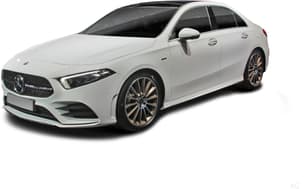
Or you could buy this car - the Mercedes-AMG A35 4Matic sedan. A lot of pundits have questioned the two-prong AMG strategy in the hatchback range, with the A35 slotting between the already-pretty-hot A250 4Matic and A45 S.
In the sedan line-up, however, there’s a different approach, with the Mercedes-AMG A35 4Matic topping the range. So is it a fitting flagship for the small sedan line-up? It certainly has the tech, safety and equipment levels to live up to buyers’ expectations.
And as a rival to the likes of the Audi S3 sedan, BMW 2 Series Gran Coupe and its own sibling, the Mercedes-AMG CLA35, does it offer a compelling alternative?
Let’s go through it, criteria by criteria.
If you’re looking for a sedan version of the RS 6 Avant, then you’ve come to the right place – sort of. See there is no RS 6 Sedan, but the RS 7 Sportback is the next best thing – you may even find it an even better thing because not only does it share RS 6 Avant’s outrageous engine and high-performance hardware, it’s also a sedan …but with a hatchback.
And if that kind of thing makes you happy, sit down – because the new generation RS 7 Sportback has just landed.
The Mercedes-AMG A35 sedan is a genuinely fun small car. To me it’s a more mature offering than the A35 hatch, while not being quite as pretentious as a CLA35. Therefore I like it on principle.
Would I personally choose it over an Audi S3? Probably not - but there are plenty of objective reasons why you would.
The new-generation RS 7 Sportback heralds the further evolution of this large majestic beast, with more features, a beautifully finished cabin and with more grunt with the looks to match. You’d be hard-pressed to find a better combination of power, dynamics and comfort in the Audi range – apart from in the RS 6 Avant of course.
This is the first AMG A-Class sedan ever, so that’s an interesting design decision. I wasn’t sure whether Mercedes needed a CLA ‘Coupe’ and an A-Class sedan to sit alongside one another, but there are distinct differences in terms of the look and intent of the two compact models.
The A sedan carries over the A-Class hatchback’s aggressive styling, with sharp, angular headlights, a strong presence courtesy of its black exterior highlights (including AMG flics on the front bumper and black side skirts, rear spoiler and rear diffuser for this test vehicle). The black 19-inch black-finish rims fitted to our test car are also optional, with silver being the standard finish.
It has a stumpy little boot with a broad stance thanks to its triangulated tail-lights and horizontal reflectors, while the twin exhaust pipes with black tips are rather pleasant to look at, too.
It’s a very attractive sedan, with nothing clumsy about its proportions at all. Is it gorgeous enough to make you think twice about the Audi A3/S3/RS3 as the ruler of the pretty little sedan? Maybe… it’s not quite there for me, although it’s close. But it is certainly a distinct design, one that Merc fans will undoubtedly adore.
The dimensions of the A35 sedan aren’t what a lot of people would actually consider “small”. It’s 4549mm long (on a 2729mm wheelbase), 1796mm wide and 1446mm tall. For context, that’s longer, wider and taller than the substantial Mazda3 small sedan, if not quite as big as the a Corolla sedan.
And if you’re wondering about how that compares to a CLA, that car has the same wheelbase but is 4688mm long, 1830mm wide and 1439mm tall. That’s bigger than a C-Class. Gosh, how confusing.
What does it all mean when it comes to interior space? Check out the interior images and details below to see for yourself.
The big news is the RS 7 Sportback now comes with five seats. The previous generation car had just two seats in the second row. I'll talk more on practicality below but for now let's examine the new styling.
This RS 7 Sportback has new broad, black mesh grille, flanked by gigantic side air intakes, narrow headlights, and a thin upper air inlet which is a hat tip to early racing Audis.
While that new angrier, more angular and menacing face is a showstopper, everything about the new RS 7 Sportback seems to be accentuated further.
Look at the wheels. The previous generation came with 21-inch rims, now the new normal for the RS 7 are 22-inches – they're huge. Those wheel guards also flare out 20mm more than a regular A7's and the rear haunches have bulked up massively.
Come to the back of the car and the diffuser and bumper have also been beefed up. Nobody sitting behind you in traffic is going to think this is just a regular A7.
Don't expect the RS 7 Sportback's insides to be just as hardcore as its exterior. The cabin is almost identical to a regular A7's. It's a stunning cockpit dominated by a dash which protrudes back towards the passengers and houses the media screen. Anther display for climate is set into the big centre console which divides the driver and co-pilot into almost cocooned cells.
The cabin isn't without its RS touches though – there's the sports seats with honeycomb stitching, fully digital instrument cluster with RS specific meters, the RS steering wheel, the Nappa leather on the dashboard and the doors, the aluminium inlays. The level of fit and finish is up there with the best that I've seen on any production car.
The RS 7 Avant is 5009mm long, 1424mm tall and 1950mm across for a wide planted stance.
I admit, I thought I’d get a bit more in the cabin of the A35 sedan. There’s no electric steering wheel adjustment, no heated steering wheel, and the fact adaptive cruise control is optional (it’s standard on some $25K cars!) is a bit rude, too.
That isn’t to say that it’s not an eye-catching space, one that will hit hard on the bling-o-meter, and will definitely impress anyone who isn’t familiar with Mercedes’ recent cabin design traits.
The twin screens are dazzling - crisp and beautiful to behold, and with graphics that are extremely high resolution. The menus have been designed to be simple, but honestly, it’s a bit confusing until you’re initiated.
Also, I found the media screen to be very glitchy. On multiple occasions it would not respond to touch, and once it even reset itself. I also had several problems connecting to Apple CarPlay. Note: I was using a Mercedes-Benz USB-C adaptor to USB-Lightning cable with an iPhone XS, and I think maybe the adaptor had a part to play in the problems I encountered.
The touchscreen is just one way to interact with the media controls, as there’s a touchpad between the front seats, and the driver has a thumb-controller on the steering wheel to jump between screens. And there’s voice control as well, with the MBUX system’s ‘Hey, Mercedes’ recognition allowing you to ask for things to be adjusted.
Furthering the wow-factor up front are beautifully designed air vents that light up blue when you turn the temperature down or red when you up the heat. There’s configurable ambient lighting for the cabin, which makes the A35 a bit of a showstopper at night, and our car had the no-cost optional red and black Lugano leather trim, which is either going to be your thing, or not.
The space for adults up front is decently accommodating, with good headroom and width, plus nice soft touch points where there should be, and there are bottle holders in the doors. There are three USB-C points up front, a pair of cup holders between the seats, and a wireless (Qi) phone charging bay.
The steering wheel is a nice shape and easy to hold, though I’m still not convinced by the little digital displays for the drive-mode dials - they’re toy-like teeny-weeny screens and look a bit pixelated compared to the other displays in the cabin.
Rear seat space is not as good as you might hope or expect, given the size of the car. As a 182cm (6.0ft) man with the driver’s seat set for me, my knees were hard against the seat in front, my toes were squashed and my head was just brushing the headliner, too.
That mightn’t be a problem for you - maybe your only rear seat riders will be short, or young. There are dual ISOFIX child-seat anchor points and three top-tether restraints for baby seats, if that’s the case.
And they’ll be well catered for, with a pair of USB-C ports, as well as directional air-vents, mesh map pockets, and bottle holders in the doors as well as a fold-down armrest with pop out cup holders.
Boot space will likely matter to you if you’re buying a sedan over the hatchback model, and you’ll find an additional 60 litres of boot space here over the five-door model, with 430L of cargo capacity.
That should, in theory, be large enough to fit all three of the CarsGuide cases (124L, 95L, 36L), but the shape of the cargo hold meant I only managed to fit the smallest case with the middle or largest case, but not all three together. Soft luggage could help.
There’s no spare wheel under the boot floor, as the A35 has a tyre repair kit.
The previous RS 7 Sportback was a four-seater, now it has five seats. That's right, a middle seat has been added to the second row, but, as you'd expect, it's not the best place be in the RS 7 Sportback, straddling the large driveshaft and ducking under the low roof-line.
That fastback profile does mean headroom in the second row is nowhere near as good as the RS 6 Avant's, but legroom is the same and, at 191cm tall, I can just fit behind my driving position with about 10mm to spare.
Up front it's not as spacious as you might think. That stepped dash protrudes into the passenger's space, the door pockets are thin and the centre console storage under the armrest is small.
Sportbacks are more practical sedans thanks the large opening offered by the hatch. The boot's 535-litre cargo capacity is great and only about 30 litres less than what you have in the RS 6 Avant.
For phones there's a wireless charger and two USB ports in the centre console storage box, while back seat passengers have two USB ports and a 12V outlets. There's also directional air vents and dual-zone climate control in the rear, too.
The Mercedes-AMG A35 4Matic sedan has a list price of $72,500, which is the manufacturer’s recommended list price (MRLP, also known as MSRP). That’s the price before on-road costs and extras.
What cars does the A35 compete with? The most obvious rival is one from within, the Mercedes-AMG CLA35, which is $85,500. Then there’s the Audi S3 sedan ($65,800) or RS3 sedan ($86,500). Or the BMW M235i Gran Coupe, which is actually its closest competitor on price, at $72,990.
You might have made your mind up about wanting the three-pointed-star badge though, so what do you get for your cash when it comes to the A35 sedan?
The standard equipment includes: 19-inch wheels, AMG body kit and 'Night Package' (blacked-out exterior trim), Lugano leather seat trim, heated and electric adjust front seats, keyless entry and push-button start, adaptive AMG Ride Control suspension, AMG drive modes, ambient lighting and a panoramic sunroof.
The cabin is equipped with a pair of 10.25-inch screens - one controlling media via the brand’s MBUX system and featuring Apple CarPlay and Android Auto, and the other a configurable display for driver info. There’s sat nav, five USB-C ports, wireless phone charging, and a nine-speaker sound system.
Other features include an auto-dimming rearview mirror, LED headlights and daytime running lights, semi-autonomous parking, front and rear parking sensors, a reversing camera and a number of active safety items beyond that. See the safety section below for more info.
Our car had a couple of options, including: black-finish 19-inch alloy wheels ($790); the 'Driving Assistance Package' - incorporating adaptive cruise control with front and rear cross-traffic alert, active lane-change assist, and 'Route-Based Speed Adaptation' - more on that below ($1890); the 'Vision Package' - with 'Multibeam LED' headlights and selective adaptive high beam assist, and a 360-degree surround view camera ($990); and the 'AMG Aerodynamics Package' - with front flics, side skirt trims, rear spoiler and rear diffuser ($2490).
All told, the as-tested price for this car was $78,660 plus on-roads.
The Audi RS 7 Sportback lists for $224,000, which is exactly $8K more than the RS 6 Avant.
Coming standard are the enormous 22-inch alloy wheels, the matrix LED headlights with laser lights, metallic paint, a panoramic glass sunroof (which is new to the model), privacy glass, head-up display, soft-close doors and red brake calipers.
Inside there's the Bang and Olufsen 16-speaker sound system (that new, too), sat nav, the 12.3-inch virtual instrument cluster, wireless Apple CarPlay (new, as well), wireless charging, full leather upholstery with RS sport front seats that are heated and now come with ventilation as standard, and four-zone climate control.
I've left off all the standard RS mechanical equipment, but I'll cover that in the driving section below.
Is it good value? Well the Mercedes-AMG CLS 53 S is $186,435 but it has way less grunt, the Alpina B5 which I've also road-tested lists for $210,000 and there's the Porsche Panamera 4 Sport Turismo for $236,300.
You could look at this one of two ways: 1) this is the least powerful AMG on sale today; 2) this is a seriously powerful small car.
If you’re glass-half-full-biased like me, you’ll see the engine specs and park yourself in the latter camp.
There’s a 2.0-litre turbocharged four-cylinder petrol motor which isn’t short on horsepower: it has 225kW of power and 400Nm of torque - those were class-killing power outputs not too long ago.
The grunt numbers give the AMG A35 sedan a claimed 0-100km/h time of just 4.8 seconds, while the top speed is limited to 250km/h. Five years ago these power figures and performance numbers would have pegged the A35 in A45 territory - this is a seriously powerful little jigger.
The engine is teamed to a seven-speed dual-clutch automatic transmission, and the A35 runs Benz’s 4Matic all-wheel drive system, which is front-biased but can shuffle torque 50:50 if needed.
The RS 7 may look like a large, well-mannered business class car, but think of it as a thug in a suit because this thing is a monster with a 441kW/800Nm twin-turbo petrol 4.0-litre V8.
That's almost 600 horsepower and the supercar acceleration that goes with it is brutal: we're talking 0-100km/h coming in 3.6 seconds. That also matches the RS 6 Avant and it's a tenth of a second faster than the Audi R8 V10 RWD supercar, (and also the previous-gen RS 7 Sportback Performance) and this is a large, four-door, five-seater.
Compared to the previous generation RS 7 Sportback Performance the power is down by 4kW, but torque is up by a whopping 100Nm. Give me torque over power any day.
Shifting gears is an eight-speed automatic transmission, sending the drive to all four wheels.
The combined cycle fuel consumption figure - that’s what the brand says the car will use over a mix of driving - is 7.4 litres per 100 kilometres.
I saw a little higher than that over my 650km of driving, which was heavily biased towards highway testing, but also included a few traffic snarls and a couple of stints of performance testing. I saw 8.4L/100km, which is okay, but I expected better given 80 per cent of my time in the car was in easy-going open road driving.
The fuel tank capacity for the A35 sedan is 51 litres, and you’ll need to fill it with 98 RON premium unleaded petrol.
This is a large, all-wheel drive car with a 600 horsepower V8, but it also has a mild hybrid system in this new generation, which will switch the engine off at let the car coast down hills or at speeds under 22km/h.
Audi says this can save up to 0.8L/100km in real-life driving. That's great news, but consumption is still fairly high with Audi saying that after a combination of open and urban roads the RS 7 Sportback will have used 11.6L/100km.
On paper this seems like the ideal option for those who know they’ll never really be able to take advantage of the outputs of an A45 or CLA45’s ludicrous power and torque figures.
In practice? It mostly lives up to that notion - though just like an A45 or CLA45, you’re going to enjoy it a lot more when you’re giving it the beans.
Driving with intent, the engine and transmission work together amazingly well. The transmission itself is thoughtful and smart shifting, swapping cogs exactly when you think it should - while you have paddle shifters available to use, in most cases you’re not going to need them.
The engine itself is an absolute weapon. There’s lots and lots of pulling power, it’s linear in the way it delivers its power, and there’s a little bit of pop and crackle from the exhaust - personally, I would like even more. I guess that’s where an A45 or CLA45 comes into its own.
The steering is superb for an all-wheel drive car, too. It’s direct and accurate, and while you can feel the electronics shuffling the power and torque between front and rear axles it’s a really nicely balanced and very easy car to drive fast – at times even faster than you really should be.
In Sport mode and Sport Plus mode the suspension and steering are tightened up, with taut responses but the suspension is never crunchy or uncomfortable. Braking performance is very good, too.
In Comfort mode though, I struggled to come to terms with the A35 a little. In my mind, it lived up to the notion of a sporty sedan a lot more readily than it did that of a compact luxury sedan. It just feels like it’s meant to be on a twisty road, not dealing with daily drudgery in commuting.
One not-very-luxurious element was the road noise intrusion, which was the worst of any new car I can recall experiencing. That might seem a dramatic claim, but the booming tyre roar on coarse chip road surfaces, including major Sydney freeways, was verging on unbearable. I measured it on my smartphone, and 78 decibels was the maximum readout.
And while very impressive under pressure, the powertrain is somewhat doughy in less demanding situations. There’s some lag to contend with, and a little bit of lunging from the transmission, too. However, it was during downshifts that I found the transmission’s behaviour most questionable, with some shift-shunts when slowing to a halt in urban driving.
One unexpected finding was the 'Route-Based Speed Adaptation' system’s behaviour, which was active in the car I was driving. The tech uses the car’s mapped position to guide its adaptive cruise control behaviour. In theory it’s a very smart idea - the car will slow itself down if it predicts you’re about to approach a tight bend and you’ve got it set at the speed limit. Or if you’re approaching a roundabout, it’ll think ahead, too.
But during my time in the car, I had an issue that I found could be potentially dangerous. Having set the speed at 80km/h in a relatively new tunnel in Sydney’s west (the WestConnex M4, opened July, 2019), the system couldn’t place the car’s location, which meant the car believed it was still on surface streets.
On multiple occasions the car slowed dramatically thinking I needed to turn a corner that didn’t exist on the road I was driving on. My instant thought was: “What if the person behind me wasn’t looking at the road ahead?” I’ve seen enough drivers with their eyes aimed at the phone in their lap and not the road ahead, to know this is a distinct possibility.
There’s also a risk from tailgating trucks, which seem to be more prevalent in Sydney’s west than anywhere else on the planet. It’s a potential risk, even if the Benz has clever tech that can flash the tail-lights if the car’s systems predict there’s a chance of being rear-ended.
Mercedes-Benz’s Aussie team let me know that the map software wasn’t up to date, which is why the car didn’t understand the situation. It’s technology you can disable by simply delving into the menus on the MBUX system, but I’d recommend you try it out to see if you’re comfortable with it.
I've never met an RS model that hasn't been great to drive – these cars are way more than just tough body kits and big wheels. The engineering which separates the RS 7 Sportback from the A7 makes them more distant cousins than siblings.
As I mentioned before the RS 7 Sportback and RS 6 share more than the same twin-turbo V8, there are also the giant brakes in form of 420mm discs at the front with 10 piston calipers and 370mm discs at the rear.
The optional carbon ceramic brakes are the largest ever to be fitted to a production vehicle at 440mm at the front and 370mm at the rear, saving 34kg in mass over the steel brakes.
Now standard for the first time is Audi's Dynamic Package, which adds dynamic steering (a variable ratio) paired with all-wheel steering, a sport differential, and a 280km/h top speed.
Coming standard is adaptive air suspension and for $2850 you can option the Dynamic Ride Control suspension, which is a hydraulically activated adaptive damper system
At the Australian launch, Audi supplied two RS 7 Sportbacks: one with the air suspension and the other with not only the Dynamic Ride Control system, but also the RS Dynamic Package Plus which adds the ceramic brakes and increases the top speed to 305km/h – this was the car I started off in.
I'm going to say right away that you don't need ceramic brakes for regular road use. Sure it means you can tell people that you have the biggest brakes in the world and they save you almost 35 kilos in weight, and, yes, they're resistant to fading, but they're expensive to replace and the steel ones are incredibly good.
I also feel the Dynamic Ride Control sports suspension isn't necessary in a car like the RS 7 Sportback. This is a Grand Tourer designed to eat up hundreds of miles at lightspeed in comfort.
So, while I found the first RS 7 Sportback with the big brakes and sports suspension sharper and firmer than the standard car, it didn't seem to fit with this vehicle's intent.
The regular RS 7 Sportback still accelerated with the same brutal force and roared at the scenery flashing past. It still handled through the tight corners superbly with excellent turn in, mind-boggling traction and grip, and excellent body control, but all in far more comfort.
This is the point – we covered hundreds of miles at the Australian launch of the RS 7 Sportback in a range of RS models, and sports suspension can go from great to gruelling on Aussie roads with their coarse-chip bitumen and potholes. The RS 7 Sportback, with its air suspension, not only made driving far more comfortable, but easier, too.
The A-Class range was awarded the full five-star ANCAP crash test rating based on 2018 criteria, and the scoring measures have progressed since then. According to ANCAP, the rating applies to all Mercedes Benz A-Class variants, though the Mercedes-AMG A35 (hatch and sedan) and A45 (hatch) are not shown on the scorecard.
However, the entire A-Class range comes with auto emergency braking (AEB) that operates between 7-200km/h and has pedestrian and cyclist detection (7-50km/h), active lane keep assist (LKAS, 0-250km/h) and lane departure warning (LDW), traffic sign recognition (TSR), and blind spot monitoring (BSM) and rear cross traffic alert (RCTA) with auto-braking. There’s also driver fatigue monitoring, cruise control with speed limiter, and speed sign recognition.
But despite being the top-of-the-range A-Class sedan, you still have to pay extra for the safety of front cross traffic alert with braking, and the brand’s Distronic adaptive cruise control system. Those are part of the Driving Assistance Package ($1890), which also incorporates active blind spot assist, active lane change assist, a system called Evasive Steering Assist (which sharpens up the steering to be more direct if a crash threat is predicted), and the aforementioned Route-Based Speed Adaptation.
ANCAP tested the A7 in 2018 and gave it the maximum five-star ANCAP rating, however, this rating does not apply to the RS 7 Sportback high performance model.
That said, the RS 7 Sportback is fortified with nearly every piece of advanced safety tech there is in Audi's cupboard. There's AEB which can detect and brake for cyclists and pedestrians at speeds between 5-85km/h and vehicles up to 250km/h; there's rear cross traffic alert and intersection crossing assistance with braking; lane departure warning and corrective steering to keep you in your lane, and blind spot warning.
Not a fan of parking, the RS 7 Sportback can do it by itself, or there's a 360-degree camera that'll help you do it yourself. There's an exit warning system, which will warn you if a vehicle is approaching as you go to get out, too, and if the RS 7 Sportback detects that it will be hit from behind, it will prepare the cabin by tensions the seatbelts and closing the windows, including the sunroof.
Along with all that there are Audi's new Matrix LED headlights with laser lights, rain sensing wipers and adaptive cruise control.
For child seats you'll find three top tether points and two ISOFIX mounts across the second row.
There's no spare wheel – instead, there's a tyre repair kit.
Mercedes-Benz Australia recently joined Korean luxury brand Genesis in meeting the market with a five-year/unlimited kilometre warranty plan for all of its models, including AMG variants.
Service intervals for the A35 sedan are set every 12 months/25,000km - yes, that’s a generous maintenance schedule, as most cars require servicing every 15,000km.
Buyers can opt to pre-pay servicing costs and roll it into their finance package, and there’s a level of discount applied if you do that.
For a three-year/75,000km service plan, you’ll pay $2150, saving you $500 over pay-as-you-go capped price servicing. There’s also a four-year/100,000km plan ($2950) or a five-year/125,000km plan ($4000). That’s surprisingly decent for a luxury car, though keep in mind it doesn’t include wiper inserts or brake pads/discs.
Buyers get roadside assistance included for the duration of the new-car warranty, too.
The RS 7 Sportback is covered by Audi's three-year, unlimited kilometre warranty which not only falls behind in duration compared to mainstream brands but also its direct rival Mercedes-Benz which now has five-year, unlimited kilometre coverage.
Service intervals are every 12 months or 15,000km with a three-year plan costing $2380 and a five-year plan for $3910.