What's the difference?
The entry-point into one of Australia's most popular brands has been around for almost 10 years in its current generation, but the Mazda2 has had a refresh.
Possibly for the last time in its current lifespan, the small hatchback gets a facelift to remain appealing, Mazda hopes, to first-car-buyers.
Mazda's up against not only direct rivals, like the Suzuki Swift and Toyota Yaris, but also the shifting market.
Mazda has sold just over 3500 Mazda2s so far this year, but almost 11,000 CX-3 small SUVs, the latter based on our friend here's platform.
It's a name with a little over two decades behind it, but can it be a first-car-favourite in an increasingly difficult small car market?
The Toyota Corolla Cross launched back in 2022 as a lifted crossover SUV version of one of the most iconic cars ever. It helped bridge the gap between the Corolla and the RAV4.
Three years on and it’s now mid-life facelift time. There are new looks inside and out, as well as some new tech and bling to catch your attention.
Competition is continually heating up in the small SUV segment, especially for those with hybrid engines, but is the updated Corolla Cross the pick of the bunch?
While Mazda's insistence that the Mazda2 is a 'first-car' could be very limited by the incomes of most teenagers or early-20s city-dwellers, the starting price being close enough to $20,000 for a dynamically enjoyable and convenient small car isn't to be scoffed at.
The new styling of the Mazda2 is well executed, and as an alternative to small SUVs (which continue to become more popular) it's a sensible option, especially considering its efficiency and ease of use.
The lower specifications in the range are probably the best in terms of value, as even the features on the higher grades aren't groundbreaking, and the Pure SP definitely exudes the most style cred.
The Corolla Cross is still an incredibly sensible car if you’re needing to buy a car, but you’re not a car person. Everything is intuitive and easy, allowing you to focus on driving.
This update has helped make this car stand out a bit more, but it’s still a bit vanilla. The Hyundai Kona, for example, offers more character. Also the asking price, especially at the top end, is creeping eerily close to RAV4 territory.
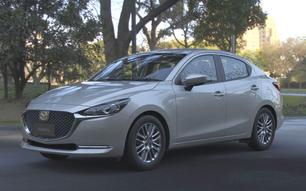
Aside from the Pure SP, the Mazda2's styling changes are subtle. Mazda's design team aimed to move the model's looks slightly away from the previous ‘premium' chrome-adorned look to a sportier and more ‘aggressive' style.
A redesigned front bumper and mesh grille, with the rear's nip and tuck being more subtle, don't need to do much to keep the hatchback looking fresh. Despite being almost a decade old, the Mazda2 looks, to some extent, like it could be a new generation.
The Pure SP in particular is a highlight, with the blocked grille evoking some ‘electrification' vibes, while the coloured-accent treatment at the front and rear of most variants is a welcome addition for something different.
The range of differing wheels is also a plus point for the Mazda2 range, with each model having its own distinct characteristics.
Inside, the Pure SP also gets a stand-out panel across the dash in a lighter colour like mint, while others get different seat trims and colour accents in places like the vent surrounds.
New colours for the range are 'Aero Grey Metallic' and 'Air Stream Blue Metallic'.
Toyota has put some effort into jazzing up the Corolla Cross’ exterior design. The pre-update car was arguably one of the more vanilla cars in its segment.
The most noticeable changes are up front. There’s a new grille set-up with hexagonal cutouts, as well as new LED headlights that are connected by a section that illuminates at night. This latter part looks quite tacky and feeds into the current trend of full-width light bars.
Around the side there are new 18-inch alloy wheel designs on this Atmos trim, as well as a revised LED tail-light set-up.
You can still tell this car is clearly a Corolla Cross from the outside thanks to the cladding around the wheel arches, but it no longer looks so boring, especially in top-spec Atmos guise.
Inside the design changes are more minimal. There’s a new centre console set-up that includes a chunkier gear selector, as well as an ambient lighting strip that wraps around the outside.
I prefer this centre console as it looks more substantial than the pre-update car’s, however, the glossy piano black is a big downside. After a week of testing it was already dusty and grimy, plus scratches are inevitable when you wipe it clean.
Beyond this there are no other obvious changes. I wish Toyota would include some differing colours and finishes inside as it’s a bit of a sea of black.
While there are some soft-touch materials on the dashboard and armrests, you don’t need to look far to find harsher, scratchier finishes. I expect better in a car that costs more than $50,000.
The Mazda2's interior is mostly unchanged through the facelift, with the car's overall dimensions unchanged and not affecting space for its occupants.
Up front, the two seats are comfortable for adults and arm, shoulder, and head room is ample.
Storage space for drinks, phones, or small bags and wallets is sufficient, though not quite road-trip-worthy.
In the rear seats, adults will find enough space to be comfortable for short trips but might get a little restless after a while.
Headroom when sitting upright is tight for anyone around 182cm (six-feet) tall, and a lack of armrest and little storage save for the doors means loose items will be joining occupants on the seat or sitting on the floor.
The Mazda2 has a claimed 250 litres of luggage space in the boot, which is fine for a small hatchback, but short of rivals like the Toyota Yaris' 270L.
The front seats in this car are deliciously comfortable. The bolsters hug you nicely and there’s plenty of upper back and leg support.
I’m also a fan of the upholstery finish in this Atmos trim. It’s a combination of leather and fabric which is great because the front seats also offer heating and now ventilation.
The steering wheel is a classic Toyota unit that features synthetic leather wrapping and heating function. There are also plenty of clearly labelled physical buttons that are a treat to use.
Behind this there’s a 12.0-inch digital instrument cluster like plenty of other Toyota models now. It features a familiar set-up that allows you to change a number of widgets and save multiple pages of configurations.
Moving across, the 10.5-inch touchscreen multimedia system is high-resolution and has crisp colours. There’s not a heap to do in the native user interface so there’s no excuse to get lost.
Thankfully there’s wireless Apple CarPlay and Android Auto. Connection was immediate with my iPhone 15 Pro Max when starting up the car and it remained rock solid throughout known interference points.
Under the touchscreen I appreciate that Toyota has retained physical climate control buttons and dials. They’re very easy to understand and use, especially on the move.
In fact, there are a lot of physical buttons around the cabin. This is great because you don’t need to dive into touchscreen menus and sub-menus.
In terms of amenities up front there are two cupholders, a wireless charger, USB-C charger, centre console box with a 12V socket, as well as a glovebox.
Moving to the second row there’s a decent amount of space for a small SUV, though if you want to use the seats more, you’ll likely want to opt for something larger, like a RAV4.
At 182cm tall I have minimal legroom behind my own driving position, though toeroom is excellent. Headroom is fine though it is impeded due to the panoramic glass sunroof, which notably doesn’t open despite the thick crossbar.
You can easily get two adults in the back of the Corolla Cross, though pushing it to three would make things squishy. It doesn’t help that there’s a central hump in the floor.
Amenities include rear air vents, two USB-C ports, bottle holders on the doors, plus a fold-down armrest with cupholders.
Around the back there’s a hands-free power tailgate that’s handy if you’ve got your hands full. In classic Toyota fashion, it opens and closes with plenty of beeps, which may attract attention.
There’s 380L of boot space with the rear seats upright, expanding to 2000L with them folded. This is fine for the segment, but doesn’t stand out. Front-wheel drive trims get a touch more boot space as they don’t have the rear electric motor.
In the boot area there’s a light, some hooks and a load cover. Unfortunately all-wheel-drive trims don’t come with a spare wheel whatsoever. Instead they only get a tyre repair kit.
It’s worth noting two-wheel-drive trims get a space-saver spare wheel. This is important if you frequently do long-distance drives away from tyre repair shops.
Mazda has managed to keep pricing for its entry model relatively low for the segment. In fact, the base Pure in manual form starts from $22,410, before on-roads, and the auto is only $2000 more.
That means at a time when the Toyota Yaris is starting to look more expensive than its historic ‘cheap and cheerful' image allows, Mazda is pushing the Mazda2 to be slightly more premium while keeping its price competitive.
Standard features for the range, which start in the Pure variant, include a 7.0-inch touchscreen with Apple CarPlay and Android Auto capability, plus auto headlights and windscreen wipers.
The Pure SP, which starts at $25,210, gains a different styling kit that adds a body-coloured front panel to the grille, plus a carbon-look roof in vinyl. It also gains the ‘shark-fin' roof aerial.
The Evolve, which starts from $25,910, gains LED DRLs, with the mesh grille replacing the SP's block colour panel.
Its upholstery gets red stitching, plus it's also got a couple more tech additions with Mazda's active head-up driver display, traffic sign recognition and satellite navigation.
Finally, there's the top-spec GT, from $27,610, which gains unique aero-inspired 16-inch alloy wheels, and a set of black leather-upholstered seats with synthetic suede and red trim.
A sedan is available in Pure or GT specification at the same prices and with the same features as the hatch, though you can't get a Pure sedan in manual - that's available in the hatch only.
The 2026 Toyota Corolla Cross line-up now starts from $37,440 before on-roads for the GX Hybrid trim, however, on test here is the flagship Atmos Hybrid AWD trim at $50,990 before on-roads. That’s a fair chunk of change for a small SUV.
For context, you can get a mid-spec RAV4 Cruiser Hybrid for around the same price as this Corolla Cross. Ultimately it comes down to whether you want a bigger car or more equipment.
Speaking of the latter, this top-spec Corolla Cross is stacked with equipment.
Highlights include new 18-inch alloy wheels, LED headlights, a panoramic glass sunroof, 12.0-inch digital instrument cluster, 10.5-inch touchscreen multimedia system with wireless Apple CarPlay and Android Auto, a nine-speaker JBL premium sound system, heated and ventilated front seats, as well as premium leather-accented upholstery.
One of the few things this car is missing over its rivals is the availability of a head-up display.
Mazda's ‘SkyActiv-G' 1.5 litre four-cylinder petrol engine is the unit used for six-speed manual and automatic models, but outputs vary slightly.
Manual cars produce 82kW and 144Nm, while autos deliver a slightly lower 81kW and 142Nm, both driving the front wheels only.
It's pretty much the same engine you used to find in an entry-grade MX-5, just with less power.
Like last year, all Corolla Cross trims now come with a hybrid powertrain. It’s unchanged with this facelift.
There’s a 2.0-litre four-cylinder petrol engine with either one or two electric motors, depending on whether you opt for a front- or all-wheel drive version. Our tester is the latter so it has two electric motors.
Total system output is 146kW with drive sent through an electronic continuously variable transmission (e-CVT). Top speed is 180km/h.
It’s worth pointing out there is no power difference between the front- and all-wheel drive trims. Uniquely, the latter picks up a ‘Snow’ drive mode.
Improved fuel efficiency and lower CO2 emissions come thanks to the automatic's slight drop in power and torque.
Mazda claims a 5.0L/100 km rating for the automatic Mazda2, which is down by 0.3L/100km over the previous version, but the manual's unchanged engine tune burns through the petrol at 5.4L/100km.
Filling the 44-litre tank with at least 91RON or even E10 is fine, and with its auto variant's efficiency rating means the Mazda2 technically has a theoretical range of 880km.
Comparatively the Mazda2 scores well here, the more expensive Toyota Yaris comes with a 4.8L/100km consumption claim with its CVT auto. A Suzuki Swift, with a smaller 1.2-litre engine, also has a 4.8L/100km rating.
Toyota claims the Corolla Cross Atmos Hybrid AWD consumes an average of 4.4L/100km on the combined cycle. This is 0.2L/100km higher than front-wheel-drive trims.
During my week of testing I saw an average of 5.0L/100km, according to the trip computer. This is fine, but I’ve experienced better in other hybrid SUVs.
However, during one trip into the office with heavy traffic I achieved an average of 3.7L/100km. Now that’s frugal!
All-wheel-drive trims get a larger 43L fuel tank compared to the 36L unit front-wheel-drive versions have.
Using my as-tested fuel consumption, this car has a theoretical range of 860km.
All Corolla Cross variants require a minimum of 91 RON regular unleaded petrol.
Our drive loop for the Mazda2's launch included a mix of urban, highway, and rural driving, with varying road quality and conditions.
Fortunately for the little hatchback, it handled everything well or at least at a passing mark, with only a couple of small shortcomings that are common in the segment.
The Mazda2 is a joy to drive in most circumstances, with a lively but confidence-inspiring chassis and controls that give a connected feel to the road.
At low speeds, the Mazda2's relatively low power isn't noticeable, with the gearbox getting things moving at a reasonable pace and the engine is responsive enough with the traditional gearbox helping it along.
It's worth noting that for ultimate control over the drivetrain, Mazda still offers a six-speed manual transmission in the entry-grade Pure, and it's a gem.
Smooth, sporty shifts and well thought out gear ratios mean the manual is easy to handle even in traffic, and the clutch has a forgiving bite point. The 'i-Stop' stop/start system works with the three-pedal car, too, as does cruise control.
In terms of handling and comfort, the Mazda2 is a little shaken by large bumps, though some of the rough surfaces on our test loop were particularly brutal.
Similarly, when pushed hard to conquer steep hills the 1.5-litre engine becomes a little harsh.
On twisty sections the Mazda2 (especially in manual form) provides ample fun while remaining predictable in its steering and chassis feedback, rather than feeling loose.
When you first start up the car it usually defaults to EV mode unless the petrol engine is bone cold. If this is the case it’ll fire it up to get the fluids warmed up.
Once the engine reaches operating temperature it typically switches off again, allowing you to cruise around exclusively on electric power. This never stops being fun and it’s almost a game to try and eke out as much electric juice as possible before the engine fires up again.
This is inevitable however once the battery charge gets low enough, or you press the accelerator that little bit harder. There’s no noticeable switch from electric to petrol that can be felt, but you do hear the petrol engine whirring away under the bonnet.
Despite this hybrid powertrain producing a total system output of 146kW, it doesn’t really feel like it from behind the wheel. Once you push the accelerator, the petrol engine tends to sound strained. It’s not a nice sound as it’s amplified by the fact there’s an e-CVT that doesn’t require gear shifts.
There’s great regenerative braking as standard which helps recuperate kinetic energy from slowing down back into the battery. This is helpful as it acts like engine braking down hills without actually using the brakes.
When you come to a complete stop the transition from the regen brakes to the traditional friction brakes can be a little grabby. You need to be prepared to alter the pressure you’re applying to the brake pedal.
The suspension in this car is a major highlight. It balances comfort and composure perfectly, allowing for an effortless driving experience. It soaks up virtually all road imperfections with ease, including harsher speed bumps.
This flows on to the steering which does err on the firmer side, but feels direct and a touch sporty. Overall this makes the Corolla Cross a fun vehicle to pilot even on the most dull roads.
On the parking front there are front and rear parking sensors, as well as a surround-view camera with great resolution. Even though this car is easy to park, there’s also a semi-autonomous park assist that can be handy if you’re not great at parallel parking.
Out on the open road the petrol engine does stay on more consistently. It’ll quickly flare the revs if you need to accelerate harder which makes me grit my teeth every time because it’s not the most refined sound.
Despite this there were moments when I was travelling at 80km/h and the petrol engine turned off, allowing the car to drive exclusively on EV power. This primarily only happens on flat roads as the moment there’s even a whiff of a hill, the engine kicks back in again.
There’s a fair bit of road noise that enters the cabin at higher speeds, which isn’t uncommon for small SUVs. However, there’s also noticeable wind noise that sounds like it comes from the sunroof or the side mirrors.
The updated Mazda2 is equipped with the brand's suite of 'i-Activsense' safety tech, which includes 'Smart City Brake Support' for operating forward and reverse, blind-spot monitoring and rear cross-traffic alert.
The Evolve and GT model grades are fitted with traffic sign recognition.
The GT model grade comes fitted with front parking sensors and a set of surround-view parking cameras.
The Mazda2 also features six SRS airbags to cover the driver and front passenger, side airbags, and curtain airbags front and rear. It also has ISOFIX anchor points and top tethers for child seats in the rear.
Mazda isn't going to put the Mazda2 up for a new crash test rating by ANCAP, with the brand telling us the new safety additions bring the car's safety up to date, though its original rating from 2015 was a maximum five stars.
The Corolla Cross was awarded a five-star ANCAP safety rating in 2022 based on testing conducted by Euro NCAP. The two safety authorities have harmonised testing protocols.
Standard equipment includes eight airbags, autonomous emergency braking (AEB), blind-spot monitoring, rear cross-traffic alert, lane-keep assist, lane centring, adaptive cruise control, front and rear parking sensors, as well as a reversing camera.
The AEB system activates from 5km/h and lane-trace assist (lane centring) can be activated from 0km/h.
Also standard is one year of complimentary access to Toyota’s connected services. This allows for SOS emergency calling, as well as a range of remote features via a smartphone app.
Stepping up to the GXL brings a surround-view camera, as well as vehicle detection for the low-speed front and rear AEB.
All three rear seats have top-tether points and the two outboard rear seats have ISOFIX child seat anchorage points.
It’s all fairly standard on this front.
Mazda offers a five-year/unlimited-kilometre warranty across the range, under which the Mazda2 will be covered. That's on par for the market, although some rivals, like the MG3, come with a seven-year term.
Scheduled servicing costs for the first seven workshop visits range from $334 to $587, and are undertaken every 12 months or 15,000km (whichever comes first).
Like all Toyotas, there’s a five-year, unlimited-kilometre vehicle warranty. However, if you service at Toyota dealers you get two additional years of engine coverage, bringing the total to seven years.
The high-voltage battery coverage can also be extended up to 10 years if you service at Toyota dealers.
Roadside assistance is available to purchase from $99 annually.
Logbook servicing is required every 12 months or 15,000km, whichever comes first. The first five services are capped at $255 each, which is incredibly affordable. It’s only beaten by the likes of Honda.
Toyota has one, if not the, most prolific dealer networks in Australia. There are around 260 dealers and they span metro, regional and rural areas.