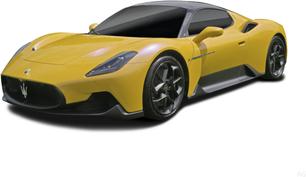
What's the difference?
With Ferrari leaving the Fiat-Chrysler family and becoming an independent entity in 2016, Maserati was left without a technology partner.
Suddenly, the Trident brand had to go it alone and come up with its own engines for the first time in more than 20 years. The MC20 sports-car is the result of that rebirth.
While there’s no doubt the Maserati brand has the currency to pull this off, the MC20 is also a big step outside the company’s usual grand-tourer box.
The new coupe is aimed at McLaren, Porsche and even Ferrari buyers, so can the first true Maserati sports car since the MC12 of 2004 walk the walk? And let’s not forget that the MC12 was Ferrari Enzo-based…
No-compromise cars are often the ones that impose the most compromises, and in that sense, the MC20’s shattering on-paper performance means its greatest attributes can’t be enjoyed on a public road.
That’s why this review was conducted entirely on Philip Island’s 4.4km Grand Prix layout. As a result, we can’t tell you much about parking ease or highway fuel consumption. But as for the things that give a super-sports car its identity, read on.
Years ago, McLaren wasn't really making McLarens. The ill-fated SLR was still in production, but was an oddity that made little sense - it was a highly specialised Mercedes and built to sell for crazy money to mega-rich F1 fans. Production was down to a trickle,and the iconic and legendary F1 had completed its run a decade earlier.
The "new" McLaren Automotive had a shaky start in 2011 with the unloved MP4-12C, which became the 12C and then morphed into the 650S, getting better with each reinvention.
The P1 was the car that really grabbed the world's attention and was then-new designer Rob Melville's first project for the British sports car maker.
Last year, McLaren sold its 10,000th car and production numbers are closing in on Lamborghini's. Sales have almost doubled in Australia and Rob Melville is still there, and is now the Design Director. The company, clearly, has done very, very well.
Now it's come time for McLaren's second generation, starting with the 720S. Replacing the 650S, it's the new Super Series McLaren (fitting in above the Sport Series 540 and 570S and below the Ultimate P1 and still-mysterious BP23), and is a car McLaren claims has no direct competitors from its rivals at Ferrari or Lamborghini.
It has a twin-turbo V8, a carbon fibre tub, rear-wheel drive and bristles with cleverness.
With a 320km/h-plus top speed and the ability to get from rest to 100km/h in under three seconds, there’s no doubting the MC20 meets or exceeds its performance brief. But when you’re paying these prices, there must be more than just the measurable stuff going on.
And there is. The MC20 brings a big dollop of purity to the ranks of current supercars, doing away with all-wheel drive and hybrid tech and relying instead on and old-school approach in terms of handling and overall feel.
Anybody who wants to argue that call has plenty of alternatives to the MC20 from other manufacturers, and for some of us, that less-is-more thing will ring true.
Note: CarsGuide attended this event as a guest of the manufacturer, with meals provided.
Past McLarens have been accused of being a bit soulless, but this one is alive. The last time I felt like this in a car was a Ferrari F12, one of the scariest but most brilliant cars I've ever driven. Except the 720S isn't scary on the road, just sheer genius.
The 720S doesn't necessarily beat the competition but it opens up new ways of doing supercar things. It's a car that looks amazing, is more than fit for purpose but has a wider range of talents than the others.
That makes it ever more compelling, both as a piece of automotive brilliance to admire, andl as something to consider when you've got half a Sydney apartment to spend on a car.
Australian roads await, but the drive through rural English country roads and villages was a great preview. All I can say is: gimme one.