What's the difference?
Driving a whopping great SUV down the straight on a race track at more than 200km/h sounds like fun, but it actually feels a bit wrong, like entering a baby elephant in a dog show.
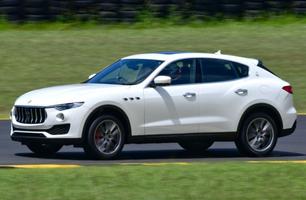
These are strange times, of course, and the Maserati Trofeo Levante is a suitably strange vehicle - stylish, classy, expensively appointed family hauler that also has the heart and soul of a race car.
Indeed, while performance SUVs are an increasingly commonplace vehicle, the Levante - which was actually getting along in the tooth as a model before this significant upgrade - has higher performance credibility than most.
That's because it has a big Ferrari V8 driving all four of its wheels and delivering a properly supercar-like 433kW and 730Nm.
It's not what you might call a typical Maserati buyer's car, but then only those who know what the Trofeo badge stands for - shouty insanity, basically - will be interested in this end of town. It is a lot of car, but is it worth the large load of money on the sticker ($330,000)?
Maseratis make a certain amount of sense to a certain kind of person. As the folks who run the brand in Australia will tell you, its buyers are the kind of people who’ve driven German premium vehicles, but find themselves wanting something more.
They are older, wiser and, most importantly, richer.
While it’s easy to see the high-end lure of Maserati’s Italian sex appeal styling and luxuriously appointed interiors, they’ve always struck me as cruisers rather than bruisers.
Again, they’re for the older, more generously padded buyer, which makes the Trofeo range something of an oddity. Maserati says its Trofeo badge - seen here on its mid-sized sedan, the Ghibli, which sits below the vast Quattroporte limousine (and side on to the other car in the range, the SUV Levante) - is all about the "Art of Fast".
And it certainly is fast, with a whopping V8 driving the rear wheels. It’s also completely bonkers, a luxury car with the heart of a track-chomping monster.
Which is why Maserati chose to launch it at the Sydney Motorsport Park complex, where we could see just how quick and crazy it is.
The big question is, why? And perhaps who, because it’s hard to imagine who wants, or needs, a car with such severe schizophrenia.
Maseratis are built for a fairly specific niche buyer; someone with a lot of money, someone slightly older and certainly someone who likes the finer things in life and appreciates Italian style, quality and heritage.
They are not, typically, the kind of buyers who want to tear around race tracks like fiends in big, shouty SUVs. But apparently there is a niche within the niche of Maserati fans who do, and they are willing to invest big dollars in vehicles wearing the Trofeo badge, like this Levante.
It might seem a slightly strange creation, a track-mad SUV with a screaming Ferrari engine, but surprisingly, it really does work.
The Maserati Trofeo Ghibli is a very strange beast, but there's no doubt that it is a beast. Fast, loud and capable on a race track, and yet still closely resembling a classy, expensive Italian family sedan, it is genuinely unique. And genuinely strange, in a good way.
While the other two Maseratis to get the Trofeo treatment - the Ghibli and Quattroporte sedans - are undeniably lovely, the Levante is not quite as pretty.
Admittedly, for an SUV, it looks very good, and the Trofeo touches - that big, nostrilled bonnet, the red gills on the sides, the carbon, the badges - really do lift its game to another level.
Overall, though, the Levante has just never felt beautiful enough to me to be a Maserati. These guys really do style well, as you'd expect from a premium Italian brand, but making an SUV sexy is beyond even them.
I'll grant you, it does look good from front on, but at the rear they just seem to have run out of ideas.
Credit is due for feeling properly special inside, however.
The Ghibli Trofeo is an alluringly beautiful car from just about every angle, with a genuine sense of occasion and presence about its nose, a sleek side profile and a much improved rear end, where the light clusters have been redesigned.
The Trofeo special touches are impossible to miss, particularly from the driver’s seat where you look straight into two vast nostrils on the bonnet. There are also carbon fibre pieces on the front air duct and the rear extractor for a sportier, wilder look.
The red details on the air vents on each side are the highlight, though, while the lightning bolt on the Maserati trident badge is another nice touch.
The interior is simply beyond special and feels even more expensive than it is. Overall, I’d say it again, it’’s alluring. Italian style at its best and the Ghibli is the Cinderella point in the range, because the Quattroporte big brother really is too large, and the Levante is an SUV.
If you've got to move five people in a genuine hurry, the Levante is a pleasant way to go about it.
There's plenty of head and shoulder room, the seats, while firm in the front, are pleasant to the touch and supportive and there's a 580-litre boot with an electric tailgate and split-folding seats.
The boot feels properly spacious, too, with a 12-volt power outlet and four tie-down points. You won't, however, find a spare wheel out there, so serious off-roading is out (although it probably was already if you look at those expensive wheels).
There are huge door pockets with room for bottles and two big cup holders in the front. The centre-console bin looks lovely, it's all carbon fibre, but is quite small.
There are also three USB points, one in the front and two in the rear, and Apple CarPlay and Android Auto connectivity.
From the driver’s seat, the Trofeo Ghibli feels spacious indeed, and while it’s not as vast in the back as a Quattroporte, there’s plenty of room for two adults, or even three small children.
The move to throw sportiness at the Ghibli has led to it having firm but fabulous seats. They’re comfortable, and the leather is luscious, but the actual seat back is constantly letting your spine know that this is no ordinary Ghibli.
Throw it around a track, though, and the seats feel just right, providing the kind of support you need.
Boot space is ample at 500 litres and the Ghibli feels like the sort of car you could take your family in, if only it didn’t make you feel like you were spoiling your children too much.
I'm sorry, but $330,000 for an SUV, of any kind? Personally I can't see the value, but then personally, as we'll discuss below in the Design section, I can't see the attraction.
This is one of the most expensive SUVs money can buy, well above things like Range Rover Sport SVR ($239,187) or even Porsche Cayenne Turbo Coupe ($254,000), although a pricier Ferrari one is surely on the way.
You'd want a lot for that, and the way it drives and sounds, thanks to that Ferrari engine, accounts for quite a few dollars.
There's also an undeniably high-quality feel to everything you touch on the car, inside and out, and a vast quantity of carbon fibre everywhere as well.
Other highlights include the 21-inch machine polished wheels, an 8.4-inch touchscreen with Navigation and DAB radio, full matrix LED headlights, and incredible Pieno Fiore natural leather, “the best the world has ever seen”, as Maserati says.
The lovely if firm front seats are heated and ventilated, sporty and 12-way adjustable, with Trofeo logos stitched into the headrests. The rooflining is lovely Alcantara, the steering wheel is sporty and features carbon-fibre shift paddles, ad the stereo system is Harman Kardon Premium and has 14 speakers.
And even the rear seats are heated. It feels expensive, and it should. But still, $330K?
At a price of $265,000, the idea of “value” becomes a different discussion, but you only need to glance at the Ghibli to realise that it looks like four times that much money.
The interior is also spectacularly boudoir-like, with lashings of carbon fibre and a whole cattle stud worth of full-grain Pieno Fiore natural leather, “the best the world has ever seen”, as Maserati likes to say.
Perhaps most vitally, this Trofeo racy edition gets a Ferrari engine; a 3.8-litre twin-turbo V8 good for 433kW and 730Nm (the first time it’s been seen in the Ghibli), driving the rear wheels only through a limited-slip differential and an eight-speed torque converter automatic gearbox. You also get very nice, expensive feeling paddles to shift those gears with.
Speaking of nice, the 21-inch aluminium Orione wheels are dead classy, if reminiscent of Alfa Romeo cars.
Ghibli Trofeo models come with a Corsa, or Race, button for hard-core sporty driving, and a Launch Control function.
There’s also an MIA (Maserati Intelligent Assistant), featuring a rather large 10.1-inch multimedia screen with upgraded resolution.
The Active Driving Assist “assisted driving function”, which has been seen in Ghibli before, can now be activated on urban roads and ordinary highways.
This will be the last time Maserati gets a proper Ferrari engine like this a 3.8-litre twin-turbo V8 shouty monster, which is good for 433kW and 730Nm.
The future, as is the case everywhere, is going to be more electric and less noisy. For now, anyone who can should enjoy this V8 masterpiece, which drives all four wheels through Maserati's Q4 on-demand all-wheel drive system via a limited-slip rear differential and uses an eight-speed automatic transmission.
Its claimed 0 to 100km/h time is 3.9 seconds, which puts it in what used to be super-car territory, and is still very quick indeed, while top speed is an unimaginable 304km/h.
This will be the last time Maserati gets to enjoy a proper Ferrari engine - a 3.8-litre twin-turbo V8 good for 433kW and 730Nm - before it moves to a more electrified future, but it’s certainly going out with a lot of loud bangs.
Deafeningly lovely, the V8, which drives the rear wheels, will shove you to a shouty 100km/h in 4.3 seconds (fast, but not stupidly so, although it feels even quicker) on your way to a very Italian top speed of 326km/h.
We can report that it exceeds 200km/h with consummate ease and has epic amounts of torque on tap.
The official claimed fuel economy for the Maserati Levante Trofeo is 13.5 litres per 100km, but good luck with that.
A more realistic number would probably sit somewhere above 17 litres per 100km, and we would have easily exceeded 20 litres while driving it like lunatics around a track.
But you just paid $330K for an SUV, what do you care about fuel economy?
Maserati claims a slightly inexact fuel-economy figure of 12.3 to 12.6 litres per 100km, but good luck ever achieving it. The desire to open the taps and really chew some fuel will aways be overwhelming.
We drove it on a race track and would easily have been exceeding 20 litres per 100km, so our test figure is probably best not spoken about.
We got to drive all three Trofeo-fettled Maseratis on track at Sydney Motorsport Park, and before that on the road, where the Levante felt very pleasant, and pleasantly expensive at all times.
As you might expect, a vehicle with 433kW is difficult to fully appreciate on public roads, although there was the occasional and exciting change to give it a quick, loud blat between gears.
It only takes hearing that engine note, and feeling that torque surge, a few times to see why someone might fall in love with this car, or at least this engine.
Out on the track, the rear-driven Ghibli and Quattroporte, which share the Levante's engine, were surely the more fun and frenetic things to drive, but there were those who chose the Levante as their best of the three, even for circuit driving.
There's no doubt that its on-demand all-wheel-drive system, which is biased towards the rear but asks the front wheels for help when required, made it feel the most planted, and the safest, through fast and slow bends.
There's a definite sense that its engine is being asked to work the hardest, though, to push all that bulk through the air (although its brakes never seemed to fade, which is impressive with more than two tonnes of SUV to stop).
While the big, deafening V8 is willing and keen to rev all the way to 7000rpm (where it bangs on the redline waiting for your upshift, if you're driving in manual mode - I do like that), it started to make large sucking sounds towards the top of each gear, as if it was desperately trying to get more oxygen in.
It genuinely sounded different to the other two Trofeo cars, which is odd, but perhaps they just weren't as near their limits. That bulk also slowed it slightly in terms of top speed down the straight, but it still exceeded 220km/h with ease.
What should be said is that I was genuinely shocked at how good the Levante Trofeo was around a track. So much so I asked to have a second go, just to make sure I wasn't going mad.
Sure, it makes no sense to me personally, and I don't know why anyone needs an SUV that's good on a track, but if you do, I can recommend the Levante for sure.
That hugely enjoyable engine is just too much fun, although it's even better in a sedan like the Ghibli...
We were fortunate enough to drive all three Trofeo models - Ghibli, Levante and Quattroporte - on the track at Sydney Motorsport Park, which really is the only way to fully appreciate vehicles with Ferrari V8 engines, 433kW and rear-wheel drive.
Maserati is keen to point out that other premium brands don’t offer that kind of grunt in their rear-drive cars, indeed most of them are going all-wheel drive, and that level of playfulness is a real USP, it believes.
The thing is, the company also acknowledges that its buyers are older, wiser and wealthier types moving up from the German brands.
The Trofeo range, in particular, then, is a real niche within a niche. I picture Maserati buyers as being slightly sedate yet stylish. Fans of the nicer things in life, but not flashy, or thrashy, about the cars they drive.
And yet, unlike other Maseratis, the Trofeos are flame-spitting beasts that sound like Game of Thrones dragons. Clearly there are people who like their classy Italian saloons to be insanely fast and track ready. And hooray for them, because as weird as it seems to flog a car like this so hard, the Trofeo Ghibli was well and truly up for it.
It’s also the pick of the litter, being less SUV like than the SUV Levante, and less stupidly long and heavy than the Quattroporte.
Its shorter wheelbase and lighter weight make it the most fun and light on its feet when being thrown around. We hit an easy 235km/h on the front straight before hurling into Turn One well north of 160km/h, and the Ghibli just held on tight before using its torque to hurl it at the next bend.
It sounds, as I’ve said, amazing, but it’s worth saying again because it’s a real Maserati (or Ferrari, really) advantage of choosing this car.
The brakes are also up to the task of repeated track-hard stops, the steering is lighter and less talkative than a Ferrari perhaps, but still excellent, and the whole Trofeo Ghibli experience is best described, on circuit, as being better than you would possibly imagine.
Out on the road, you don’t have to put up with the firm ride that pressing the Corsa button compels, and the Ghibli reverts to its smooth, cruiser persona - while still looking sporty as hell.
The only letdown is the seats, which are a little on the firm side, but everything else about the cabin is so luxe you almost forgive it.
While this car makes no sense to me, it obviously excites enough people for Maserati to make a business case, and charge $265,000 for the Trofeo Ghibli. Good luck to them, I say.
Maserati's safety offering on the Levante includes six airbags, a reversing camera and 360-degree overhead camera, parking sensors front and rear, adaptive cruise control and Blind Spot Detection, Forward Collision Warning Plus, Pedestrian Detection, Lane Keep Assist, Active Driver Assist and Traffic Sign Recognition.
There is no ANCAP rating for the Levante as it's not been crash tested here.
There is no ANCAP rating for the Ghibli as it has not been tested here.
The Trofeo Ghibli comes with six airbags, Blind Spot Detection, Forward Collision Warning Plus, Pedestrian Detection, Adaptive Cruise Control, Lane Keep Assist, Active Driver Assist and Traffic sign Recognition.
Maserati offers a three-year, unlimited kilometre warranty, but you can choose to buy 12-month or two-year warranty extensions, and even a sixth or seventh-year drive-train warranty extension.
When much, much cheaper Japanese and Korean cars are offering seven and even 10-year warranties, this is so far off the pace that such a fast vehicle should be embarrassed. And if you're buying something Italian, a better, longer warranty would seem like a must. I'd be negotiating at sale for them to throw the longer warranty offer in.
Maserati says servicing for the Ghibli has a "ball park costing of $2700.00 for the first three years of ownership" with a service schedule of every 20,000km or 12 months (whichever occurs first)
Also, "please note that the above is indicative only of the manufacturers basic routine service maintenance schedule and does not include any consumable items such as tyres, brakes etc or additional dealership charges such as environmental levies etc."
Maserati offers a three-year, unlimited kilometre warranty, but you can choose to buy 12-month or two-year warranty extensions, and even a sixth or seventh-year drive-train warranty extension.
When much, much cheaper Japanese and Korean cars are offering seven and even 10-year warranties, this is so far off the pace that such a fast vehicle should be embarrassed. And if you're buying something Italian, a better, longer warranty would seem like a must. I'd be negotiating at sale for them to throw the longer warranty offer in.
Maserati says servicing for the Ghibli has a "ball park costing of $2700.00 for the first three years of ownership" with a service schedule of every 20,000km or 12 months (whichever occurs first)
Also, "please note that the above is indicative only of the manufacturers basic routine service maintenance schedule and does not include any consumable items such as tyres, brakes etc or additional dealership charges such as environmental levies etc."