What's the difference?
The Lexus RX holds broad appeal. Families with a bit of money that don’t need a third seating row, older people who love the brand and want a bit of space, and people stepping up into the premium marque from a mainstream brand are all potential buyers.
The fifth-generation version that launched in early 2023 proved to be a significant step up over the previous RX.
Lexus made it more dynamically capable, and there’s been a sharpened focus on refinement, value-for-money and safety credentials.
We spent three weeks getting to know the most affordable RX - the entry-grade Lexus RX350h Luxury two-wheel drive - to see whether it’s worth putting it at the top of your premium family SUV shopping list.
Mercedes-Benz has brought back the entry-grade GLC200 and it's now the most affordable way into the sleek, mid-size luxury SUV.
But ‘entry-level’ doesn’t always mean ‘everyday friendly,’ so we’ve been family-testing it to see if it delivers that signature Benz comfort, quality and class without the premium sting.
The question is, does it offer enough substance and style to take on its high-profile rivals, the Audi Q5 and BMW X3?
It’s hard to look past the value equation of the RX350h Luxury 2WD when comparing it to almost all its competitors. The pricing is on point, but there are some features missing.
However, there are very few (if any) rivals with a true hybrid powertrain (sorry, mild hybrids do not count), so the RX will capture buyers looking for environmental credentials and efficiency without going full EV.
The drive experience is much better than before and it’s all wrapped up in a very stylish package. The Lexus RX should not be ignored.
The new Mercedes-Benz GLC200 might be the base-grade, but it doesn’t look or feel like it. From the outside, it’s stylish and refined, and inside, it delivers that signature Benz luxury with premium features, impressive tech and a beautiful cabin.
While the engine isn’t wildly powerful, it’s more than capable for everyday driving and long stretches on the highway and the ride quality overall is smooth, quiet and composed. It loses points for being more expensive than its entry-grade rivals and for those steep ongoing servicing costs, which could be a sticking point for some buyers.
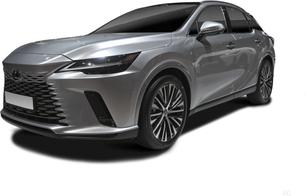
Across its five generations, the RX has held significant visual appeal - especially the still-handsome second-gen version that was the first RX sold Down Under. The first-gen model skipped Australia.
The new model that launched in 2023 is a clear evolution of the car that came before, but it’s been softened and sharpened in the right areas, giving it one of the most appealing designs in its segment.
The proportions and design elements like the squat stance, unique C-pillar treatment, slimline headlights and nicely sloping roofline give it a sporty look.
In fact, I reckon it might be the best looking Lexus available today - not including the jaw-droppingly beautiful LC coupe and convertible, of course.
The interior is modern and feels like an evolution of Lexus’ previous cabin design - but elevated. The gloss black section of the dash helps here.
Levels built into the dash break up the bulk, but the interior is very grey. It could do with a dash of colour.
The synthetic leather seat trim doesn’t look premium. If you want a more expensive feeling RX, you need to pay more for a higher grade.
The GLC is a handsome SUV with a strong, confident stance. It looks fit and premium, but not overly sporty, especially with the standard 'Avantgarde' exterior styling seen on our test car.
The entry-level grade rolls on 19-inch alloy wheels, features slimline running boards, LED lighting all around and an interior ambient lighting package that even includes logo 'puddle light' projection from the side mirrors.
Inside, the GLC200 doesn’t skimp on style. You get sports seats trimmed in synthetic leather (available in a range of colours), plus a panoramic sunroof, flashy dual displays and a black headliner that adds a cocooned feel.
The ambient lighting is a real standout and reminiscent of sci-fi films like Tron! It adds to the cabin’s upmarket vibe.
Combined with the soft-touch surfaces and neat trim details, the interior feels luxurious. And to be frank, it should at this level. But not every base-grade SUV in this segment gets it right. This one does.
The RX is a five-seat only proposition in this generation - the previous model had a seven-seat option - so if you need a third row you can look at the Lexus LM people mover or massive LX 4x4 SUV, or at any number of other three-row lux SUVs like the Volvo XC90 or new Mazda CX-90.
That doesn’t mean the cabin isn’t practical.
Up front the seats offer excellent comfort levels and ample upper body support, but not a lot of hip support.
Lexus has changed up the door handles for the new RX and it can be complicated - initially.
The interior handles bamboozled every new person that got in my press car over the three week loan. But once you realise it’s a simple push of the thumb on the handle’s thumbpad and a gentle push, it all makes sense.
Lexus calls the electrically activated door handles an ‘e-latch’. Is it tech for tech’s sake? Probably.
I recently reviewed the Lexus LM and commented on how much I like Lexus steering wheels and that’s true of the RX, too.
It has clearly identifiable controls and feels nice in your hands. Thankfully, the cruise control buttons are housed on the wheel too, so no annoying stalk on the wheel.
There’s plenty of space across the front row so you should avoid the awkward driver-passenger elbow bump on the centre armrest.
Under the armrest is a huge central bin that opens on the driver and passenger side. There’s also a big covered storage nook forward of the shifter and another ledge above that, as well as a sizeable glove box.
The doors have ample storage room for bottles, but the space is almost too wide. My bottle slid around when driving so I had to lay it down.
The centre console houses two big cupholders with adjustable depth in one of them. Clever touches like this and the central bin add to the appeal.
As with the Lexus LM, I am a fan of the new Lexus multimedia set-up. It has an easy-to-navigate menu along the side, easy wireless Apple CarPlay connection, and visually appealing graphics.
It’s a world away from Lexus’ previous system. That frustrating touchpad is, thankfully, in the bin.
I quite like the gear shifter with its unusual gate and even the indicator feels and sounds premium.
Small rear windows make for a rear three quarter blind spot, but visibility is otherwise good.
On a side note, the RX has very strong air conditioning - perfect for an Australian summer.
Jumping into the second row, there’s plenty of space all around and no shortage of head, leg, knee and shoulder room. Although foot room under the front seats is tight.
As with the front seats, the rear row offers comfortable seating. Kids should be happy back there.
There’s only a small transmission tunnel so middle-seat legroom is good. And in great news for passengers, the rear backrests recline.
Lowering the 40/20/40 split-fold rear seats for more cargo space is done via a lever on the side of the outboard seats, or by a button in the boot area. There are ISOFIX clips on the two outboard seats.
Other amenities in the second row include map pockets, two USB-C ports, knee-level air vents, climate control, and a pull-down armrest with pop-open cupholders.
Open the power tailgate and you’ll find cargo space of 612 litres with all seats in place, or 1678L with the second row stowed.
That’s a decent amount of space but not class leading. The Mercedes-Benz GLE has 630L and the VW Touareg can swallow 810L.
There’s no under-floor storage because that’s where some hybrid hardware is housed. You will find audio speakers, nice carpet, a cargo blind, two 4.0kg hooks and three top tethers. No spare, only a tyre repair kit.
The cabin is spacious in both rows, with decent access thanks to wide door apertures and 195mm of ground clearance. That said, it’s the kind of cockpit you sort of tuck into and I knocked a knee or elbow on the steering wheel getting in (my husband joked this was just a user issue). My eight-year old had no trouble hopping in and out, though.
The front seats are best described as sumptuous, with features like expandable under-thigh and lumbar support. It’s super easy to get comfortable and stay that way, a big plus for anyone who does long drives, like I do.
The rear seats are equally comfy, with generous padding and deep bases. You’ll find three top-tether points in the back row, but realistically, it’s a space better suited to two child seats.
Keeping the cabin tidy is simple thanks to thoughtful storage throughout. There are deep door bins with drink bottle holders, a couple of cupholders in each row, a largish glove box and a dual-lid centre console.
Up front, there’s also a phone cubby, two USB-C ports and a wireless charging pad. In the rear, you get another two USB-C ports and some handy map pockets.
The boot has proven to be a practical space, with 620L of capacity and a level load floor. There’s a reversible mat and underfloor storage, which is also where you’ll find the space-saver spare tyre.
This grade now includes a powered tailgate, a welcome addition, and the second row folds electrically in a 40/20/40 split, giving you more flexibility when you need it.
The updated media display is easy enough to use once you spend a bit of time with it. The touchscreen is responsive, and wireless Apple CarPlay maintained a steady connection throughout our test. I also appreciated how the instrument cluster and head-up display pull through directions from either your phone or the in-built sat nav system.
The range-opening RX350h Luxury 2WD petrol-electric hybrid starts at $86,904, before on-road costs, and for that amount, the standard specification list is healthy. But it doesn’t include everything.
As well as a long list of standard safety gear (see section below), the RX350h comes with three-zone climate control, heated and eight-way adjustable power front seats, electric steering wheel adjust, rain-sensing wipers, a 14-inch multimedia set-up with wired Android Auto and wireless Apple CarPlay, digital radio, sat nav, a 12-speaker audio system, five USB-C (and one USB-A) ports and more.
It is missing a few items, however, that should be standard, such as a head-up display and wireless device charging. Those features are available as part of an options pack - or 'Enhancement Pack' in Lexus speak.
For $5000 more you get those two things and a panoramic sunroof, ventilated seats, a more digital instrument cluster and other goodies.
You can opt for an all-wheel drive version of the 350h and that adds just over $3500 to the price. If you want the same powertrain but more gear then you’ll need to step up to the $110,575 Sports Luxury.
There’s also the petrol-only RX350 in F Sport and Sports Luxury guise, as well as the flagship RX500h F Sport Performance hybrid that tops out at $124,675.
Looking at the opening price of some of its rivals, Lexus has most of them beat.
The Mercedes-Benz GLE300d starts from $144,900, the BMW X5 xDrive30d is $134,900, Porsche Cayenne starts at $138,700 and the Volvo XC90 B5 Ultimate Bright kicks off from $100,990.
Only the Volkswagen Touareg 170TDI ($89,240) and Jaguar F-Pace P250 R-Dynamic ($83,700) are close on price.
There are five variants in the GLC range, and for this review we’re testing the new entry-level GLC200, priced from $84,455, before on-road costs.
While it’s definitely more affordable than the next step up, the GLC300, it still wears the highest price tag among its base-grade rivals, with the Audi Q5 35 TDI starting from $73,400 and the BMW X3 xDrive20i from $77,601.
That said, the GLC200’s generous equipment list could easily convince you it sits higher in the range. Standard features include 19-inch alloy wheels, synthetic leather trim as well as electric front seats with memory, heating and Mercedes’ ‘kinetic’ function.
You also get a panoramic sunroof, a slick 12.3-inch digital instrument cluster, a colour head-up display and a vertical 11.9-inch media screen running an upgraded operating system with satellite navigation plus wireless Apple CarPlay and Android Auto.
Practicality hasn't been overlooked, either. There’s a space-saver spare tyre (a welcome change from the run-flat tyre solution often employed by Euro brands), a handsfree powered tailgate, adaptive LED headlights, dual-zone climate control, four USB-C ports, two 12-volt sockets and a wireless charging pad.
Our test car also includes the optional 'Plus Package', which adds $5846 to the price. It bundles in a 15-speaker Burmester sound system, digital matrix LED headlights, heated and noise-insulating glass, augmented reality navigation and a digital key via the Mercedes-Benz app.
You’ll also find a few extra safety additions here, such as a lane centering aid, emergency steering assist, interior monitoring and external surveillance for added occupant protection and theft deterrence.
Overall, a bit more expensive but you get an impressive amount of features.
Powering the RX350h is a series parallel hybrid system consisting of a naturally aspirated 2.5-litre four-cylinder petrol engine, a front-mounted motor and a nickel-metal hydride battery.
Lexus doesn’t provide combined torque outputs for the hybrid, but total power for the system is pegged at 184kW.
This drives the front wheels only via a continuously variable transmission (CVT).
The GLC200 is powered by a 2.0-litre, four-cylinder, turbo-petrol engine paired with a 48-volt mild-hybrid system, producing up to 150kW of power and 320Nm of torque. It’s the least powerful engine in the GLC range, but still manages to feel punchy when you need it to.
This all-wheel-drive variant is paired with a nine-speed automatic transmission. While it can feel a little twitchy at lower speeds when the auto start/stop system is active, it’s otherwise a smooth and well-matched combination for everyday driving.
The official combined cycle fuel consumption figure for the RX350h 2WD is 5.0 litres per 100 kilometres, with CO2 emissions of 114g/km. You won’t get figures like that in a petrol or diesel competitor.
Over three weeks of mixed city, country, urban and freeway driving, I recorded 6.8L/100km which is not too bad given some of my spirited driving. The trip computer said 7.0L which is close to my figure.
The RX350h takes premium unleaded petrol and has a 65-litre fuel tank, so expect a range of around 950km based on our real-world consumption number.
The GLC200 has an official combined cycle (urban/extra-urban) fuel consumption figure of 7.5L/100km and with its 62-litre fuel tank, you’re looking at a theoretical driving range of up to 826km which are solid figures for a family cruiser.
In real-world testing, I averaged 7.8L/100km, mostly around town with one longer trip thrown in. Overall, I’m pretty happy with its efficiency.
Mercedes-Benz recommends a minimum of 95 RON premium unleaded petrol for this model.
The old RX was competent and even nice to drive but not a patch on the likes of the BMW X5. The new-gen RX improves on that in a big way.
It offers solid acceleration from a standing start. Lexus says 8.1sec from 0-100km/h - without giving you chills. The sportiest RX is the 500h Performance hybrid and that covers the same distance in 6.2sec.
The transition from electric power to petrol propulsion is more evident in this model than it was in the LM350h people mover I tested recently - the RX is a little noisier. The CVT doesn’t help this, offering up an uninspiring engine note.
It is, however, a much more fun car to push into tight bends than the previous RX. It remains reasonably flat in corners, and pulls out of tem with ease, but can’t compare to the dynamics of the dearly departed IS sedan.
The 19-inch tyres have large sidewalls and as a result soak up harsh bumps on the road. The non-adaptive suspension is tuned for better dynamism, meaning the ride quality is on the firm side.
The front-wheel drive RX lost traction for a second on a sweeping uphill section of my drive route, but the electronic traction systems otherwise kept the big SUV in check.
But around town in urban areas, there is very little to complain about behind the wheel of the RX350h.
Despite having the ‘baby’ engine in the range, the GLC200 doesn’t feel underpowered. Power delivery is generally quick, and there’s enough in reserve when you need to get up to speed or overtake. It’s responsive and confident in everyday driving.
That said, the auto start/stop feature is frustrating around town, especially at give way signs or roundabouts where you’re more likely to pause than come to a full stop.
It will cut the engine, and then when you want to accelerate, there’s a delay - sometimes even a little rollback. Not ideal, and definitely something that takes away from the otherwise polished drive.
The suspension hits a lovely balance, it’s forgiving but not floaty. You feel the road just enough to stay connected without it ever feeling harsh, which means the ride stays smooth and composed. It’s also a lovely highway cruiser, easily settling into long stretches with comfort and ease.
Visibility is solid, with minimal blind spots thanks to slim pillars, and the steering is responsive. It corners with confidence, too, with very little body roll, which isn’t always the case in a mid-size SUV.
Parking is straightforward thanks to a clear 360-degree camera system and park assist. The reversing camera turns with the steering wheel, which takes a moment to adjust to, but ultimately makes tight manoeuvres that little bit easier.
The RX comes packed with standard safety gear and the SUV was awarded a maximum five-star crash safety rating from ANCAP in 2022.
Just some of the inclusions are auto emergency braking with pedestrian (day/night), cyclist (day/night) and motorcyclist (day) detection, intersection assist, emergency steering assist, driver monitoring, lane keeping aid and lane departure warning, adaptive cruise control, front and rear parking sensors, blind spot monitor (including stationary) with rear cross-traffic alert and safe exit assist to avoid 'dooring' incidents.
I must say, Lexus’ (and parent company Toyota’s) driver assistance tech has come a long way.
In the early days of the pandemic during a rare non-lockdown period in Melbourne, I drove from Melbourne to Sydney in the previous-generation Lexus RX200 Sports Luxury.
The lane keeping system and adaptive cruise control were shockingly underdone. The cruise control would simply stop working when you encountered even a slight downhill section.
Not anymore. The new, smoother lane keeping set-up uses subtle wheel adjustments, unlike the ping pong effect of the previous RX, and the cruise system is now very much in control of the speed.
The Lexus safety suite now operates without too much intervention and is hard to beat among its key rivals.
The GLC carries a maximum five-star ANCAP safety rating, based on testing conducted in 2022. It scored an excellent 92 per cent in both adult and child occupant protection, which gives plenty of peace of mind for families.
It’s also well-equipped when it comes to safety tech. There are 10 airbags in total, including a front centre airbag and side chest airbags for both rows; a solid showing in this segment.
Even without the optional Plus Package, the GLC comes loaded with safety features including blind-spot monitoring, side exit assist, lane departure alert, lane keeping aid and traffic sign recognition.
There's also driver attention warning, a 360-degree camera view, front and rear parking sensors, forward collision warning, intelligent seatbelt reminders and rear cross-traffic alert.
With the Plus Package, you add interior and exterior monitoring systems, along with something called 'Pre-Safe Impulse Side'; a clever feature that gently moves front occupants away from the doors if a side impact is imminent.
Autonomous emergency braking is also included, with pedestrian, cyclist, car and backover detection. It operates from 7.0-80km/h (or up to 250km/h for vehicles), which is slightly higher than most systems that usually activate from 5.0km/h.
In the back, there are ISOFIX child seat mounts on the outboard seats and three top-tether anchor points across the row.
The RX350h is covered by a five-year, unlimited-kilometre warranty, and the servicing schedule is every 12 months or 15,000km.
There’s a capped-price servicing plan lasting five years and it will cost $695 per service. That's significantly less than some rivals like the Mercedes GLE.
The RX is covered by the 'Lexus Encore' loyalty program and includes complimentary service loan cars, fuel offers as well as discounts and other offers with Lexus partners.
The GLC is backed by a five-year/unlimited kilometre warranty, which puts it on par with key rivals in this space. Servicing intervals are generous, too, at every 12 months or 25,000km. Great news if you rack up a lot of kilometres.
But the catch? Servicing costs are steep. Mercedes-Benz offers pre-paid servicing plans in three-, four-or five-year bundles, and the five-year package will set you back $7350. That averages out to almost $1500 per visit. Oof.
For comparison, the Audi Q5’s five-year plan is $3520, and BMW’s five-year 'Basic Service Inclusive' package for the X3 is $2475. So, while the GLC might win on features and finish, it definitely asks more of you when it comes to ongoing costs.