What's the difference?
This is a BIG moment for the Lexus RX in Australia. And I'm not just referring to the spindle grille that adorns the front-end of this all-new model (though it too is almost commercially massive).
I'm talking more about the vehicle itself, and its importance to the Lexus brand here. The RX is one of Lexus' best sellers in Australia, and so this new one – which welcomes a new platform, new powertrain options and an all-new F Sport Performance trim level – is a big deal.
So, does it live up to the hype (and to its German competition)? Join me as we figure all that out ahead of the RX's debut here in early 2023.
Late last year, Audi gave its large SUV range a freshen up by stocking its showrooms with the Q8 55 e-tron model; a rebadged, facelifted full-sized electric SUV designed to go head-to-head with things like the Mercedes-Benz EQE.
As it turned out, the Q8 55 was destined to become the mid-spec model and now Audi has book-ended the Q8 range with the entry-level Q8 e-tron 50 and the flagship SQ8 e-tron.
And while the previous 55 model was available in Sportback and SUV (station-wagon) forms, the latter has now been dropped.
That leaves the 50 model as an SUV only, while the headline act – and the vehicle we’re testing here – the SQ8 can be had in either body style.
The reason we’re concentrating on the biggest, baddest, most expensive variant, is that’s precisely what Audi is tipping the Australian market will gravitate towards.
In fact, as many as 70 per cent of Q8-platform sales could be the SQ8. That’s in line with the Australian market’s fondness for spending up big on the sportiest version of many makes and models, but it remains a bit of an anomaly in the rest of the car-buying world. Nevertheless, it remains the reason we’re focussing on that variant here.
Of course, electrification has never been more important for a carmaker operating here since the New Vehicle Efficiency Standard was announced recently, and even though the Q8 range will be a small percentage of Audi’s sales here, any EV represent progress towards meeting corporate targets.
The RX is a big SUV that doesn't always look, or drive, like one, and – in 500h guise especially – can put a smile on a driver's face, too.
Gone are the cabin quirks and the polarising design elements (well, mostly...), and in their place you'll find a solid, premium-feeling family offering without much in the way of drawbacks.
Note: CarsGuide attended this event as a guest of the manufacturer, with travel, accommodation and meals provided.
There’s not doubt large, luxury SUVs like the SQ8 have a lot to gain from electrification in terms of refinement, performance and running costs. The flip-side is the extra mass of the batteries and other electrical gear but, in this case at least, there might be a silver lining there in the way the hulking SUV manages to force the air suspension into agreeable submission.
For our money, the station-wagon variant is the one to buy. It’s cheaper to begin with and with its greater luggage capacity, it simply makes more sense. Which is not to say the Sportback version is compromised in luxury, safety or performance terms, but if practicality doesn’t figure highly in any purchasing decision involving an SUV, then we sense a great disturbance in the force.
Regardless of what’s powering the SQ8, the driving experience is vintage Audi and that’s a good thing, and even that massive kerb mass can’t blunt the sort of chassis dynamics and feedback we’ve come to expect from the brand.
Some buyers will possibly baulk at the projected range and the Audi’s appetite for electrons, but when lined up side-by-side with its major competition, the SQ8 is every chance to emerge as the one to buy. We’ll need a proper comparison for that, of course, but the Audi should be on any short-list of big, deluxe, electric SUVs.
Note: CarsGuide attended this event as a guest of the manufacturer, with accommodation and meals provided.
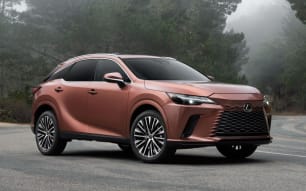
Honestly, the Lexus RX looks far more powerful, and cohesive, in the metal than it does in some photos, and in the right colour (we're fond on the deep black or the copper-rose hues), it looks downright fetching.
That Predator-shaped front-end is massive, but the way the Spindle grille kind of bleeds in the body work at the nose of the vehicle is a neat trick, and the whole design ethos gives the RX a sportier, more modern, and more intimidating, energy from almost every angle.
Perhaps the most clever element though is the wave-like design piece that links the rear window with the boot, somehow managing to shrink almost-five-metre SUV (visually, at least), and leaving the RX looking more sporty than hulking.
The door handles are cool, too. They’re fixed, and you just touch them to open the door, with a similar system used once inside to get out again.
Inside, Lexus has gone for a clean, modern-feeling space, and, thankfully, there isn't a Remote Touch trackpad in sight. Instead, you can choose between two screen sizes – 9.8- or 14.0-inch – which kind of dominate the dash, while the air-con controls are digital and interactive, too.
It must be said, though, some interior treatments feel far more special than others, and while Lexus in Australia isn't spilling on specifics for our market just yet, the top-spec models will almost certainly feel more plush than the cheaper ones.
Stylistically, the big news is that the SQ8 is the second model to take up Audi’s latest exterior design language. That includes the two-dimensional Audi grille logo as well as a 'singleframe' (Audi’s own word) light bar that links the matrix headlights.
The SQ8 also gets Audi’s Sport Package as part of the price of admission, and that includes black roof rails and other touches.
Of more technical interest is the way the front of the car has been designed to aid air flow around the front wheels. Controllable flaps in the front fascia as well as underbody winglets keep the air flowing around the wheels without contributing to excess aerodynamic drag at speed.
In an engineering sense, the big news is the adoption of a three-motor layout. While some manufacturers are yet to see the value in this, having a motor on each of the rear wheels means there’s no longer a need for a rear differential.
The entire RX range now rides on Lexus' GA-K platform, which is lighter (-40kg), more rigid, and offers a lower centre of gravity (-15mm) than the model it replaces.
The RX is wider (+25mm to 1920mm), lower (-10mm to 1695mm), but no longer (still 4890mm) than the outgoing model. But Lexus has lengthened the wheelbase (+60mm to 2850mm) to earn some extra backseat space for rear riders.
And it must be said, there is lots of room for backseat riders. Sitting behind my own 175cm driving position I had more than enough knee room, and enough head room, and a general feeling of airy spaciousness.
Elsewhere you get the usual practicality perks, with two cupholders up front, two more in the pull-down seat divider that splits the rear seat, and there are two ISOFIX attachment points in the back seat, too.
Charging is handled by a four USB ports, and depending on the trim/spec balance Lexus in Australia shoots for, you should at least find vents with temp controls for backseat riders, too.
Lexus is yet to confirm the luggage space specs for the new RX, but given it’s only being offered with five seats, and that there’s been no change to the vehicle’s length, you can expect a fair bit of room for bags in its auto-opening boot.
There’s absolutely no question Audi knows a thing or two about cabin layouts and ergonomics. Like other contemporary Audis, this one features the fully customisable Virtual Cockpit with a huge range of possible displays and layouts. And again, as usual, it all works seamlessly and efficiently.
The head-up display is amazingly clear and the twin touchscreens divide the car’s tasks logically. Yes, there’s a lot going on, but compare the way the Audi applies logic to the menu strategy to the scatter-gun approach of many others, and you can see that plenty of thought has gone into this stuff.
Also, it goes without saying, of course, that there are multiple charging points as well as plenty of connectivity with good wireless connections available. That includes wireless phone changing.
The front seats are sporty but not too firm, even if they do give you a bit of a squeeze thanks to high bolsters and lots of contouring. The rear seat is likewise firm initially and is really best for two backsides thanks to the sculpting of the rear bench.
That said, it will accept a centre passenger, but that seat will be the last one occupied. Rear legroom – important in a car like this - is good, there’s enough room for your feet under the front seats and headroom, even in the allegedly racier looking Sportback, is ample if not huge.
The panoramic sunroof means there’s plenty of light to counter the dark interior colours, and the only real surprise is the amount of hard plastic on the upper part of the door trims, just below the glass. Given the acres of much plusher trim farther down the door, this seems a bit odd.
The other comment we’d make is that the SUV body simply makes more sense in terms of load carrying (569 litres plays 528) and makes more of the SUV’s claim to practicality.
The Sportback is also a bit of an acquired taste and while it’s not the first SUV-coupe mash-up we’ve seen, to many eyes, the combination never looks right. Coupe on stilts? Surely, not for everyone.
On that subject of practicality, the SQ8 bucks the trend in EVs by being able to tow up to 1800kg with a braked trailer. The factory towing pack is a $2180 option.
This is an arbitrary seven out of 10, here. Because we don't yet know how many trim levels the new RX will launch in, how much each will cost, or what you'll get for your investment.
What we do know is that the RX will launch with three powertrain options: an all-new turbocharged hybrid, a second, more conventional hybrid, and a turbo-petrol engine. There’s a plug-in hybrid version available overseas, but we ain’t getting it. Or at least, not yet.
In terms of specific trims and equipment levels, you’ll need to wait until closer to the RX’s launch in early 2023 for the full skinny. But you can expect a choice between a 9.8-inch or 14.0-inch central touchscreen with wireless Apple CarPlay and Android Auto, an eLatch door system with fixed handles that unlatch at the push of button inside and out, as well as more high-tech safety kit (thanks to Lexus Safety System 3.0) than you can shake a radar at.
None of the Q8 variants are what you’d call remotely spartan, and even the entry-level Q8 50 gets air suspension, Audi’s 'Virtual Cockpit', 20-inch alloy wheels, LED headlights, ambient interior lighting, dual-zone climate control, driver’s seat memory function, a head-up display, digital radio and a 360-degree camera.
The Q8 55 builds on that with the Sportback body (which is not available on the 50 variant) an extra 50kW of power from its twin electric motors, 21-inch alloy wheels, sports front seats and four-zone climate-control. There’s also an electrically adjustable steering column (the 50 has manual adjustment).
What makes the SQ8 the flagship car, of course, is not just more equipment (though there is plenty of that) but rather the optimised driveline with its three electric motors and 370kW output.
Beyond that, you also get a panoramic sunroof, 22-inch alloys, matrix LED headlights, heated front seats and a Bang & Olufsen premium sound system with no less than 16 speakers including 3D loud-speakers.
And because choice equals luxury, the SQ8 can be had in either of the Q8’s body styles; the station-wagon SUV or the Sportback. Neither of which run to a third row of seats.
Option packs include the 22kW charger option at $6900 and the 'Sensory Pack' which gets you headlights capable of branded projections on to your garage wall, e-tron branded puddle lights, powered, soft-close doors, heated rear-outer seats, an interior ioniser and 'fragrancer', extra dashboard leather and manual rear-window sun-shades. Yours for an extra $9600.
And if the SQ8 doesn’t look menacing enough, there’s a black exterior package at $2300 that, um, adds extra blackness.
The one option you need to think about carefully is the virtual mirror package which, at $3500, replaces the conventional mirrors with cameras that show what’s behind on panels in the top corner of the front door trims. It takes a bit of acclimatisation and revision of muscle-memory and is definitely not for everybody.
The price hike over the $140,600 entry level car is a hefty $33,000 for the SUV variant ($173,600) and a neat 40-grand for the Sportback ($180,600).
Let’s start with what we’re not getting at launch. Internationally, there's a new plug-in hybrid variant that pairs a 227kW hybrid system with a 18.1kWh lithium-ion battery for an EV driving range of more than 65kms, but fight though Lexus in Australia did, it couldn't secure the model for our market at launch. It wants it though, and badly. So watch this space.
Instead we get three options, including the RX 350h, which pairs a 2.5-litre petrol engine with Lexus' existing hybrid system to produce a total 180kW and 316Nm. It's paired with a constantly variable transmission and will be offered in two- or all-wheel drive.
There’s also a turbocharged 2.4-litre petrol engine on offer in the RX 350, good for 205kW and 430Nm, and paired with an eight speed automatic and AWD.
But the powertrain I really, really like lives in the RX 500h F Performance, and pairs a 2.4-litre turbocharged petrol engine with an electric motor up front, and a second at the rear axle, for a total of 273kW and 551Nm.
The all-new hybrid system has been designed with turbocharged engines in mind, and features a single electric motor at the front, and a bigger rear motor, with the latter able to provide real driving power to the rear tyres - and contribute to a sprint to 100km/h of just 5.9secs.
Lexus calls it an 'eAxle' motor, and it can deliver some 76kW to the rear tyres. It pairs with a 'DIRECT4' all-wheel drive system which the brand says improves "handling, controllability, and feel."
Fitting, then, that it features on the RX 500h F Performance, which also introduces a new go-fast tier for the Lexus brand (though one you can expect to see more frequently in the near future), and which sits between the existing F Sport and the top-tier, full-fat F models.
The brand says things like bigger brakes, performance components and the highest power outputs will be reserved for the F Performance models. And so it is with the RX 500h F Performance, which welcomes six-piston front brakes, adaptive variable suspension, dynamic rear steering and 21-inch wheels.
While many electric all-wheel-drive vehicles use a motor on each axle, the Audi electric 'Quattro' system here arguably goes one better with a total of three motors.
The front axle features the traditional single motor while the rear axle has two; effectively a motor on each rear wheel.
When they all chime in, they bestow the e-tron with a maximum of 370kW of power and an astonishing 973Nm of torque; more than enough to get the 2.6-tonne e-tron moving.
Enough, in fact to get the car from rest to 100km/h in a claimed 4.5 seconds and on to an electronically limited top speed of 210km/h.
A single-speed reduction transmission is fitted and drive is constantly sent to all four wheels via an electric version of Audi’s famed Quattro all-wheel-drive layout.
Suspension is by adaptive air springs and there’s adjustable (via the steering wheel paddles) regenerative braking.
Let’s start with the pure-petrol RX 350, which will sip a claimed 8.8 litres per hundred kilometres on the combined cycle, and will demand premium petrol. The RX 350h is more fuel efficient, demanding 6.4 to 6.7 litres per hundred kilometres on the combined cycle.
But the most impressive is the RX 500h, which Lexus says will need 8.2 to 8.5 litres per hundred kilometres — making it more efficient than the petrol-powered RX 350, despite producing an extra 68 kilowatts of power and 121 newton metres of torque.
Moving this much weight at such velocities and for such distances requires a big battery. In fact, Audi claims the SQ8’s battery, at 114kWh is the biggest in the business.
But, again, it needs to be, especially with the claimed energy consumption of a hefty 28.8kWh per 100km for the SUV version and 28.0kWh per 100km for the slightly slipperier Sportback.
That gives a theoretical range of 417km for the SUV and 430 for the Sportback, both of which are numbers some potential buyers won’t consider sufficient.
But those same people should consider the fact that in a mix of winding country roads and some freeway running, we were able to beat those consumption claims, recording closer to 26 or 27kWh per 100km which, if nothing else, suggests the published range figures might be somewhat closer to reality than the EV (or any other segment of the car industry) market typically gets.
The standard charger runs at 11kW but on a 10-amp household socket, home charging will be limited to 7.2kW, although an optional 22kW charger ($6900) is also available from Audi.
The DC charging is the highlight, however, and the SQ8 can cope with charging speeds of up to 170kWh, meaning it can theoretically get from 10 per cent to 80 per cent charged in about 31 minutes on a commercial charging station with enough grunt.
Right, let’s cut to the chase here. I like the way the all-new RX family drives, pretty much across the board. If that’s all the information you want or need, feel free to check out here and move on to the next sub-heading.
Still here? Ok, then let’s go a little deeper.
None of the powertrains on offer feel under-powered in the RX range, which is a good start, but they all do their jobs a little differently.
The RX 350 is probably the most familiar, with a traditional automatic and that well-known petrol-powered punch. It’s not the most powerful engine on offer here, but it’s more than enough to get the RX up and moving — but, for mine, it can feel a little thrashy (or like it’s straining a little too hard), when you really start to push it, but such is the price you pay for a four-cylinder engine pushing a large SUV.
Next up is the RX 350h, which Lexus reckons will be the best-selling model in Australia. Lexus and Toyota have been doing hybrid powertrains for some time now, and the system fitted to the new RX is predictably solid-feeling, though it too has its drawbacks – namely that the constantly variable transmission can drone on and on under constant acceleration, and even the commendably insulated cabin can’t block it out completely.
So if this is a Goldilocks’ scenario, then the just right has to be the RX 500h, which blends its powerful powertrain with a traditional-feeling automatic to deliver plenty of performance and a tight, engaging drive experience that makes it feel as though the big SUV is somehow shrinking around you from behind the wheel, courtesy of the best performance kit (brakes, adaptive suspension, etc).
But to be honest, no matter the RX, the thing that really stands out here is its on-road dynamics. The car doesn’t really wobble about, there’s not much in the way of body roll, and it feels tight and confidence inspiring, no matter the model - but especially the rear-wheel-steering equipped 500h.
The RX also does a commendable job of locking the outside world outside of the cabin. Where you want it to be a calm and sedate family hauler, it can be that. But it can also put a smile on your face on the right road, too.
And that, I think, is something to be celebrated. And also not something we’ve come to associate with Lexus over the years. But that’s now beginning to change. Long live F Sport Performance, then.
Almost a thousand Newton-metres (not to mention 370kW) infers some pretty serious performance and so it is.
When you press down on the throttle pedal, there’s an instant and somewhat furious response from the driveline. And just as the Audi’s touchscreens have been calibrated to respond on a human scale, so too have the major driving controls.
That said, while there’s more acceleration on tap than most drivers will ever have experienced, the SQ8 doesn’t move forward with quite the irresistible force the bald numbers might suggest.
And that’s purely down to the thing weighing the wrong side of 2.6 tonnes. Sure, Audi claims 4.5 seconds and that seems fairly believable, but it’s not quite as ballistic as some other current EVs.
Still, that’s hardly its mission in life, anyway. Top speed, in the interests of thermal management, has been limited to an entirely understandable – not to mention adequate - 210km/h.
But one thing all that kerb mass has (arguably) done is make the suspension work properly. Speaking purely personally, until I’d sampled the SQ8 over a variety of bitumen joins, potholes of all sizes and even clattering level-crossings, I was yet to drive a passenger car on air suspension that worked as well as the brochure claimed.
Historically, air suspension has been okay on smooth roads and even sometimes bigger lumps and bumps. But it usually fell short of expectations on small amplitude, high frequency stuff that made the suspension judder and stutter. Not this Audi.
Even on the 'Dynamic' setting, the ride never falls beyond plush although you will notice a little more stiffness being dialled into it by the computer.
The best advice is to leave it in the 'Comfort' setting where there’s still lots of roll and pitch control, yet an even higher degree of suppleness that fundamentally refuses to be beaten by a lack of post-Covid road maintenance. And this from a car that rides on 22-inch wheels and tyres.
Perhaps compressed air doesn’t scale in a linear manner, making the addition of a couple of tonnes of sprung mass a positive, rather than a negative.
The other thing Audi has done well to maintain is that almost indefinable corporate steering response.
It’s kind of muted this time around in terms of its ability to talk to you, but there’s still an over-arching Audi-ness to it with an instant pointiness without the frenetic feel often associated with a quick ratio and sticky tyres.
The Lexus RX welcomes the brand's Lexus Safety System 3.0 setup, which means more high-tech kit than you can shake a radar at.
What appears where on the Australian lineup remains to be seen, but internationally the RX will offer things like Advanced Park, remote parking from your smart phone, Safe Exit Assist that will actually prevent you opening the doors should the cameras detect pedestrians or cyclists, and Pre-Crash Safety, which scans intersections for bikes, people or cars, and activate alarms and the brakes should it sense a collision.
That, and things like Front Cross-Traffic Alert, active cruise, Lane Departure Warning and Lane Tracing Assist, road-sign recognition and Lane Change Assist, should see Lexus shooting for a five-star ANCAP safety rating.
Like any modern, high-end SUV, the Audi is dripping with safety gear, both passive and the latest active driver aids.
Autonomous Emergency Braking is included, of course, but goes a bit further with pedestrian and cyclist detection. There’s also adaptive cruise-control with a speed limiter and the Audi offers assistance rather than just a passive warning with traffic-jam assist, collision avoidance assist, turn assist, exit assist, intersection assist, rear-cross traffic assist and lane-change warning and assist.
There are also front and rear parking sensors combined with a 360-degree camera system which includes a kerb view function for tight parking spots.
Given the bulk of the e-tron, that might be a pretty handy addition. A tyre-pressure monitoring system is also a great standard feature.
The SQ8 hasn’t been locally crash-tested but has scored a maximum five stars in European testing.
What’s missing? Probably only a central airbag to prevent front-seat head clashes in the case of a side impact.
The Lexus family is covered by a five-year, unlimited-kilometre warranty, which is about bang-on in the premium-vehicle space.
While servicing details are yet to be confirmed, the previous RX required a trip to the service centre every 12 months or 15,000kms, and it will fall under the brand’s capped-price servicing program, and the Lexus Encore program, which offers all sorts of perks to owners.
Audi’s factory warranty is a good, but no longer remarkable five-year/unlimited warranty on most of the SQ8.
The exception is the battery which is covered by a six-year/160,000km warranty. Audi will also come to your home and connect the standard 10-amp charger and there’s an Origin Energy green power offer that comes with it.
Charging is taken care of for the first six years with a Chargefox subscription as well as Audi Connect. You’ll also get six years of free roadside assistance and the first six years of standard servicing are also included.
The SQ8 also makes good on the EV promise of less maintenance with service intervals every two years or 30,000km, whichever comes first.