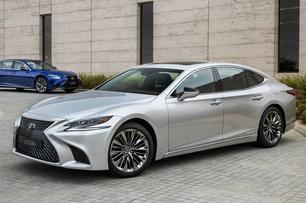
What's the difference?
Lexus is returning to its roots and playing to traditional strengths with the 2021 LS update, as the Japanese luxury brand braces itself for the imminent release of an all-new Mercedes-Benz S-Class.
On sale now from $195,953 before on-road costs, the facelift ushers in a raft of comfort, refinement, driveability and technological upgrades, striving to deliver the quietest and most luxurious experience in the upper luxury sedan segment.
The blink-and-you'll-miss-it makeover runs to redesigned headlights, wheels, bumpers and tail-light lenses, as well as the inevitable multimedia screen update, improved seating revised trim and better safety.
Along with an all-in equipment list and unparalleled levels of ownership benefits, the goal is to emulate the dramatic differences that existed between the LS and its mostly German competition more than 30 years ago, which helped make Lexus a disruptor, decades before the term was even coined.
The MY21 range will continue offering two grades – the racier F Sport and opulent Sports Luxury – in either V6 twin-turbo petrol LS 500 or V6 petrol-electric hybrid LS 500h powertrain choices, as per the XF50-generation's Australian debut back in late 2017.
The question is: has Lexus gone far enough with its limousine flagship?
In light of the large volume of dirt-road-friendly camper-trailers being seen on bush tracks of late you’d be safe in assuming that they are the flavor of the month.
Sure, lots of people buy into the idea of the off-road-camping lifestyle and may get a surprise when faced with the reality of it, but the number of those who swiftly grow to love the camper-trailer way, far out-weigh the number of those who don’t.
We took a Hawk Outback into the bush to check it out.
One might be surprised to learn that, without having driven the latest S-Class, rival large luxury sedans have struggled to juggle comfort and refinement with agility and speed. Even in this modern age of adaptive dampers and air suspension. The Germans, in particular, seem to struggle at times.
The latest Lexus LS, however, walks the line with impressive confidence and poise, prioritising the former yet without dropping the ball with the latter. Just keep in mind that the 500h Sports Luxury manages the balance best.
The bar may just about be raised with the bestselling Stuttgart's arrival from March, but even then, with its extensive and complete specification, outstanding hybrid efficiency/performance combination and remarkable build quality and presentation, Japan's master luxury sedan deserves to find more buyers in this country.
Well done, Lexus.
The Jayco Hawk Outback is a solid, feature-packed camper-trailer without being flash about it. It looks good – checker plate is always a nice touch – and it is easy to tow and set up. Sure, it may not be as gung-ho an off-road unit as its name suggests, but it is more than capable of handling gravel or dirt tracks on the way to your campsite and will be a comfortable camper when you actually arrive there.
This is more like it.
While nowhere near the apex of striking interior design, with a dashboard that – again – is quite clearly from the contemporary Toyota way of thinking, the LS is massive inside, heaving with standard luxury and obsessively crafted in a few key touchpoint areas.
The brand makes a big noise about the floating door-sited armrests and their very obviously expensive craftspersonship, but it is eye-catching and satisfying to drink in the detailing, extending in and around into the dash seamlessly, carrying on the flowing, salubrious themes of sculptured multi-dimensional shapes. In 1989 journos were handing out similar platitudes in the original LS.
If the techno-overload of a Mercedes MBUX or Tesla's OTT tablet leave you cold, this enhances the luxury experience by adding a rich, cosy, warm ambience – though the instrumentation binnacle is familiar; all we can see is the first IS 250 of 1999, complete with its single, watch-face inspired analogue dial.
Here, of course, it's digitised and multi-configurable to accommodate sat-nav, multimedia and other vehicle-related needs, but it is a oddly nostalgic, given the brand's first BMW 3 Series rival is now almost forgotten. Still, it's interesting and isn't that what eccentric rich people who don't want to drive the cliché luxury behemoths desire?
With endless adjustability, the seats are sumptuous to the point of subsuming, in the way you'd imagine a limousine to be, but because of their bolstered support, they also can be manipulated into gently cupping you enough to stop you sliding about when throwing the Lexus about with gay abandon – more on that later on.
It doesn't need mentioning that the fit and finish is fabulous, with the enveloping luxury continuing out in the back seat. The Sport Luxury's airline-style recliners are enough to turn doubters into doe-eyed believers, with their restful, relaxing, relieving, refreshing and revitalising ways – well, to an extent that an airport massage-chair minus the coin box and dodgy stains can, in any case. But the fact remains: ensconced deep into that leather-lined luxury, slumber beckons. Namaste!
And that's the point of LS. It creates a sanctuary from the outside elements at least as effectively as Audi A8s, BMW 7s and Merc S' have costing upwards of 50 per cent more. The cabin is spacious, soothing and secure. On our extended drive of both 500 models, this was made abundantly clear with two stints behind the wheel of the visually similar ES 300h.
Quiet and refined, that car felt loud and coarse compared to the smooth silence of its supersized sibling. Mission accomplished, Lexus.
Jayco camper-trailers have a nice touring-friendly floor-plan but where the Hawk Outback deviates from the line-up norm is that its kitchen is positioned to the left of the door as you step inside, rather than in front and to the right of you as you step inside on other models.
The interior height tops out at 2070mm high – pretty standard for these campers – and inside is roomy enough not to feel like a confined space, although it will get squeezy if all four adults and two kids are in here and milling about at the same time.
Looking from the door, to the left is the four-burner stove, then, as you look to the front, the extended lift-up bed and storage, and, swiveling to your right, the Dometic 95-litre fridge (Touring models get the 90-litre fridge), then stainless-steel sink, dinette seat, table, club lounge, double bed, then TV cabinet.
Drawers are all Ezi glide pull-out style. The pop-in/pop-out button on each handle – to lock it in place and unlock it – is generally a good system but can be prone to becoming fiddly, even sticking. This is a minor problem and can be found in many campers with a similar mechanism on their drawers.
Interior lighting includes overhead LEDs for the main area and reading lights for the beds. There’s a fan for the beds.
No matter what it says on the badge, the LS is first and foremost a large, heavy and imposing luxury sedan. Its sporting capabilities are relative.
Keeping that in mind, the updates for the MY21 version are a success, since the largest Lexus passenger car is uncannily quiet and refined, as you might hope and expect. The ride quality is largely cushioned and free of bump intrusion inside, with a sense of gliding over most road surfaces as if they were blemish-free.
We much prefer the Sport Luxury version, and the 500h in particular, because it can run silently in electric mode for periods, and somehow feels more lavish and plusher to ride in.
Whether that's psychosomatic or actual is debatable, for essentially both the 500 and Hybrid share the same multi-link front and rear platform, adaptive dampers and rear air suspension set-up, but the impression is that this grade is the choice for those wanting to feel ultimate luxury and peace.
On paper, the 500 F Sport should be the driver's choice, since it has the racier look and set-up, as well as 600Nm of tree-trunk-pulling torque.
The thing is, it doesn't necessarily feel all that athletic, and maybe that's because the whole existence of this model is based around isolating its occupants as comfortably as possible. This is no criticism, and the LS certainly envelopes everybody as a great limo ought to, but don't expect Audi S8 levels of steering crispness or handling agility.
Anyway, if you need to feel as if you are a princess in exile escaping villains with bazookas out the back of a Kombi, then the LS does an exceptional job in keeping the 2.3-tonne-plus mass in motion, cornering safely and precisely where it is pointed to, without losing too much composure or traction in tight, fast bends. This is quite a feat, really, for the big Lexus can be hurried along a mountain pass through narrow passages like a much smaller sedan, and without being bumped out of line or off course.
Again, for all-out performance, the 500h feels stronger, especially when called on to pull ahead instantly at speed, because the electric assistance is palpable compared to the regular 500's twin-turbo V6. Both are obviously very, very fast and sufficiently responsive to throttle inputs – and it's a sign of the brand's engineering prowess that their internal serenity means the speed isn't obvious until you're looking at the speedo – but there isn't even a whiff of lag in the Hybrid. That said, once on the go, that twin-turbo V6 in the 500 soars.
Considered in this context, you have to say that the MY21 LS is an exceptionally sumptuous and sophisticated limousine with the speed, safety, security and capability of taking you from point A to B without drama or noise.
Or, for that matter, excitement.
Because of its compact size – especially relative to caravans which are, by their very nature, generally bigger and bulkier than camper-trailers – the Hawk Outback is a very easy thing tow as it sits low and stable on all surfaces and well within the confines of even narrower bush tracks.
The single-axle camper – 5060mm long (including drawbar), 1910mm high, 2240mm wide, and with a 1285kg tare weight – hardly registered behind our tow vehicle, a 2019 Ford Everest, with the new 2.0-litre four-cylinder bi-turbo-diesel engine (157kW/500Nm).
It always felt secure on the towball (with a 145kg download) during highway, gravel track and undulating dirt-road driving.
The Hawk Outback, like other Outbacks, has a hot dip galvanised Endurance chassis on Jayco’s JTech coil-spring suspension set-up. (Note: Jayco’s Outback models are designed and engineered for, at worst, dirt roads and gravel roads, not 4WD tracks. They are not built for hard-core off-roading.)
Another bonus: visibility is clear and open along both of its sides and even over the top – no need for towing mirrors here.