What's the difference?
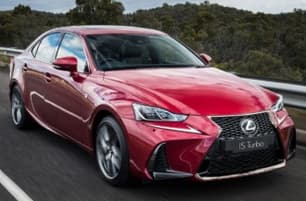
Peter Anderson road tests and reviews the new Lexus IS200t F Sport with specs, fuel consumption and verdict.
Long ago, the Lexus IS overtook the LS as the most recognisable Lexus on the road. With strong, angular styling, sharp pricing and spec against the Germans, and a 2.0-litre straight six engine, it seems like Lexus sold a million of them and only one of them has broken down irretrievably and is now being used to prop up the Harbour Bridge, such was its solid build quality.
Hell, Lexus was even able to hide for a while that it was a rebadged Japanese Toyota Altezza, partly because Toyota didn't do funky rear-wheel drive sedans outside of Japan. The IS took the brand into many more homes than the ES or GS could ever hope to because it looked like it was a Lexus.
We're now three generations and one facelift into the IS and the big selling IS250 is no more, replaced some time ago by a 2.0-litre turbo four and renamed IS200t. You can now get an F Sport version, too, just like you can buy an Audi with S Line or a BMW with M Sport.
That turbo engine hopefully addresses one of the problems with the entry-level IS sedan - it was always a little on the slow side...
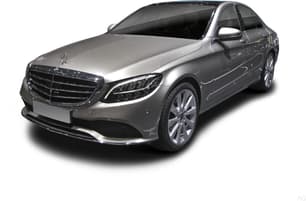
Do you know how many bones you have in your body? Stop counting, there are 207. And if say half those bones were replaced with different ones would you consider yourself to still be the same? Well that’s what Benz has done with the new C-Class – sort of. Of the roughly 13,000 parts which make up a C-Class car, 6500 of them have been modified or changed.
You don’t need to know every change to the new C-Class, but at the end of this review you will be across the differences that you can see, feel and hear.
Just a note before we start. The top-of-the-range Mercedes-AMG C63 S arrives in early 2019 and wasn’t available to drive at the Australian C-Class launch. That’s why we’ll focus on the other grades here - the C 200, C 220 d, C 300 and C 43. We’ll test drive and review the Australian C 63 S when it arrives – promise.
The Lexus range comes with a four year/100,000km warranty with roadside assist for the duration. Servicing is every 15,000km or twelve months, whichever comes first.
Sadly, there's no fixed or capped-price servicing regime, not even a pre-pay option like the stingy Germans. Lexus will only commit to indicative pricing, although the first service at 15,000km is priced keenly - it's free.
When you buy a Lexus, they don't like to let go of you. My father-in-law's original IS 200 is still fetched by the dealership - should he so desire - for its annual service. If he chooses to darken the dealership door himself, he'll drive out in a loan car. Nobody has ever stalked him at the dealership demanding he consider a new one.
The IS200t seems the pick of the IS bunch, despite pricing on par with a couple of the IS350s. It's a worthy alternative to the usual suspects, with its own look, feel and approach to luxury motoring. In fact, it's far more a luxury car than sports sedan, but manages to do both well. In the end, a BMW will edge it for handling and overall chassis grace, the Merc has that badge and the Audi is all-wheel drive and bang-up-to-date.
But none of them can touch the Lexus for after-sales service nor are any of them quite as well put together as the Japanese-built IS. It may not be as fast or as fun, but it's very, very good.
This may well be just an update to the C-Class, but the changes made are significant in terms of technology and performance, and you’re paying hardly any extra money for it. A good all-rounder for dynamics, features, refinement and value.
The sweet spot in the range has to be the C 300. It’s less than $10K more than the entry grade C200, but gets a powerful 2.0-litre engine, leather seats, the extra advanced safety equipment, tinted windows and convenience features such as a power tailgate (on the wagon) and proximity unlocking.