What's the difference?
Ah, yes, the Lexus GS. Toyota's luxury off-shoot had high hopes for the new big boy when I first saw it a few years ago. Not thousands-of-sales high hopes, but the company thought a rear-wheel drive luxury sedan stacked with gear you didn't even know you wanted would be a dead-set winner.
And to be fair, they were right. I ran a GS as a long-termer and it was impeccably-mannered. In hybrid form. It wasn't sparkling, but my goodness, it used barely any fuel; especially impressive given its size.
As the sun is surely setting on the GS, it's time to have a look and see if it's a match for the BMW 5 Series or the Mercedes E.
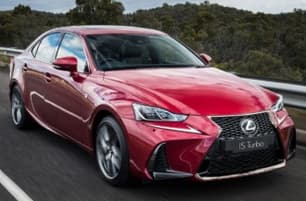
Peter Anderson road tests and reviews the new Lexus IS200t F Sport with specs, fuel consumption and verdict.
Long ago, the Lexus IS overtook the LS as the most recognisable Lexus on the road. With strong, angular styling, sharp pricing and spec against the Germans, and a 2.0-litre straight six engine, it seems like Lexus sold a million of them and only one of them has broken down irretrievably and is now being used to prop up the Harbour Bridge, such was its solid build quality.
Hell, Lexus was even able to hide for a while that it was a rebadged Japanese Toyota Altezza, partly because Toyota didn't do funky rear-wheel drive sedans outside of Japan. The IS took the brand into many more homes than the ES or GS could ever hope to because it looked like it was a Lexus.
We're now three generations and one facelift into the IS and the big selling IS250 is no more, replaced some time ago by a 2.0-litre turbo four and renamed IS200t. You can now get an F Sport version, too, just like you can buy an Audi with S Line or a BMW with M Sport.
That turbo engine hopefully addresses one of the problems with the entry-level IS sedan - it was always a little on the slow side...
Weirdly, given all the good things I've had to say about the GS F Sport, it doesn't quite hang together. It's missing that certain something the Europeans have in their chassis, particularly the BMW 5 Series, and with ageing interior tech, it's struggling to keep up.
It's a car built for specific tastes, and they're more California than Straya. And that's perfectly okay, but unfortunately, that doesn't translate to a stampede of buyers. Having said that, none of its German rivals (or its beleaguered Japanese counterpart, Infiniti) could claim wild sales success either.
The GS is a terrific car, underrated but also just not quite there for my taste. The GS F, though, that's another thing altogether.
The Lexus range comes with a four year/100,000km warranty with roadside assist for the duration. Servicing is every 15,000km or twelve months, whichever comes first.
Sadly, there's no fixed or capped-price servicing regime, not even a pre-pay option like the stingy Germans. Lexus will only commit to indicative pricing, although the first service at 15,000km is priced keenly - it's free.
When you buy a Lexus, they don't like to let go of you. My father-in-law's original IS 200 is still fetched by the dealership - should he so desire - for its annual service. If he chooses to darken the dealership door himself, he'll drive out in a loan car. Nobody has ever stalked him at the dealership demanding he consider a new one.
The IS200t seems the pick of the IS bunch, despite pricing on par with a couple of the IS350s. It's a worthy alternative to the usual suspects, with its own look, feel and approach to luxury motoring. In fact, it's far more a luxury car than sports sedan, but manages to do both well. In the end, a BMW will edge it for handling and overall chassis grace, the Merc has that badge and the Audi is all-wheel drive and bang-up-to-date.
But none of them can touch the Lexus for after-sales service nor are any of them quite as well put together as the Japanese-built IS. It may not be as fast or as fun, but it's very, very good.