What's the difference?
This is actually the Carnival that Kia always wanted.
See, the last Carnival, the one this replaces, was Covid compromised, missing out on key technologies, as well as skipping an in-depth ride and handling localisation program, due to part supply issues and a freeze on international travel.
This one, though, addresses all of that, which is why you get a new cabin experience, new tech, and a complete overhaul of the steering and handling.
It is, however, significantly more expensive, right across the range.
So, is the Carnival still worth it? Let’s find out.
Even though it’s expected to be superseded by a sixth-generation model next year, we're reviewing the fifth-gen Toyota RAV4 Hybrid Cruiser 2WD model to see if its hybrid powertrain and features still secures its position as top-selling medium SUV for families.
Aussies love mid-size SUVs in part because they're a tad more practical than their larger cousins, especially in the city.
You also have a better chance of fitting one inside your garage (unless you use your garage for storage, like me).
Ok, here's the rub. Everything you just read could well be pointless. You like the Carnival. In fact, it sometimes makes up close to 90 per cent of the sales in its segment, and outsells all of its competitors combined.
So whether I like it or not, I suspect you'll be buying one anyway.
But I can say this - the new Carnival improves the formula right across the board. Well, everything except for price.
The Toyota RAV4 Cruiser Hybrid 2WD model reaffirms why the RAV4 is so popular in Australia. It offers families space, convenience and features in a well-priced and handsome package. The cabin noise might be an ick for some but for everything else this model offers it could be overlooked.
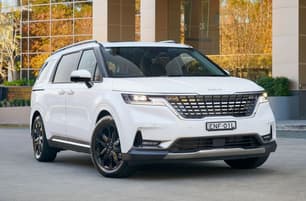
Surely the greatest trick the Carnival pulls off, and it does so convincingly, is that it manages to make something so quintessentially uncool, the people-mover, and make it look good. Somehow sporty, even.
I like the Carnival's big, bold and blacked-out front end of the GT-Line, and with its two-tone 19-inch alloys, wide stance and low ride height, it looks almost like some mad attempt at a JDM tune car, rather than a sensible people mover.
Elsewhere, the boxy profile, the sharp body creases and the third-row compartment that kind of juts over the rear tyres like a house that's been extended all somehow work, and give the Carnival far more street cred than you might expect.
Inside, we spent time only in the flagship GT-Line and its GT-Line Lite sibling, and both present as calming, comfortable spaces, and Kia's minimalist approach to combining the climate and audio controls into a single strip (it's functionality can be changed by pushing a button) helps keep the cabin fuss free.
The tech in the top-spec models feels modern and on-point, too, and the materials are all nice under the touch. Be warned though, the cabin plastics get progressively worse the further back you sit, and the third row is cocooned by hard and scratchy plastics.
In anticipation of the next-gen model, there hasn't been any design changes for the RAV4 - it remains a good-looking family SUV despite being a little heavy-handed with its angles.
Some external design highlights include garage friendly dimensions and a host of black accents across the body, including 18-inch alloy wheels that help to create an edgy kerb-side appeal.
Head inside and the RAV4 Cruiser offers a premium cabin-feel with its leather upholstery and large tech screens that headline the dashboard.
As always, there is a sense that design is based on functionality rather than style, which is typical of Toyota, but the simplicity makes the cabin relaxing to be in.
You’re not overwhelmed by touchpads or gadgets as can be the case in other new cars and there is a certain charm about that.
The Carnival measures 5115mm in length, 1995mm in width and 1775mm in height, and it rides on a sizeable 3092mm wheelbase.
And those mini-van dimensions have a predictably positive impact on luggage space, with room growing from 627 litres with all seating rows in place, to a massive 2827 litres with the third row stowed.
The key practicality perk here, though, is space, and lots of it. At 175cm, there was ample room for me in the middle row, and you can configure the cabin to your liking, too. You can slide the row on rails, for example, to prioritise leg room where you need it, and the middle seat folds down to reveal cupholders in a kind of hard plastic travel tray.
But even in the third row I could easily get comfortable, though head room begins to get a little tighter. There are cupholders and USB connection points, too, and I can honestly say you could send full-size humans back there and not feel overly guilty about it.
The Carnival will tow 2000kgs braked, too.
The RAV4 continues to impress with its practicality.
Access and comfort for both rows is excellent. The heat and cool functions for the front seats are perfect for all seasons and the two-position memory function on the driver’s side is handy if you often share driving duties with your partner.
The rear row seating is well-padded and middle seaters will love the legroom the lower transmission tunnel offers. Head- and legroom is good in both rows, even for taller adults.
Amenities and storage are also great throughout the car.
Front rowers enjoy a decently sized middle console which I can squeeze my small handbag into, a glove box, two cupholders, two drink bottle holders, a phone tray and two shelves in the dashboard. You also get a sunglasses holder!
In the rear you get a single map pocket, two cupholders and two drink bottle holders, which is enough for my little family of three.
In terms of technology, you get a bunch and the usability is great.
The 10.5-inch touchscreen multimedia system looks really nice and is now the same system that Lexus uses, which is a big plus as it’s much easier to use than the previous Toyota one. The next-gen model should see this upgraded to a 12.3-inch system, which is more in line with its rivals.
You also get built-in satellite navigation, wireless Apple CarPlay and wired Android Auto. CarPlay maintains a strong connection.
There's a multitude of charging options throughout, including a USB-A port, four USB-C ports, a 12-volt socket and a wireless charging pad.
Rounding out the cabin is a boot that offers plenty of space with its 580L capacity and you get a temporary spare tyre, as well as, a retractable cargo cover.
However, the quality of the cargo cover isn't the best and it would be easier to use if it had a handle to grip onto.
The Cruiser model comes with a powered tailgate, which is always handy but the 'warning' alert as it opens or descends is very loud. Truck-reversing-beeping loud. Everyone will know when you open the boot!
Bad news first. The price is higher this time around, right across the five-trim line-up, with the prices up between around $2600 and $5300, depending on which trim level you’re shopping for.
Prices start at $50,150 for the entry-level S petrol, and climb to $72,910 for the top-spec GT-Line diesel. There’s also a GT-Line Hybrid, which tops the group at $76,210, but it’s not here yet, so we’ll cross that electrified bridge when we get to it and stick with the ICE range for now.
The range opens with the S ($50,150 petrol, $52,380 diesel), which scores 17-inch alloys, LED headlights and DRLs, heated mirrors, cloth seats, an electronic parking brake, and a smart key with push-button start, which is new for this update.
On the tech front, there is a new integrated 4.0-inch driver display, and a new 12.3-inch central screen with Apple CarPlay and Android Auto, linking with an eight-speaker sound system, now with a surround-sound function.
Stepping up to the Sport ($56,050 petrol, $58,280 diesel) adds 18-inch alloys, rear LED combination lamps, a leather steering wheel and shifter, and dual-zone climate up front with single-zone temperature control in the second row. New for this update is a wireless charging pad and artificial leather seats.
Next is the Sport+ ($62,380 petrol, $64,610 diesel), which gets a whole host of new safety equipment, which we will come back to in a moment, along with a powered tailgate, automatic sliding doors and auto windows, and heated seats in the first and second rows. It also ups the tech, with twin 12.3-inch screens taking care of multimedia and driving info duties.
Then comes the GT-Line Lite ($66,350 petrol, $68,580 diesel), which is fitted with bigger 19-inch alloy wheels, scores LED interior lighting, gets a dual-pane auto sunroof and some chrome embellishments on the exterior. The trade-off, though is that the powered windows are now for the driver only, as is the powered front seat.
Finally, there’s the flagship GT-Line ($70,680 petrol, $72,910 diesel), which nabs dual-projection headlights, a heated steering wheel, a 12-speaker BOSE sound system, ventilated seats up front, a big head-up display and a digital rear-view mirror, along with a slightly better interior treatment and the return of the auto window and powered seat to the passenger side of the car.
The model line-up for the RAV4 consists of five variants with each available in front- or all-wheel drive.
The model on test for this review is the Hybrid Cruiser 2WD, which sits second-from-the-top in the line-up and is priced from $51,410 MSRP.
This price tag nudges it to the top of its rivals, the GWM Haval H6 Ultra Hybrid ($45,990 MSRP) and Nissan X-Trail e-Power ST-L ($50,490 MSRP) but the standard equipment for the Cruiser highlights its overall good value.
Premium features include leather-appointed upholstery, electric front seats with heat and ventilation functions, two-position memory function for the driver's seat, a sunroof and carpet mats.
Technology has had a good look in recently with the 10.5-inch touchscreen multimedia system now powered by the Lexus system (much easier to use) and a customisable 12.3-inch digital instrument cluster.
Other tech includes built-in satellite navigation, a nine-speaker JBL sound system, USB-A port, four USB-C ports, a 12-volt socket, a wireless charging pad, digital radio, digital rear view mirror, and a 'Toyota Connect' app with over-the-air updates.
Practical items include keyless entry and start, rain-sensing wipers, dusk-sensing LED headlights, dual-zone climate control, a powered tailgate and directional air-vents in the rear.
For the grade level and compared to its rivals, the Cruiser more than holds its own.
There are two ICE options on the table here. The first is what I reckon is the lesser of the two, a 3.5-litre petrol V6, producing a rev-happy 216kW and 355Nm.
The better option, I think, is the 2.2-litre, four-cylinder diesel, which makes 148kW and 440Nm, and just suits the nature of the car a little better.
Both pair with an eight-speed automatic, and send their power to the front tyres.
All RAV4 models have a continuously variable automatic transmission and the same hybrid combination of a 2.5L four-cylinder petrol engine and electric motor which combine to produce up to 160kW of power and 221Nm of torque for front-wheel-drive models.
The combo delivers decent power for an SUV of this size.
The petrol engine will sip a claimed 9.6 litres per hundred kilometres on the combined cycle, and produce 220g per kilometre of C02. The diesel lowers both those numbers, to 6.5 litres and 170 grams.
Both models are fitted with a 72-litre fuel tank, which means you’ll be sailing well north of $100 to fill one up.
The Toyota hybrid powertrain produces the lowest official combined fuel cycle figure compared to its rivals at just 4.7L/100km and the best theoretical driving range of up to 1170km courtesy of its 55L fuel tank.
After covering a mix of open-road and urban driving this week, the on-test figure is 5.5L/100km, which proves Toyota does hybrids well.
Forgive the horrific paraphrasing, but it seems rumours of the death of diesel have been greatly exaggerated, at least when it comes to the Kia Carnival.
Get this – diesel sales make up some 90 per cent of the Carnival's total haul, with petrol providing a pittance towards the sales total, presumably being picked up by fleet buyers.
And to be honest, that means nine out of 10 people are making the right choice here. Yes, the petrol makes more power, but it's the torque on offer from the diesel that makes pushing the Carnival around feel far more effortless.
The petrol engine can definitely get you moving, but it feels a bit too rev-happy and thrashy when you really put your foot down, and its significantly thirstier to boot.
The diesel isn't perfect – the thrum of the engine is a constant companion whenever you put your foot down, and there's actually too much torque on offer at times, like if you're accelerating up hill from a standstill on a damp road, and so the front tyres can scrabble and scramble for grip.
But it otherwise so perfectly suits the nature of the Carnival that it is definitely the best and most satisfying choice.
Another big change for this update is the fact that Kia's complete ride and handling program has been rolled out here. Kia says local work done on the outgoing car, the one this replaces, was curtailed by Covid and bushfires, and so ended up being done by correspondence.
This one, though, has had the whole enchilada thrown at it, and it shows. They've succeeded in making a bigger car feel smaller around you. It's not a sports car by any measure, but nor does it ever feel too big and unwieldily.
Part of that is down to the steering, which is direct and confidence inspiring, but mostly I suspect it's because of the ride, which is firmer than you might expect in a family hauler, but also offers a connection to that road below that makes you feel in control.
Whether a firm-ish ride is a perk or negative is up to you, but it definitely works for me.
The RAV4 Hybrid Cruiser 2WD is stupidly easy to drive which is one of its best qualities.
The driver is front and centre for design, so you don’t have to take your eyes off the road to twiddle with climate controls or changing your music. That makes the driving feel… well, cruisy.
Power delivery is mostly smooth and offers decent punch when you need to put your foot down. However, it can be laggy off the mark from a cold-start, so take care when crossing traffic.
Suspension feels well-tuned for our Aussie roads, even the regional ones, but never feels floaty. This is well-grounded but you do get some roll in corners.
A drawback is the cabin is annoyingly loud once you hit the open-road and there is a wind-whistle near the driver that drove me nuts.
There are also a lot of squeaky/rubbing noises when you hit bumpy roads. However, it is a refined experience around town, when engine noise is all but nil. The urban environment is where it shines.
The steering is direct with a tight 11.4m turning circle, which makes the RAV4 easy to park. It also helps that the 360-degree view camera set-up is top-notch, which is not always the case for Toyota, and you get front and rear parking sensors too.
Part of the change package for this updated Carnival is in its safety kit, some of which simply wasn’t available when Kia launched its predecessor.
Which is why every model now gets a centre side airbag, 'Forward Collision Assist AEB', 'Rear Occupant Alert', 'Trailer Stability Assist' and front parking sensors, joining the rear ones that were already there.
Sport+ Models and up now add a 'Blind Spot View Monitor' and rain-sensing wipers, as well as rear AEB through the 'Parking Collision Avoidance' function.
I have to say, though, when your entry-level car is $50k-plus, there’s no real excuse for limiting the best safety kit to the upper-spec models.
Also standard are lane keep assist, with 'Lane Follow Assist', multi-collision braking, a speed-limit warning (which you will turn off) and a reversing camera.
The Carnival range carries a five-star ANCAP safety rating, which it earned in 2021.
The RAV4 has a maximum five-star ANCAP rating from testing done in 2019 and has seven-airbags but doesn’t have a front-centre airbag yet.
It has high individual scores for protection, scoring 93 per cent for adult, 89 per cent for child, 85 per cent for vulnerable road-user, and 83 per cent for its safety assist systems.
The RAV4 has AEB with car, pedestrian and cyclist functions, operational from 10-80km/h (180km/h for car) but it is usual to see the system operational from 5.0km/h.
Standard crash-avoidance safety kit includes blind-spot monitoring, an SOS call button, emergency steering assist, driver attention alert, a rear occupant alert, rear and forward collision warning, rear cross-traffic alert and lane departure alert.
There's also lane keeping aid, traffic sign recognition, an intelligent seatbelt warning, adaptive cruise control with stop/go functionality, a 360-degree view camera system as well as front and rear parking sensors.
You also get a digital rear view mirror, which is great when you have compromised vision out the back window.
There are ISOFIX child seat mounts and three top tethers in the rear row. You might be able to get three seats across but two will fit best.
Like all Kias, the Carnival arrives with a seven-year, unlimited-kilometre warranty, with capped-price servicing throughout.
Kia’s servicing costs are higher than some of its competitors, though, so you might want to compare them, as well as compare what’s included, and the diesel model will usually cost slightly more to maintain than the petrol version.
Service intervals are every 12 months or 15,000kms, and while the brand is still finalising the petrol servicing costs, the diesel prices are $386, $682, $480, $869, $434, $845 and $461, covering the first seven years of ownership.
The RAV4 is offered with a five-year/unlimited km warranty, but you add two more years if you service exclusively with Toyota and on schedule.
There is a five-year capped-priced servicing program and it costs just $260 per service, which is very competitive for the class.
Servicing intervals are reasonable at every 12-months or 15,000km whichever occurs first.