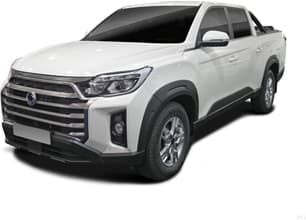
What's the difference?
What new 4x4 dual-cab ute can you buy for $50K these days? Well, if you want to stick with the major players, $50K will only get you into base-model workhorses like the Ford Ranger XL 2.0L auto ($50,880), Toyota HiLux Workmate 2.4L auto ($50,420) or Isuzu D-Max SX ($50,700). And that's list pricing before on-road costs.
However, if you’re prepared to try something different, the same money can let you drive away in the top-shelf model of KGM SsangYong’s MY25 Musso range, which is a 4x4 dual-cab ute that's bursting with luxurious standard equipment.
We recently spent a week behind the wheel to determine if its comparative bargain pricing does not come at the expense of quality or performance.
I couldn’t say I’m familiar with Australia’s inland deserts. I thought there were two or three - the Simpson, Gibson, maybe the Great Sandy.
But did you know there are 10? And Volkswagen knows each intimately thanks to a recent Guinness world record verified crossing of them all… in one go.
It took a tweaked-up Amarok six days and 17 hours if you must know, and to celebrate VW has created a limited build (300 unit) version of the dual cab ute called, you guessed it… the 10 Deserts Edition.
And we were invited to steer it on-road and over a variety of challenging (public) off-road trails around Mt Macedon and Cobaw, about an hour’s drive north-west of Melbourne.
Not quite the Strzelecki Track, but tough enough to see if this special VeeDub has what it takes to drive your off-highway ambitions. So, stay with us!
The lack of an ANCAP rating and centre rear lap-sash seatbelt may be deal-breakers for some. However, the Musso offers a tantalising menu of luxurious standard features, in a refined, comfortable and capable package backed by a generous warranty. For $50K driveaway, it represents compelling value for money.
It’s been developed with adventurous four-wheel-drive enthusiasts in mind, but we don’t know exactly what it will cost. However, given the current ballpark estimate, the value equation will likely stack up well and things like safety and the ownership package are solid. And we know it’s tough and capable in rough going, which is the main point, after all. This package works brilliantly well.
Note: CarsGuide attended this event as a guest of the manufacturer, with travel, accommodation and meals provided.
The XLV option adds 110mm to the wheelbase (3210mm) and 300mm to load tub length compared to the SWB Musso, so our test vehicle's external dimensions are about the same as a Ford Ranger dual-cab ute. Even so, its 12.2-metre turning circle is tighter than the Ford and only slightly larger than its shorter Musso sibling.
It exudes a high standard of finish and build quality throughout, including the latest lower-body-to-chassis mounts with enlarged volume and a redesigned profile which, according to SsangYong results in superior bump absorption. As a result, ride comfort has been improved.
The leather-accented interior has a refined look and feel consistent with its prestige positioning, with fine exposed stitching along seams and a tasteful mix of contrasting surfaces that include different shades of grey and splashes of piano black and satin chrome.
The Amarok is already a sleek-looking dual cab and the ‘Clear White’-only 10 Deserts Edition picks up unique black badging, a standard black tonneau cover and 17-inch satin ‘Asphalt Black’ alloy wheels shod with all-terrain rubber. More hardcore off-road tyres are a no-cost option, which is a nice touch, and there are black side steps and a ‘Asphalt Black’ mesh grille with ‘Bolder Grey’ inserts.
An ARB lift kit raises ground clearance by 40mm, from an already decent 235mm to 275mm, and ‘Genuine VW’ underbody protection is added.
The interior is cool, calm and collected in typical VW fashion with a predominantly dark grey colour palette highlighted by silver and brushed metal accents.
The 8.0-inch digital instrument display and 10.1-inch multimedia screen look contemporary without being garish, and there’s a workable mix of digital and physical controls, with climate being the former and audio the latter.
With its 2100kg kerb weight and 2980kg GVM, our test vehicle has an 880kg payload rating.
It’s also rated to tow up to 3500kg of braked trailer and with its big 6480kg GCM rating (or how much it can legally carry and tow at the same time), that means it can tow its maximum trailer weight while carrying its maximum payload.
The latter is an unusual capability for a dual-cab ute of this size, which offers great versatility for heavy load-hauling requirements in both work and recreational roles.
The longer XLV load tub has square internal dimensions of 1610mm in length and width, which combined with its 570mm depth results in 1262 litres (or more than 1.2 cubic metres) of load volume. Load-anchorage points are located at floor level in each corner.
The new assisted-tailgate operation, which SsangYong claims has a soft-opening and easy-close design, also needs some beefing-up as we found the level of assistance was not sufficient.
Cabin storage includes a single glovebox, plus small and large-bottle holders and a storage bin in each front door. The centre console has a small tray up front, two small-bottle/cup-holders in the centre and a storage box at the back with a padded lid that doubles as a comfortable driver’s elbow rest.
Rear seat passengers also get a small-bottle/cup-holder and storage bin in each door, plus two cup-holders in the fold-down centre armrest and storage pouches on each front seat backrest. The rear bench seat-base cannot be swung up and stored vertically to create more internal carrying space, like some rivals, but it does provide hidden storage underneath for soft items.
The Musso's rear doors are only 50mm shorter than the front, which ensures easy entry/exit and comfortable rear seating, even for people my height (186cm).
There are large assist handles on the A and B pillars and, when I'm seated in the second row behind the driver’s seat in my position, there’s still sufficient knee clearance and plenty of headroom.
This also applies to those seated in the slightly higher centre position, where they’ll also appreciate the minimal height of the transmission hump that allows both feet to sit together behind the centre console.
However, like all dual-cab utes short of a full-size US pick-up, shoulder room for three adults across the back seat is marginal and only tolerable for short trips.
Our only gripes are the lack of a lap-sash seatbelt for the centre rear passenger (there’s only a lap-belt), which remains a glaring safety omission that should have been addressed years ago.
At just over 5.3m long, a little more than 1.9m wide and close to 1.9m tall (with a 3270mm wheelbase) the Amarok lives within the same dimensional footprint as key competitors like the Ford Ranger, Toyota HiLux and Isuzu D-Max.
Up front, it's easy to get in and out thanks to big door apertures and this limited edition’s slightly higher ride height. There’s plenty of breathing space and good separation from your co-pilot.
In terms of storage there are door bins with room for decent size bottles, a couple of cup/bottle holders in the centre console, a lidded storage box between the seats (which doubles as a centre armrest), a wireless charging pad ahead of that, two glove boxes, a shallow well in the centre of the dashtop and a drop down sunglasses holder.
In the back, sitting behind the driver’s seat set to my 183cm position, there’s plenty of head, leg and toe room.
Three full-size adults across the second row will be okay for short to medium trips and a trio of up to late teenage kids will be fine. There are bins in the doors with room for medium-size bottles, a fold-down centre armrest with a pair of cupholders and map pockets in the front seat backs.
On the not so good side, there’s no individual ventilation control for back-seaters and the only power option is a 12-volt socket with USB-A and -C ports confined to the front only. Shout out for the USB input in the mirror housing for a dash cam, though.
The roughly 1.5m long by 1.2m wide illuminated tray will accommodate a Euro pallet between the wheel arches. There are multiple tie-down rings and tailgate closing is assisted.
Maximum towing capacity for a braked trailer is 3500kg (750kg unbraked), a full-size spare is on-board and there are two towing hooks at the front.
Our test vehicle is the Musso XLV Ultimate Luxury Pack, which comes standard with the same 2.2-litre four-cylinder turbo-diesel and six-speed automatic transmission shared by other Musso models, for only $50,500 drive-away or $49,500 drive-away for ABN holders.
Our example also has the Indian Red metallic paint option, which adds another $595 to the price.
The list of standard Ultimate features (before you add the Luxury Pack) is impressive, starting with 18-inch black alloy wheels with 255/60R18 tyres and a full-size alloy spare. There's also HID headlights, LED daytime running lights and new vertical LED front fog lights, front and rear parking sensors, 360-degree ‘birds-eye’ and reversing cameras, heated door mirrors and assisted tailgate operation.
There's more luxury in touch-sensing front door locks and a walk-up welcome system that ensures the door mirrors unfold and puddle lamps illuminate as the driver approaches with the keys. Likewise, as the driver moves away from the vehicle, the doors and tailgate lock automatically.
The Luxury Pack adds a new dual-zone climate control hub with full touchscreen control, powered sunroof and premium leather seating, with powered front buckets that offer heating/cooling and adjustable lumbar support/base cushion rake. The outer rear seating positions are also heated.
This is in addition to a height/reach-adjustable and heated leather-rimmed steering wheel with multi-function controls, 12.3-inch digital LCD driver’s instrument cluster and 12.3-inch touchscreen for the six-speaker multimedia system with Apple CarPlay/Android Auto connectivity, two USB-C ports and two 12-volt sockets. And there’s more, so you could say it’s fully loaded even before you put something in the tub.
Although it’s being cagey on exact pricing at this stage, Volkswagen says the Amarok 10 Deserts Edition will be positioned between $65 and $70K (likely closer to former than the latter).
The Amarok Life TDI500 this car is based on boasts a healthy standard equipment list including LED headlights, daytime running lights and fog lights, adaptive cruise control (with stop/go), alloy rims, a towbar, wireless charging and tailgate lift assist plus wireless Android Auto and Apple CarPlay.
There’s also six-speaker audio (with digital radio), single-zone air-con, electrically folding and heated exterior mirrors (with courtesy lamps), auto headlight and high-beam control, a leather-trimmed steering wheel and gearshift, and auto rain-sensing wipers.
Not a bad fit-out, even before adding the extra 10 Deserts kit (see Design) and that prospective price puts it between the existing Amarok TDI500 Life ($59,490) and Style $69,740), both before on-road costs, and a step up from Ford’s close to $57K limited-run (1500 unit) Ranger Black Edition.
The quiet and refined 2.2-litre inline four-cylinder turbo-diesel produces 133kW at 4000rpm and (for the XLV) 420Nm of torque between 1600-2600rpm.
The smooth-shifting Aisin six-speed torque converter automatic provides the option of sequential manual shifting, plus three drive modes comprising Eco, Power and Winter. It also has overdrive on the fifth and sixth gears for fuel-efficient highway driving.
The part-time, dual-range 4x4 drivetrain has an auto-locking rear differential that automatically locks and unlocks in response to changing traction requirements.
The record-breaking Amarok was a V6 Style, but this limited edition is based on the Amarok TDI500 Life, so a 2.0-litre turbo-diesel four-cylinder engine sits under the bonnet, sending 154kW/500Nm to the rear, or all four wheels, via a 10-speed automatic transmission.
This twin-turbo, dual-overhead cam unit is shared with the Amarok’s twin under the skin, the Ford Ranger (where it’s referred to as the ‘Bi-Turbo’), and the selectable all-wheel-drive system features three driving modes - 2H, 4H & 4L - and there’s a mechanical rear diff lock.
KGM SsangYong claims a combined average consumption of 9.0 litres per 100 kilometres and the dash readout was showing 10.1 at the end of our 317km test, which comprised the usual mix of suburban, city and highway driving.
Our own figure, calculated from fuel bowser and tripmeter readings, was higher again at 11.0 which, while not the thriftiest we've tested, is still not bad for a ute weighing more than two tonnes in mostly urban driving, of which about one third of our test distance was hauling a near-maximum payload.
So, based on our figures, you could expect a ‘real world’ driving range of around 680km from its 75-litre tank.
The TDI500’s official fuel consumption figure on the combined (urban/extra-urban) cycle is 7.2L/100km. With an 80-litre fuel tank on board, theoretical range is around 1100km.
Stop-start is standard, but we’ll have to wait for an as-tested figure, as this launch drive leant heavily into arduous off-road work.
For reference, in previous testing we’ve recorded real-world consumption closer to 10.0L/100km for this Amarok powertrain, which would deliver a driving range of around 800km.
Drivers of most heights and widths can find a comfortable driving position, thanks to a combination of multiple powered seat adjustments, a height/reach adjustable steering wheel, nicely-positioned elbow rests on either side and a large left footrest ideal for big Aussie boots.
The turbo-diesel’s 1000rpm-wide peak torque band between 1600-2600rpm, combined with well-matched ratios in the six-speed auto, ensure good response in the 40-80km/h speed range often encountered during city and suburban driving. However, we could not detect a noticeable change in response when switching between the Eco and Power drive modes.
The unladen ride quality is commendable, given its supple four-coil suspension and longer XLV wheelbase. Combined with nicely-weighted speed-sensitive steering (light at parking speeds, firmer at highway speeds) and responsive braking, it’s enjoyable to drive in urban environments.
It also has impressively low engine, tyre and wind noise, particularly at highway speeds where the refined drivetrain only needs 1700rpm to maintain 110km/h. These attributes create a pleasant cabin environment and low-stressed cruising.
We forklifted 650kg into the load tub, which with our crew of two equalled an 830kg payload that was only 50kg less than its 880kg legal limit. The rear coil springs compressed 70mm, which allowed the rear axle to engage with large cone-shaped jounce rubbers mounted on the chassis rails above it.
These rubbers not only provide a second stage of support when hauling heavy payloads, but also eliminate the jarring thuds of traditional hard-nosed rubber bump-stops when the suspension uses up all its travel.
The Musso made light work of hauling this payload up our 13 per cent gradient, 2.0km set climb at 60km/h, self-shifting back to third gear and 2500rpm to easily reach the summit.
Engine braking on the way down, in a manually selected second gear, wasn’t as strong as the auto transmission over rode our manual selection when the engine reached 3700rpm on overrun (4500rpm redline) and shifted up to third gear.
These engine-protecting measures are increasingly common in utes and vans, which can spring a surprise when you’re leaning on the engine to assist with braking on a steep descent and the auto suddenly shifts up a gear and the vehicle starts running away from you.
Even so, the Musso’s quartet of disc brakes were more than capable of keeping speeds in check for the remainder of the descent.
The Amarok TDI500 is easy and effortless to drive on the open road. Peak power of 154kW (at 3750rpm) is adequate, but it’s the 500Nm of pulling power, delivered exactly where you want it at just 1750rpm, that sets the tone.
With 10 ratios to cycle through, the auto transmission also helps keep things in the sweet spot and while you’re aware of a certain amount of diesel thrum under acceleration, in this type of ute that’s more reassuring than annoying.
Suspension is by double wishbones and coil springs at the front with leaf springs supporting a live axle at the rear. And as is typical for a ute with this set-up (particularly unladen) bumps on a typical B-road make their presence felt, but not to an alarming degree.
We drove it on loose dirt roads and some challenging trails (which we’ll get to shortly), but overall it feels capable and pretty well planted on the road.
The steering is electrically assisted and there’s a good connection between your hands on the wheel and the tyres on the road.
Standard 17-inch alloys are shod with 225x70 Continental CrossContact ATR (all-terrain) tyres and they’re civilised on the highway. Also worth noting more aggressive off-road-focused rubber is a no-cost option, which is a nice touch.
The brakes are discs front and rear, which is notable because the entry-level Amarok Core is fitted with drums at the back.
On the open-road and in slow-going off-highway, where you’re constantly feathering the brakes during steep declines, braking remains strong with a progressive pedal feel.
The off-road section of the launch drive was more about the nature of the terrain than ultra-steep inclines or declines.
Big boulders, cavernous ruts, bulging tree roots as well as loose gravel and sand surfaces were the flavours of the day and the Amarok did a great job.
Standard approach, departure and ramp-over angles for the Life TDI500 are pretty solid, but an extra 40mm of ground clearance makes a big difference.
Worth noting the 10 Deserts Edition held its own with the more heavily modified V6 Style that set the Guinness record, which we also had a chance to steer.
With around 80kg less weight on the front axle, the four-cylinder feels agile and eager in the rough stuff and we saw some impressive axle articulation as the suspension and drive systems helped the Amarok pick its way through the most difficult sections.
We stepped our way through two-wheel high, four-wheel high and 4WD low modes, pulling in the diff lock only when things got hairy.
In terms of miscellaneous observations, it’s worth noting the turning circle is 12.8m. The Amarok is a sizeable vehicle and you’d expect the turning circle to be up there, but just be prepared for a reasonably wide arc when you’re parking or making three-point turns.
And the front seats are a stand-out. They’re pretty much sports editions - grippy and comfortable even after a full day behind the wheel on- and off-road. And their lateral support keeps you nicely located in the corners.
No ANCAP rating but the active safety menu includes auto emergency braking (AEB), front collision and lane-departure warnings, trailer sway control, blind-spot monitoring, rear cross-traffic alert, front/rear parking sensors plus 360-degree/reversing cameras and more. There’s also driver and front passenger front and side (thorax) airbags plus curtain airbag protection for both rows of seating, along with three top-tethers and two ISOFIX child seat-anchorage points for the rear seat.
The Amarok was given a maximum five-star ANCAP assessment in 2022 and active (crash-avoidance) tech includes AEB (with pedestrian and cyclist monitoring), lane keeping assist and lane departure warning, adaptive cruise control (with stop and go function), rear cross-traffic alert, blind-spot monitoring, hill-descent control, tyre-pressure monitoring, driver fatigue alert, roll-over mitigation and trailer sway control.
There’s also ‘Swerve Steer Assist’, road and speed sign recognition, front and rear parking distance controls, and a reversing camera. That’s an impressive suite for the category.
If a crash is unavoidable, there are nine airbags onboard - dual front and front side, dual front knee, full-length side curtain and a front-centre bag to help reduce the chance of head clash injuries in a side-on crash. Again, above average.
The Amarok scores well with ANCAP for vulnerable road user protection, multi-collision braking minimises the chances of secondary collisions following an initial impact and there’s an auto emergency call-out function able to sense if the driver is incapacitated following an airbag deployment.
Important to note there are top tethers and ISOFIX anchors for baby capsules and/or child seats on the outer rear seat positions only.
It comes with a seven-year/unlimited kilometre warranty, which includes commercial use (which SsangYong claims is a unique offering in this segment) and seven years roadside assist.
Scheduled service intervals are 12 months/15,000km. Capped price for the first seven scheduled services up to seven years/105,000km totals $3238, or a reasonable average of $463 per year.
Volkswagen covers the Amarok with a five-year/unlimited-km warranty, which is expected in the mainstream market.
Service is recommended every 12 months/15,000km, which is pretty handy, and the price averages $360 for the first five years, which is competitive for the class and price point.
Fixed price three- or five-year plans are also offered, which brings a modest discount and locks in the pricing. Twelve months of roadside assistance is complementary, renewed for another year each time you service the car at an authorised VW dealer.