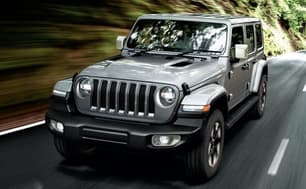
What's the difference?
The first two things any new starter who arrives in the design department of Jeep’s headquarters in Ohio is told are, 1) The bathrooms are here and, 2) Don’t change the Wrangler.
Okay, I made that up, but it’s probably not far from the truth, because the Wrangler isn’t just iconic for Jeep, but iconic for the entire car world in a similar way to the Porsche 911 and the Ford Mustang.
The Jeep Wrangler is the equivalent of a Hollywood superstar - the Clint Eastwood of the car world - with its design that stretches all the way back to the iconic little off-roader purpose-built for the US Army in World War II.
So, how do you make changes without changing the recipe? Well, the Wrangler has been updated and we went to the Aussie launch to see what’s changed.
Cub Campers is Australia’s oldest camper-trailer manufacturer and one of the oldest businesses in the caravan and camping industry, having just celebrated 50 years of operation in 2018.
The company can lay claim to inventing the soft-floor camper trailer, pioneering the rear-fold and championing off-road campers when everyone else was concerned with the on-road market. Amongst all that, though, it was late to the game when it comes to forward-fold campers, not releasing the Frontier until early in 2016, well after the flood of Chinese manufactured versions became immensely popular. So why did Cub wait so long and was it worth it?
The changes to this updated Jeep Wrangler are small but meaningful. The inclusion of airbags, the updated media screen, and a feisty engine which suits the plucky nature of this off-roader make it a better Wrangler than ever.
Note: CarsGuide attended this event as a guest of the manufacturer, with travel, accommodation and meals provided.
All in all, the Frontier is the best forward-fold camper on the market, although it is also the most expensive. If you were making a buying decision purely based on features, you’d probably look elsewhere, but if you are prepared to pay a little more because this camper-trailer is Australian made, you get a very functional camper that’s easy to set up, reliable, strong and light.
When we review most SUVs practicality is scored on things like legroom, storage space and boot size. But in the case of a vehicle with removable doors and roof, and a cabin that has one-way drainage valves so you can hose the interior out, practicality takes on a different meaning.
The Wrangler’s practicality seems focussed on serving adventurous folks in search of a muddy off-road expedition and, so, while there is storage it’s mainly nets for door pockets, moulded wells on top of the dash, and smaller hidey holes to makes sure loose items don’t get flung around the cabin.
Given the roof can be removed there’s also a lockable glove box and centre console storage box.
When it comes to cabin space the Wrangler’s interior feels a bit cramped. The footwells up front don’t offer much space and headroom throughout is restricted by the roll cage which stretches from the front to the boot.
The four-door Wrangler has five seats and good legroom in the second row, even for me at 189cm tall. As mentioned above, headroom is limited in places because of the safety structure. Boot space behind those rear seats is 898 litres.
The two-door Rubicon has four seats. The back ones aren’t the most spacious and the boot behind them is almost too small to mention at 365L, Two pieces of carry-on luggage wouldn’t fit back there and we had to put our bags on the rear seats.
The rear tailgate for all Wranglers is side-hinged (opening left to right) and splits to allow just the window section or lower part to open separately.
For charging and powering devices all Wranglers have two USB ports up front (one -A and one -C) and four USB ports in the second row (two -A and two -C). There are also two 12V outlets on board (front and rear).
There are two cupholders, seatback map nets and directional air vents for the second row.
The Wrangler sits high and climbing into the rear seats might be a challenge for smaller kids or even fully-grown humans, but there are chunky handholds at the pillars for extra help.
So, the Wrangler has excellent practicality, but this is geared more to its intended purpose of adventuring off-road rather than the city commute and school pick-up.
The real appeal of a forward-fold camper-trailer is the internal configuration. Because the bed folds out over the front of the camper, the trailer body is configured with a wrap-around lounge and dinette area, that also converts into a bed. It brings a certain level of caravan comfort to a camper-trailer-sized package. Cub’s execution is quite good. The lounge is comfortable and the dinette table is highly adjustable up and down or around and around. It converts into a bed more simply than any other on the market I’ve seen.
The downside of the forward-fold concept is the quantity and access of storage. Very little of the internal storage is easy to get to, and in truth there’s very little of it. That’s what happens when you put a couch in a trailer, sorry. There are hatches under the seats, but even they are limited by the slide-out kitchen and battery box across the back, plus, they’re not as easy to get to as a drawer. It’s the same in every manufacturers version, though. However, the Frontier has one unique features that makes it stand out – a series of pigeon holes under the foot of the bed which provide the only easy-to-access internal storage in any forward-fold I’ve come across so far.
Every one of the Jeep launches I’ve attended over the past 15 years has involved a pretty decent off-road component and it’s clear the company has a lot of faith in its product.
This Wrangler launch’s off-road test had been scaled back due to days of flooding rain beforehand, but the section that was passable was enough to remind us of what we already know and that is the Wrangler is formidable.
A Queensland bush off-road course full of steep, muddy hills, ruts, rocks, dirt and slippery descents was still all there for us to test the Wrangler Rubicon four-door.
Fun and comfortable are the first words that pop into my head when recalling how the Rubicon fares. This is a super-capable beastie that feels planted, secure and adept at all times.
We tested low- and high-range four-wheel drive, locked the rear differential and let the hill descent mode do its thing and get us down the sides of hills that felt so close to vertical all we could see through the windscreen was the ground.
What's also clear is the new turbo-petrol, four-cylinder feels well suited to the job, with plenty of torque along with a feisty and responsive nature that fits the Wrangler better than the old V6.
There was also plenty of time spent on the road in the four-door Rubicon and its smaller two-door sibling. And was here it was also super clear the Wrangler felt like we’d taken it out of its natural habitat.
At 110km/h on the motorway the two door Rubicon feels light and floaty in its suspension, with steering adjustments having to be made constantly, like actors pretending to drive cars in movies, as the Wrangler wanders around in its lane. The Wrangler wander is a known trait and isn’t specific to this updated car.
And even though our launch drive took us on some great winding country roads which would have been perfect for a Mazda MX-5, the Wranglers found the fast tight turns difficult to handle.
I’m sure I heard a sigh of relief from our Rubicon as we pulled off the road and selected low-range four-wheel drive before bouncing up what looked to be a sheer cliff, with ease.
Of course, our Adventure Expert Marcus 'Crafty' Craft will put the Wrangler though its paces once we have one in the CarsGuide garage.
The Frontier is quite good under tow. Cub designed and manufactures its own coil-spring independent suspension and has paid quite close attention to the balance and dynamics of the trailer.
As it’s not overly heavy, it’s not a handful, even on the beach, and behind the Mitsubishi Triton I tested it with, it was barely a struggle. On the road, the camper is well behaved, easy to see over and around and because it’s not very long, it’s not very daunting.