What's the difference?
Jeep's Renegade might be late to the mini-SUV party but it comes with a pretty impressive back catalogue to suggest that this is a SUV that can cash the cheques its name can write.
The top of the range Trailhawk can write even bigger cheques than the lower models, bringing with it a range of off-road tech toys to let you really get down and dirty.
Among the many strange new car brands and names we're increasingly confronted with Subaru is an established and trusted beacon along with Honda, Hyundai, Mazda and Toyota. And Subaru’s Crosstrek SUV competes against rivals such as the Honda HR-V, Hyundai Kona, Mazda CX-30 and Toyota Corolla Cross.
So, what does the Crosstrek give you for your money and what’s different or better about the Crosstrek compared to those rivals?
We tested the mid-grade Crosstrek 2.0S and rediscovered what this small SUV does so well and what could probably be improved.
Rugged, dependable and good off-road are the most obvious qualities of the Trailhawk. It stands out from the rest of the mini-SUVs by being able to do the S and the U with plenty of vigour.
It's just a shame that its on-road manners can't match that of its big brother, the Cherokee. Unless you're planning on proper off-roading, the Trailhawk might not be quite what you're looking for.
The Crosstrek is good to drive with great ground clearance and an excellent all-wheel drive system for light off-road adventures. I’m also a fan of the styling and features for the money. But The letdowns comes in the form of limited boot space and cabin storage, a short warranty and pricey servicing. Still, it’s great to see Subaru has updated the car's safety systems, the most important part of any car.
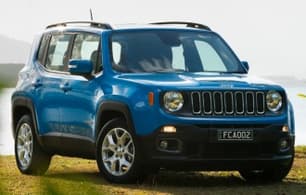
In what is absolutely not a coincidence, the Renegade immediately conjures up the Wrangler. Upright grille from the Willys Jeep (references abound here), round headlights, squared off wheel arches to mimic the Wrangler's guards, short overhangs and big rear view mirrors.
The 17-inch wheels look completely lost in the wheelarches which are even more cavernous owing to the Trailhawk's 50mm of extra ride height. The wheels are also a bit cheap looking but will probably survive the belting the car is intended to take.
Less rugged is the interior, despite a fairly self-conscious effort to make it look and feel chunky. The front seats are flat and unsupportive with the rears just as lacklustre making sure everyone is sliding around together. Luckily, front passengers get a dash-mounted grab handle.
It seems quite well put together, however, but with carpets and easily-marked plastics, you'll hope your passengers don't bring the mud in with them too often. And the "Since 1941" stamped into the steering wheel can go.
The dashboard is reasonably clear and has plenty of information to share via the screen between the dials but whoever thought marking the redline with a water splash graphic in bright orange should probably rethink their design decisions.
Storage is limited to two cupholders up front, door pockets in each door and nets on the front seat backs.
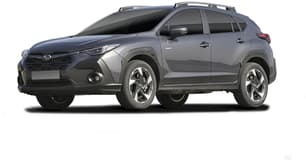
While SUVs tend to come in either a tall and boxy or coupe-like shape, the Crosstrek has a uniquely sleek and sporty wagon look that has stayed much the same over three generations.
Also while the Crosstrek competes with the Honda HR-V, Hyundai Kona, Mazda CX-30 and Toyota Corolla Cross the Subaru is the most off-road suitable thanks in part to its high 220mm ground clearance
As if to signal those adventurous aspirations the Crosstrek has a more rugged appearance with robust-looking plastic guards and chunky roof rails.
Inside the Crosstrek looks so much the same as most other new Subarus it's hard to work out which one you’re in. The materials are dark and soft, there is not much in the way of glitzy trimmings but there’s a high quality feeling throughout.
The Renegade range starts at $28,000 for the 1.6-litre Renegade Sport manual front-wheel drive, climbing between $2000 and $3000 through the Sport Auto, Longitude Auto, Limited Auto with a final jump of $4000 to the 2.4-litre auto-only Trailhawk.
Standard is a nine-speaker stereo with Bluetooth and USB, 17-inch alloys, dual-zone climate control, reversing camera, rear parking sensors, keyless entry and start, cruise control, electric front seats with heating, satellite navigation, automatic bi-xenon headlights, auto wipers, leather trim, roof rails, front and middle bash plates, full size spare, heated leather steering wheel, privacy glass, trailer sway control and tyre pressure monitoring.
The lairy Omaha orange is $500, part of an eleven colour palette with only two no-cost paint options (black and white).
You can add lane departure warning, auto-parking and a black painted roof for $500 each, a removable and retractable roof called My Sky Roof for $2200 or a more conventional electric sunroof for $1900.
The Beats-branded nine-speaker stereo is run via Fiat-Chryser's UConnect system, accessible through the 6.5-inch touchscreen. While it improves with every attempt, it's still quite clunky and when the sat-nav is added, becomes a bit of a mess.
Thankfully, not every function has been crammed into the touchscreen interface, so you'll spend more time with your hands on the wheel rather than working out which bit of the screen has the climate control.
The Crosstrek range is divided into three petrol variants and two hybrids. With a list price of $43,990, our test Crosstrek 2.0S sits at the top of the petrols and second from the top of the line-up under the Crosstrek AWD Hybrid S flagship.
Standard features on our 2.0S include 18-in alloy wheels, roof rails, LED headlights and tail-lights, dual-zone climate control, push-button start, proximity unlocking , 10-speaker audio, wireless phone charging, Apple CarPlay and Android Auto, an 11.6-inch media touchscreen and leather-trimmed seats.
If you’re looking to save a few thousand dollars the 2.0R is almost as well equipped.
Is it worth stepping up to the hybrid? Not in my opinion. The hybrid is the 'mild' kind and doesn't offer a great deal in terms of real-world fuel savings. You can read more on fuel efficiency below.
The Trailhawk is powered by Fiat's 2.4-litre four naturally-aspirated four-cylinder producing 129 kW and 230 Nm. Jeep reckons you'll get 7.5L/100km on the combined cycle. Our mostly city driving with a longish motorway run produced an 11.0L/100km average over a week.
The transmission is a nine-speed ZF automatic driving all four wheels.
The Trailhawk also has Jeep's five mode Selec-Terrain system which should cover pretty much every eventuality – Auto, Sport, Mud, Sand and, just for the Trailhawk, Rock. The Trailhawk is rated to tow 400kg unbraked and 907kg braked.
The Crosstrek 2.0S uses a 2.0-litre, four-cylinder, horizontally-opposed 'boxer' petrol engine which makes 115kW and 196Nm. A continuously variable transmission (CVT) with eight 'speeds’ isn’t the most exhilarating automatic but all Subaru now use CVTs.
The boxer engine has advantageous in terms of a lower centre of mass and helps deliver better driving feel thanks to more adept handling. Boxer engines also sound better to my ears with their throaty burble.
The Trailhawk name suggest that things are going to get muddy – compared to the rest of the range, the range-topper rides 50mm higher and has exposed, easy-to-reach tow hooks in the fairly unlikely event you get stuck. It also has a 20:1 low-range crawl ratio and Active Drive 4x4 which means it can switch between front and all-wheel drive. It'll also wade through almost half a metre of water. It's a genuine mud-plugging proposition and will take on some much bigger machinery out in the bush.
On the road, where we spent all our time in the Renegade, it's not what you'd call particularly inspiring. There's a number of sources of noise that contribute to a less than quiet cabin and having to constantly correct your course at freeway speeds adds to the tiring nature of the Renegade.
It's much better at lower speeds, pottering around but then again, its nine-speed transmission needs a lot more work on the shift mapping because it seems to forget which gear it needs to be in when you sink the right foot. If you don't need the Trailhawk's extra off-road goodies, consider the 1.4 litre Limited or Longitude.
I’ve never met a new Subaru that wasn’t good to drive, apart from that time a friend sent me his 30-year old Brumby minus brakes. But even that was fun, until it was time to stop… Anyway, in my view the Crosstrek is better than its rivals in multiple areas except one, which I’ll get to in a moment.
The Crosstrek 2.0S is comfortable to sit in and its ride and handling balance is exceptional for a vehicle in this class. Honestly, the ride quality, body control and steering outshines the HR-V, Kona, CX-30 and Corolla Cross in my view.
A big call out has to go to the Crosstrek's all-wheel drive system, which is exceptional. I have tested this vehicle in some pretty adventurous settings and the kind of terrain it can devour would frighten its rivals.
But the one area that lets the experience down is the CVT auto. I feel this way about this type of transmission in any car and I’m not alone. CVTs provide smooth acceleration and deceleration but if you’re hoping for an engaging, sporty experience you’ll be left wanting.
That said, my wife also drove the car and thought it was perfect for city traffic. And I agree, it’s just on the motorway where you might notice the lack of oomph when overtaking.
Visibility is good and you sit quite high for a little SUV. That small size makes it easy to park and manage in the city’s tighter spaces.
Seven airbags (including driver's knee bag), traction and stability controls, roll mitigation, blind spot monitoring, ABS and brake assist.
The Renegade does not yet have an ANCAP star rating although it scored five EuroNCAP stars in 2014.
Part of the reason we're testing the Crosstrek is because it was updated with more safety tech and equipment towards the end of last year. This safety boost means the Crosstrek continues to boast a maximum five-star ANCAP rating.
The big change was to the 'Eyesight' sensor system with better traffic sign recognition and enhanced AEB systems. An emergency vehicle stop system has also been added to bring the car to a halt if the driver becomes unresponsive.
The rest of the Crosstrek’s features carry over including AEB, lane-keeping assistance, front and rear cross-traffic alert (with braking) and blind-spot warning.
For child seats there are two ISOFIX points and three top tether anchor mounts across the second row.
There is a spare where but it's a temporary type which will get you to a repair place.