What's the difference?
Jeep's Renegade might be late to the mini-SUV party but it comes with a pretty impressive back catalogue to suggest that this is a SUV that can cash the cheques its name can write.
The top of the range Trailhawk can write even bigger cheques than the lower models, bringing with it a range of off-road tech toys to let you really get down and dirty.
Australia is experiencing a mass extinction event.
Like the dinosaurs before them, and hopefully not the bees in the near future, the sub-$20,000 car is nearing the bitter end.
An evolutionary dead-end, as higher emissions and safety regulations relegate older models (read Mitsubishi Mirage) to the great scrap-heap in the sky and prevent newer ones (read Honda Jazz) from leaving their local markets.
For you, this means there are quite literally a handful of brand-new vehicles left in Australia which wear before-on-road price-tags under the magic $20,000 number.
One of them is the car we’re looking at for this review: The Kia Rio S, with the catch being you’ll have to be happy changing gears yourself.
So, is this most basic Rio worth your while, or is it best left as a puzzling fossil for future generations to study? Let’s have a look.
Rugged, dependable and good off-road are the most obvious qualities of the Trailhawk. It stands out from the rest of the mini-SUVs by being able to do the S and the U with plenty of vigour.
It's just a shame that its on-road manners can't match that of its big brother, the Cherokee. Unless you're planning on proper off-roading, the Trailhawk might not be quite what you're looking for.
The Rio S Manual is a fun-to-drive little car with a big practicality and multimedia offering in a segment rapidly heading towards extinction.
While some elements of the drive experience are reminiscent of budget cars from 10-20 years ago, Kia makes up for it by wrapping the Rio in a contemporary looking and feeling package, ready for the buyer who needs no frills and demands no nonsense. Until the manual transmission goes the way of the dodo, there is almost no better option.
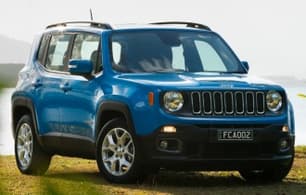
In what is absolutely not a coincidence, the Renegade immediately conjures up the Wrangler. Upright grille from the Willys Jeep (references abound here), round headlights, squared off wheel arches to mimic the Wrangler's guards, short overhangs and big rear view mirrors.
The 17-inch wheels look completely lost in the wheelarches which are even more cavernous owing to the Trailhawk's 50mm of extra ride height. The wheels are also a bit cheap looking but will probably survive the belting the car is intended to take.
Less rugged is the interior, despite a fairly self-conscious effort to make it look and feel chunky. The front seats are flat and unsupportive with the rears just as lacklustre making sure everyone is sliding around together. Luckily, front passengers get a dash-mounted grab handle.
It seems quite well put together, however, but with carpets and easily-marked plastics, you'll hope your passengers don't bring the mud in with them too often. And the "Since 1941" stamped into the steering wheel can go.
The dashboard is reasonably clear and has plenty of information to share via the screen between the dials but whoever thought marking the redline with a water splash graphic in bright orange should probably rethink their design decisions.
Storage is limited to two cupholders up front, door pockets in each door and nets on the front seat backs.
While notable equipment is missing, the Rio reclaims lost ground with the way it looks, and to a degree, the way it feels.
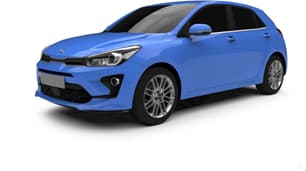
Ever since this new generation hatch launched, I’ve thought it brings a slick modern design to the city-car space, and even in its most rudimentary form as-tested (our car even came in the most basic ‘Clear White’ paint) it’s a great looking little hatch.
Sure, it doesn’t have the romance factor of the Fiat 500, nor the more delicate curvature of the much more expensive new-generation Toyota Yaris, but it certainly has a more refined visage than, say, the MG3 whilst feeling a bit more grown-up than the Suzuki Swift.
Solid, squared-off lines give this car a sporty pose, and its frowny-face and blocky rear round out a stout city-car persona, and I especially like the way even this most basic trim is adorned with contrast pieces, a spoiler above the boot lid, and body-coloured door handles and mirrors.
Sure, the 15-inch steelies dress it down a bit, but on the Rio these leave the impression of financial prudence rather than cost-cutting.
Inside is basic but tidy. The overall look maintains a hint of sportiness, with an appealing symmetrical finish to the dash.
There’s no question the Rio is a budget model when it comes to the touch though, with everything either a soft polyurethane or a nasty hard plastic, so while it all might look neat it’s far from the most comfortable place to be for long periods of time.
The basic dot-matrix multifunction display, chunky plastic air-conditioning controls, and polyurethane items from the wheel to the handbrake and shifter are reminders of a bygone era, but the overall aesthetic of the driver’s space is pleasing.
The Renegade range starts at $28,000 for the 1.6-litre Renegade Sport manual front-wheel drive, climbing between $2000 and $3000 through the Sport Auto, Longitude Auto, Limited Auto with a final jump of $4000 to the 2.4-litre auto-only Trailhawk.
Standard is a nine-speaker stereo with Bluetooth and USB, 17-inch alloys, dual-zone climate control, reversing camera, rear parking sensors, keyless entry and start, cruise control, electric front seats with heating, satellite navigation, automatic bi-xenon headlights, auto wipers, leather trim, roof rails, front and middle bash plates, full size spare, heated leather steering wheel, privacy glass, trailer sway control and tyre pressure monitoring.
The lairy Omaha orange is $500, part of an eleven colour palette with only two no-cost paint options (black and white).
You can add lane departure warning, auto-parking and a black painted roof for $500 each, a removable and retractable roof called My Sky Roof for $2200 or a more conventional electric sunroof for $1900.
The Beats-branded nine-speaker stereo is run via Fiat-Chryser's UConnect system, accessible through the 6.5-inch touchscreen. While it improves with every attempt, it's still quite clunky and when the sat-nav is added, becomes a bit of a mess.
Thankfully, not every function has been crammed into the touchscreen interface, so you'll spend more time with your hands on the wheel rather than working out which bit of the screen has the climate control.
Value seems less important here when you’re contending with a limited list of potential options at this end of the market.
The Rio S manual currently wears an MSRP of $19,690, and if you’re able to shuffle cogs yourself, it counts its rivals as the Suzuki Baleno GL ($18,490), Suzuki Ignis GL ($19,490), or Fiat 500 Lounge ($19,550).
There’s also the option of the MG3 (from $18,990) or Kia’s own much smaller Picanto (from $15,990).
I’m pleased to report the Rio S is one of the best among these options, though. Not only is this car much more modern in terms of its platform and design than pretty much anything on that list, it packs great standard equipment, too.
The major wow-factor item is the Rio’s best-in-class multimedia system, consisting of an 8.0-inch touchscreen with wireless Apple CarPlay and Android Auto connectivity, just one of the areas where this car will grab eyes over rivals.
Elsewhere is a predictably honest list of standard equipment, including basic halogen headlights, 15-inch steel wheels, manual air conditioning, cloth seat trim with a polyurethane steering wheel, a small multifunction display in the dash, two USB ports, a six-speaker audio system, and surprisingly, steering-wheel mounted controls.
There’s no keyless entry or push-start ignition, and this level of equipment makes you feel lucky to have automatic headlights. Sadly, the S manual also misses out on the basic luxury of cruise control.
It’s cheap, missing a lot of gear, and feels it with an abundance of plastic trims, but somehow this car gets by with almost everything you really, truly need. Sure, it’s a bit of a hark back to the equipment lists of the early 2000s, but if you’re just looking for a basic car to get the job done, you could do far worse than this Kia with its impressive multimedia offering.
The Trailhawk is powered by Fiat's 2.4-litre four naturally-aspirated four-cylinder producing 129 kW and 230 Nm. Jeep reckons you'll get 7.5L/100km on the combined cycle. Our mostly city driving with a longish motorway run produced an 11.0L/100km average over a week.
The transmission is a nine-speed ZF automatic driving all four wheels.
The Trailhawk also has Jeep's five mode Selec-Terrain system which should cover pretty much every eventuality – Auto, Sport, Mud, Sand and, just for the Trailhawk, Rock. The Trailhawk is rated to tow 400kg unbraked and 907kg braked.
The Rio is beginning to fall behind here with an antiquated 1.4-litre four-cylinder non-turbo petrol engine. Peak outputs aren’t far off where they should be for this segment, with 74kW of power and 133Nm of torque, although they arrive at the most distant end of the rpm range (6000rpm and 4000rpm respectively) so you need to rev it.
It can be clumsy to extract this power, too, with the engine paired in this circumstance to a six-speed manual which leaves a lot to be desired in terms of action and clutch feel.
While the abundance of ratios can be beneficial for fuel consumption, it’s clear this car was designed to be paired with the more modern three-cylinder turbocharged engine only available on the top GT-Line trim.
The Trailhawk name suggest that things are going to get muddy – compared to the rest of the range, the range-topper rides 50mm higher and has exposed, easy-to-reach tow hooks in the fairly unlikely event you get stuck. It also has a 20:1 low-range crawl ratio and Active Drive 4x4 which means it can switch between front and all-wheel drive. It'll also wade through almost half a metre of water. It's a genuine mud-plugging proposition and will take on some much bigger machinery out in the bush.
On the road, where we spent all our time in the Renegade, it's not what you'd call particularly inspiring. There's a number of sources of noise that contribute to a less than quiet cabin and having to constantly correct your course at freeway speeds adds to the tiring nature of the Renegade.
It's much better at lower speeds, pottering around but then again, its nine-speed transmission needs a lot more work on the shift mapping because it seems to forget which gear it needs to be in when you sink the right foot. If you don't need the Trailhawk's extra off-road goodies, consider the 1.4 litre Limited or Longitude.
A six-speed manual with a tiny non-turbo engine is an absolute oddity in today’s new car market, but as a result of its rudimentary approach, there’s something refreshingly honest about the Rio S.
The engine requires a wringing to extract the desired result, and a lot of action on the gears, as six speeds proves to be quite a few to work your way through before you achieve cruising speed.
As so much interaction is required with the transmission, I wish it was tighter when it comes to the clutch which feels a bit doughy at the best of times.
The Rio is very organic, though, with next to no electrical assistance for any of its interaction points offering the driver a high level of control.
The steering is direct, but as a result of a cheaper rack (with less teeth compared to this car’s Stonic relation), it feels simple and brittle when it comes to feedback.
The same criticism can be levelled at the suspension, which errs on the side of firm. This attribute combines with the low seating position to make even this most basic Rio an absolute hoot in the corners.
But it can be a little crashy over every-day potholes and corrugations, despite the abundant amount of rubber cladding the 15-inch steel wheels.
Visibility is superb out of this little car’s big windows, making you feel in control of your surroundings (necessary in the multi-lane confines and tight parking conditions of a city), and ergonomics in the cabin are absolutely on-point with the large touchscreen elements easy to reach and the instruments taking a basic no-nonsense form.
While noise levels are okay at urban speeds, they pick up above 80km/h, making the Rio more unpleasant to drive over long distances than, say, the more upmarket-feeling Yaris.
The Rio does find its place in this price bracket as a fun-to-drive, but predictably rudimentary experience, for the niche audience of drivers seeking an entry-level car who are still able to shift gears themselves.
Seven airbags (including driver's knee bag), traction and stability controls, roll mitigation, blind spot monitoring, ABS and brake assist.
The Renegade does not yet have an ANCAP star rating although it scored five EuroNCAP stars in 2014.
Sadly, the Rio S misses out on any advanced active safety items. This is one area where city-sized cars are struggling to keep up, as expensive active safety systems tend to push them well into the mid-$20,000 region.
Unlike the mid-range Rio Sport, the S has no auto emergency braking, lane keep assist, or driver attention alert.
It makes do with the more basic array of brake, stability and traction controls, with the addition of a great reversing camera, three top-tether and two ISOFIX child seat mounting points, and six airbags.
The Rio carries a valid five-star ANCAP safety rating, to an earlier 2017 standard before its missing modern active safety items were mandated.