What's the difference?
Jaguar has announced that by 2025 it will only make and sell electric vehicles. That’s less than four years away and means the F-Pace you’re thinking about buying could be the last Jaguar with an actual engine that you ever own. Heck, it could be the last car with an engine you ever own.
Let’s help you pick the right one then, because Jaguar’s just called last drinks.
This is a BIG moment for the Lexus RX in Australia. And I'm not just referring to the spindle grille that adorns the front-end of this all-new model (though it too is almost commercially massive).
I'm talking more about the vehicle itself, and its importance to the Lexus brand here. The RX is one of Lexus' best sellers in Australia, and so this new one – which welcomes a new platform, new powertrain options and an all-new F Sport Performance trim level – is a big deal.
So, does it live up to the hype (and to its German competition)? Join me as we figure all that out ahead of the RX's debut here in early 2023.
The F-Pace has been gifted new styling, new engines and more practicality making it an even better SUV than it already was. You could seriously pick any of the grades and be happy with your purchase. Then there’s the question of the engine…
Jaguar says there’s a few more years left in the combustion engine yet, but we know exactly how many years – four, because the company has gone on the record announcing it will go fully electric by 2025. The question for you is – how will you ring out the end of an era – with a four-cylinder petrol, a six-cylinder turbo diesel, an inline turbo six petrol or a cracking V8?
The sweetspot in the range is the R-Dynamic SE 400, with just enough luxury and more than enough grunt.
The RX is a big SUV that doesn't always look, or drive, like one, and – in 500h guise especially – can put a smile on a driver's face, too.
Gone are the cabin quirks and the polarising design elements (well, mostly...), and in their place you'll find a solid, premium-feeling family offering without much in the way of drawbacks.
Note: CarsGuide attended this event as a guest of the manufacturer, with travel, accommodation and meals provided.
The very first F-Pace arrived in Australia in 2016 and even after all these years and the arrival of more rivals I still think it’s the most beautiful SUV in its class. The new one seems to look a lot like the old one, but the styling updates have kept it cool.
If you want to see instantly how the design of the F-Pace has evolved from the original to the new one, be sure to watch my video above.
Short story is, this new F-Pace has been given a pretty major styling overhaul inside and out.
Gone is the old F-Pace’s plastic beak. That sounds weird but the previous F-Pace’s bonnet stopped short of the grille and a nose cone had been fitted to cover the rest of the distance. Now the new bonnet meets a larger, wider grille and its flow from the windscreen down isn’t disturbed by a large join line.
Also more pleasing to the eyes is the badge on the grille. The snarling jaguar head is now larger and no longer mounted on a terrible looking large plastic plate. The plate was for the adaptive cruise control radar sensor, but by making the Jaguar badge bigger, the plate was able to be house in the badge itself.
The headlights are slimmer, and the tail-lights have a new design which looks futuristic, but I miss the styling of the previous ones and the way they dipped into the tailgate.
Inside, the cabin has been made over with a giant landscape screen, new chunky climate control dials, a new steering wheel and the rotary shifter has been replaced by a regular upright one which is still small and compact, with cricket ball stitching. Again, take a look at the video I’ve made to see the transformation for yourself.
While all F-Paces have a similar look, the SVR is the high-performance member of the family and stands out with its giant 22-inch wheels, a tough body kit, quad tailpipes, a fixed SVR rear wing, and bonnet and fender vents.
For this update the SVR has been given a new front bumper and larger cooling vents flanking the grille. But it’s more than just tough looks, the aerodynamics have been revised to decrease lift by 35 per cent, too.
What hasn’t changed are the dimensions. The F-Pace is a mid-sized SUV measuring 4747mm end to end, standing 1664mm tall and with the mirrors out is 2175mm wide. That’s not huge, but make sure it’ll fit in your garage.
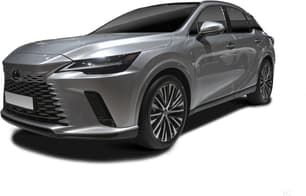
Honestly, the Lexus RX looks far more powerful, and cohesive, in the metal than it does in some photos, and in the right colour (we're fond on the deep black or the copper-rose hues), it looks downright fetching.
That Predator-shaped front-end is massive, but the way the Spindle grille kind of bleeds in the body work at the nose of the vehicle is a neat trick, and the whole design ethos gives the RX a sportier, more modern, and more intimidating, energy from almost every angle.
Perhaps the most clever element though is the wave-like design piece that links the rear window with the boot, somehow managing to shrink almost-five-metre SUV (visually, at least), and leaving the RX looking more sporty than hulking.
The door handles are cool, too. They’re fixed, and you just touch them to open the door, with a similar system used once inside to get out again.
Inside, Lexus has gone for a clean, modern-feeling space, and, thankfully, there isn't a Remote Touch trackpad in sight. Instead, you can choose between two screen sizes – 9.8- or 14.0-inch – which kind of dominate the dash, while the air-con controls are digital and interactive, too.
It must be said, though, some interior treatments feel far more special than others, and while Lexus in Australia isn't spilling on specifics for our market just yet, the top-spec models will almost certainly feel more plush than the cheaper ones.
The F-Pace was always practical with a big 509-litre boot and great rear leg and head room for even me at 191cm tall, but the cabin re-design has added better storage and usability.
The door pockets are larger, there’s a covered area under the floating centre console and in a victory for common sense and practicality the window switches have been relocated from the window sills to the armrests.
This is along with a deep centre console storage area, and two cupholders in the front and another two in the rear fold-down armrest.
Parents will be happy to know that all F-Paces come with directional air vents in the second row as well. And there are ISOFIX outboard child-seat anchors and three top-tether restraints, too.
The entire RX range now rides on Lexus' GA-K platform, which is lighter (-40kg), more rigid, and offers a lower centre of gravity (-15mm) than the model it replaces.
The RX is wider (+25mm to 1920mm), lower (-10mm to 1695mm), but no longer (still 4890mm) than the outgoing model. But Lexus has lengthened the wheelbase (+60mm to 2850mm) to earn some extra backseat space for rear riders.
And it must be said, there is lots of room for backseat riders. Sitting behind my own 175cm driving position I had more than enough knee room, and enough head room, and a general feeling of airy spaciousness.
Elsewhere you get the usual practicality perks, with two cupholders up front, two more in the pull-down seat divider that splits the rear seat, and there are two ISOFIX attachment points in the back seat, too.
Charging is handled by a four USB ports, and depending on the trim/spec balance Lexus in Australia shoots for, you should at least find vents with temp controls for backseat riders, too.
Lexus is yet to confirm the luggage space specs for the new RX, but given it’s only being offered with five seats, and that there’s been no change to the vehicle’s length, you can expect a fair bit of room for bags in its auto-opening boot.
There’s a Jaguar F-Pace for every budget as long as your budget is somewhere in between $80K and $150K. That’s quite a large range in price.
Now, I’m about to take you through the grade names and I need to warn you that it’s going to be messy and confusing a little bit like white water rafting, but not as wet. Life jacket on?
There are four grades: the S, SE, HSE and top-of-the-range SVR.
They all come standard with the R-Dynamic pack.
There are four engines: the P250, D300, P400 and P550. I’ll explain what this means in the engine section down below, but all you need to know is 'D' stands for diesel and 'P' for petrol and the higher the number the more grunt it has.
The S grade only comes with the P250. The SE comes with a choice of P250, D300 or P400. The HSE only comes with the P400 and the SVR has exclusive rights to the P550.
Following all this? Great.
So, the entry grade is officially called the R-Dynamic S P250 and it lists for $76,244 (all prices listed are MSRP - before on-road costs). Above this is the R-Dynamic SE P250 and it lists for $80,854, then there’s the R-Dynamic SE D300 for $96,194 and the R-Dynamic SE P400 for $98,654.
Almost there, you’re doing super.
The R-Dynamic HSE P400 lists for $110,404 and at the top is King F-Pace – the SVR with the P550 listing for $142,294.
There you are, wasn’t so bad was it?
Coming standard from the base grade up is the new 11.4-inch touchscreen, sat nav, Apple CarPlay and Android Auto, there’s keyless entry, push-button start, dual-zone climate, power adjustable front seats, leather upholstery, LED headlights and tail-lights, and an auto tailgate.
The entry-level S and the SE above it come with a six-speaker stereo, but as you step into the HSE and SVR more standard features appear such as a 13-speaker Meridian sound system, plus heated and ventilated front seats. A fully digital instrument cluster is standard on all grades apart from the entry S.
The options list is extensive and includes a head-up display ($1960), wireless charging ($455), and an Activity Key ($403) which looks like an iWatch that locks and unlocks the F-Pace.
Paint prices? Narvik Black and Fuji White are standard at no extra cost for the S, SE and HSE. The SVR has its own standard palette and includes Santorini Black, Yulonhg White, Firenze Red, Bluefire Blue and Hakuba Silver. If you don’t have the SVR but want these colours it’ll be $1890, thank you.
This is an arbitrary seven out of 10, here. Because we don't yet know how many trim levels the new RX will launch in, how much each will cost, or what you'll get for your investment.
What we do know is that the RX will launch with three powertrain options: an all-new turbocharged hybrid, a second, more conventional hybrid, and a turbo-petrol engine. There’s a plug-in hybrid version available overseas, but we ain’t getting it. Or at least, not yet.
In terms of specific trims and equipment levels, you’ll need to wait until closer to the RX’s launch in early 2023 for the full skinny. But you can expect a choice between a 9.8-inch or 14.0-inch central touchscreen with wireless Apple CarPlay and Android Auto, an eLatch door system with fixed handles that unlatch at the push of button inside and out, as well as more high-tech safety kit (thanks to Lexus Safety System 3.0) than you can shake a radar at.
Jaguar’s engine names sound like forms you have to fill in when you apply for a home loan.
The P250 is a 2.0-litre four-cylinder turbo petrol engine making 184kW and 365Nm; the D300 is a 3.0-litre six-cylinder turbo diesel producing 221kW and 650Nm; while the P400 is a 3.0-litre six-cylinder turbo petrol with outputs of 294kW and 550Nm.
The P550 is a supercharged 5.0-litre V8 producing a colossal 405kW and 700Nm.
The SE grade gives you the choice of the P250, D300 and P400, while the S only comes with the P250 and the SVR of course is powered only by the P550.
The D300 and D400 are new engines, both are straight sixes and replace the V6 engines in the old F-Pace. Superb engines, they are also found in the Defender and Range Rover.
Jaguar calls the D300 and P400 mild hybrids, but don’t be misled by the terminology. These engines are not hybrids in the sense that an electric motor is working to drive the wheels along with a combustion engine. Instead, a mild hybrid uses a 48-volt electrical system to help take the load off the engine by helping it start and running the electronics such as climate control. And yes, it does help save fuel, but not stacks.
There’s plenty of grunt from all these engines no matter which you choose, they all have eight-speed automatics and all-wheel drive.
You are also very likely looking at the last combustion engines to go into an F-Pace. See Jaguar has announced that it will only sell electric vehicles beyond 2025.
Four years and that’s it. Choose wisely.
Let’s start with what we’re not getting at launch. Internationally, there's a new plug-in hybrid variant that pairs a 227kW hybrid system with a 18.1kWh lithium-ion battery for an EV driving range of more than 65kms, but fight though Lexus in Australia did, it couldn't secure the model for our market at launch. It wants it though, and badly. So watch this space.
Instead we get three options, including the RX 350h, which pairs a 2.5-litre petrol engine with Lexus' existing hybrid system to produce a total 180kW and 316Nm. It's paired with a constantly variable transmission and will be offered in two- or all-wheel drive.
There’s also a turbocharged 2.4-litre petrol engine on offer in the RX 350, good for 205kW and 430Nm, and paired with an eight speed automatic and AWD.
But the powertrain I really, really like lives in the RX 500h F Performance, and pairs a 2.4-litre turbocharged petrol engine with an electric motor up front, and a second at the rear axle, for a total of 273kW and 551Nm.
The all-new hybrid system has been designed with turbocharged engines in mind, and features a single electric motor at the front, and a bigger rear motor, with the latter able to provide real driving power to the rear tyres - and contribute to a sprint to 100km/h of just 5.9secs.
Lexus calls it an 'eAxle' motor, and it can deliver some 76kW to the rear tyres. It pairs with a 'DIRECT4' all-wheel drive system which the brand says improves "handling, controllability, and feel."
Fitting, then, that it features on the RX 500h F Performance, which also introduces a new go-fast tier for the Lexus brand (though one you can expect to see more frequently in the near future), and which sits between the existing F Sport and the top-tier, full-fat F models.
The brand says things like bigger brakes, performance components and the highest power outputs will be reserved for the F Performance models. And so it is with the RX 500h F Performance, which welcomes six-piston front brakes, adaptive variable suspension, dynamic rear steering and 21-inch wheels.
It doesn’t make sense that Jaguar has announced that it will be going all electric by 2025 yet doesn’t offer a plug-in hybrid in its Australian line-up, especially when there is one available overseas.
Jaguar says it doesn’t make sense either, but by that they mean business sense, in bringing one to Australia.
So, for fuel economy I’m marking the F-Pace down. Yes, the D300 and P400 use clever mild-hybrid tech, but it doesn’t go far enough to reducing fuel use.
So the fuel consumptions, then. The official fuel consumption for the petrol P250 is 7.8L/100km, the diesel D300 will use 7.0L/100km, the P400 is stated to sip 8.7L/100km and the P550 V8 petrol will drink 11.7L/100km. Those figures are "combined cycle" numbers, after a combination of open and urban driving.
Let’s start with the pure-petrol RX 350, which will sip a claimed 8.8 litres per hundred kilometres on the combined cycle, and will demand premium petrol. The RX 350h is more fuel efficient, demanding 6.4 to 6.7 litres per hundred kilometres on the combined cycle.
But the most impressive is the RX 500h, which Lexus says will need 8.2 to 8.5 litres per hundred kilometres — making it more efficient than the petrol-powered RX 350, despite producing an extra 68 kilowatts of power and 121 newton metres of torque.
My two test cars at the Australian launch of the new F-Pace were the R-Dynamic SE P400 and the R-Dynamic S P250. Both were fitted with the road noise cancellation system which comes with the optional $1560 Meridian stereo and reduces the level of road noise coming into the cabin.
Which would I rather? Look, I’d be fibbing if I didn’t say the SE P400 with its smooth inline six that has seemingly endless shove, but it’s $20K more than the S P250 and neither engine is low on grunt and both handle and ride almost identically.
That ride has been improved in this new F-Pace with the rear suspension being retuned so that it’s not so firm.
Steering is still on the sharp side, but body control feels better and more composed in this updated F-Pace.
On the twisty and quick country roads I tested the S P250 and SE 400, both performed superbly, with responsive engines, great handling, and serene cabins (thanks to the help of the noise cancelling tech).
The second part of the test was driving both in city traffic for the best part of an hour each which isn’t pleasant in any car. The now wider F-Pace seats were comfortable and supportive, however, the transmission seamlessly swapped gears and even rolling on 22-inch wheels in the SE and 20-inch alloys in the S the ride was excellent.
Right, let’s cut to the chase here. I like the way the all-new RX family drives, pretty much across the board. If that’s all the information you want or need, feel free to check out here and move on to the next sub-heading.
Still here? Ok, then let’s go a little deeper.
None of the powertrains on offer feel under-powered in the RX range, which is a good start, but they all do their jobs a little differently.
The RX 350 is probably the most familiar, with a traditional automatic and that well-known petrol-powered punch. It’s not the most powerful engine on offer here, but it’s more than enough to get the RX up and moving — but, for mine, it can feel a little thrashy (or like it’s straining a little too hard), when you really start to push it, but such is the price you pay for a four-cylinder engine pushing a large SUV.
Next up is the RX 350h, which Lexus reckons will be the best-selling model in Australia. Lexus and Toyota have been doing hybrid powertrains for some time now, and the system fitted to the new RX is predictably solid-feeling, though it too has its drawbacks – namely that the constantly variable transmission can drone on and on under constant acceleration, and even the commendably insulated cabin can’t block it out completely.
So if this is a Goldilocks’ scenario, then the just right has to be the RX 500h, which blends its powerful powertrain with a traditional-feeling automatic to deliver plenty of performance and a tight, engaging drive experience that makes it feel as though the big SUV is somehow shrinking around you from behind the wheel, courtesy of the best performance kit (brakes, adaptive suspension, etc).
But to be honest, no matter the RX, the thing that really stands out here is its on-road dynamics. The car doesn’t really wobble about, there’s not much in the way of body roll, and it feels tight and confidence inspiring, no matter the model - but especially the rear-wheel-steering equipped 500h.
The RX also does a commendable job of locking the outside world outside of the cabin. Where you want it to be a calm and sedate family hauler, it can be that. But it can also put a smile on your face on the right road, too.
And that, I think, is something to be celebrated. And also not something we’ve come to associate with Lexus over the years. But that’s now beginning to change. Long live F Sport Performance, then.
The F-Pace scored the maximum five-star ANCAP rating when it was tested in 2017. Coming standard is advanced safety tech such as forward auto emergency braking (AEB), blind-spot assist, lane keeping assistance and rear cross-traffic alert.
This tech is great, but in the five years since the F-Pace first arrived safety equipment has moved on even further. So, while the AEB can detect pedestrians, it’s not designed to work for cyclists, there’s no reverse AEB, nor evasive manoeuvre systems, nor a centre airbag. All are items which weren’t common in 2017 but are now on most 2021 five-star rated cars.
The Lexus RX welcomes the brand's Lexus Safety System 3.0 setup, which means more high-tech kit than you can shake a radar at.
What appears where on the Australian lineup remains to be seen, but internationally the RX will offer things like Advanced Park, remote parking from your smart phone, Safe Exit Assist that will actually prevent you opening the doors should the cameras detect pedestrians or cyclists, and Pre-Crash Safety, which scans intersections for bikes, people or cars, and activate alarms and the brakes should it sense a collision.
That, and things like Front Cross-Traffic Alert, active cruise, Lane Departure Warning and Lane Tracing Assist, road-sign recognition and Lane Change Assist, should see Lexus shooting for a five-star ANCAP safety rating.
At the launch of the new F-Pace Jaguar announced that all of its vehicles would be covered by a five-year unlimited/kilometre warranty, a step up from the three-year coverage it used to offer.
Service intervals? What are they? The F-Pace will tell you when it needs maintenance. But you should sign up for a five-year service plan which costs $1950 for the P250 engine, $2650 for the D300, $2250 for the P400 and $3750 for the P550.
The Lexus family is covered by a five-year, unlimited-kilometre warranty, which is about bang-on in the premium-vehicle space.
While servicing details are yet to be confirmed, the previous RX required a trip to the service centre every 12 months or 15,000kms, and it will fall under the brand’s capped-price servicing program, and the Lexus Encore program, which offers all sorts of perks to owners.