What's the difference?
The dual-cab ute market and light truck market are potentially two very different landscapes.
While the dual-cab continues to storm the sales charts in Australia, there’s also a growing awareness among hardcore users of these vehicles, that a light truck might often be a better solution.
Better payloads and higher Gross Combination Mass ratings in an age of increasing legal and insurance concerns over overloaded vehicles, were once the light truck’s strong suit. But these days, vehicles like the full-sized US-made pick-ups and even the muscled-up Ford Ranger Super Duty have bridged or even exceeded that gap.
At which point, the light-truck’s benefits become the ease with which it can take on heavier jobs and the sheer size of the cargo and cabin area, not to mention those truck-specific qualities born of generations of refining a concept.
In Australia, it’s Isuzu that absolutely brains the opposition in sales terms. And part of the reason for that has been a realisation that not all would-be buyers want the hassle of the traditional truck-buying process of purchasing a bare chassis and then equipping it so suit their needs.
Which is where Isuzu’s RTW (ready To Work) concept comes in. You simply choose the truck you want, choose a tray, van or service body and then let Isuzu deal with it and phone you when it’s ready to collect.
It's so simple, it’s a wonder not everybody is doing it.
The other news is that Isuzu has finally updated its popular N Series fleet after about 16 years. A new cabin, extensive chassis changes, uprated engines, and all-new transmission, improved suspension and a new focus on safety are all headlines. But 16 years is a long time between drinks, so do the improvements make enough of a difference to keep the concept relevant in a changing market?
Once upon a time Queensland was the home of Aussie camper-trailer manufacturing and companies, such as Lifestyle Camper Trailers, were pumping out camper after camper to happy customers. But then came the imports and the price that people were willing to pay for the product dropped very quickly. Many local companies succumbed and just went out of business, others started importing their own and some innovated, developing new products; Lifestyle did two of the three.
Today Lifestyle only builds light-weight, heavily off-road caravans which it calls Hypercampers and others would call a hybrid caravan, because it takes some elements of a camper-trailer and others of a caravan. It has four models, one of which is built in China in a factory the company part-owns. The other three, including the Reconn R2, which I’m testing, is built in Queensland.
A truck like the NPR (or any other truck, really) is never going to replace a dual-cab ute in terms of its duality. While the latter can tend to weekday chores and be quickly reconfigured for weekend fun, the light truck has no such facility. Nope, it’s a workhorse. Period.
You need a fair bit of real estate just to park the Isuzu overnight and it certainly won’t fit in the typical supermarket car space. It’s hardly sporty to drive, either, although the latest upgrades have made it more user friendly in a total sense and safer than ever before.
But what it does do that a dual-cab ute can’t often do, is tackle bigger, heavier jobs with a fair bit of bandwidth still up its sleeve. And if the nine-to-five side of things is where you need to be, then a vehicle like this has to be worth a look. And if you consistently find that you’re sailing close to the wind in terms of exceeding a ute’s legal payload, towing capacity or GCM, then the extra bigness of a light truck could make a huge difference.
That’s especially so given the price tag. Okay, you’re not buying a lot of high tech for your money, but you are getting some seriously stout engineering and an expectation that you won’t be working the thing to death anytime soon.
Note: CarsGuide attended this event as a guest of the manufacturer, with meals provided.
This is one of the campers that very finely straddles that line between camper-trailer and caravan. It’s light-weight and simple to use, even if (and mostly because) it lacks the wide-open comforts of a traditional caravan. It’s very capable, well-equipped and very well made.
If you do like to escape the great outdoors occasionally while camping (or someone you dearly love, does), this is well worth a look. It’ll follow you just about anywhere and your camp life will be better for it.
The new cabin Isuzu has brewed up certainly brings the truck into the present, but it’s still very much a light truck in some respects. As in, it’s still a pretty good climb inside, although there are steps and handles to make that easier. The steering column still gets in the way as you swing your left leg inside, though.
The plastic surfaces would still make a car interior designer cringe, and the floor is vinyl and the seats cloth. But the three-abreast seating arrangement makes sense and, should you choose the dual-cab N Series option, there’s actually seven seats in all.
Cabin storage has obviously been a priority for Isuzu, and there are three large, netted overhead bins above the top of the windscreen, as well as bins and buckets across the width of the lower dashboard. Interestingly, each door has just a single, slim pocket and no bottle storage.
The centre console addresses that somewhat with a pair of cup-holders and a pen slot, while there’s also a large bin behind the seat on the bulkhead. There’s also an interior light that wouldn’t look out of place in an industrial kitchen.
The dashboard is home to a pair of USB charge-ports in the centre and the truck stuff continues with a wand for the exhaust brake and a knob near the steering column for a fast-idle setting. It’s also nice to see that even though Isuzu has adopted keyless entry and start for the N Series, the starter button resembles a conventional key and is located right where it should be in the side of the steering column.
What’s missing? Mainly a vanity mirror on either side of the cabin and a physical volume knob for the stereo. Oh, and paddle shifters would be nice too, especially when towing.
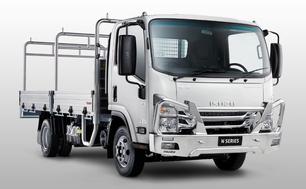
Externally, the Tradepack option gets you an aluminium drop-side tray, sturdy ladder racks, a tow bar, bull bar, toolboxes fitted below the tray between the axles and even a wash station for after-work clean ups.
The tray is fitted in Australia (many of the Ready to Work body options are also made here) and the load floor is a vast expanse of alloy with the ability to cope with small, heavy objects thanks to its high-impact materials. But the usual drop-side tray caveats apply including a high loading height, rattling from the sides and the legal requirement to lash everything down before hitting the road.
Meantime, part of the overall appeal of the Isuzu line-up is that there are something like 40 different permutations of cabin width, wheelbase, GVM, overall length and driveline.
But here’s perhaps the N Series’ greatest trick when it comes to being practical: While it’s easy to dismiss the vehicle for being too big and unwieldy, many operators would possibly find that the extra payload and real estate in the cargo area means that they might not need to tow a trailer every time they venture on to a job site. At which point, the dual-cab ute with a tandem trailer starts to look less convenient, especially if there’s any reversing or squeezing on to a tight site involved.
Oh, and if tight spaces really are an issue, the N Series’ sub-10m turning circle makes a typical dual-cab’s 12.5 metre turning circle look ridiculously ungainly. And that’s before we get to that trailer.
Typically for a vehicle like this, a full-sized spare tyre is included.
The Reconn’s interior is interesting, as unlike most modern caravans, there’s not a lot of free space in here, thanks largely, to the height of the bed. It sits right at the top of the camper, like a second-storey mezzanine. To get in, you have to climb onto the dinette lounge, or use the fold-down step built into the base.
There is also a small dinette and lounge space with a folding table that’s comfortable enough for two to sit at ease and read or eat dinner, but I get the feeling Lifestyle doesn’t expect you to be spending the majority of your time in here – that’s not what this camper is about.
Above the dinette there’s cabinet space, while all the dinette seats lift up to reveal more storage areas. The dinette closest to the door has two drawers in it, to make accessing the storage easy.
If this floorplan isn’t for you, there are three other options. One features a pair of bunks, another an ensuite with shower and toilet. The third packs both the bunks and the ensuite all in, somehow – it’s not an overly large space.
Actually climbing aboard the Isuzu is job one, and you’ll need the handles and step to do it safely. Then again, it’s probably no more testing than getting into a really low sports car in a degree of difficulty sense.
With that accomplished, you’re met with two things; the view out and the very un-car-like driving position. The first is fantastic for forward vision. And it’s not just the height advantage over other traffic. The cab-over-engine layout also means you’re almost at the very front of the truck, meaning you can see a lot more of what’s directly in front of you, even if it’s almost under your nose. Jumping back into a dual-cab ute for comparison emphasises the point enormously.
The driving position, meanwhile, might take more getting used to. The steering wheel is almost flat and you tend to sit pretty upright. Long-distance drivers will tell you this is actually great for long stints at the helm, and it honestly feels pretty natural after just a few minutes. But the steering column placement means there’s no chance of left-foot braking which some drivers (this one included) prefer.
Once you’re rolling, the dual-clutch transmission starts to feel pretty handy with short, sharp upshifts and a calibration that sees it keen to downshift on deceleration to help balance the vehicle, take the stress off the brakes and ensure that the engine is in its power band for when you next throttle on.
Speaking of which, the engine is not exactly overpowering, but it does produce the meat of its muscle in the right places, helped no end by having nine ratios to play with. And here’s an interesting point: The way the engine is installed in the NPR – and despite the fact that you’re sitting pretty much right on top of it – there’s less noise and vibration from the 3.0-litre than in an Isuzu D-Max ute. Obviously, low vibrations and less noise are factors in staving off driver fatigue, and clearly Isuzu knows how to achieve this.
Ride quality will vary hugely depending on what’s on board. We tried the NPR with a full load of gear on the tray, taking it almost to its payload limit. At that point, the ride was actually quite compliant, and the only odd sensation is that of having your backside right over the front axle.
The other mantra held dear by fleet managers is that the best way to reduce breakdowns is to take the driver out of the equation as much as possible. That explains the dual-clutch transmission, for one, but it also perhaps explains why the NPR is set up to be actually very easy and simple to drive. It’s definitely scarier to look at than to pilot. And that turning circle is something else!
I towed it behind a RAM 1500 Laramie, which was serious overkill for a trailer of this size and weight, but it did all the right things. Because it has an adjustable air-suspension underneath, its ride is quite compliant and soft and its height can be adjusted to suit the terrain, or even lowered to reduce air resistance.
Off-road, it posed little trouble, although the tracks we did were mild, at worst. It has no shortage of clearance (and can be dialled up further if you are short of it) and is fitted with a Cruisemaster DO35 off-road hitch.
One of its best off-road features, though, is the completely clean underside. There’s actually no plumbing, tanks, wiring or fittings under the floor or exposed to the elements, river crossings, dust or stones. The camper’s two tanks, batteries, pumps, electricals and plumbing are all contained within a compartment under the driver’s-side storage section. There’s even room in there for expansion – it’ll fit another water tank, another batteries and extra electrical gizmos easily.