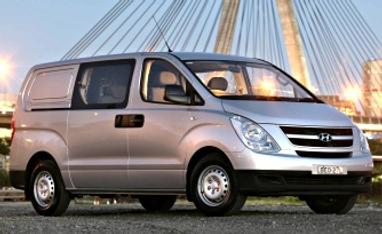
Used Hyundai iLoad review: 2008-2009
By Graham Smith · 23 Sep 2010
Hyundai reckoned there was money to be made in vans and why not after seeing the Kia Pregio cut a swathe through the market. It didn't take a rocket scientist to work out that a value-for-money van could do to the light commercial market what the Korean carmakers had done to the passenger car business.The Koreans transformed the local car business with their value-for-money proposition and it stood to reason that the same could be done to the van market. A quick scan of the monthly sales numbers is enough to show that the Hyundai has, indeed, had a major impact with its iLoad van.MODEL WATCH While the Kia Pregio had been a great sales success with its value-for-money proposition, diesel engine, and features like air, CD player and power windows it was a rather crude device that won few fans. The Pregio's diesel engine was old technology and the exhaust emission laws of this country eventually caught up with it and Kia removed it from the market.But in the time it was in the market it shook up the van segment, racing to second overall behind the top-selling Toyota HiAce. Its departure left a gaping hole in the market, one that every van maker looked to fill.No one has actually filled the void left by the Pregio, but the Hyundai iLoad has come the closest to doing it. It was always going to be difficult to take over from the Kia van where it left off because the Pregio was a very basic, even crude vehicle and no one was building anything similar.The only similarity between the Pregio and the iLoad was their country of origin; both came from Korea. In reality they were poles apart. While the Pregio was rough and ready the iLoad was smooth, comfortable, refined and used modern technology.The iLoad was available in two models, the van and the crew van. The van had seating for three in a well laid out, comfortable and modern, well-equipped cabin, while the crew van had an extra row of seats and could accommodate six.There was a choice of two engines, a 2.4-litre four-cylinder petrol engine putting out 129 kW at 6000 revs and 228 Nm at 4200 revs, and a 2.5-litre common rail turbo diesel producing 125 kW at 3800 revs and 392 Nm at 2000 revs.The petrol engine came bolted to a five-speed manual gearbox; there was no auto option, while the diesel could be had with either the five-speed manual or a five-speed auto. In standard form the iLoad came with sliding doors on each side and a lift-up tailgate at the rear, but there was an option of barn doors that allowed it to be loaded using a forklift.The load space is cavernous. The iLoad van would take up to 5.3 cubic metres of cargo weighing up to 1100 kg; the crew van a little less.Both came with plenty of standard features including air conditioning, keyless entry, power windows and mirrors, iPod jack and MP3 integration. The crew van also came standard with a fixed floor-to-ceiling partition with inbuilt rear view window for extra safety.IN THE SHOPHyundai's build quality has improved markedly in the years since the brand was first launched in this country, and owners have few complaints about their vehicles. Like the rest of the range the iLoad is well built and gives little trouble.When buying a commercial vehicle look for possible abuse through being driven by hired hands who could care less about the boss's investment. Commercial vehicles also operate regularly in tight spots, like loading docks, yards, and back alleys, in the course of their work. Bodywork can often be scarred when accidentally scraped on walls, bins and obstacles they encounter. Check for servicing records, owners and drivers sometimes neglect servicing to keep their vehicles on the road and earning an income. For them servicing time is downtime.IN A CRUNCH All models features dual front airbags, ABS anti-lock braking and electronic brakeforce distribution. At launch the diesel models could also option electronic stability control and traction control. ANCAP rated the iLoad at four stars when it was tested.UNDER THE PUMP Hyundai claimed the iLoad would do 10.1-10.6 L/100 km with the petrol engine and when tested by Cars Guide it returned 11.8 L/100 km. Those with the diesel engine, it was claimed, would do 8.5 L/100 km with the manual gearbox and 9.6 L/100 km with the auto.LOOK FOR Modern looksVoluminous load capacityEasy to driveGood visibilityEconomical dieselFour-star safetyWell equippedTHE BOTTOM LINERefined, comfortable, efficient and well-built workhorse that gets the job done. 80/100