What's the difference?
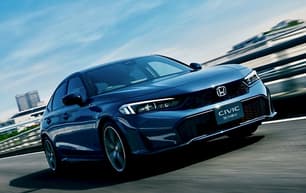
I’m just going to cut to the chase here. This Honda Civic hybrid is a good car. A great one, even.
But for some reason, nobody is really buying it. And it’s not just because it’s not an SUV – it has been outsold in its segment this year by the the BMW 1 Series, the Mercedes A-Class, the MG4 EV, and the VW Golf. Premium and non-premium alike, they’ve all got the little Honda licked.
So, what’s going on? A CarsGuide investigation is required. Stick around and we’ll try to figure this out together.
Tesla’s Cybertruck truly is a giant wedge of cutting-edge technology, and not only because its edges are so sharp you could literally cut yourself, or chop kindling, with them.
No vehicle, nor indeed even any of his stupid ideas, so perfectly represents the manic mania, the whooping, wanton wackiness of Elon Musk as this comically angular, sharp-edged savager of pedestrians.
And yet people, and American people in particular as we discovered on a trip to Los Angeles to drive one, love the Cybertruck. Tesla is said to be holding as many as 2 million pre-orders for it in North America alone and many Australians have expressed interest in buying one, when the company finally manages to build it in right-hand drive, and get it on sale down here, almost regardless of the price (spoiler alert: it’s going to be a lot).
I’ve seen a lot of strange and wildly ugly cars over the years, but if you parked the Cybertruck next to all of them, they’d just disappear because you really can’t take your eyes off its pointy, almost dangerous looking lines. It’s like a human tried to engineer an echidna on wheels.
It does make me laugh, though, and so it was with a smile on my face and acid dripping from my pen that I arrived at a giant Tesla delivery centre in LA to drive it. Come with me.
Talk about your new-car unsung heroes – I can't believe Honda's not selling more of these. So, if you can get over the price, and you worry it might be too small for you, I encourage you to check the Civic out. The back seat and boot are both bigger than you might expect, and the drive experience leaves most SUVs in the rear view mirror.
Weird, wild, unnecessary, arguably horrific to look at, or at least challenging, too fast, too silly, the Cybertruck is many things, but all of the bad things are obvious from a distance while you only realise just how impressive, clever and intense it is once you take it for a drive.
The drive-by-wire steering alone is a revolutionary bit of tech that will surely bleed into the wider world.
Overall I thought I would hate it, but I walked away, head still shaking, with grudging respect approaching admiration for the Tesla Cybertruck.
Beauty. Eye. Beholder. All that. But I reckon this Civic looks fantastic. Low-slung and sporty. The perfect antidote to all those bland, beige SUVs currently doing the rounds.
New as part of the most recent refresh is the front-end treatment, a new front bumper, more body-coloured flourishes and new designs for the 18-inch alloys.
I think it looks sleek, premium and purposeful, and not at all boring.
Inside, though, it’s a little less adventurous, though I do adore some of the little design touches, like the perforated metal effect that spans the dash.
The central screen is pretty small by modern standards, and you don't want to push too hard on some of the touch points, like the gloss-black highlights on the doors, which feel flimsy, flexible and pretty cheap.
Now, the screen. Does UX design count in the overall design section? Let's say that it does. I haven’t really experienced less intuitive and user friendly cabin tech lately.
For example, I couldn't figure out (though I must admit I didn't resort to owner's manual) how to get Apple CarPlay to load automatically, if you can.
Instead I had to select my phone, cycle through several screens of approval, and then select my phone again, every single time I got in the car. I had a similar issue using Google maps, which simply wouldn't connect at all for me.
Good tech is easy and intuitive. This wasn't.
Is there anything interesting about a Narwhal, or a rhinoceros? It’s hard to know whether to give the Tesla Cybertruck 10 out of 10 for how interesting its design is, or zero for how offensive it is, but it would certainly get a solid 20 out of 10 for uniqueness.
Sure, in pictures it looks pretty out there, but when you stand before it in all its shiny steel it makes you laugh out loud, to the point where it has taken your breath away.
And then you start to notice all the fingerprints on it. Every time you - or any of its many admirers - touches it, you get nasty, oily stains and keeping it clean would make looking after a car painted in a matte finish look as easy as sleeping.
So, stainless steel as a choice for constructing a car? Perhaps there’s a reason no one else has ever followed the DeLorean’s lead here, but there’s no denying it grabs your eye, and provides a certain solidity to the whole structure.
Much like a Frank Gehry building, you’re either going to love the Cybertruck and think it a work of modern art, or dismiss it as a childish man’s fantasy made real (essentially that was the design brief for this vehicle, “make Elon a toy”, and it has nailed that brief), but either way you’ll definitely have strong feelings about it.
A car, or even a pick-up truck, with no round surfaces, nor subtlety of any kind, can’t really be described as beautiful in any way. But interesting? Definitely.
The Honda Civic measures 4569mm in length, 1802mm in width and 1415mm in height, and as you've no doubt already noticed, it's not an SUV, rather a liftback-style sedan.
But if you feel like you need an SUV to move a family, I beg to differ. While the middle seat in the second row is too tight for adults (owing largely to the intrusive raised tunnel that runs through the middle of the cabin), the two window seats can absolutely fit adult humans. I'm 175cm, and had absolutely no issue sitting behind my own driving position.
But the biggest surprise is the boot, which opens to reveal a flat and wide storage space that can swallow 409 litres (VDA) of luggage. In real terms, that's more than enough for our pram and the assorted knick-knacks that go with it on a baby day out.
Unfortunately, though, there’s no spare. Instead you’ll find yourself wrestling with a hateful repair kit should you get a puncture, and you don't want to wait for roadside assist.
There's also twin USB ports in the back, as well as air vents, along with twin cupholders in the pulldown divider.
While the front and rear seats feel plenty spacious, that odd peaked baseball cap roof is a bit challenging in terms of headroom, and I smashed my noggin into it a few times trying to reach into the back seat for more Oreos and Mountain Dew.
You can pop up the bench seat in the back to create even more space for storage, or to provide a flat floor to sleep on.
You can also lie an American sized pizza box on the vast swathe of dash between you and the wildly angled windscreen, there’s plenty more storage on the floor between you and the passenger and then more storage bins at your hip, as well. A wireless phone charger sits twinned with the spot where you park your Tesla card key.
It’s a practical, semi-rugged feeling space, but with the usual kind of Tesla less is more feeling, except when it comes to the screen, which is stupidly large and requires far too much input when you’re driving to be safe. And there’s still no speedometer where you need one, in front of your eyes, and no head-up display, despite Tesla’s love of other jet-fighter tech, like drive-by-wire steering.
Ah, so we may have hit the first Honda hurdle. Ours is the entry-level e:HEV L, and it’s a cool $49,900, drive-away. The top-spec LX is $55,900, on the road.
To put that into perspective, Toyota's two Corolla sedan hybrid grades are about $36K and $39K, drive-away, at the moment. The admittedly non-hybrid Golf starts at $39,990, on the road.
The German premium brands are still more expensive, but I think that might be at least part of the Honda’s problem. It now occupies a space between mainstream and premium, which might also be something of a no-man’s land.
Still, the entry-level L is decently equipped, with 18-inch alloy wheels wrapped in quality Michelin Pilot Sport rubber, all-LED lighting all around and key-less entry.
Inside, there’s synthetic leather and fabric seats, dual-zone climate, a 9.0-inch central touchscreen with Apple CarPlay and Android Auto, but also with Google built-in that provides mapping and updates and a 12-speaker Bose stereo.
Both Civic variants also arrive with a three-year subscription to 'Honda Connect', which gives you remote access to your car to lock or unlock it, pre-heat or cool the cabin, or set a geofence alert if your teenagers are borrowing it, that sort of stuff.
But… there are no full-leather seats, there's no sunroof, no wireless charging and you have to open the boot yourself.
The lack of all that doesn’t feel overly premium.
How does one define value when it comes to the vehicular equivalent of a cockroach, one that seems capable of surviving the apocalypse with it indestructible (but possibly slightly rusty in appearance) stainless-steel exterior, HEPA filters (will protect you from pollution, pollen and “industrial fallout”) and (almost, kind of) bowling-ball proof super-strong windows (it can allegedly survive the impact of a baseball at 112km/h - handy if someone is trying to kill you with a baseball)?
And what price can you put on the kind of attention driving a Cybertruck gets you? Perhaps only a Bugatti or a Pagani could match the level of wide-eyed, slack-jawed excitement you see from other people when you drive this thing around.
Then there’s the fact that it accelerates like an actual rocket, is allegedly so cosseted in the cabin that it’s “as quiet as outer space” (this is a comparison test I am up for, if Elon’s Space X would like to arrange it), and can tow “an average African elephant”, or 4,990kg, and has a 1134kg capacity in that vast rear tray, covered by a standard, automatic tonneau cover that’s so tough you can stand on it.
In that rear tray you’ll find a bottle opener, and some storage tubs with drainage holes to keep your beer cold or your fish frozen. You could sleep in there, on the composite bed, which is tough you don’t need a liner, but why would you when you can sleep in the truck - the dash is so large you could comfortably lie under the windscreen to sun yourself - using 'Sleep Mode', which runs the air con all night from its giant battery to keep it at your set temperature.
Speaking of your battery, you can also charge things with it using the integrated power outlets, and that includes the ability to charge another Tesla, or to re-zap your Tesla Powerwall at home and run your house during a blackout. Or the Apocalypse.
Tesla has put a price on all this, of course, and in America it ranges from US$81,895 to US$101,985. Frankly, that seems like quite good value when you add it all up, or at least it would if the Cybertruck really could tow five tonnes further than the end of the street, and if range - surely something of an issue for an outdoorsy vehicle like this - really could be guaranteed at 547km.
If and when it gets to Australia, of course, its value will need to be reassessed on what is sure to be a much, much larger number.
The Civic range is an all-hybrid affair, which in this case is what Honda calls its 'two-motor hybrid', which pairs a 2.0-litre petrol engine with two electric motors, one being an electric generator, and the other being the actual propulsion motor which sends power to the wheels. Expect a total 135kW and 315Nm, which is sent to the front wheels via a CVT auto.
Yes, I’m giving it 10. Because how could you want for more than a torque figure of 13959Nm, and a Ferrari-humbling 630kW of power to boot?
The Cybertruck is the perfect example of Elon Musk’s approach to what we’ll call science, or Twitter, or X. If it can be done, just do it, don’t ask whether it’s a good idea, or batshit insane.
So because he could fit a vast 123kWh battery and two crazy powerful motors to this pick up monster, and that could provide enough grunt to send three tonnes of mass to 100km/h in 2.8 seconds, they did.
Is it wise? Probably not. Is it wild and almost, somehow, strangely admirable? Yep.
Honda says you can expect 4.2L/100km on the combined (urban/extra-urban) cycle, but we found the fuel use was a still impressive 5.5L or so, admittedly mostly in the city.
The 40-litre tank drinks 91 RON 'standard' fuel, meaning its cheapish to fill up, and — using Honda’s numbers at least — should deliver a 950km driving range.
Yesterday, 91 RON was about $1.80 per litre meaning you can theoretically get from Melbourne to Sydney for around $75.
Tesla claims a range of 547km between charges and that even when towing something of “reasonable size” (a smaller Tesla perhaps) it will still get 400km. I, for one, very much doubt that.
Tesla also claims you can recover up to 235km of range with just 15 minutes of Tesla Supercharging, while a charge from 10 to 80 per cent on that same Supercharger would take 44 minutes. On a 110V American plug it would take 110 hours, or 4.5 days, to fully charge from zero to 100 per cent.
First things first – I really, really like the way this Honda drives. There's a finesse, a confidence, in the drive experience that's sometimes missing from the new brands when they first arrive in Australia.
In short, it feels like it was engineered by people who really know what they're doing. That's the easiest way to describe it.
If you're used to driving older-fashioned hybrid systems you might be used to a bit of shuddering harshness when the engine kicks in, but that's simply not the case here.
Instead, the transition is seamless, with the Honda Civic making the choice for you and largely leaving you out of the process entirely.
Where the powertrain does let itself be more known is under heavier acceleration, with engine thrum seriously invading the cabin, without much in the way of flat-footed performance to accompany it.
But the magic of the Civic drive experience is in its balance. It's not a performance car, but there's real driver engagement to be found in the way it rides and handles. Equally, though, it's never uncomfortable, striking the balance between road-holding confidence and comfort really well.
Happy in the city, happy on a twisting road - this is not one of those smaller cars that leaves the drive experience as a secondary factor. It feels like it really has the driver at heart.
It’s fair to say the Tesla Cybertruck is an intimidating prospect in the metal. It towers over you and seems to stretch into forever, because it does, at 5.68m long (too long to fit in a standard Australian parking space).
It’s also a full 2.0m wide, 1.8m tall and weighs 3.1 tonnes, but along with its size comes the fact that it just doesn’t look… right. There’s not a round surface on it but there are plenty you could cut yourself with, or lose a finger in.
It’s no less weird inside, as the giant A-pillars, vast dash, crazy yoke steering device and graphically lovely screen confront you, making it feel like you might be on the Starship Troopers ride at Universal Studios rather than in an LA car park.
Then, while you’re getting used to this and having a good laugh at the Easter egg on the touch screen (smash the windows on the graphic of the car with your finger and you hear the sound of Elon freaking out at the infamous failure demonstration of its unbreakable glass), you’re warned that it is going to be almost as weird to drive as it looks.
This is, in part, due to the Cybertruck’s unique drive-by-wire steering - a technology previously popular only with jet fighters and other planes - which allows it to have a yoke instead of a steering wheel without being annoying, because your hands will never cross over and be left grasping air.
Yes, the Infiniti Q50 debuted with 'steer-by-wire' a decade ago, but featured a full mechanical system as a fail-safe back-up. No mechanical safety net here.
The Cybertruck has less than one full turn lock-to-lock, and it has not just passive but aggressive rear wheel steering, allowing the back wheels to turn the opposite direction to the front ones at parking speeds, quite radically, which, once you’re used to it, makes it much easier to park than seems possible.
It also makes this Tesla incredibly sharp and direct and means that, for the first few minutes of driving it you will turn the wheel, sorry, yoke, far more than necessary.
Once you get used to it, however, it is fabulous, as long as you don’t think about what would happen if the software that’s the only thing connecting you to the wheels - rather than actual moving parts - failed.
The steering makes the Cybertruck shrink around you to the point where you forget, at times, just how big it is. Combined with the low centre of gravity and the bank vault solidity of the chassis, it also makes it turn-in and handle like a much smaller sports car (and it has a turning circle that defies belief, one that’s sharper than some sedans).
Speaking of sports cars, most of them won’t keep up with the Cybertruck if there’s someone brave in its driving seat. Indeed, you’d need a proper hypercar to match its constant, surging torque (no, I don’t believe it can really have 13,000-plus Newtons, but it’s a lot), and its purely outrageous, surging speed.
Tesla has a habit of calculating torque at the wheels, not the motor(s) and gearing reductions increase torque markedly.
Yes, I do believe it would do 0 to 100km/h in three seconds, maybe slightly less, but I’m also equally sure it’s not a great idea to try (I'm also very grateful I didn't experience the problems with the throttle sticking open on some examples that recently saw every Cybertruck recalled).
The problem is that 3.0-tonne weight figure, and all that mass. It feels beyond weird to move something this big, that fast, and it quickly makes you pause for a chilling thought about whether it’s all going to be able to stop again. It does, or it did for me, but boy, it puts the wind up you every time you try.
Overall, though, it’s hard to overstate just how surprisingly good, and yes, at times even fun, the Cybertruck is to drive.
Oh, and for the trainspotters out there, claimed efficiency is 22.4kWh per 100km, but we actually saw 27kWh during our two days of test drives. Our second Cybertruck was also making some distinctly weird metallic clanking noises from underneath, particularly when we switched between forward and reverse.
It might be worth waiting for the second generation of this thing before buying one, but that won’t be an issue for Australian fans, anyway.
As far as its off-road abilities, we managed to find a bit of beach in a car park and pointed the Cybertruck at it. After an initial fearful moment of being sure we were going to sink, we just put the foot down and let all that torque power us out of trouble. It felt effortless.
The big safety news surrounding the Civic is that its eight airbags are joined by 'Honda Sensing', which packages up every safety system you can possibly imagine — forward collision warning, lane keeping, adaptive cruise, AEB – and delivers them as standard across the range.
But the bigger news is that, refreshingly, none of it is overly intrusive. Even the speed limit warning, which – as in most cars – always gets the speed wrong, just flashes gently on the driver display, rather than binging and bonging through the cabin.
The Civic Hybrid scored a full five-star ANCAP safety rating, with the score based on crash testing in Europe through Euro NCAP.
Some unkind experts have referred to the Cybertruck as a “death machine” and a “guideless missile”, pointing out that putting a stainless steel body on top of a big old battery is inherently problematic. As is the lack of crumple zones.
Making all this very pointy metal move as fast as a McLaren supercar has also raised some questions about sanity.
Then there was the recent recall of every Cybertruck built so far:
"Cybertruck owners reported that their vehicles were at risk of getting stuck driving at full speed due to a loose accelerator pedal. Video showed the pedal itself falling off and the piece beneath wedging itself into the car’s interior, which would force the vehicle into maximum acceleration. One driver was able to save himself from a crash by holding down the brake pedal."
Elon Musk, has claimed, however, that the Cybertruck, is “much safer per mile” than its competitors.
Australia has different pedestrian safety regulations to the US and while some have posited that the Cybertruck will pass, pointing to the fact that you can buy an even bigger Ram truck here, others are not so sure.
The Tesla Cybertruck does have six airbags, and a suite of active safety features as part of its 'Autopilot' system, but it does not yet have 'Full Self Driving'.