What's the difference?
There are good surprises and bad surprises. Like the time I was driving my ute and the steering wheel came off. Bad surprise. Or the time the chicken shop accidentally gave me a large chips when I paid for a medium. Good surprise. The Haval H6 also surprised me. And it was up there with a large chips type of surprise.
See, my expectations of Haval have been of a brand which is really big in China where its owned by Great Wall Motors, but can’t keep up with the likes of Toyota and Mazda when it comes to driving and styling. Instead, their strength seemed to be just value-for-money.
Surprise! The new generation H6 isn’t just good value-for-money any more. It’s still really well priced but it has stunning looks, too. But that wasn’t the biggest surprise.
If you are considering a mid-sized SUV such as a Toyota RAV4 or Mazda CX-5, I strongly suggest you widen the net and consider the H6, too. Let me explain.
Andrew Chesterton road tests and reviews the new BMW 5 Series 520d, 530i, 530d and 540i sedans with specs, fuel consumption and verdict at its Australian launch in Victoria.
When we're all living under the cruel rule of our robot overlords, the few remaining human historians will track the genesis of our downfall to the technology explosion that occurred in 2017's new-car market.
Never before have car companies focused so hard on producing cars that can't just be driven, but that can drive themselves, negotiating corners, unexpected obstacles and changing traffic conditions without ever needing to consult the human actually sitting behind the steering wheel.
And BMW's all-new 5 Series sedan takes yet another a step forward, eliminating the need for said human to even be sitting in the car. Owners can instead move their 5 Series in and out of tight parking spaces simply by pressing a button on their key.
The Active Key function is admittedly a $1,600 cost option, but it proves the techno-focus applied to the seventh-generation of BMW's executive express, which will land in Australian dealerships this month. Every car is also fitted with what the German brand calls its personal co-pilot; a series of nifty cameras and radars that allow the car to be driven completely autonomously for spells of 30 seconds.
But the question is, has all this new technology come at the cost of regular, old-school driver enjoyment?
The H6 could be the turning point for Haval in Australia. The brand’s first big success that changes the way Aussies view this Chinese carmaker. The H6’s great value and stunning looks will win over many but add an excellent warranty, advanced safety tech, plus the surprisingly good, and you have a package that appears right up there with the likes of the Toyota RAV4 and Mazda CX-5.
The sweet spot of the range would have to be the Lux - the car I tested with its leatherette seats, privacy glass and dual-zone climate control.
Sleek and attractive in the city, engaging on a country back road and with plenty of clever technology, the 5 Series sedan ticks all the right boxes as an executive express. If you can stomach the price hike, the six-cylinder 540i is our pick of the bunch.
This new generation H6 is ridiculously good looking. So much so that my Dad thought it was a Porsche when I arrived to pick him up. But in saying that Dad also has a glass coffee table supported by a golden naked lady and thinks I work in a car dealership, despite me explaining that motoring journalism is an actual job.
He’s not wrong, for once. Well, it doesn’t look like a Porsche, but I can see what he means given the way the LED strip across the tailgate lights up and connects with the tail-lights either side.
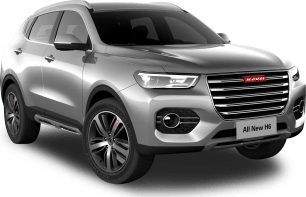
I don’t know what kind of deal with the devil the H6’s designer made but there isn’t an angle from which this SUV looks nothing short of beautiful. There’s the flashy but not over-the-top grille, the sleek headlights, and the smooth lines in profile which wrap around to the curvaceous back end.
Havals in the past have seemed low quality and unfinished, but this new H6 seems the opposite.
The same goes for the minimalist cabin. Those screens house almost every function except for the climate control and that clears the dashboard of buttons.
This cabin is a premium design with a floating centre console and metallic trim. Stepping up to the Lux from the Premium adds 'leatherette' upholstery, a leather steering wheel and then the Ultra takes the high-end feeling further with a 12.3-inch media display and a panoramic sunroof.
As for the dimensions, the H6 is larger than most mid-sized SUVs but smaller than a large SUV at 4653mm end to end, 1886mm wide and 1724 mm tall.
The six exterior colours are, 'Hamilton White', 'Ayres Grey', 'Burgundy Red', 'Energy Green', 'Sapphire Blue' and 'Golden Black.'
Hardly a revolution, the 5 Series has instead undergone a few nips and tucks. But if it ain't broke and all that. It might not be the most head-turning offering, but the 5 Series sedan remains sleek, powerful and understated, and it is undeniably handsome on the road.
Its 8mm wider, 28mm longer and 2mm taller than the car it replaces, but it's also around 95kg lighter, thanks to its aluminium doors and boot and a clever magnesium frame for the instrument panel that saved another two kilograms. There's some other clever design elements, too. The kidney grille has active air flaps that open when extra cooling is required, closing when it isn't, reducing drag and helping accleration.
Inside, the 5 Series offers a beautifully crafted yet joyously understated cabin, with quality materials joining modern technology in a seamless way.
The H6 is cavernous for a mid-sized SUV with large and wide seats up front and excellent leg and headroom in the second row. The H6 doesn’t come with a third row which is shame because there’s room for one.
A 600-litre cargo capacity is big for the class and cabin storage is good with two cupholders in the second row, another two up front, a large space under the floating centre console, although the door pockets could be better.
Second rowers will be pleased with directional air vents back there, plus two USB ports. There are another two USB ports either side of the floating centre console, too.
The leatherette upholstery in the Lux I tested was easy to keep clean and would suit families better than the cloth material used in the Premium.
You’re going to notice the high load lip on the boot and for people as tall as me (191cm/6'3") the opened tailgate and your head may meet occasionally. Still the H6 is super practical.
This is a full-size sedan, and every seat feels spacious and airy. The sloping, slightly coupe-style roofline does cut into headroom in the back, but human-sized people will have little trouble, even sitting behind a tall driver.
Each trim offers two cupholders in the front, with another two housed in a pull-down divider that seperates the rear seat. And there's two ISOFIX attachment points, one in each window seat in the back.
The 5 Series' boot opens to rival a surprisingly sizeable storage space, offering 530 litres with the 40:20:40 rear seats in place.
You’re saving a decent amount of moolah choosing a Haval H6 over, say, a Toyota RAV4, Mazda CX-5 or Nissan X-Trail. The H6 entry-grade is called the Premium and lists for $30,990 drive-away, while the mid-range Lux is $33,990 driveaway.
Both come in front wheel drive only. If you’re after all-wheel drive you’ll need to step up to the top-of-the-range Ultra for $36,990 drive-away, or pay $2,000 less and have it in front-wheel drive.
In comparison the RAV4 and CX-5 ranges start more than $3K higher than the entry-grade H6 and don’t get the same level of features. Let me show you what you get for your money.
Coming standard on the Premium are two 10.25-inch displays with Apple CarPlay, six-speaker audio, digital radio, air-conditioning, proximity key with push-button start, a reversing camera, paddle shifters, LED headlights and 18-inch alloy wheels.
Stepping up to the Lux adds dual-zone climate control, privacy glass, power adjustable driver’s seat, the front seats are also heated, leather steering wheel, 360-degree camera and roof rails.
The Ultra brings in a 12.3-inch media screen, power adjustable front passenger seat and both front seats are now heated and ventilated. There's also wireless charging, a head-up display, a heated steering wheel, panoramic sunroof, an electric tailgate, and auto parking.
That’s incredibly good value. Normally things that are cheap (like a Jetstar flight) offer nothing in return (like a Jetstar flight). Yep, nobody is going to accuse you of being ripped off here.
BMW's venerable 5 Series is now 45 years old, and this all-new model arrives in four distinct flavours, with a fifth - an incoming M5 performance sedan - still some way off.
For now, though, the range kicks off with the 520d, before stepping up what BMW hopes to be the big seller of the range, the 530i (replacing the outgoing 528i). Next up is biggest diesel, the 530d (replacing the the 535d), before the current range tops out with the petrol-powered 540i (replacing the old 535i).
Be warned though, there's been some pretty serious price increases right across the line up, ranging from $9,145 to a whopping $19,245. In fact, only the 530d has seen its price come down, now $3,755 cheaper than the outgoing 535d. BMW justifies the hikes by pointing to an increase in standard inclusions across the range.
It might not be the most head-turning offering, but the 5 Series sedan remains sleek, powerful and understated.
The 520d kicks off from $93,900, and arrives predictably well equipped for your money. Expect 18-inch alloys, leather trim, dual-zone climate control and a 12-speaker stereo. You'll also get a technology overhaul, with a bigger and upgraded Head Up display (it can now read street signs and beam that info onto the screen), a 10.25-inch touchscreen and a wireless (insert link to chi charger story) charging pad.
Step up to the 530i ($108,900) or 530d ($119,900) and you'll add 19-inch alloys, adaptive dampers with dynamic mode (that reads both driver input and navigation data and tweak suspension, gear and steering settings automatically) a 16-speaker Harman Kardon stereo and a crystal-clear 12.3 high-resolution digital display in the driver's binnacle. You'll also find heated front seats, a powered boot and sports seats in the front.
Finally, spring for the 540i ($136,900) and you'll get 20-inch alloys, a sunroof and electric blinds for the rear windows. You'll also find better Nappa leather on the seats, which now also offer a cooling function. Under the skin, you'll get an active anti-roll bar at each axle designed to keep the car from rolling side-to-side on the twisty stuff.
One quirk, however, is the fact that BMW's very cool wireless Apple CarPlay is a cost option on every trim level, and one that will set you back $479.
The same four-cylinder turbo-petrol engine is in all three grades. It’s a 2.0-litre and makes 150kW/320Nm.
This engine had no problems pulling the H6 around when I tested it with my little family onboard with good acceleration and smooth shifts from the seven-speed dual-clutch automatic transmission.
When pushed hard the four-cylinder responds well, but it’s on the noisy side.
As mentioned at the start of this review only the top-of-the-range Ultra grade gives you choice of all-wheel drive or front-wheel drive. The Premium and Lux are front-wheel drives only.
The car we tested was the front-wheel drive Lux, but we’ll be able to review the all-wheel drive version when it arrives in our garage soon.
On paper the all-wheel drive Haldex system in the H6 looks promising and in this generation the SUV has a rear differential lock for better off-road capability. That said, the H6 is not an off-roader in the Toyota LandCruiser sense, and you should keep your adventures in it mild rather than wild.
There’s no diesel in the H6 line-up, nor will you find a hybrid variant or and electric version of this SUV at this stage.
Braked towing capacity is 2000kg for all-wheel drive and front-wheel drive H6s.
The hunt for efficiency sees all but the most expensive 5 Series models equipped with four-cylinder engines, including the entry-level 520d, which is fitted with a 2.0-litre diesel unit that will produce 140kW at 4,000rpm and 400Nm from 1,750rpm. That's enough to push the cheapest 5 Series to 100km/h in a not particularly inspiring 7.5 seconds, topping out at 235km/h.
The cheapest petrol, the 530i, arrives with a turbocharged 2.0-litre engine good for 185kW at 5,200rpm and 350Nm from 1,450rpm. That will see you clip 100km/h in 6.2 seconds and push on to a limited top speed of 250km/h.
The turbocharged six-cylinder feels right at home in a car this size, with acceleration effortless and freeway overtaking manoeuvres an absolute breeze.
The 530d introduces the first six-cylinder engine, a 3.0-litre unit that will produce 195kW at 4,000rpm and an impressive 620Nm from 2,000rpm. That's enough to knock off the sprint in in 5.7 seconds and offers a top speed limited to 250km/h.
Finally, the top-spec petrol, the 540i, will produce 250kW at 5,500rpm and 450Nm from 1,380rpm from its 3.0-litre turbocharged straight-six engine. Those are healthy numbers, and enough to welcome 100km/h in a sprightly 5.1 seconds before topping out a limited 250km/h.
Every model is paired with an eight-speed torque converter automatic transmission.
Haval says that after a combination of open and urban roads the 2.0-litre turbo-petrol four-cylinder should use 7.4L/100km in the front-wheel drive cars and 8.3L/100km in the all-wheel drives.
In my testing of the front-wheel drive I measured 9.1L/100km at the fuel pump. That was after an even split of motorway and urban running.
Thirsty work considering most of the time it was just me and an unloaded car. Add a family of four plus holiday gear and you can expect that mileage to be worse.
It’s here that the H6 is showing a weakness in its offering by not having a hybrid powertrain in its Australian range.
BMW quotes a combined 4.3 litres per hundred kilometres from the 520d, which will also spit out 114g per kilometre of C02. The 530d lifts that number to 4.7 litres per hundred kilometres (which seems a small price to pay for all that extra torque), with C02 pegged at 124g per kilometre. Both diesels get a slightly smaller tank, at 66 litres.
The 530i will sip a claimed/combined 5.8 litres per hundred kilometres, with C02 emissions a claimed 132g per kilometre, while the big 540i requires 6.7 litres per hundred kilometres, with C02 pegged at 154g per kilometre. Both petrol models get a 68-litre tank and require 95RON fuel.
I’m still in shock. This is the biggest surprise. The H6 I tested was effortless to drive, with a comfortable and composed ride. I was not expecting it, not when most Havals I’ve piloted in the past have disappointed when it comes to the driving bit.
Sure, the engine isn't overly powerful, but it's responsive, and the dual-clutch transmission shifts smoothly whether driving in slow traffic or at 110km/h on the motorway
Sharp speed bumps taken a bit too fast in the front-wheel drive Lux I tested reveal only modest suspension travel, causing a reverberating ‘bang’ as the shocks and springs react. I’ve experienced the same thing in many cars I’ve tested – even properly prestige ones.
This though is one of very few complaints I have about the way the H6 drives, for the most part this SUV performs remarkably well with a (high) level of refinement I seriously wasn’t expecting.
I can’t tell you what the all-wheel drive version of the H6 is like to drive having only tested the front-wheel drive version, but we’ll no doubt have one in the CarsGuide garage soon.
BMW's pre-drive briefing was so technology focused we half expected the black turtle neck and dad jean-wearing ghost of Steve Jobs to emerge from behind a curtain clutching an iPad. Only a minuscule portion was dedicated to the cars' drivetrains, with BMW instead hammering home autonomy functions, technology upgrades and the fact that its car was a preview to "the future".
But once we'd slipped behind the wheel of the all-new 5 Series, it all started to make more sense. Having briefly sampled three models (the 530i, 530d and 540i), we can safely report there's nothing particularly revolutionary about their on-road behaviour. That's not necessarily a bad thing - they do everything you could ask of a car in this bracket. They're mostly smooth and always quiet, the new chassis has done nothing to dampen engagement when you start to ask a little more of it, and it's generally a luxurious experience. But then so was the old car.
But what's new is the technology poured into the 5 Series. Every car gets what BMW is calling its personal co-pilot, for example, which is a set of tricky systems (there's six cameras, five radar sensors and 12 ultrasonic sensors scattered around the car) that work with the active cruise control and allow the car to be driven completely autonomous for 30-second intervals. Now, it's not quite as advanced as some of its competitor's systems - it can't change lanes for example - but if you're out on a country road or on a highway, it will stay within its lane, turn around corners and keep up with the traffic, even if they stop in front of you.
This is a full-size sedan, and every seat feels spacious and airy.
While the cheapest diesel model has historically been the best seller, BMW is hoping the new 530i will prove the most popular this time around. And while you couldn't describe it as fast, the power from its four-cylinder engine is ample for all that will likely be asked of it, and it feels sorted and composed on more challenging roads. It's a smooth and comfortable ride, too, even with the optional 20-inch alloys fitted, though that's undoubtedly thanks to the adaptive dampers and ever-changing dynamic ride function, both of which are fitted as standard. In fact, we're yet to drive a car without those options fitted, so we're forced to reserve judgement on the as-standard ride quality of the cheaper models.
Be warned though, none in the 5 Series range offer the disconnected and perfectly smooth conveyance you might find in some true luxury offerings, and you'll still know when you're diving into deep pockmarks in the road. But the trade off is a an engaging ride and steering set up that always feels planted, with enough feedback to ensure you feel connected to what's happening beneath the tyres. And that's a trade we're more than willing to make.
Step up to the 540i and things take a much sportier turn. The turbocharged six-cylinder feels right at home in a car this size, with acceleration effortless and freeway overtaking manoeuvres an absolute breeze. And while we didn't find roads quite brutal enough to really test the active anti-roll bars housed at each axle, there's a wonderful and stable flatness to the way the biggest petrol handles corners.
It's not cheap, but thanks to the bigger engine and sorted dynamics, the 540i feels most like a 5 Series probably should.
Is the Haval H6 safe? Well the H6 hasn’t been given an ANCAP rating yet, but this new generation car looks to be equipped well with advanced safety tech across all three grades.
All H6s come with AEB which can detect pedestrians and cyclists, blind spot warning and lane change assistance, traffic sign recognition, lane departure warning, lane keeping assistance, and rear collision warning.
The Lux adds adaptive cruise control, while the Ultra brings rear cross-traffic alert with braking, and an 'Intelligent Dodge' overtaking system.
Along with all that tech there are seven airbags on board, too. And for child seats you’ll find two ISOFIX points and three top tether anchor mounts.
Expect plenty of clever safety gear, with every 5 Series sedan arriving with six airbags (dual front and full-length side airbags, along with head protection bags for front passengers). You'll also find a surround-view reversing camera and parking sensors.
But the high-tech stuff arrives courtesy of active cruise control, cross-traffic alert, lane keep assist and cross-road alerts.
The H6 is covered by Haval’s seven-year/unlimited kilometre warranty. Servicing is recommended every 12 months or 15,000km, although the first service is required at the 10,000km point, then 25,000km and so on. Servicing is capped at $210 for the first service, $280 for the second, $380 for third, $480 for the fourth and $210 for the fifth.
The BMW 5 Series is covered by a three year, unlimited-kilometre warranty, and requires condition-based servicing (rather than a pre-defined service interval).
You can also prepay your maintenance costs for five years/80,000kms, with prices ranging from $1,640 for the basic package, and climbing to $4,600 for the all-inclusive option.