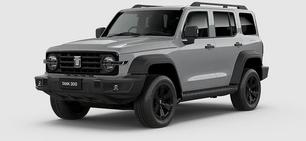
What's the difference?
GWM’s Tank 300 struck a chord with Australian buyers when it launched in 2023. The rugged, boxy design, serious off-roading ability and unbeatable value for money - especially compared with similar models like the Jeep Wrangler - won it a number of new fans.
But something was missing. With an uninspiring petrol engine and a patchy hybrid powertrain the only options, the Tank 300 was sorely missing a diesel.
GWM itself says about 75 per cent of models in the off-road-focused large and upper-large SUV segments are made up of diesel-powered SUVs, so it was missing out on a chunk of sales.
Thanks to some serious nudging from GWM Australia and New Zealand, the Chinese parent company saw the potential and have added a diesel engine to the mix. This is the same diesel unit found in the GWM Cannon and Cannon Alpha utes.
Is the diesel now the pick of the Tank 300 range? Or should you look at another oil-burning 4x4?
The days of very short caravans are over – almost no one would consider buying even a 14-foot caravan in today's age – but despite that, Jayco's simplest camper-trailer almost mimics the layout of a regular-sized vintage caravan.
At just 14-foot long, the Penguin encloses its bed, dinette and kitchen without any extensions, and does it quite smartly, too.
The diesel is now the pick of the Tank 300 range. It’s the best fit for this vehicle and offers greater driver engagement than the petrol or hybrid.
It also has genuine off-road chops while still managing to suit family life.
While it could benefit from further refinements to on-road behaviour, cabin noise and the ADAS systems, none of these are deal breakers.
The fact that it is priced so keenly against some excellent competitors and is stacked with standard gear adds to the Tank 300’s appeal.
Note: CarsGuide attended this event as a guest of the manufacturer, with meals provided.
At nearly $25,000 the Penguin can't really be called cheap, but what does make it worth a look is the completely contained living space – the sitting, sleeping and cooking are all done inside, and that's a boon when the weather turns.
It's ideal if you want the comfort of a caravan without the bulk of one, and the ease of towing a more traditional camper-trailer offers, without the struggle of set-up.
Up front the Tank 300 offers a commanding view of the road and it’s easy to find your perfect driving position thanks to the power-adjustable seats.
Those seats have good side bolstering but could do with a little extra cushioning for the thighs. The Nappa leather-appointed seats in the Ultra look and feel lovely.
Storage is average for the segment with room for larger bottles and additional flat items in the door pockets, and a well-sized central bin that also houses two cupholders, although they sit low in the cavity and two coffees sit awkwardly together.
The Tank has one USB-C port for charging only but another USB-A port up front for connectivity. You shouldn’t need that given Apple CarPlay and Android Auto is wireless.
Keen off-roaders will have fun with the extensive Tank Expert Mode in the multimedia screen, which allows you to individualise your 4WD experience.
Beyond that the screen is neatly laid out, responsive and easy to use. GWM has come a long way when it comes to in-car tech. The icons on the digital instrument cluster, however, are still too small.
There’s ample leg room in the rear, with space between my knees (I am 184cm tall) and the rear of the front seat, and enough toe room. It doesn’t feel enormously spacious across the rear row but three kids should be comfy. Headroom is enhanced by a scalloped section of the roof specifically for rear-seat passengers, but it doesn’t leave a huge amount of space for taller people.
The rear seat bench is flat but the backrests have some support and overall the seats back there are comfortable.
You’ll find lower rear-seat air vents, map pockets, a fold-down central arm rest with two cupholders, room for small bottles in the doors and two USB-A ports.
The boot can take 400 litres with all seats up and 1635L with the rear seats folded. That figure is measured from the floor to the top of the rear seats.
Jeep says the Wrangler has 898L capacity with all seats in place but that is measured from the floor to the roofline.
There is no under-floor storage in the 300’s boot and the full-size spare wheel is housed in traditional 4x4 fashion on the tailgate.
Inside, the layout is simple, but comfortable for two people. The rear of the camper is dominated by the east-west oriented bed.
The dinette, to the front of the camper, is cosy and only good for two people. It does actually fold down into a second bed for a third body (or a second body who's not allowed in the first bed), but although there's sleeping for three, seating that many would be difficult. Maybe a small grandchild, occasionally. It's comfortable, though and both seats lift up to reveal a little extra storage. There's even a hidey-hole behind the driver's side back-rest.
Typical of all campers of this sort, the bench heights are low and will frustrate taller people who need to stoop to use them.
This camper has a canvas skirt, but really there's more see-through plastic window than actual canvas, so it's quite panoramic inside. It's not hard to gain a bit of privacy, though; there's a dark tint to them so it's hard to see through during the day, and all the windows have curtains, so you can shut everything out, easily enough.
Lighting is simple, with just two LED lights in the roof, although unless you pay extra for a battery, they'll only work at powered sites.
I last drove a Tank 300 in late 2023 and it was the hybrid variant. While the hybrid has some positives, its driving characteristics were not high on that list.
It had an erratic throttle response, hesitation on take-off and it felt underdone.
In contrast, this new diesel variant just feels like the right fit for this SUV.
There is slight lag accelerating from a standing start, but the powertrain is torquey and there’s plenty on tap when overtaking or just increasing speed when already on the go. GWM has not provided a 0-100km/h time.
It is clear you’re in a diesel as soon as you turn on the ignition - it has that typical diesel rattle, but it is not as unsophisticated as some oil-burners I have driven.
The cabin could do with some extra insulation with wind and tyre noise detected, but it’s hardly a deal breaker.
Given the vehicle’s size, heft (nearly 2.3-tonne kerb weight) and the fact it’s shaped like a brick, the 300 holds its nerve on winding stretches of road with only a little body roll. In saying that, best not to treat it like a Mini Cooper on your favourite twisty road.
Ride quality is a bit mixed. We only drove the Ultra on 18-inch wheels and while it manages to soak up bumps, the ride is jittery, and that’s even more evident on uneven road surfaces.
Steering is heavily weighted and a little vague, but fine for a big off-roader, and the brakes need to be pushed hard.
One quirk is the indicator - it appears to be a one-touch setup for indicating to change lanes, but then the indicator stays on. I tried several times to test this, even flicking it to the opposite side to turn it off and it was very stubborn.
The good news is it appears GWM has toned down the awful indicator sound of its earlier models and is now much more subtle.
So on-road the Tank 300 is more than competent, and a much nicer vehicle to drive in an urban setting than a Jeep Wrangler, for example.
We also drove it briefly on an off-road trail, and in low range the Tank 300 proved that it can do what it says on the box.
I’m no off-roading expert and there are much more challenging trails out there, but I had confidence that the Tank 300 would not let me down traversing the many chunky rocks, massive holes and fallen tree limbs.
Because the Penguin is so light – as mentioned above – and because the towing height is just 1660mm, lower than the roof of most cars and certainly below that of SUVs, it's easy to tow, even if you don't have the largest 4WD to haul it around.
The Subaru Forester I tested this camper with, for instance, did the job quite well and would be ideal if you towed the camper down the coast a few times a year.
Underneath, the camper's got a simple beam axle with leaf slipper springs and shock absorbers. They do a commendable job and, as this is a purely on-road camper, there's no need for it to be anything else.